The Swede

Longtime Readers will all know of my fondness for the venerable 6.5x55mm Swede (SE), and I happened on an article which gives chapter and verse to this wonderful cartridge.

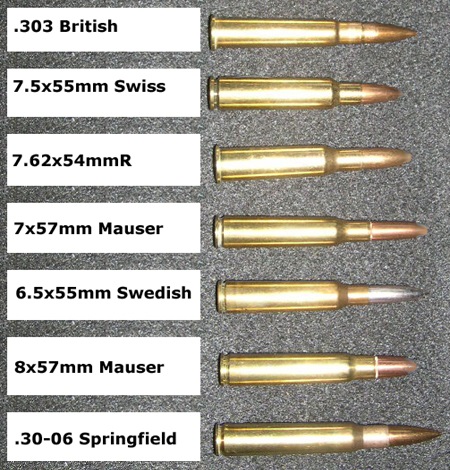
With all due respect to its larger 7mm / .30 siblings, I stand firm in my belief that the Swede is quite possibly the perfect medium-game cartridge, the excellence of the .308 Win, .30-06 Springfield and so on notwithstanding.  When you take all the factors of shooting into account:  bullet velocity, flatness of trajectory, penetration, and most especially recoil, the sum of the Swede’s parts of this equation are probably higher than the bigger cartridges.  Here’s a pic I’ve posted before, comparing the Swede to its contemporaries:
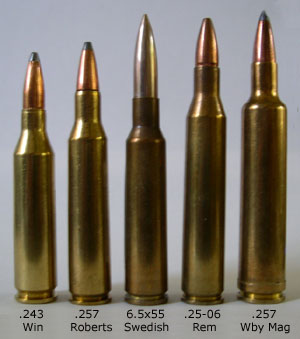
Here it us with some other “quarter-inchers”:
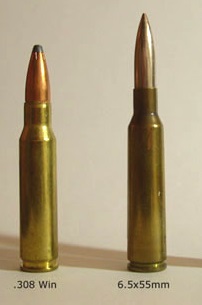
And finally, vs. the .308 Win (my “1.a” choice for a do-it-all cartridge):
I will say unreservedly that if I were limited to only one cartridge for “ordinary” (i.e. excluding African large game) hunting whether human or animal, the Swede would get my vote ahead of every other cartridge I’ve ever fired.

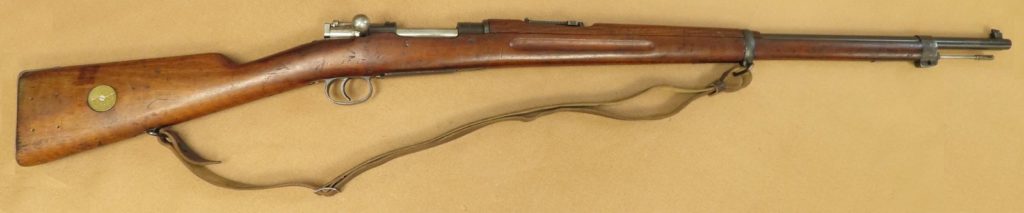
The only caveat I have is that the Swede doesn’t seem to do as well in shorter-barreled rifles.  I think that in standard loadings — and certainly with the Hirtenberg mil-surp stuff — the bullet needs a longer barrel to get that bullet spinning towards its performance apex.  And the ultimate expression of that is in the wonderful Mauser Mod 96 with its 29″ barrel, as never used (in combat) by the Swedish Army:
In my earlier post on Great War Rifles, I said:

But of all the rifles issued to soldiers of that era, the one I’d have chosen to go to war with would have been the Swedish Model 1896 Mauser.  It has moderate recoil, yet the bullet travels flat and hits hard.  The rifle is also fantastically accurate: consistently-placed head shots at 400 meters and torso shots at 600 meters are quite possible even for an average shot like myself.

I haven’t changed my mind since.

That said, I have old eyes and the iron sights would be problematic — but mounting a scope on the old M96 can be tricky, with that 90-degree-lift straight bolt.  So I’d have to take instead my current love, the CZ 550 with its 24″ barrel:
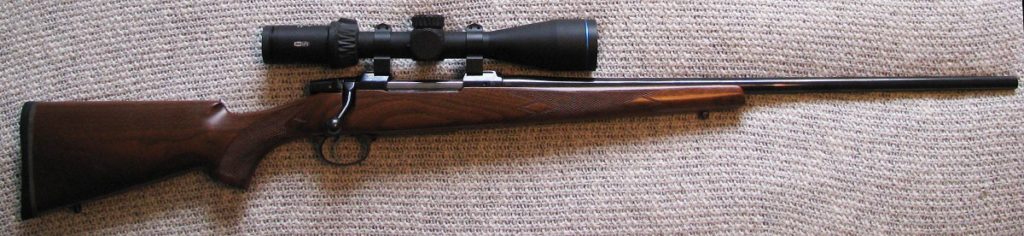
Compromises… we all have to make them.
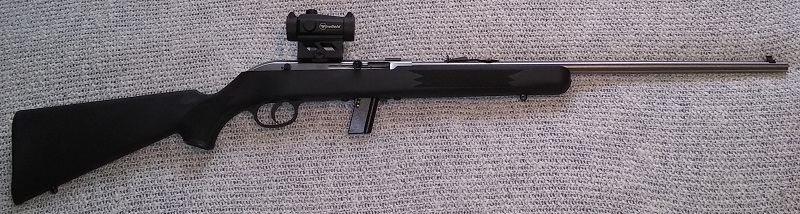
Range Report: Savage 94F (.22LR) & Firefield 1×22 Impulse

Having established that Ye Olde Eyes were no longer up to the task of using a rifle’s iron sights to actually hit anything, I decided to quit fooling myself and accept that Time Marches On, and leaves one’s eyesight in the rearview mirror.

I had an old Firefield 1×22 red-dot scope lying around, so I mounted it onto the Savage 94F wot my kids gave me for the latest birthday, thus:

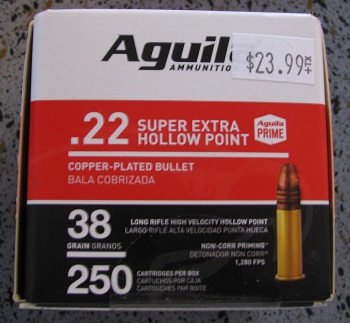
…and headed off to the range.  I decided to try the Aguila ammo this time:

(Note the price… ugh.)

I first messed around at the pistol range, simply to get the bullets “on paper”, then moved to the rifle range, which can accommodate things like rests and such to get the job done properly.

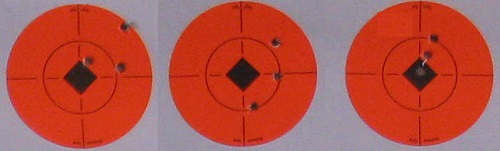
Now the Firefield, as its description indicates, has 1x (i.e. no) magnification (which really doesn’t help Men Of Failing Eyesight such as myself), so I wasn’t sure just how precisely I would be able to zero the thing.  Nevertheless, I persevered.  In order of shooting, 25 yards at 3″ targets:

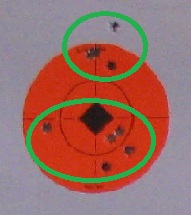
Played around a bit (two 5-round strings):

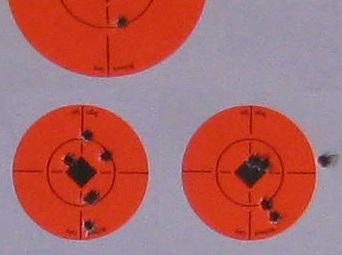
Then I got a little more serious, shooting the smaller 2″ targets at 15 yards (because at 25 yards, the red dot was almost larger than the 2″ target):

But try as I may, I couldn’t get groups to tighten up any more than that — always four decent rounds and a flyer.  So I started to get irritated, and got really serious — except that I was getting worse, not better:

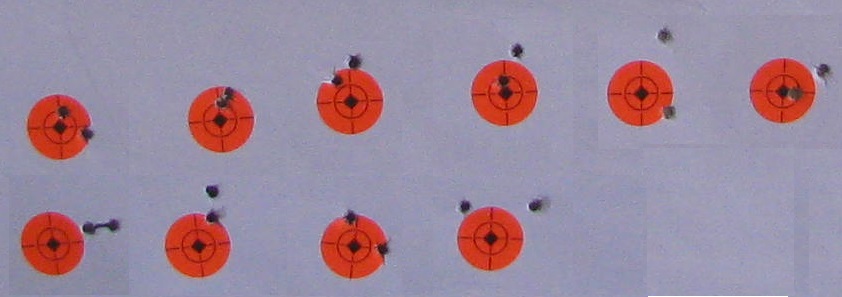
I gave up, and did two “torture tests” — rapid fire, one shot per 1″ target, then repeated the exercise in the same order:

I’ve done better with a damn pistol, shooting offhand.  I was getting seriously angry at myself.

I was done for the day but I had five rounds left over, and I hate having loose rounds rattling around in the gun bag — you know what’s coming, right?

I loaded them up, put one round into some white space on the target, then shot off the last four as quickly as I could pull the trigger, using only the first bullet-hole as the aiming point:

Okay, I have to admit that I felt a lot better after that.


Afterthought:  I forgot to mention that this Aguila variant is consistently accurate in pretty much all my rimfire guns.  All flyers are therefore very definitely the result of “operator error”…

Enough Gun?

In Comments about the .375 H&H cartridge, Fergie asks:

I wonder why the venerable .45-70 isn’t on the table for him?  North American bison are heavyweights too, and .45-70 will handle them with aplomb even at range.  I wouldn’t hesitate if offered a decent shot at that critter – a properly stoked cartridge with a hard cast 500 grain round nose from an elegant 1885 single shot would end the hunt nicely.

I’ve thought about that a lot myself (not owning a rifle chambered in .375 H&H, but owning the aforesaid 1885 High Wall rifle in .45-70 Govt).

I remember looking at the situation back when I was thinking of joining Mr. Free Market and Doc Russia on a South African safari, and basically I was told that the PH wouldn’t let you hunt Cape buffalo with the .45-70 Govt because it’s too underpowered.  I bridled a little at that, and went looking around.

Here’s what the stats say about Buffalo Bore .45-70 Govt “Magnum” offerings:

Mono-Metal Flatnose:  380 gr.  @ 2,075 fps / muzzle energy 3,632 ft-lbs
LBT-LFN:  430 gr. @ 1,925 fps / muzzle energy 3,537 ft-lbs
FMJ-Flatnose:  500 gr.  @ 1,625 fps / muzzle energy 2,931 ft-lbs

Compare that to Buffalo Bore’s own .375 H&H Mag offering, which they call “Supercharged”:

SUPERCHARGED: 300 gr. Barnes TSX @ 2,550 fps / muzzle energy 4,330 ft lbs

Here’s the critical part, though.  Most PHs recommend that the bullet arrives with no less than 3,000 ft-lbs at 100 yards.

At 100 yards, the .375 H&H  Hornady DGS 300gr lands at 3,292 .  The Buffalo Bore .45-70 Govt (or any manufacturer’s, for that matter)?  Anywhere from 2,500 – 2,700 ft-lbs.  Not nearly enough;  those big, heavy ol’ boolets lose velocity too quickly.

More telling is the bullet’s ballistic coefficient (BC) / sectional density (SD) or, for a better definition, penetration power.  (The higher the BC / SD, the better the penetration.)

At about 2,500 fps (which is at about 175 yards), the .375 H&H 300gr bullet has a BC of 480, and its SD is 305 (480/305).

At 1,900 fps (which is at the muzzle), the  .45-70 Govt 300gr bullet  has a BC of 185 and an SD of 204 (185/204).

In other words:  if you were to shoot a Cape buffalo with the hottest-possible .45-70 Govt cartridge, you’d pretty much have to be in halitosis range to get the same result as you’d get with a .375 H&H cartridge at 100-150 yards.

And as Longtime Friend Combat Controller succinctly put it when we were discussing the topic last night:  “If the .45-70 worked in Africa, they’d be using it.  They don’t.”

Yup.  In any safari camp, when you un-case your .375 H&H rifle, the PH will nod in approval.  And especially so when it’s a CZ 550 Safari, a.k.a. the Brno 602.

Range Report: Federal 6.5x55mm Swedish 140gr

Yesterday I went off to the 100-yard indoor range to play around a little with the new rig:

…and see which ammo it likes best of all.  I have quite a few different brands / types of 6.5x55mm ammo, so picking one is no easy choice.  I decided to start with the Federal ammo, because I’ve always had good results with it, and long ago I standardized my bullet weight at 140gr because that’s what all my rifles thus chambered (there have been a few) have shot well.

Before we look at the target, I need to talk a little bit about the scope technique.

Last week, after zeroing the scope, I reset both the top- and side knobs to zero.  All “warmup” strings were fired with that scope setting, and then I’d adjust the scope (once) for that ammo, and let off another string.  While I was letting the barrel cool between the different ammo brands, I’d reset the both scope turrets to their original zero, before changing to the new ammo.

All aiming-points are the center (bull) diamonds.

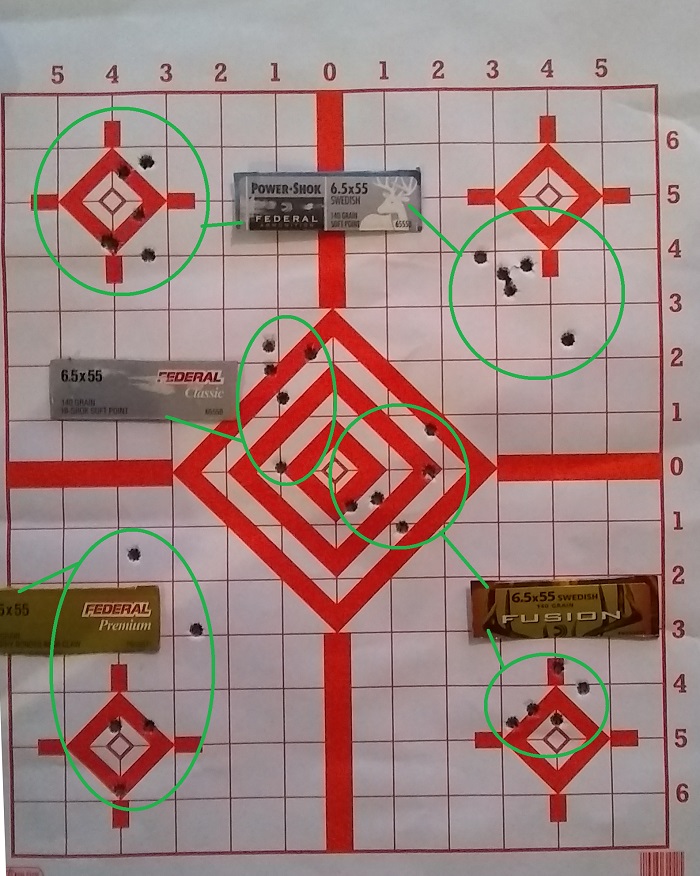
Because I couldn’t take too much time — the range is always fairly busy, even on a Monday — I had to shoot a little more quickly than I normally would, which meant the barrel heated up quite a lot.  So here’s the 100-yard target:

The top two targets were as follows:  the top right-hand target was the warm-up string with this type (includes a called flyer), and the top-left was after I’d adjusted the scope.  Not bad.

The large center target held two groups:  the left-hand group (with yet another called flyer) was basically the same ammo I used to zero the scope last week, and I was a little worried because my aim-point was the center diamond.  Was the barrel starting to whip?  I decided to let the thing cool for about ten minutes, and then I tried the “new” ammo I’d purchased a few weeks ago:  the Federal “Fusion”, the first string of which which is the right-hand group on the large target, and then, after scope adjustment, the bottom-right target.  Lovely. Good thing I have lots of it.  (Okay, I have a lot of all the ammo types, but whatever.)

Then, disaster.

The bottom-left target was reserved for Federal Premium “Trophy Bonded Bear Claw”, which has always given me excellent results, across three or four different rifles.  All this ammo, incidentally, has the same lot number on the boxes;  it was very carefully chosen and ordered, and it has worked consistently well.

Just not this time, with this rifle.

The two flyers were not called — in fact, all five shots felt “right” when I touched them off — and while I can live with flyers an inch or two off, these two came out of the blue, and were not the last two fired, either:  from memory, they were the 2nd and 4th in the string.  In fairness, the barrel was really hot by then, so… I ended the range session.

The reason this is so perturbing is that if I were suddenly to be called away on a hunting trip with no chance to test-fire any of the types shown, I would grab the Bear Claw in a heartbeat and head out.

It looks like I need to spend a little more time with this ammo.

That aside — and I will get to the bottom of the problem — the Federal ammo brands and types all performed well, under the circumstances.  Remember that this was really just a “rough” test — I plan on fine-tuning each type in separate sessions over the next couple months, with the scope adjustments noted.

Range Report: CZ 550 American / Meopta Optika6

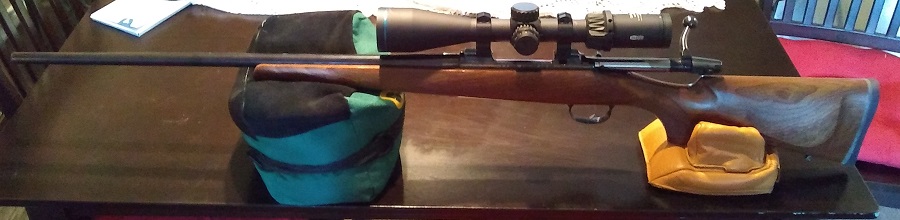
Yesterday I took the new toys out to work, said toys being a CZ 550 American (6.5x55mm Swede), topped with a Meopta Optika6 3-18x50mm scope.  Here’s the tout ensemble:

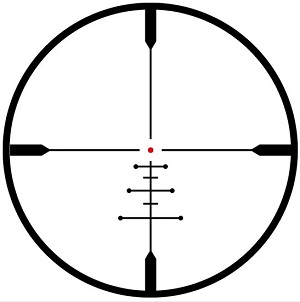
…and the illuminated reticle:

…which I would only use if I were hunting at dusk or dawn.  (On paper, the cross-hairs work just fine.)

Now, I’m pretty sure I heard someone saying, “Meopta-whut?”

Me, too;  until I discovered who they are.  Here’s the full scoop, but the executive summary is:

  • Czech company
  • been around since the 1930s
  • mainly makes commercial photo-enlargers
  • renowned for the quality of their glass
  • started making scopes a couple decades ago
  • if you’ve ever bought a Zeiss Conquest scope [raises hand], it was made by Meopta and stamped by Zeiss
  • congratulations;  you just paid two hundred-odd dollars more than you had to, for the identical scope.

Let me get the basics out of the way, first.

This scope cost me about $650, and I honestly think I got $1,200 value for it.  Holy cow:  the precision of the scope is astonishing, and the clarity as as good as any scope I’ve ever looked through.  I was originally going to get a Minox ZX-5i of similar power for about $100 more, but nobody had it in stock at the time and I was antsy, so I took a flyer on the Meopta, and I don’t regret it, at all.

That said, there are a couple of things that irritated me about the scope’s setup operation.

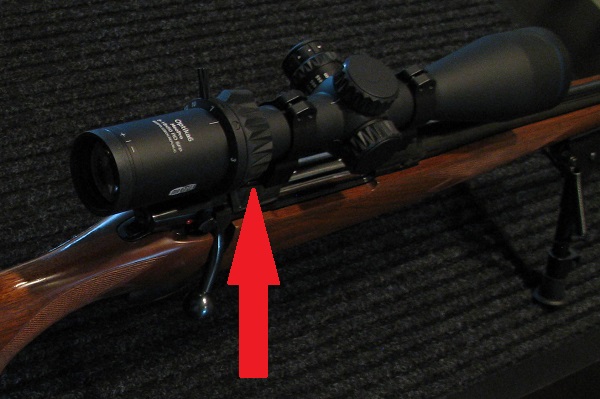
I’m using Warne Maxima rings, the tallest you can get, because the 50mm bell needs to be raised off the barrel and CZ bases are quite low.  As it turned out, the bell wasn’t a problem.  What was a problem was that yuge magnification adjusting ring on the scope:

…which proved very good at preventing the bolt from being pulled back — which, in a bolt-action rifle, is Not A Good Thing.  I had to put a shim into the rear scope ring to raise the scope the requisite millimeter or thereabouts so that the bolt handle would clear the adjusting ring.

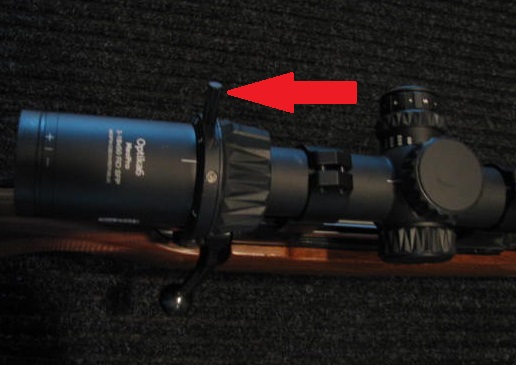
The second issue also involved the adjuster, and it was the little stick screwed into it, supposedly to aid the easy working of the mag adjuster (which, by the way, is hellish stiff, more than it has to be, I think, but it should ease up with use).

Well, maybe the stick helps adjust the ring, but what it also does is get in the way when you’re working the bolt — and yes, there are several threaded holes to choose from to overcome this problem:  but what I found was that moving the stick so that it stayed out of the way worked for one magnification setting, but as soon as I changed the magnification (from, say, 10x to 5x or 12x to 18x), the fucking thing would catch on my hand when I worked the bolt.  And nothing makes Uncle Kimmy crankier than when something interferes with him working the bolt.

So I unscrewed the little stick and threw it away.  Don’t need it, won’t need it, especially as the adjusting ring has those deep, thick grooves to provide a decent grip*.

But those were the only issues I encountered at that session.  The scope worked flawlessly, and zeroing it took just under an hour (I generally let the barrel cool between strings, especially a skinny lil’ thing like the 550’s.)

Like an idiot, I hadn’t bothered bore-sighting the scope before hitting the range, and I paid for it by having to waste over a dozen rounds just to land the boolets into a dinner-plate group.

I had no intention of going for MOA (except by luck) during this session, anyway.  This is a hunting rifle rather than a precision target piece, and in any event, I was only shooting one brand of ammo to get everything into the same zip code.

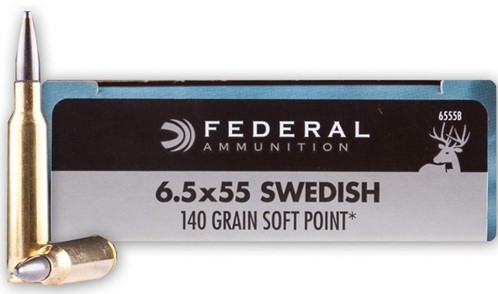
The ammo was my standard sighting-in choice:  bottom-of-the-line no-frills Federal 140-gr Soft Point:


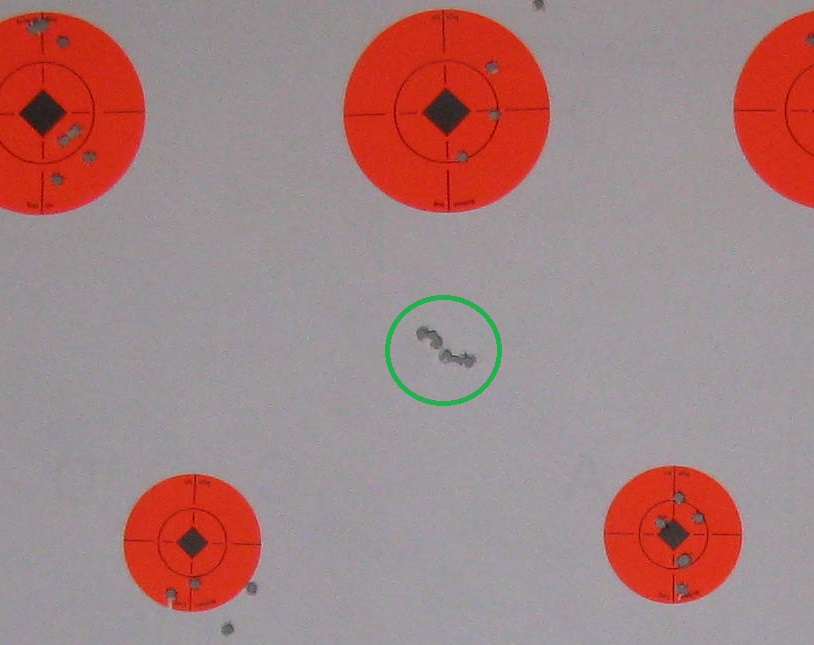
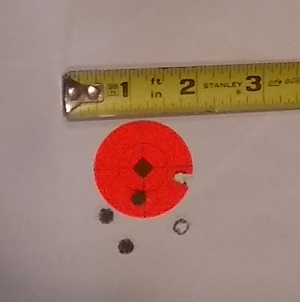
…with which I managed this 100-yard grouping with the last 5 rounds in the box.

That’s close enough for government work (or anti-government work, depending on your circumstances).

Now that the scope is roughly zeroed, next week I’ll get serious and start running through the dozen-odd different brands and bullet weights I have lying around in Ye Olde Ammoe Locquer, to see which one works best.

What fun.


*I don’t wear heavy gloves when shooting, anyway — in very cold weather (e,g, Scotland), I use the flip-off mitten type over thin gloves.