Market Garden Final Thoughts

From Longtime Friend & Reader Sage Grouch comes this response to last week’s Market Garden post:

Thanks for the flattering request for my opinion.

Montgomery, for whom I have a mixed opinion because of his terrific performance in the African desert versus his lackluster performance on mainland Europe (Caen, anyone?), famously said that Market-Garden was “90% successful;” sadly for the Allies that means it was in fact a strategic failure. No question, as you say, it saw some stunning victories at Eindhoven, Vegel, Grave, and Groesbeek;  and Frost’s paras, and the Poles, were nothing short of magnificent. But I think it would be fair to say that British airborne forces were gutted for the rest of the war after Market-Garden, particularly the 1st Abn Div, which suffered 75-80% casualties and never fully recovered, playing no more combat role (as opposed to the US 82nd and 101st Abn Divs who went on to even more glory in the Bulge and beyond). The 6th AbnD, their other para division, was still refitting after Normandy and played only a minor backup role in the Bulge.

In the larger context of Market-Garden’s strategic failure, this loss was compounded by the operational cost: elite troops, including very valuable officers who could have been husbanded for future opportunities (or used more conservatively) were instead expended in a high-risk gamble that yielded only a vulnerable salient.

There were certainly some wins for the Allies as a result of Market-Garden. As has been said, the US 82nd and 101st performed brilliantly and largely achieved their objectives, not least of which was holding “Hell’s Highway” against fierce German counterattacks. The offensive freed a big swath of south and central Netherlands, including some V-2 launch sites and, of course, liberating a large number of Dutch civilians, who were thus spared the worst effects of the “Hunger Winter” yet to come. It inflicted large losses on the two German SS Panzer divisions that were refitting in the area, which affected Hitler’s ability to use them as he would have liked in the Bulge in December. And to be sure, the area captured was a useful jumping-off salient for operations in 1945, even though that wasn’t one of the stated objectives of the operation.

Having said that…

As we’ve said, seizure of the Arnhem bridge and establishment of a firm bridgehead over the Lower Rhine was the stated goal of the whole exercise, and that failed; with it failed the plan to outflank the Westwall and end the war 7-8 months earlier than it ultimately did, with all the casualties and physical damage to Europe caused during that period. (And no seizure of Berlin by the Western Allies, which could have shaped the Cold War in Europe differently for half a century. I like to think Eisenhower would not have stopped at the Elbe had his forces gotten that far by, say, November or December 1944, when the Russians were still ~300 miles and several months away, on the Vistula, but I could well be optimistic about that.)

The resulting salient after the operation was a vulnerable “bulge” that had to be defended by a large number of Allied troops who could have been used elsewhere, instead of acting as a springboard for further offensive operations. And I’ve already talked about the damage to British airborne capability and the high overall cost in elite troops and equipment.

So I maintain that Market-Garden was a strategic and operational failure, which featured many brilliant tactical performances.

To my mind, the most important part of how Market Garden turned out is what I missed, i.e. “It inflicted large losses on the two German SS Panzer divisions that were refitting in the area, which affected Hitler’s ability to use them as he would have liked in the Bulge in December.”  The effect of that attrition on the Bulge attack was incalculable.

So we’re all clear on the matter:  I respect Mr. Grouch’s opinion on the WWII Western Front as I do few others.  (He’s actually a twice-published author on the Battle Of The Bulge, so his expertise in these matters is beyond question.)  And fortunately for me, our views on the above are so similar as to be pretty much identical.

Thanks, buddy.

Revision

I have to say that I’ve always thought that WWII’s Operation Market Garden was actually a very successful military campaign, and not the horrible failure as it’s been painted.  And this guy agrees with me:

In fact, the operation succeeded at six of its seven principal objectives, a rate of achievement that would be considered remarkable in almost any other military context. The American 82nd Airborne Division, under Brigadier General James Gavin, faced the daunting task of seizing the great road bridge at Nijmegen across the Waal River, one of the widest river crossings in Western Europe. They did so after brutal urban combat and a daylight assault river crossing in canvas boats under direct enemy fire, one of the most audacious tactical actions of the entire war.7 The bridge was taken intact even after the Germans tried to blow it up. The 101st Airborne Division, led by Major General Maxwell Taylor, seized the majority of its assigned bridges and canal crossings in the southern portion of the corridor and held the vital road that the operation depended on, quickly dubbed “Hell’s Highway” by the soldiers who fought along it, against repeated and determined German counterattacks. British armored units of XXX Corps advanced deeper into occupied territory in a shorter period than in any previous operation in the Western campaign. The scale of what was accomplished tends to disappear in the shadow of Arnhem, but it was genuinely extraordinary, representing the successful coordination of tens of thousands of men, hundreds of aircraft, and an armored column driving north along a single road through hostile country.

I have read a ton of history on the topic — WWII is very much a period of history near to my heart — and I think that too often Market Garden is used a lot by American historians to have a go at Brit Field Marshal Montgomery.  (He’s too often caricatured instead of appreciated.  Not that I have a problem with that, in general terms, because he set himself up for it pretty much all the way through the war.  But we tend to forget that the reason Monty was so cautious a military commander was that he was faced with the stark fact that British and Commonwealth manpower’s losses were, to use the modern term, quite unsustainable.)

Going back to Market Garden:  it may well have been a bridge too far (Arnhem), but its only real failure was that even if it had been a total success, it’s doubtful that it would have been the war-ender that Montgomery believed it would be.

I await Reader Sage Grouch’s informed opinion on this.

Amateurs Vs. Professionals

In which some smart guy compares the hard-headed and realistic professionalism of Trump’s foreign policy towards Iran vs. that of the feckless Obama administration.

While then-Secretary of State John Kerry famously treated Iranian negotiators like esteemed colleagues, Vice President JD Vance just treated them like a landlord dealing with a delinquent tenant who thinks he owns the building.

I’d like to think that was Kerry’s underpinning philosophy — simple foolishness and a massive misread of the room — but then I’d have to think that Fuckface’s dealings with Iran didn’t involve in-depth discussions with Barack Traitor Obama, who always had another, more malevolent attitude towards his adopted country.

The fact of the matter is that the Obama administration sold the United States out to Iran — with cash as well as white-glove treatment — and it’s taken us this long to reverse that ghastly policy.

Swarming

Many years ago, back when we were still in the “win wars with boots on the ground” mindset, and when we were battling a weak or non-state enemy (e.g. Afghanistan), I suggested that ground support for the troops could be fairly cheaply (and adequately) be fulfilled by using in-theater two hundred WWII-era P-51 Mustang fighters armed with small smart bombs.  The idea of course was that such a high number could swarm the battlefield or area of interest to overcome any poorly-armed resistance.

Of course, this was before remote-controlled drones came on the scene to the extent they have, and Doug Ross gives an excellent overview of how this has changed modern warfare.

Military drones aren’t just one thing — they come in a huge range of sizes, costs, and purposes. On the low end, you’ve got $500 disposable quadcopters that soldiers fly into enemy positions. On the high end, there are $100 million surveillance drones that fly at 60,000 feet and can stay in the air for days. The key pattern is simple: the cheaper the drone, the more of them get used. The most expensive drones exist in small numbers, while the cheapest ones are built and destroyed by the hundreds of thousands. By 2026, militaries around the world have organized their drone forces into what’s called a “drone stack” — a system where different types of unmanned aircraft are layered by altitude, flight time, cost, and mission, covering everything from a single squad’s needs to an entire war zone.

Here’s an idea of the scale:

By 2025, Ukraine was building over 200,000 small attack drones per month.

So I had the right idea, but I just wasn’t thinking small enough.  Mea culpa.

Shooting Them Down

Interesting stuff, this (via Insty):

I Have Seen the Future of Anti-Drone Warfare, and It’s Dirt-Cheap

I vaguely remembered reading something about the Sting a year or more ago, but I just learned today that they’re both dirt-cheap and extremely effective — mostly at shooting down Russia’s Geran-2 one-way attack drones, which are licensed copies of Iran’s Shahed that have caused us considerable trouble in Operation Epic Fury.

Ukraine needs tons of these things, because Geran is essentially a terror weapon aimed in large numbers — currently 100 to 200 per attack — at Ukraine’s cities and infrastructure. Larger attack waves include anything from 300 up to just over 800 Geran-2s in one night.

So the concept behind Sting is simply enough: Make something cheap and fast to build, easy to use, yet still capable of knocking a Geran-2 out of the sky far enough out from its target for some degree of safety.

And the Ukrainians did just that.

Of course, that’s all well and good in a military context, and our own .dotmil needs to hop onto this with all due dispatch, if they haven’t done so already.  (I assume they have, but whatever.)

What interests me as a civilian, however, is a solution closer to home [sic], in that these little airborne nuisances can also be used by anti-social elements to both spy on people and, in the worst case, to kamikaze themselves into a target — such as, for instance, your home or similar.  Why go to all the trouble of kitting yourself up with a suicide explosive vest or a rifle in order to inflict death and damage on (say) a church or synagogue, when you can essentially outsource the suicide bit to something you hand-built in your garage?

And in the above scenario, how would ordinary people — say, adherents of the Second Amendment — defend themselves or their communities against such nefarious electro-mechanical mosquitoes?

I’m thinking of something like this, of course:

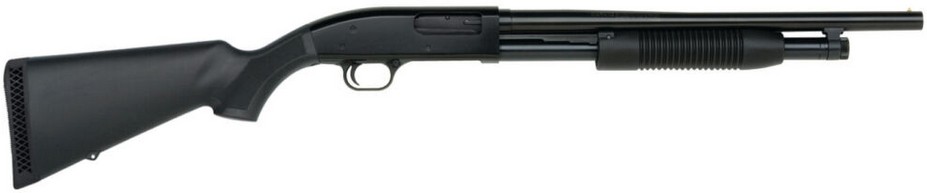
That’s the semi-auto 12ga Browning Silver Hunter (and of course there are less-expensive options because America).  This differs from your standard home defense shotgun, say a 12ga Mossberg Maverick 88:

…in that the Hunter is not a pump action device but semi-auto (ergo  a higher rate of fire) and it has a much longer barrel (ergo  much greater accuracy at distance, ask any bird shooter).

I’m interested in this concept because it raises a couple of practical issues such as the type of ammo that would work best to bring down a drone (00 buck, or perhaps something lighter?).  Obviously, a 12ga slug would end the flight path of a drone with spectacular effect, but it has to be accurate:  far easier to spread the terminal effect with shot… but which shot?  00 buckshot is excellent, but it also kicks like hell — and getting followup blasts off quickly with said semi-auto action means a quicker target re-acquisition time is necessary.  Would 7/8 birdshot do the trick as well?  For that matter, would a 20ga shotgun be as effective as a 12ga under such circumstances?  (Almost all semi-auto shotguns are offered in both chamberings.)

I’ve owned a 20ga semi-auto shotgun in the past, and I have to say that the effect downrange is almost as effective as a 12ga (if those watermelons and milk jugs are at all indicative), but the recoil was far less problematic.

Of course I think that the Silver Hunter is just dreamy, in so many ways:

…and yes, the addition of a red-dot sighting device may certainly be of assistance (even though I think it spoils the look of the gun).

Feel free to discuss this topic in Comments, of course.

Quote Of The Day

From this guy, talking about the Iranian Ass-Kicking Exercise and BritPM Starmer’s reaction thereto:

“Progressive realism has met reality: when the chips are down, nobody cares about international law; nobody cares about tolerance and diversity; nobody cares about human rights; nobody cares about doing the right thing. They care about winning.”

Yup.  It works at both the macro- and micro levels, btw.  (see:  Righteous Shootings)