Apex Stuff

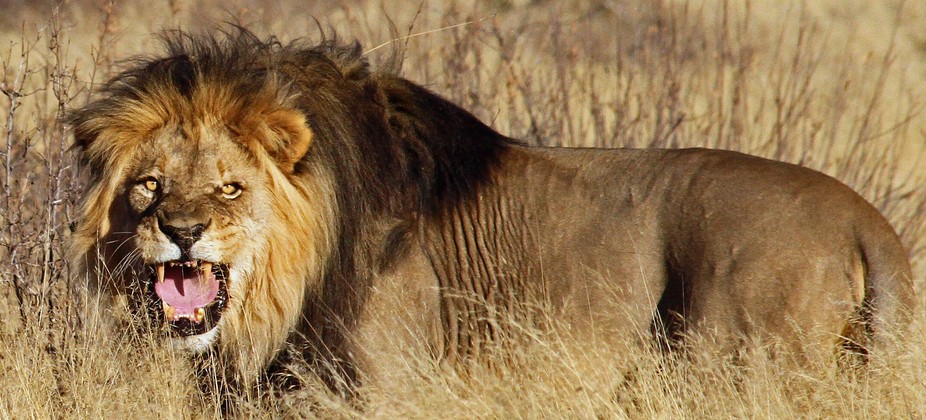
I’m sometimes asked the best way to hunt dangerous game — specifically in Africa, where there are lots of things with teeth and claws and such, waiting for an opportunity to turn the next easy target into dinner.

Let me be perfectly clear about this:  human beings are the ultimate prey for hunters like lions.  We can’t run very fast nor very far, we have no sense of smell compared to, say, lions or leopards let alone antelopes, we don’t have sharp horns or hooves to protect ourselves or cause some kind of defensive injury to a predator, and we sure as hell can’t swim like a damn crocodile.

We are, in the animal kingdom, like marshmallows.  Pork-flavored marshmallows, to be precise, just the thing to make lions sharpen their claws before putting on a dinner napkin.

So why do these dangerous animals think that we are the apex predators?

Because we don’t fight fair.  As though fighting for one’s life, or hunting down food requires us to be all Marquis-of-Queensbury types;  what foolishness.

Fuck that.  If a pride of lions wants to target a few humans for brekkie, well… say hello to an A-10 Warthog or an Apache attack helicopter, and let’s see who’s really the apex predator, Fluffy.

The only reasons we don’t use our peak powers to hunt game are because the stupid government won’t let us, the weapons are a little on the pricey side (if you think .50 Browning ammo is spendy, try a depleted-uranium 20mm boolet).  And lastly, we don’t use all that cool wizardry because it kind of messes up the trophy hides and meat somewhat.  (Not much market for half-inch-sized hides and bloody slurry instead of steaks.)

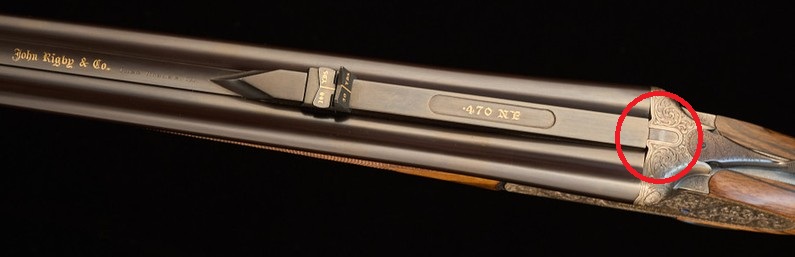
So we’re stuck with rifles like this rather pretty Chapuis Elan Classique double rifle, in .470 Nitro Express:

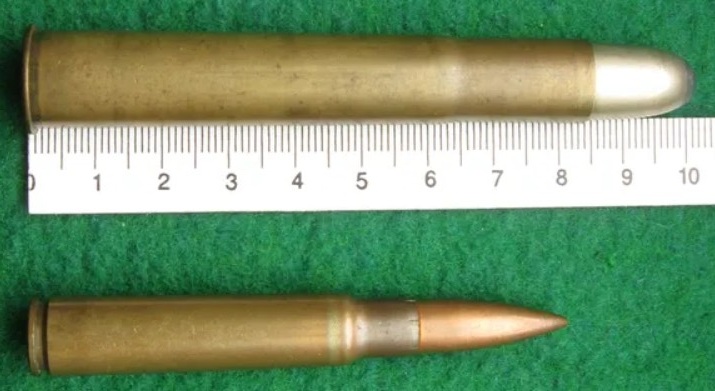
For those unfamiliar with this beast of a cartridge, here’s a comparison to the 8x57mm Mauser (itself no slouch in the “killin’ things” business):

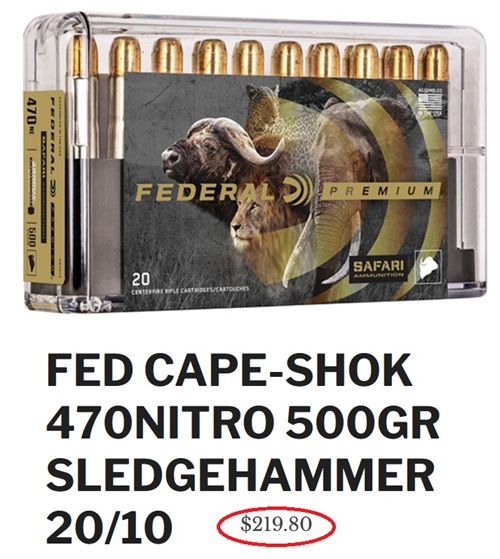
And speaking of hammer blows:

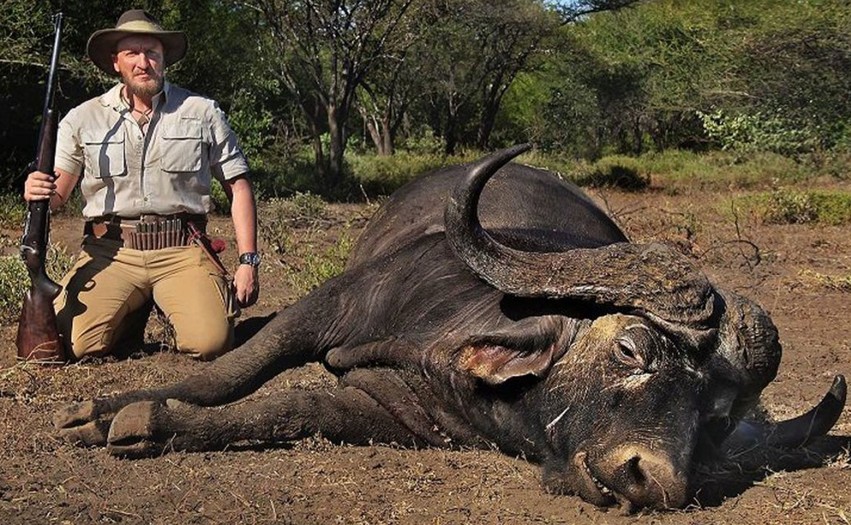
Of course, if you know what you’re doing, you’ll only need one or two blows to your wallet for that Cape buff or 600-lb Kalahari lion.

If you don’t know what you’re doing, refer to my “pork-flavored marshmallow” description above.

Seriously Tough

Mr. Free Market has been doing some Internet research (LOL) during his break from evicting widows and demolishing historic homes, and has come up with this series of African hunting escapades, the PH being the peerless Buzz  Lightyear  Charlton, who cannot be described as a Zimbabwean.  Nope, anyone who stalks his prey in the African bush wearing Crocs or Birkenstocks is a damn Rhodesian.

Eland  (which makes me realize how lucky I was to get mine)

Buffalo

Elephant

I can’t see what the clients are shooting, but Buzz carries a .500 Nitro Express double rifle.

To call him an expert PH is to make a mockery of the term “expert”.

Oh, and note that after the shot is made, the party is in no hurry to get to the downed animal.  Caveat venator.

The Old Cartridge Question

Ron Spomer was recently challenged to name his favorite cartridges for specific animals.  The catch?  He was restricted to only those cartridges developed and commercially sold before 1950.

In case you don’t have 20 minutes to watch the video, here’s the executive summary (with my very respectful preferences in parentheses):

Elk:  .300 H&H Magnum (9.3x62mm)
Mule Deer:  .270 Win
Whitetail:  7×57 Mauser
Moose:  .30-06 Springfield (9.3x62mm)
Pronghorn Antelope:  .257 Weatherby Magnum (.25-06 Remington)
Bison:  .375 H&H Magnum
Black Bear:  .35 Whelen (.32 Win Special OR .45-70 Govt, depending on the terrain)
Grizzly Bear:  .375 H&H Magnum
Elephant:  .375 H&H Magnum (.416 Rigby)

And by the way, I have absolutely no argument with any of Ron’s choices.  My “alternatives” are a personal preference, no more.  (I’d hope that he wouldn’t have a problem with any of mine, in return.)


Of course, I have opined on those wonderful cartridges of yore, and for those New Readers or else Elderly Readers Of Fading Memory, here’s a link to that 2003 post.

Getting The Blues

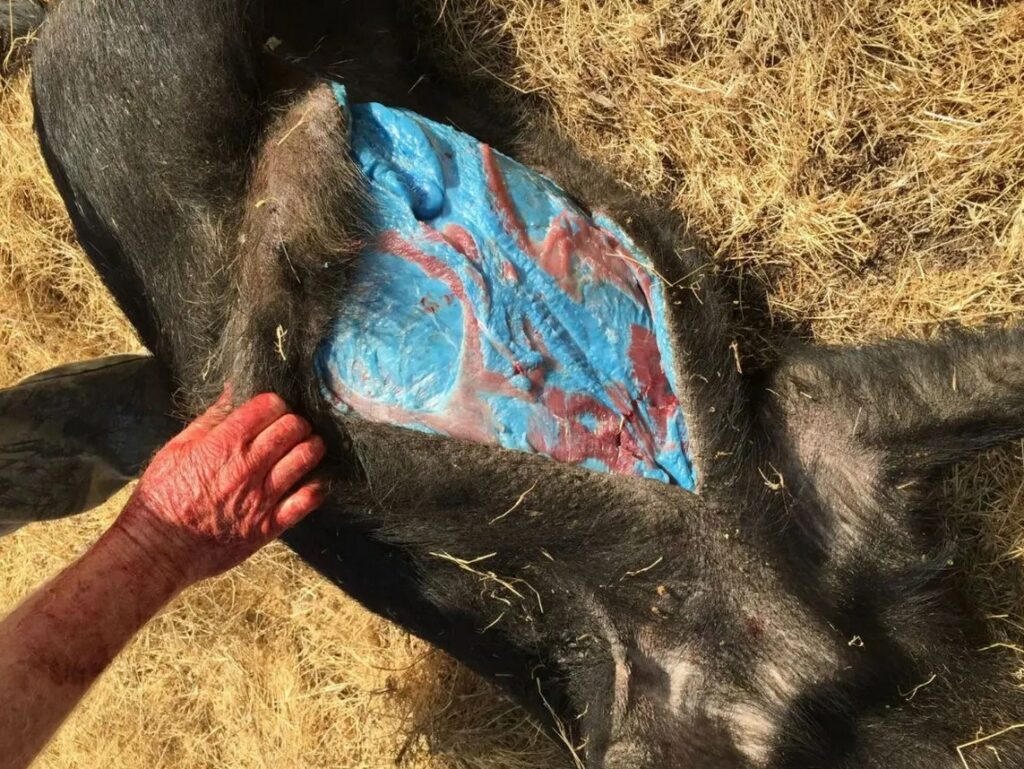
Okay, I never expected to see this:

Swarms of pigs have been found with neon blue skin after ingesting life-threatening pesticides.  

The electric blue-skinned hogs were first reported in Monterey County, California in March when trapper, Dan Burton, discovered several wild pigs with blue fat and muscle.  He told LA Times: “It’s wild. I’m not talking about a little blue. I’m talking about neon blue, blueberry blue.”

The feral swine are thought to have ingested the rat poison from dyed bait or feeding off other infected species.

Wow.  Assuming that all the above is true and not some cock-and-bull story cooked up by The Usual Suspects, I’m not at all sure how to comment.

I’ve never supported using poisoned bait to keep vermin under control, for the same reason that I don’t support fishing with explosives:  a bullet has one intended target, whereas both explosives and poison are simply labeled “To Whom It May Concern” — i.e. it’s indiscriminate targeting.

However:  there are two known facts extant.  The first is that wild pigs are becoming a pest on a national scale.  In Texas, you don’t need a permit to hunt them, and when you do there’s no bag limit, wild pigs being regarded as vermin.  Texas farmers not only allow pig-hunters on their property, they welcome them.

The second fact is that the state of California has the same regard for hunters as landowners have for vermin.  California, more than almost any other state, hamstrings the practice of hunting with all sorts of nonsensical regulations, even in the remotest parts of the state.  So landowners, not wanting to draw attention from the state’s feral bureaucrats and law enforcement, simply use other means to control the population — such as poison.

I’m not saying I agree with the practice, but I sure as hell understand it.

But that pic is still some kind of spooky, innit?

Finishing The Job

This is interesting:

Burmese pythons, one of the world’s largest snakes, are also one of the most problematic invasive species in South Florida. First spotted in the Florida Everglades in the 1970s, the snakes were introduced, either accidentally or intentionally, through the exotic pet trade.

Since then, pythons have become top predators in the local food ecosystem. Despite the fact that they now exist throughout much of South Florida, they remain difficult to track down. That means researchers and conservationists need to find creative ways to lure them out into the open. 

And by creative, we mean really creative—and University of Florida (UF) researchers clearly understood the assignment.

Researchers led by UF professor of wildlife ecology and conservation Robert McCleery have released 40 solar-powered, remote-controlled robot bunnies in South Florida this month. The researchers replaced the plush toy’s stuffing with motors and heaters to imitate the motions and body temperatures of one of pythons’ favorite snacks: marsh rabbits.

I’m no professor of anything, but it seems to me that these boffins are missing a trick, here.  It’s all very well to “lure” these giant worms out into the open, but it’s pretty much useless when it comes to actually killing the loathsome creatures.

My suggestion:  a small explosive charge — it doesn’t have to be greater than, say, that of a large bottle rocket — inserted into the robo-bunnies, triggered by pressure on the outer frame.  This will do one of two things:  blow the snake’s head off when/if it bites the bunny;  or else blow the snake apart when it crushes the thing prior to ingestion.  Either outcome is satisfactory.

Of course, this will never happen because reasons.