They may have lost most of their empire, but you have to hand it to the Brits sometimes. See this little bit of World Cup humor on the final match…

The Brits may have lost the World Cup (3rd), but they won the Humor Games in convincing fashion.

They may have lost most of their empire, but you have to hand it to the Brits sometimes. See this little bit of World Cup humor on the final match…
The Brits may have lost the World Cup (3rd), but they won the Humor Games in convincing fashion.
All those English people who came over here and swooned about the United States — the freedom, the politeness, the hospitality, Buc-ees (and did I mention the freedom?) had a somewhat rude awakening after their team got beaten by the Argies in the semi-finals.
Seems as though some things are not easily forgotten, among them being the Margaret Thatcher-era beating dished out to the Argies when the latter tried to invade the Falkland Islands (a.k.a. the Malvinas).
So after beating England at their own game last week, the Argie football team had a little celebration in their dressing room, waving a banner which said “Malvinas are Argentina” (or something like that).
Well, the response was an outburst of “How dare they?” from the UKgov:
“It prompted a fierce response in London as Business Secretary Peter Kyle demanded a FIFA investigation into the matter before (then-BritPM) Sir Keir Starmer publicly backed those calls.”
A FIFA spokesman said: “As is standard procedure, FIFA’s independent Disciplinary Committee is currently assessing the match reports and considering the relevant circumstances before deciding on potential further steps based on the FIFA Disciplinary Code.'”
Yeah, well fuck FIFA, their disciplinary code and the UKgov.
You see, this particular World Cup match was played in the United States of America, where we have a First Amendment — basically guaranteeing the right of the Argies to be as rude and disrespectful as they want. (I should point out that the Brits still mock the Krauts for having lost the last pair of World Wars, so their peevishness is somewhat ironic.)
So here’s the lesson for the Brits: freedom of speech sometimes means putting up with stuff that you find offensive. I know that BritLaw seems to have overridden that simple precept recently — where people can get arrested just for posting naughty things on Teh Intarwebz — but there ya go. Deal with it.
As for FIFA: your little disciplinary code doesn’t supersede our laws, so if you don’t want stuff like this to happen during your precious tournaments, feel free to hold your future World Cups in countries that don’t have a First Amendment.
Good luck in North Korea.
Footnote: The Argies lost the final to Spain (0-1), in the most boring football match ever played.
I often watch a podcast show called “Stick To Football”, because I love football. It’s hosted by Gary Neville (ex-Manchester United and England captain), who is arguably one of the best right backs ever to play the game. It’s no understatement to say that without Neville at his back, David Beckham might not have been as successful as he was, in no small part because Beckham was always assured of having a rock-like and intelligent defender behind him, and someone who could always be counted on to lay an intelligent pass on to him so that Golden Balls could work his own magic in turn.
Alongside Neville are the dour, waspish midfielder Roy Keane (also ex-Man U, and Ireland) and the brilliant goalscorer Ian Wright (Tottenham and Newcastle United). Between the three of them, they provide excellent coverage for their various guests, themselves all fine former footballers and football managers.
It’s a show, however, that would mostly be lost on Murkins because Murkins prefer to watch and talk about their own brand of “football” and not that boring FIFA rubbish, and mostly their discussions are about events that are well known to Brits and Euros, but in large part unknown Over Here.
Neville & Co. don’t always have footballers as guests, however; Rory McIlroy has been on a couple of times, for example, as has snooker genius Ronnie O’Sullivan. And what has happened is that the show is starting to evolve into a discussion and analysis of sporting greatness rather than just great footballers. And in keeping with the current World Cup show Over Here, they’re interviewing Americans and not just Brits and Euros.
Which is why I have to recommend their latest show to y’all, because their guest is none other than superstar quarterback Tom Brady.
Now as any fule kno, NFL football is not my favorite sport, but as I enjoy most sports, I do know something of the game, and especially shall we say “highlights” of both the game and its players — so Tom Brady is not unknown to me.
What I did not know was how intelligent this guy is, and how much he devoted to making himself inarguably one of the greatest quarterbacks ever to play the game. Seven Superbowl rings (one with a team not the New England Patriots) pretty much speaks for itself, because seven championships in any sport (e.g. Lewis Hamilton’s string in F1) has to be treated with respect for the rarity of such an achievement.
So take an hour and a half out of your busy lives and watch this episode of Stick to Football. I think it’ll be worth your time.
Quote of the show (from Brady): “The standard was perfection; we settled for excellence.”
Every time I read something that begins “Environmentalists Warn”, I get an almost uncontrollable urge to either fall asleep or head to the range. This one’s no exception:
Environmentalists Warn World Cup “Most Polluting Ever”…
Yeah, that’s really going to grab your attention, innit? Because just about every mass spectator event could be similarly brushed. But wait!
…as FIFA Boss Uses Private Jet to Hit Two Matches a Day
Ummm well, given that FIFA is the organizing body for the whole damn extravaganza, it kinda goes with the territory that they would be flitting from one venue to another, and we are not Qatar, where all the matches took place basically within walking distance of each other. No; this latest Big Sport Thing is happening in the United by gawd States, which is a yooge ginormous country and is the only country which, when tasked with providing the proper match facilities for some massive number of matches and hundreds of thousands of visiting spectators, looked at the list, spat some baccy into a cup and said, “Is that all you got?” We didn’t have to build one single extra stadium, road, hotel or parking lot to handle the huge numbers of spectators. Sure, the venues were somewhat far apart (by Rest Of The World standards, that is), but them’s the breaks.
If the enviros want to end that little bit of logistical city-hopping, they should hold all future World Cup competitions somewhere else, like Britishland. Good luck with that.
Ain’t gonna happen, Watermelons, so go and suck it.
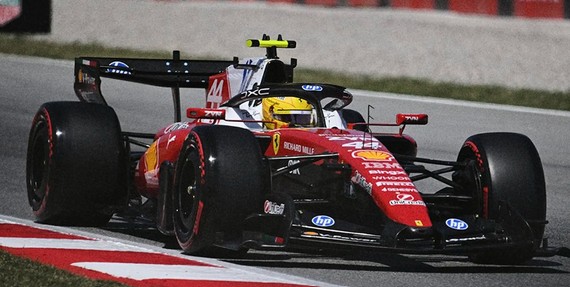
I see that Lewis Hamilton won the Spanish F1 Grand Prix in his Ferrari yesterday, this after coming in second place a week ago in Monaco. Also, he’s been bonking Kim Kardashian recently.
I’m sure the two events (improved GP results and bonking Kimmy) aren’t related, unless the entire Kardashian coven has been casting spells on his behalf (which wouldn’t surprise me).
When I came Over Here in the Great Wetback Episode of 1986, I knew nothing about baseball, other than its mechanics — we’d played rounders in grade school occasionally, but of course it was very much looked down upon when compared to the King of Ballgames (that would be cricket, to you colonial peasants).
So I never really showed any interest in going to the ballgames to watch the Texas Rangers play during my first few months living in Texas, right after I arrived. It didn’t help that back then the Rangers’ stadium was a dank, miserable piece of steel and concrete, devoid of any character or atmosphere.
But all that changed when I moved to Chicago. As the Great Big Research Company’s headquarters (GBRC) was located in the northwest suburb of Willowbrook, it was naturally a breeding ground for Chicago Cubs fans — the White Sox being of the southern suburbs (ergo, very infra dig) and whose home field of Comiskey Park was of the Texas Rangers type: horrible. Compared to the cozy and intimate confines of Wrigley Field, with its ivy-covered walls lining the infield, there was no comparison.
My then-boss was a keen baseball fan, and as our department was allocated a certain number of season tickets (for “client entertainment”, yanno), he encouraged me to use one of the tickets to go to Cubs games. I turned the offer down at first, and then he decided to take me to a game. There, he proceeded to school me in the game of baseball, with all its intricacies and subtleties. Once I saw that, I became a rabid baseball fan (helped of course by the massive database of statistics available, which was like catnip to this one-time statistician), and I started to go to every one of their home games, and to a few of their away games, when coincidental to a client business trip to places like St. Louis.
The only thing that bothered me was that the Cubs were perennial losers. I mean, you can only watch so many losing games before getting disenchanted. However, there were times that the Cubs didn’t lose, and it didn’t take much for me to learn that most of the times they won was because of their star pitcher, Greg Maddux. So I became a student of pitching, because I was deeply curious as to how this skinny guy could deliver so many strikes, no-hitters and wins when he didn’t have a rocket fastball like other pitchers. Our season tickets weren’t behind home plate but over the Cubs dugout in right field, so I couldn’t see what Maddux was doing that made him so unplayable. To learn more, therefore, I watched the Cubs games on WGN-TV, and with the aid of more seasoned baseball fans (like my boss), I saw how “Mad Dog” did it, and I became a rabid Greg Maddux fan. I believe that in one season (I forget which) I saw every single game he played, either live at Wrigley Field or on TV when playing away.
What irritated me, though, was that the Cubs organization seemed to have little interest in building a team — specifically, spending money on bulking up the pitching staff — around him so that they could go to the playoffs, at least. It’s not like they didn’t have any good players, anything but: first baseman Mark Grace, shortstop Ryne Sandberg and outfielder Andre Dawson were outstanding. But it doesn’t matter how good the other players are if your pitchers are giving up five or six runs a game, compared to Maddux’s one (or often zero).
What it looked like to me was that the Tribune Corporation (who back then owned the Cubs) were treating the team like a marketing exercise more than a sports franchise. I mean, Wrigley Field was always sold out for home games, even during the work week, and merchandise sales were as high as any MLB team except the New York Yankees, and they had TV coverage locked up with WGN-TV — which had national coverage through cable for out-of-towners; so (I asked myself) what was the incentive to spend money when they were pretty much maxxing out revenue already? It was a pretty cynical attitude — and nobody has ever been able to convince me that it wasn’t the Tribune’s policy, by the way — but what the hell: Chicago is a lovely place in summer, Wrigley Field lovelier still, and the Cubs got me out of the office at least several times a month. (I should point out that should anyone wonder why the GBRC was so lenient in this regard was because I worked longer hours than anyone else in the department, I had built excellent relationships with my clients, and I had come up with a couple of data analysis programs which were not only efficient but revenue generators. Funny how that works.)
Then it all went to shit.
Maddux’s contract with the Cubs came to an end, and their offer for a new contract was absolutely pitiful for a Cy Young award winner with one of the best pitching records in Major League Baseball. It’s not like the Tribune Corporation had financial difficulties, so it seemed pretty obvious that they cared more about the bottom line than winning — not that this was a new thought, as seen above — and their absolute refusal to pay Maddux what he was worth ended up with him going to the Atlanta Braves, who knew what they were getting: a World Series championship and an endless stream of divisional titles over the next decade or so of Maddux’s tenure. They, at least, had a decent pitching staff, unlike the Cubs ever did.
When Maddux left the Cubs for Atlanta, therefore, was the day that baseball died for me. I stopped watching the Cubs, and baseball altogether, and threw away my treasured Cubs T-shirt. When he came back to the Cubs for his “farewell” tour, I watched occasionally, but he was in his late thirties by then, and while still capable of flashes of his earlier brilliance, he was nowhere close to the pitcher he’d been. No fun at all, even though I still believe he was the greatest pitcher ever to play baseball.
For those Readers of short memories or to my Furrin Readers who don’t know what the hell I’m talking about, here’s a decent summary of Greg Maddux.
Also, it should be remembered that the Cubs did eventually win the World Series (after a drought of 108 years); but it was in 2016, eight years after the Tribune Corporation had sold them, and fifteen years after I’d left Chicago for Texas.