Back when I was rebuilding a grocery chain’s loyalty program, I encountered a situation that was apparently not at all uncommon: astonishing incompetence. Here’s what happened.
I’d relaunched our loyalty card in our Long Island stores, in the face of fierce competition. Long Island, while geographically tiny, is densely populated and therefore had a huge number of grocery chains in the area at the time: A&P, Pathmark, ShopRite, Stop & Shop and our company Grand Union. In addition, there was any number of independent operators, ranging from bodegas to large stores located in a single town or area. It was, at the time, quite probably the most competitive grocery market in the world. No single chain had more than 3% market share, for example.
Which is why, when I joined Grand Union to fix their loyalty program, the management committee insisted that the relaunch take place in Long Island. (I’d suggested taking a small area such as Connecticut to test the program, but for strategic reasons, Long Island was the division in most trouble, so that was what I had.)
Anyway, I did the thing: redesigned the card’s appearance (to distinguish itself from the older card) and taking previous customer spending as a benchmark, stratified customers into “Platinum”, “Gold” and “Regular” groups.
This, by the way, was a cause of great consternation to the management group and to Operations, who for decades had treated every customer as equal. That was nonsense, of course; when I analyzed the data, it worked out that each store’s financial viability depended on a very few customers. In large stores, the per-store actual count was about 2,000 shoppers, and in smaller stores, much less — as little as 1,100 customers. As I put it to management, if I were to write a letter to all those top customers, telling them to stop shopping with us or they’d be murdered, we’d have to close all our stores inside a month. Not only did those 20%-odd account for about 72% of total sales, they accounted for nearly 90% of our gross profits. (Which makes sense, because those top customers shopped the whole store, most especially the high-margin departments such as Deli, Produce, Scratch Bakery and Butchery.)
I’d also redesigned our advertising approach. Instead of relying on those familiar weekly store “flyers” (distributed in newspapers and in the stores themselves), we would stop using flyers altogether and do direct mail offers only to our Platinum and Gold customers, sponsoring both production costs and markdowns by reallocating the print spend. I didn’t care about the “regular” customers, who not only shopped just the weekly discounted items (low margin) but hardly spent anything in the rest of the store. I didn’t even care if they stopped shopping with us altogether, because the benefits accrued (lower staff counts and more-profitable sales) would more than make up for the expected sales loss. (Just to be clear on this, it wasn’t just supposition on my part. In my previous consultancy job, I’d steered several chains into a similar direction, with almost universal success.)
Of course, the resistance I got from, well, just about everyone, was fierce. The only thing that saved me was that the CEO was on board with my plan, as was a key board member, who’d been a client from a previous job, as CEO of his supermarket company in Chicago.
Anyway, we launched the new program, and as the sales were reported weekly and not daily, I sat back confidently to await the results.
Which were catastrophic. Relaunch week showed sales down by nearly forty(!) percent. I nearly had a heart attack.
Then I went into the data, and started looking at the daily sales. Hmmm, what was this? No sales reported at all for the first three days of the promotion week (Wednesday through Friday) — I mean, zero sales, not a single dollar. Clearly, something was amiss.
So I went over to the IT department to see what had happened. It turned out that they had chosen that same week to test a new software product which collected the in-store returns, collapsed the data to make it all fit into the data pipe back to head office, then opened the zipped files once on the mainframe. Well, the program hadn’t worked at all, resulting in the loss of three days’ sales data.
I nearly had a heart attack, again. The most disturbing thing was the attitude of the IT department — essentially an insouciant shrug, accompanied by “Well, it’s working now so your data will get better.”
To say I was enraged would be the world’s largest understatement. My own boss was likewise angered, but not as much as I was because he was not a data person.
The CEO was unavailable, so I went off to see the CFO. (A little background: he was a recent arrival at Grand Union, but as luck would have it, we’d met before during my earlier career when I’d been advising his company — a Florida chain — with their own loyalty card program. He’d been very impressed with my input, his finance brain immediately understanding the financial implication of customer segmentation; but I’d been unable to implement the new program because I’d quit to join Grand Union.)
I walked into his office in a white-hot rage, but somehow managed to hold back. In calm, but very lucid tones, I outlined what had happened and what the effect had been on our data. To say he was appalled would also be a huge understatement. “The data is completely lost? We can’t retrieve it at all?”
Back in those days, data storage was not the simple and inexpensive task it is today, so at store level, once the data had been shipped off to head office, the space was cleared to make way for the next week.
He looked at me. “Of course, I’m going to make sure that Management knows all about this at our next meeting. But how did this happen?”
I thought about it for a moment, then said, “It is difficult to comprehend incompetence on this scale. I am not a paranoid person, but if I were, I would suspect sabotage.”
I told you all that, so you could look at this situation on the same basis.
New Jersey Gov. Mikie Sherrill had to confess that some 6,600 noncitizens landed on the Garden State’s voter rolls in 2023-24, and 400 voted.
And:
“I am appalled by the reckless failures that allowed this to happen and the lack of transparency shown by those in charge at the time,” Sherrill, just six months into her first term, said in a statement.
Yeah, I’m sure she is.
Sherrill blamed system software for the “error” and pledged an investigation into the alarming failure. She said she’s also canning the vendor involved.
Of course it’s the software’s fault. [eyecross] But the oversight of the data? That’s not the vendor’s job, it’s her state government’s remit, and that’s the biggest failure. More to the point:
New Jersey’s registration “glitch” is just the latest in a growing record of noncitizens doing what Democrats and their accomplice media friends say rarely happens: registering and voting in U.S. elections.
“The revelation comes as President Donald Trump and other Republicans continue to assert that voting by noncitizens is rampant in U.S. elections, even though it’s rare and, when caught, can be punished as a felony that can lead to deportation,” useful idiot Geoff Mulvhill wrote in his coverage of the scandal.
When caught? Such crimes are rarely caught due to lack of interest by many election and law enforcement officers on the front and back ends of the system. Democrat policymakers have bent over backwards to be “inclusive” and “equitable” in voter rights legislation, at the expense of election security.
Now let’s revisit my words to Grand Union’s CFO:
“It is difficult to comprehend incompetence on this scale. I am not a paranoid person, but if I were, I would suspect sabotage.”
It’s clear that Democrats, in New Jersey and indeed nationwide, are cooking the books everywhere:
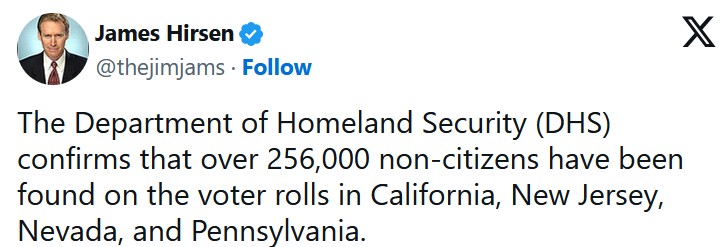
This is why they’re refusing to open their respective voters’ rolls to federal scrutiny and verification — not to hide their incompetence, but their sabotage of probably our most important institution: the vote.
Feel free to be as enraged now as I was back then.
Afterwards: The head of IT at Grand Union was fired couple of months after my meeting with the CFO. His replacement? The guy who had authorized the use of the new data-compression software. He was not only found to be truly incompetent (duh), but I was actually approached to head up the corporate IT department — an offer I declined, with thanks.
As for the relaunched program: the Long Island group became the most profitable of all Grand Union’s divisions, and sales grew every month thereafter, resulting in a full point of market share growth. Then the CEO retired, and his successor announced that the new loyalty program would not be allowed to roll out into the other areas (upstate New York, New Jersey, Connecticut and Vermont). More to the point, my advertising campaign was to be shut down and the company would revert to the old store flyer program.
I resigned immediately.
Grand Union went out of business three years later.