Ammoman (over on the right-hand sidebar) has this deal:
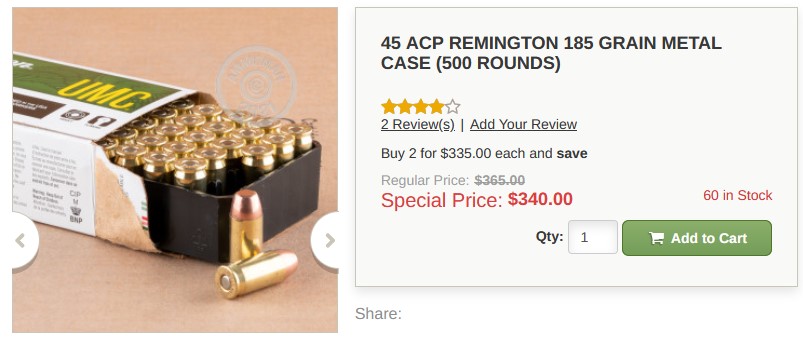
That’s 67c per round if you buy two cases. Get there quickly if you’re interested.
Ammoman (over on the right-hand sidebar) has this deal:
That’s 67c per round if you buy two cases. Get there quickly if you’re interested.
The chorus of Eye In The Sky.
BTW, I love the Alan Parsons Project, especially the earlier albums.
Saw this little piece via Insty, and had to laugh:
Worlds are colliding in Denver’s Capitol Hill neighborhood. Homeless encampments are popping up right outside million-dollar homes.
Michael Beckley is one of a growing number of homeowners who are taking matters into their own hands, trying to keep tents from appearing in the parkways in front of their streets. “It’s brutal, because it will effectively kill the grass. When the first tent showed up here, I fenced it off and said you f—— aren’t coming up here,” Beckley said.
Fences can now be seen roping off parkways throughout the neighborhood. The action is legal, according to the city, because homeowners are required to maintain and care for the parkways adjacent to their homes. Many homeowners are convinced the homeless encampments will lead to a spike in neighborhood crime, especially thefts in the neighborhood.
I don’t know Denver at all, but I’m willing to bet that the Capitol Hill neighborhood votes solidly Democrat/Socialist at every election. If this is true, then:
Update: Longtime Reader Tim M grew up in Denver, and agrees with my analysis.
Looks like it’s a Sonny & Cher kinda day, because (once again via Insty) I see the following:
President Joe Biden’s latest round of attacks on guns is helping to drive a historic sales surge that continues to leave store shelves bare of firearms and ammunition.
Industry officials said that June sales were the second-highest ever for the month, at about 1.3 million. Only June 2020 had a higher number for that month, at 2,177,586.
Anyone checked the availability of AR-15s recently? Orders still backed up out to infinity? Thought so.
And now that the 9mm/5.56mm ammo pipeline seems to be opening up, things are going ahead as planned.
Not as planned by Biden and the anti-gunners, of course, which is why they’re running around like headless chickens, trying to pass all sorts of stopgap anti-gun legislation.
Now if we can just get the increased flow of .45 ACP to lower the prices down from nosebleed levels, maybe I can get some 1911 practice going again. My Springfield thinks I must have left town or something…
Like most Africans (real ones born in Africa, not the phony Jesse Jackson kind), I have a fear and loathing of snakes. I’ve heard all the calls that they keep the rodent population down and all that, and if the slithery little bastards kept on doing just that, I’d be fine with them.
It is said to feel like two sharp nails being hammered into your skin – and we can reveal that deadly snake bites are rising dramatically in a trend that is worrying experts.
An Austrian man was the latest victim when he “felt a pinch in the genital area” while sitting on his toilet at home in Graz on Monday, according to a local police report.
Wait: Austrian? At first I read “Australian” (which would be nothing out of the ordinary) but was stopped by “Graz” (which isn’t in Australia). Sheesh, if the fucking things are in Austria, they could be anywhere. And they are.
Read the rest of the article, and I hope your breakfast has settled, because otherwise you’ll be heading off to the can to puke.
Just check before you do, though:
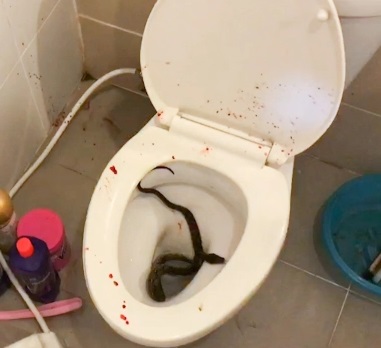
Brrrr… I fucking hate them.
Whenever there’s a chance that I’m about to walk anywhere remotely bush-y, I carry my little NAA Mini-Revolver, and it’s loaded with .22 Mag shotshells.
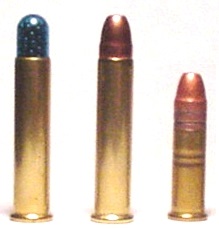 I once saw a video of a snake being shot with one of these, and it was excellent: in a split second, it went from being all hissy and strikey to totally limp — whereupon I bought about 500 rounds of the stuff.
Be careful out there.
I was wondering how long it would take for this kind of thing to happen:
A statue of Martin Luther King Jr. was vandalized with SS bolts and a swastika in Long Beach over the weekend. It is the second time in two years the statue, erected in 1986, has been targeted, after a plaque bearing one of his quotations was stolen in 2019.
What’s interesting is that it happened in oh-so liberal California (although it should be noted that Long Beach does not share the same socio-political profile as, say, San Francisco or West Hollywood).
Here’s the pic:
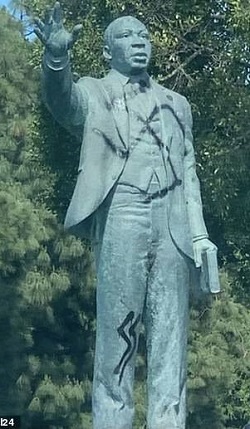
To all those assholes who think it’s okay to desecrate monuments to past heroes like Thomas Jefferson and George Washington while revering those like Martin Luther King, let me just say this: you started it.
I’m not excusing this kind of thing; but I do understand the rationale.