
Foreword
This work was inspired by a man who started off as a passing acquaintance, then a fellow-traveler, and then a great and lifelong friend who remained so even though our lives crossed but briefly and would eventually be separated by the oceans. How we lost touch, then regained touch, and discovered that our friendship had endured, is a story for the ages.
So this memoir is dedicated to him. And you’ll meet Max later, as the tale unfolds.
Chapter One: Singing In The Choir
I’ve always been able to sing, and sing well. It was a thing of complete wonder to my parents, both keen amateur singers themselves, and so I was constantly being called upon to sing to their friends and our family at various gatherings – an invitation I always firmly refused because I was painfully shy as a small boy. Also, I never bothered to learn the lyrics of any song completely, and could only sing snatches of things like Pat Boone’s Bernadine, April Love and similar ballads of the time, so any songs I’d sing would be of short duration indeed.
Then at age 11 I was shipped off to boarding school at St. John’s Preparatory School in Johannesburg, and as part of the entrance process my mother told the school’s interviewer – the College Second Master (Vice-Principal) that yes of course Kim would love to join the Prep School choir if accepted.
I passed the school’s entrance exam with ease, and when I arrived at the Prep was told to meet with the choirmaster, Mr. Robert Barsby in the Music Room. This room contained wooden benches and a full-sized Steinway concert grand piano, and the place was to be my home away from the dormitory for the duration of my time at St. John’s.
Mr. Barsby asked me to give him a song or two that I would be comfortable singing, and all I could think of was a hymn I’d learned at Sunday School, a couple of years before. He, of course, could play pretty much any piece of music, let alone There Is A Green Hill Far Away, so off I went, heart in my mouth and determined at least not to make a fool of myself.
Would I be good enough?
Halfway through the hymn – I think after the second verse – Mr. Barsby stopped playing, told me that choir practices were on Tuesday and Thursday evenings an hour before supper, took place in the same music room we were in, and would I mind being there for the next one?
At last I’d be able to sing, properly; and under Bob Barsby’s gentle tutelage over the next two years in the Prep, I became an accomplished chorister. There were two steps towards becoming proficient and getting a place in the Royal Schools Of Church Music (RSCM): the first was to become a “Senior Chorister”, the requirements being an ability to read sheet music and of course to demonstrate the ability to sing just about anything required – piece of cake. The next level, “Leading Chorister”, was a lot more difficult in that it required an ability to sing, note-perfect, an unknown piece with just the sheet music in front of one (known as “sight-reading”), as well as an ability to “lead” the choir so that the song would remain in tempo without a conductor.
One did not apply for such honors, of course: one had to be invited to perform the audition by the choirmaster himself. It was actually quite difficult to get the sought-after lapel badges for each level. Many boys were invited, but only a very few actually earned the privilege. In my time in the Prep School choir, there were a total of six Senior Choristers (out of about thirty boys over two years), and only three Leading Choristers. I was one, Greg Kastell another, and a boy named Andrew Gibb was the third. I’d known Andy since forever; we’d been classmates at primary school (Linksfield Primary, a “government” institution), but he’d left for St. John’s a couple of years prior to my move. Like me, “Gibby” was an accomplished singer, and unlike me an extraordinary musician. Our paths would cross again and again for the rest of our lives together, as you will see later.
Then my time in Prep School came to an end, and I went over to the College (high school). This may sound like a big journey, but the College began just a passageway on from the Prep, and in fact the two schools shared the Music Room as a kind of geographical no-man’s land.
The College had a different choirmaster, James Gordon, MMus (Cantab), who was a different teacher to Bob Barsby altogether. Himself an opera singer (not to say a brilliant church organist as well), “Jimmy” was an exacting taskmaster when it came to singing, and the standard of choral music reflected that discipline. The St. John’s College Choir was renowned in the same way as the Mormon Tabernacle Choir is regarded in the United States, often invited to perform on the national radio service (SABC). Also, whereas the Prep choir was all-soprano ensemble, the College choir encompassed the complete choral range, from soprano (treble) to alto, first- and second tenor, and first- and second bass.
Of course, as we boys hit adolescence, our voices changed (referred to colloquially as having one’s “balls drop”). For some, this was a catastrophic event, because for perhaps six months, the voices would fluctuate from angelic treble to an awful braying noise, and their place in the choir became uncertain. (A couple of boys actually had to leave the choir because their voices changed so radically that they could not fit in the choir’s sound at all, and they were banished to the “congregation”: a traumatic event, to be sure.)
Fortunately, my own voice changed so gradually that over three years I went from treble to alto to first tenor quite smoothly. (Eventually, after about twenty years, I would end up being a baritone.)
By far the biggest change, however, was in the music we performed: from simple ballads like Panis Angelicus, we were now called on to perform serious sacred music: colossal hymns backed by a 54-pipe organ during Sunday Mass, a cappella Plainsong (Gregorian) chants at Sunday Evensong (many in Latin), Handel’s Hallelujah Chorus (which was probably the easiest such piece we sang), and the like. And always, always we strove to achieve the incredibly-high standards set by Jimmy Gordon. He could listen to a section singing their part, then rap his conductor’s baton sharply on the music stand to make us stop, then point to one boy and say, “You’re singing flat in bar 35; please sing it for me,” and the unfortunate miscreant had to sing the part solo, over and over until he got it right. Worst of all, Jimmy was never wrong because he knew what each boy’s voice sounded like.
Of course, being a mischievous lout, I would sometimes sing a different harmony line just for the hell of it, and Jimmy would squint his eyes, make us sing it again, and then he’d scowl and point to me, saying, “Du Toit: what you are singing is not dissonant; but it is not what Bach wrote. Kindly confine yourself to what’s on the sheet.”
That discipline stayed with me all my life.
There was another side to this. We hardly ever sang popular Christmas carols, for instance, but instead performed little-known songs, some from as far back as the Middle Ages, because I think they were a lot more challenging than the “standards”. At one point we protested — I can’t remember whether it was Gibby or I who voiced our displeasure. Jimmy listened to us seriously, then nodded noncommittally and that, we thought was that. At the following choir practice he handed out sheets of the new music we were to learn to sing, and the melodies were instantly recognizable: Silent Night, O Come All Ye Faithful and so on.
Not one was in English. Instead, we got Stille Nacht (German), Adeste Fideles (Latin) and just to top it off, a totally-unfamiliar German carol Es Ist Ein Ros Entsprungen, in which we had to learn a new song and the language it was scored for.
Es ist ein Ros entsprungen,
aus einer Wurzel zart,
wie uns die Alten sungen,
von Jesse kam die Art.
Und hat ein Blümlein bracht
mitten im kalten Winter,
wohl zu der halben Nacht.
Jimmy had a sense of humor.
Another part of singing was more serious. In a choir there is no room for vibrato, because it’s impossible to reconcile all the different vibrato speeds across, say, thirty voices. So we were trained to suppress any kind of vibrato – which Jimmy referred to as “warbling”. Why was this serious? Because after a while, one’s vocal cords stiffen up with age, and by the late teens, vibrato becomes almost impossible. This non-vibrato style of singing, so necessary in choral singing, was to haunt me much later.
One other thing is worth mentioning at this point. We were so immersed in music that most of us choirboys developed “perfect pitch” – the ability to hear a note and immediately identify its position on the scale: C, G, E-flat, F-sharp, whatever, without needing to refer to the sheet music or needing a piano to play the note first. Add to this our constant discipline in keeping time, and once again most of us could not only keep in perfect tune while singing, we could sing in perfect time without needing a metronome. All Jimmy Gordon needed to tell us was “You’ll sing this piece at forty BPM” (beats per minute), and off we’d go. If we were wrong, he would sigh with exasperation and set the metronome to keep time, all while glaring at the Leading Choristers.
Our singing was not confined to the choir. In my final year in the Prep, the school had put on a production of Ivor Novello’s Huckleberry Finn, the choir of course comprising most of the cast, and I was in the chorus – not a lead character, to my initial chagrin but later profound gratitude – standing next to Gibby on the one side and my boyhood friend Mark Pennels on the other. (Pennels would deserve an entire chapter all to himself if I were writing a full autobiography, but in these memoirs he was just a constant and treasured singing companion.)
It was my first real exposure to the musical stage, and it was to prove a pivotal point in my musical life within a few years. It was great fun, but I found the ensemble nature of a stage production exhausting.
College, when I arrived there, was a different experience altogether. Every other year the school would put on a musical play, usually one of Gilbert & Sullivan’s operettas, in which we as the choir were enrolled without any choice involved – most activities in the College were compulsory – and so we endured productions of Iolanthe, H.M.S. Pinafore and Yeoman Of The Guard over the next five or so years. When I say “endured” the musical stage productions, it was largely because of two factors. The first was my inherent shyness, which was gradually starting to improve, and the second was that because I was severely short-sighted, my spectacles were a constant and necessary companion. But you can’t wear glasses on stage, of course, so I’d have to take them off and would set off blundering around on stage, missing marks, bumping into others, and perforce introducing a comedic aspect to the production where none was called for. (On one notable occasion, I went through an entire scene in Iolanthe – dressed as a fairy – wearing my forgotten glasses, provoking titters from the audience and a blasting from the director afterwards.) The teachers always suspected that I was doing this just to screw around, but at this point in my life I can truthfully say that in this, at least, I was quite innocent.
Singing in a choir at St. John’s didn’t end upon graduation, oh no; that would have been too easy. The alumni (called “Old Boys”) had a choir too, and so concerts, church performances and even stage musicals by the Old Johannian Choir were to follow. Participation in this, of course, was no longer compulsory, and I found myself drifting away from this over time, because I no longer wanted to sing in a choir or on the musical stage.
I wanted to be a rock musician.
– 0 –
Chapter Two: Getting The Gig
At the age of sixteen, long after the age when most people start playing a musical instrument, I decided to learn how to play guitar.
I don’t honestly know why I decided this; perhaps I’d been at a party or picnic when someone played a guitar, or maybe it was hanging out with Gibby, who played both piano and guitar, I don’t recall. I’d had piano lessons for two years in the Prep, which had helped my musical theory proficiency, but I’d been put off by the drudgery of practice necessary to become keyboard-proficient – a dislike that was to curse me for the rest of my musical life – and plugging away at the ascending- and descending scales became absolute torture. When I got to the College, I told my parents that I wasn’t going to continue piano lessons, to their great disappointment.
But guitar was a different story. My fumbling and painful learning on the fretboard became less of a chore, because unlike scales, the mastery of chords meant the ability to actually play a tune. To his everlasting credit, Gibby lent me his guitar, a battered old Hofner nylon-stringed thing, and it was on this that I tortured my dormitory companions for the next year or so, painstakingly trying to place my fingers on the fretboard as demonstrated in the “Teach Yourself Guitar” pages of chord charts that were published in some magazine or other each week. As I recall, the very first song I learned was Creedence Clearwater’s Bad Moon Rising, followed soon thereafter by Proud Mary, and then more and more followed as I got a little (but not much) better; although I was able to play bar chords after only a couple months and, it should be said, some coaching from Gibby.
One of the guys in my Physics class (Richard Hammond-Tooke) had a book of songs with not only the chords but the lyrics handwritten therein, and he lent it to me to copy. To my horror, some of the songs (e.g. Blood Sweat & Tears’s Spinning Wheel) used chords that I hadn’t seen anywhere on the rudimentary chord charts (E-flat minor 7th, WTF?), which set off a mad scramble to find them printed somewhere. Even worse was when I tried to use actual published sheet music; while I could of course read the musical notation with as much ease as reading English (thank you Messrs. Barsby and Gordon!), translating each note into its position on the guitar’s fretboard was another thing altogether; but I persevered because I wanted to become a guitar player, damn it.
What amazed me was that in the course of learning all the fifty-odd songs in Hammond-Tooke’s songbook, I’d learned to play the Beatles’ mournful ballad Eleanor Rigby. Well, of course I wasn’t going to play that syrupy nonsense, so I turned it into a bluesy/jazzy arrangement instead, complete with rasping vocals à la David Clayton-Thomas of BS&T. When I played it to Richard, he listened in stunned silence, and at the end blurted out, “You should do this professionally!”
On such small seeds do plants often grow.
Next came GROBS. GROBS was a show that the pre-Matric (11th grade) class would put on each year, with comedy skits, musical numbers, magic tricks, poetry reading and other such stuff on the playlist. What set it aside from all the other activities was that is was put together solely by the boys, and not by the teachers. It was performed only for the school – the teachers were not going to let us loose on the public, and especially on parents – and it would take place on a Saturday night in the school hall. (Remember, we were mostly boarders at St. John’s, so a weekend night in school was no big deal.)
In great excitement, Gibby and I decided to form a band to play a couple of songs, me on guitar and he on bass. Of course, I didn’t have an electric guitar or amplifier, and while he had a Hofner “Beatle” bass, he likewise had no amplifier, but cobbled together something from the school’s stage PA system. Then we got a couple of other guys: Hamish Brebnor had a set of drums, and Paul Garwood had an acoustic guitar. So bass, two guitars and drums – if it was good enough for the Beatles, right? We rehearsed for a week or two beforehand, and then Garwood pulled out for no reason, two days before the show.
Panic!
Fortunately, two other guys stepped forward: Chris Chomse and Alistair Louw, both of whom had electric guitars and amps, offered to join. Both were already members of bands – garage bands, but hey – and they would bring not only their experience but equipment! to the gig. Problem solved.
However, whatever songs we’d originally planned to play were tossed out as being stupid, and we ended up playing The Who’s version of Summertime Blues (with me on solo vocals, doing my best Roger Daltrey impersonation) and the Rolling Stones’ Paint it Black, Alistair doing his impersonation of Mick Jagger. So I had to play lead guitar in the latter song, and here was my first lesson in rock music: I was okay playing chords on guitar, but lead guitar? Total shit.
Nevertheless, the show had to go on, so I sweated it out, practicing as much as I could before the fateful night. It didn’t help that my after-school hours activities were consumed by hockey practices and a couple of matches against other schools as well as choir practice, but came the night, came the player and I fumbled my way through the Stones classic with nary a misplayed note. (I didn’t, and still don’t know the lyrics for Summertime Blues but I just sang any old thing in an incomprehensible fake Wolverhampton accent – something I would do again and again for the next fifteen years.)
To my astonishment, the gig was a complete success: instead of being insulted and cat-called, our set was met with loud and sustained applause. The only negative came when we were called out for an encore, and had to refuse because we only knew two songs. Much booing and whistling followed.
Lesson: always have more songs to play than the occasion demands.
But that loud applause was another little seed.
I should point out that my childhood shyness had almost completely disappeared by this stage in my life, for two reasons. Firstly, I’d grown up physically and thanks to the compulsory sport regime, I was of fairly impressive stature. Secondly, adolescence had hit me, and along with only a minor brush with teenage acne had also come a rather impressive way with the girls. (I’m fairly sure that a series of casual girlfriends, plus my loss of virginity at only a couple weeks after my sixteenth birthday were largely responsible.)
My nickname was “Poke”, bestowed upon me by my girlfriend of the time and quickly picked up by my leering circle of friends, the bastards. Even my housemaster referred to this flaw in my character as “toujours chercher la femme”, which says it all. (I was faintly surprised that the old bastard didn’t say it in Latin.)
But back to the music. I left high school and started my first year at university, which ended up being a total failure. From a star student at St. John’s (a First, along with a couple other academic accolades), I turned into a total failure, because nobody had thought to warn me that the amount of work required for a First at high school was the equivalent of half the amount of study required per course at university. So my first year at the University of the Witwatersrand was a complete disaster. (It hadn’t helped that almost an entire semester was spent in court, having been arrested for participating in an anti-apartheid demonstration on campus. But to be honest, the writing had been on the wall ever since the half-year exams, which I’d likewise failed, unanimously.)
Musically, however, it was another story. I’d enrolled in the Wits Dramatic Society and performed in the chorus of Oklahoma!, but it really bugged me that the months and months of rehearsals had ended up with only a week’s worth of performances.
Then in the second year after high school matriculation, I was invited to join the PG Players, an amateur musical group from the Johannesburg suburb of Edenvale. The invitation came from my old school friend and choir-mate Mark Pennels, who’d met Peter Griffiths (the “PG”) and recommended me to him. I didn’t really want to do it, but Mark prevailed on me with the plea that they were desperately short of men who could actually sing. So I joined the group and set about rehearsing for the performance of Ralph Trewhela’s El Dorado, a story set in Gold Rush Johannesburg of the late 1890s. This time, though, I wasn’t in the chorus but part of a comedy duo, playing the part of a hobo, and singing a duet with Danny O’Connor.
The leading man was a tenor named Mike du Preez, who (I later discovered) was actually a well-known pianist and band leader who’d appeared on TV shows and was much in demand on the cocktail- and cabaret circuit.
Towards the end of the show’s run, Mike came up to me and said, “Mark Pennels tells me you can play bass guitar. Well, I need a bassist for a Christmas gig I’ve got in Margate” – a seaside town on the South Coast of Natal – “…so are you interested?”
Now I need to be clear on this point. Gibby had gone off to do his military service (ending up as an armored-car driver), and had asked me to “look after” his bass guitar – that old Beatle violin bass, and I used to sit and pick at it idly while reading a book; making a sound but not actually playing anything. Mark had seen me doing this during his several visits to my house, hence the recommendation to Mike.
Now I could have ‘fessed up and told the truth: that I was an absolute novice, nay worse than that, and had no idea what was involved.
But I didn’t. Instead, I said: “Sure. What dates are we talking about?”
So I’d landed my first proper gig, not in some garage band or anything like that. No; I was going to be playing professionally with a renowned band leader and (I learned) a very experienced drummer, in a trio. And anyone who knows about this stuff will tell you that a trio is one of the most difficult gigs to play, because there’s absolutely no place to hide. Each part has to perform perfectly, and all have to mesh together withal.
Worse still, I was completely unfamiliar with — and didn’t like — the material, which was to be largely jazz standards of the Cole Porter-Dick Rogers-Hoagy Carmichael-George Gershwin genre.
And I didn’t even have a bass amplifier.
Of course, Mike insisted on a quick rehearsal a week before we left for Margate, so I called on an old friend from university who knew about such things, and asked him if he could make me an amp in a week. As luck would have it, John actually had one lying around in his workshop so I bought it from him on trust, promising to pay it out of my salary from the gig. (I was lying in my teeth, of course, but times were tough and I figured I could always find a hundred bucks somewhere.)
Anyway, I arrived at Mike’s house like Louis XVII walking up the steps to the guillotine. The amp, however, was impressive: a “head” perched atop a truly massive speaker cabinet – four 12-inch speakers, even, so Mike must have thought I was a pro. How wrong he was.
Actually, it was even worse than I’d dreaded. There’s no place to hide in a trio, and there was even less place to hide when it was just the pianist and me. I couldn’t play a single song, not even the easiest of ditties. After about twenty minutes Mike threw up his hands and fired me on the spot. So I slunk off, tail between my legs, but with what I had to acknowledge was a profound sense of relief.
Then two days later Mike called me up. “Well, I can’t find another bassist at this short notice, so we’ll just have to make it work somehow.”
I gulped, and said “Thanks.” Then something clicked in my brain and I asked. “Do you perhaps have any sheet music for the stuff we’re going to play?”
“Not much, maybe thirty or so songs. Why?”
“Well, I might not be able to play the music, but I can read it,” and I told him how I’d taught myself to play guitar by doing just that, and of my choral background in the St. John’s College Choir.
There was a stunned silence on the line, and then Mike said, “Do you think you can learn thirty songs before we leave for Margate in four days’ time?”
“Absolutely.” (Once again, lying like a Clinton at a press conference.)
But in the end I did, simply by going without sleep for four days and playing, as the story goes, until I had blood coming out from under my fingernails. I had done some difficult things in my life so far, but nothing could compare to this.
How I made it through the four hundred miles down to Margate without falling asleep at the wheel is a miracle for the ages.
And the next four weeks were to change my life.
– 0 –
Chapter Three: Learning to Play
To say that I was woefully unprepared for life after high school would be guilty of the gravest understatement. Looking back, I’d been horrendously cossetted against the Shakespearean arrows by protective parents, then by the closed environment of an exclusive boys’ boarding school. And I’d rebelled strongly and constantly against that protection, always being self-centered and cocksure of my ability to get through life in my own way and under my own terms.
That attitude would come to a screeching halt in 1972, when I was arrested and put on trial for my opposition to apartheid – opposition that was based on nothing but peer approval, really, because at age 17 (yes, I turned 18 long after my final first-year exams at Wits) I knew sweet F.A. about apartheid other than it was Bad, man. And my 100% academic failure – yup, four out of four courses – was like a bucket of cold water dropped on my head.
Year Two at Wits, so to speak, wasn’t any better. I lazed my way through the year, playing bridge in the student cafeteria instead of attending lectures, and all the time listening to the music (Cat Stevens, Jefferson Airplane, T. Rex, you name that early 70s music, they played it) that came through the tinny speakers of Wits Radio (not really radio, because it was piped, not broadcast).
Rock music had formed the background to my life in College, too, because it was the time of the Beatles, the Moody Blues, the Hollies, Traffic, the Doors, Cream and In-A-Gadda-Da-Vida, baby. But I’d listened to all this stuff purely as an audience, not knowing how it was constructed.
Which, come to think of it, was strange. When listening to classical music, of course, I could pick apart all the different instruments, identifying the different tones and modalities of clarinet vs. bassoon vs. French horn vs. the cor Anglais, violins vs. violas vs. cello, and so on – what is known academically as “close listening”. I’d had all the training in the world for that, thanks to Messrs. Barsby and Gordon’s Musical Appreciation courses and of course the choir.
But I’d never done it with modern music. Oh sure, I could get moved by a lead solo from Eric Clapton or Jimi Hendrix, and of course I could sing any part of a Crosby, Stills & Nash harmony and rejoice in the artistry. But really, I was just a spectator to the game instead of a participant.
So when I arrived in Margate (having freshly failed yet another year’s studies), I was secure in the knowledge that I’d mastered all three dozen-odd songs Mike Du Preez had given me. I expected that the next four weeks were going to be a breeze: play in the band at night, lie by the pool by day, and get paid for it. Living the dream, baby.
Except that I didn’t know how to play the bass guitar. Oh sure, I could play the notes just fine; but what I didn’t know was that in modern music, the bassist is tied to the drummer – the two are jointly called the rhythm unit, after all – and most importantly, the bass guitar is tied to the drummer’s bass pedal. So it wasn’t just getting the notes right in whatever key we were playing; I soon learned that whenever that bass drum was struck, there’d better be a bass guitar note striking at the same time, or else the band’s sound was as flat as a pancake. And of course the number of times that happens depends on the key signature, or timing of the piece or even of the bar (because the tempo often changes during the song, as well as the key).
Of course, I only learned of this new thing after we’d arrived, set up our gear and launched into a little practice session. Also of course, that little practice session turned into an all-day practice session so that the Idiot Ignorant Bassist could learn the differences in beats between (deep breath) regular ballads (2/4, 3/4, 4/4, 6/8, 12/8), up-tempo (4/4), waltzes (3/4), (polka (2/4), all the Latin tempos (cha-cha, samba, rhumba, tango etc.) and of course which one to play for the various ballroom dances such as the foxtrot, quick-step, Charleston, West Coast Swing, Dixieland jazz… I think you get the picture. Worse still, a supposedly-simple song like When The Saints Go Marching In would start off in 2/4, shift to 4/4 for the solo and then revert to 2/4 for the rest of the song – unless the pianist/band leader decided that the song needed another solo, of course – in which case Our Newbie Bassist would get into a sweat trying to play catch-up with the bass pedal, and usually failing.
What a nightmare. And we had not yet played our first night in the dining room.
To my everlasting relief, the only guests in the dining room that first night were not there for the dancing, only the dining, so they were out of the room by 9pm. And so two members of the Mike Du Preez Trio used the remaining three hours trying to teach their Accidental Bassist how to play his instrument. Then the whole thing began again the next morning at 10am till 1pm, break for lunch till 2, then again practice until 5pm, break to get showered and dressed in uniform (red-and-white striped or white and black-striped shirts on alternate nights, black trousers and -dress shoes – my old school shoes for added humiliation, because I didn’t have anything else), dinner at 7.30pm and then back on stage at 8 for the next four hours of torture.
And the same thing happened the next day and night, and the next day and night, and the next… five days in all till midnight on Sunday, then practice again on Monday, but! we had Monday nights off! So Mike gave us the night off from practice, too, the first since our arrival.
By the end of the third night the Mike du Preez Trio’s members were heartily sick of each other – okay, the other two were just heartily sick of me – so at this point I guess that I should spend just a little time talking about them.
Mike du Preez was justly well-regarded on the gig circuit (except by me apparently), and his knowledge of 1930s, 40s and 50s “standards” was I think unparalleled. And when I say “knowledge”, I mean he knew the music and the lyrics to all those songs (maybe about three hundred?) and could play them, faultlessly and without any sheet music on the piano, organ, guitar and (to my utter humiliation) bass guitar. He was endlessly patient with me, but not in a good-tempered manner. This meant that he’d yell at me whenever I made a mistake or forgot something we’d practiced earlier – which only happened about every half-minute or so – until my nerves ran ragged. On one such occasion he must have seen that I was about to chuck it all in and leave, which made him even angrier. “You cannot fucking quit, sonny-boy!” he raged. “You’re supposed to be a professional musician and by God you’re going to act like one even if you’re nowhere close to being one!” Pause. “Now let’s do Desifinado again – yeah, I know we just did it yesterday, but you’ve probably forgotten everything about it.” (Which of course I had.)
Side note: I had discovered that if I stuck to playing the bass guitar softly with the treble turned almost completely off at both the guitar and the amp, the sound was quite muddy and indistinct: a bass tone but not necessarily noticeable as being out of tune. It was a trick I was to use many, many times in the future.
In my perpetual state of confusion, the only way I could even remember what key the songs were in was by watching Mike’s left-hand pinkie on the piano. If that finger played E-flat for the song’s opening, the key most likely was E-flat, and any key changes would be indicated by his playing a different note outside the E-flat scale. So I had to keep looking at Mike’s left hand on the keyboard and hunting for that note’s place on the fretboard while simultaneously trying to watch the drummer’s bass pedal to tell me when to play (a wrong note, usually).
The drummer was an old pal of Mike’s, Dick by name and a dick by nature. Outwardly a jovial sort, he was in fact mean-spirited and cruel, not just to me but to everyone, and with my residual private-school good manners, I was often appalled by his blatant rudeness. While Mike had his own room in the hotel, the hotel management had (in a moment of what I can only call cosmic bloody-mindedness) booked a tiny one-bedroom cottage up the road for Dick and me to share: him in the bedroom and me on a small uncomfortable cot in the living room. (Oh how nice, but as I’d slept on a horsehair mattress for two years in the Prep, this didn’t bother me too much.) So it was bad enough that I had to put up with his cutting remarks during the day’s practice and evening performances: I had to endure them in the lousy cottage as well, sleep being the only refuge. Apparently, Dick had a parallel career as a stand-up comedian, but I’d never heard of him. I learned that he specialized in a broad, Jerry-Lewis type of comedy, which I’d always hated anyway, and still do. (When I was a small boy, Lewis had once toured South Africa and my parents had taken me to see him in concert. Even as a child, I thought he was the unfunniest man I’d ever seen. So you can imagine my reaction to Dick’s description of his own act.) There were several times I wanted to punch him in the mouth, especially on one occasion when he said something unpardonably nasty about our employer, Rick the hotel manager.
I was to get on famously with Rick, a tall, slender dark-haired man in his, I guess, mid-thirties, a man who had (I was to discover) endless patience with his staff and a sense of humor to match. Having no one else to speak to, I bumped into him that Monday off in Reception, my ears still burning and my pride in tatters after yet another fearsome practice session. Clearly, he saw my distress, took me into his office, sat me down and started chatting with me, asking about my background and so on. He then told me the most appalling lie: he’d heard us practicing and was truly impressed by our dedication, and especially by my contribution (!) to the band’s sound. Apparently, after firing me at that first disastrous audition back in Johannesburg, Mike had called Rick and told him he would be doing the gig solo – but Rick wasn’t having any of it. “I booked a trio, not a pianist” he told me he’d said to Mike.
Which is why Mike had called me back for the gig, then.
Anyway, Rick said, “Why don’t you relax tonight? You’ve got the night off, so go down to the Grove and listen to the band, have some drinks and just sign for everything . I’ll tell the barman to comp you for the length of your stay here – but just for you, not for anyone else, okay?”
Margate was the largest of dozens of resort towns strung out along Natal Province’s South Coast, and was justly famous for its beach:

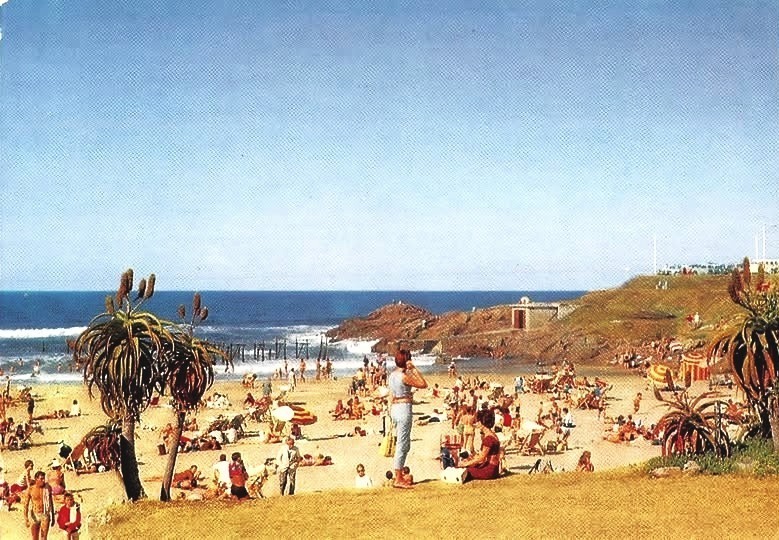
…which changed quite a bit during the holiday season.
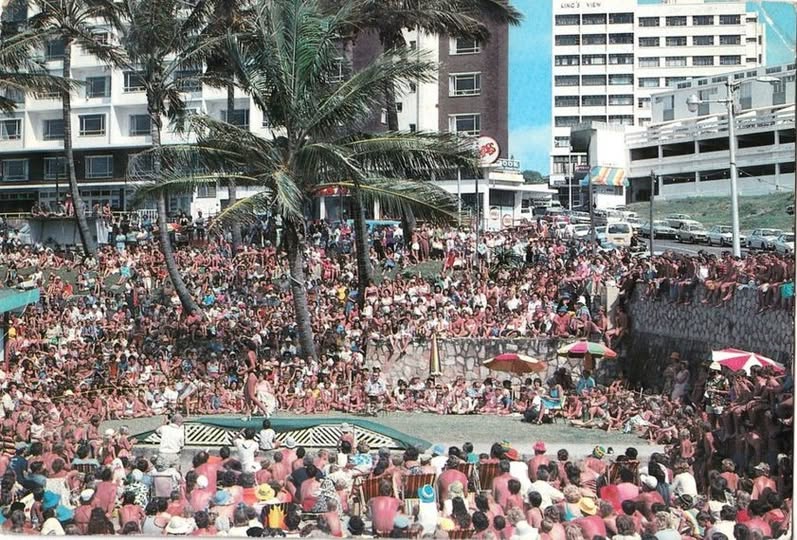
The Margate Hotel’s Palm Grove Club deserves an entire book, let alone a few words in a work like this. Suffice it to say that it was probably the most famous of all the resort clubs on the Natal South Coast, having opened (I think) shortly after WWII, and just about every name band and orchestra in South Africa had played there at least once or twice. If you’d played the Grove, you’d pretty much made it.
I’d never heard of the place.
It was by then a vast, rather ugly structure (see below), but very much the place to go to when it was open – November through mid-January, and maybe over the June-July period, and only then.
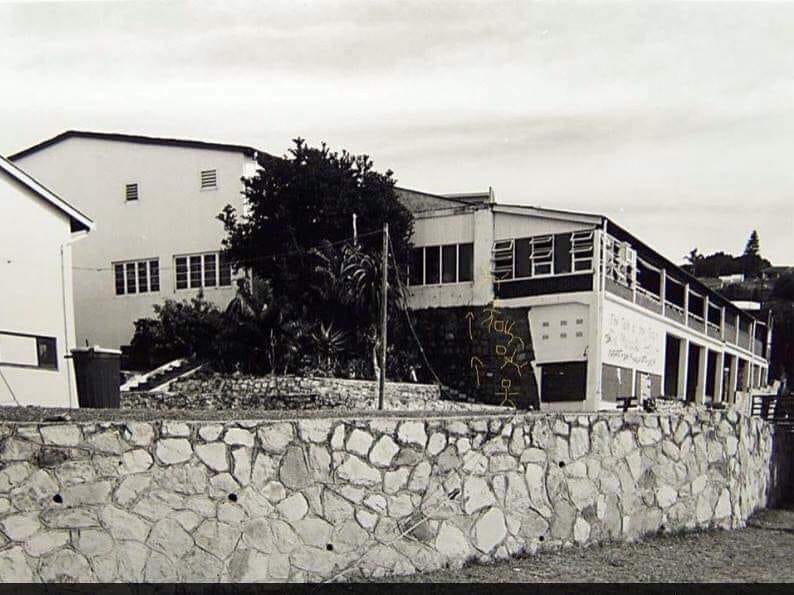
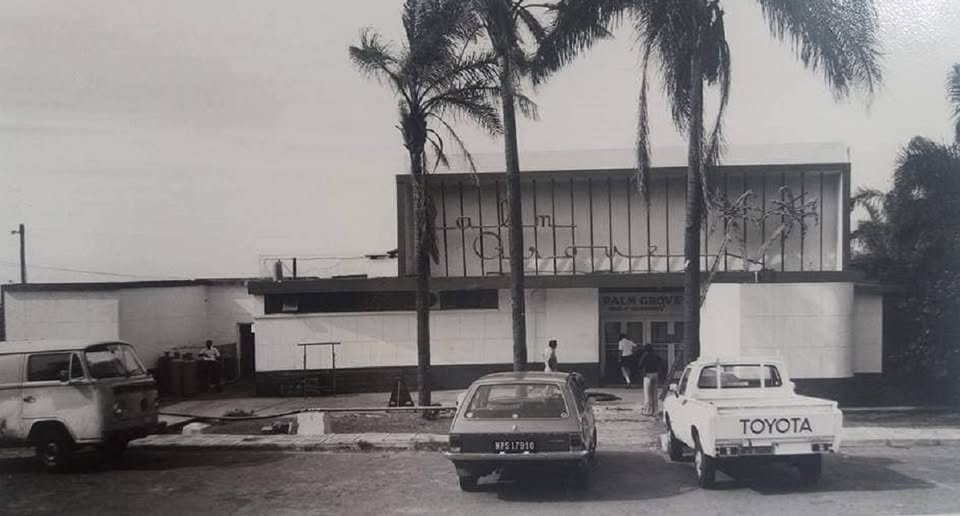
(pics found SOTI)
So as instructed, I went down to the Grove, to be greeted by two young and very pregnant girls at the entrance. “The cover is one Rand,” the one said (about 25 cents in today’s US$, or the cost of a bottle of beer back then).
I didn’t have any money. I mean, I really Had. No. Money. I’d been surviving on hotel food and water since I’d got there, having used the last of my meager funds to pay for the gas needed for the four-hundred-mile trip down from Johannesburg. (I must have lost 10lbs in weight during that first week alone.)
So I shrugged miserably and turned away, when the other girl said, “Wait; aren’t you in the band in the hotel dining room? You are? Well then there’s no cover. Go on in.”
So I walked into the Grove that Monday night, and it was at that point that my life changed forever.
– 0 –
Chapter Four: How A Band Works
In case it hasn’t been clear in this narrative so far: I had a dream and an ambition to play rock music in a band, but not a single clue how to make that happen. To call me “clueless” would imply that I had even the faintest idea of where I could find a clue, or any inkling of a clue’s existence.
But when I discovered Shalima, the Palm Grove’s resident band that season, I started to get the picture.
Let me first, however, list the dramatis personae who comprised Shalima, because almost all of them would be important to me (pics courtesy of Max):
Pete The Drummer
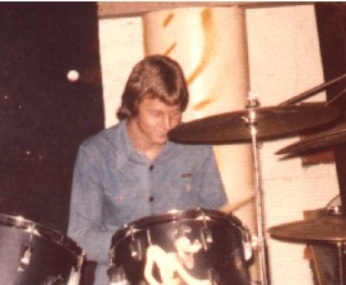
A rock-solid drummer who kept perfect tempo, and put down a lovely beat.
Richard The Bassist
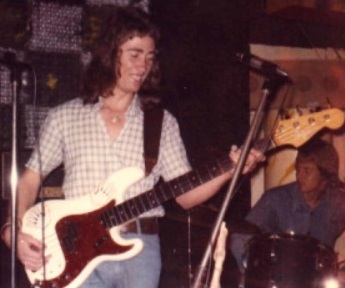
Richard was a wonderful bass player. Good grief, looking at the ease with which he played his Fender Precision bass, sometimes so inebriated that he could barely stand (to be explained later), I nearly quit on the spot.
Jeff The Lead Guitarist
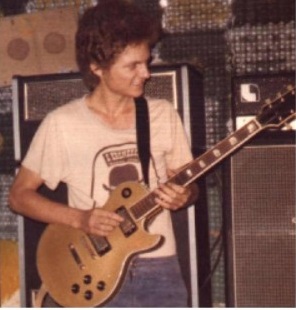
Jeff was just as good on lead guitar. It seemed like there was no guitar part he couldn’t play, note-perfect. If he had a fault, Jeff was shy and self-effacing, so much so that I think he would occasionally hold back a little with his lead solos – but when he did cut loose, it was an awesome experience.
Tommy Sean The Vocalist
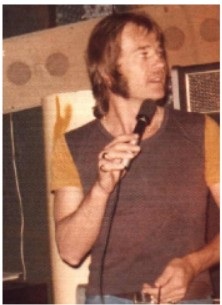
Tommy Sean (whose surname I include because it’ll be important later) had a powerful and very distinctive voice, but which he seemed to lose as the evening went on. Clearly, he hadn’t been vocally trained at all, because he’d wear his voice out fairly quickly. The immense quantities of beer he’d consume during the evening couldn’t have helped much, either.
Rory (“Max”) on keyboards
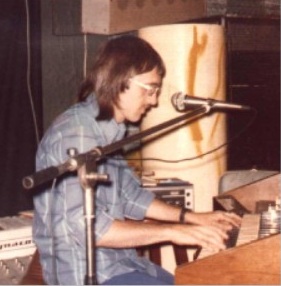
Finally, there was Max. If ever I’m asked, as I have often been, who most influenced my musical career, it would be Max — not so much for his considerable musical ability, but through the way he managed the band and the different personalities to keep them on track. Max had started out as Shalima’s bass player, but when Richard arrived on the scene he moved to keyboards.
Sheila (the pregnant book-reader, and Max’s wife) featured occasionally on keyboards and vocals.
Now, their music; and man, this bunch of scruffy Rhodesians could play. Of course, as with all club bands in South Africa at the time, their repertoire consisted of covers of hit records, and only hit records. They didn’t play any of their own stuff (if indeed they had any), but what struck me the most was that every song sounded precisely like the original artist’s recording, with only the occasional variance being of course the vocal sound.
Incidentally, one of the first songs I heard them play was the 3 Degrees hit When Will I see You Again? and the (very) pregnant Sheila had a voice of lovely clarity, absolutely the equivalent of the song’s original lead singer. That was impressive by itself; but what stunned me was that Shalima’s backing harmony vocals mimicked the soprano voices of the 3 Degrees perfectly.
I told you earlier that I had no idea, and in this case I had no idea that male singers could sing female voices, in a rock context. Of course I knew about falsetto – I could sing pretty much any female vocal part myself that way – but I’d never known it could be used in performance, and especially in rock music. Like I said: no clue.
Anyway, the band played the first set, each song impressing me more than the previous one, and then they took a break, going over to sit at a table clearly reserved for their use on the side of the dance floor. And then they each proceeded to drink three beers during the next fifteen minutes.
Back on stage, they continued on with the performance, and more drinks during the breaks, and so on.
I wanted to talk to them, but I felt somewhat intimidated because, let’s be honest, I wasn’t musician enough to walk on stage with them let alone play what they did. Finally, though, as the evening started to wind down at about midnight and I’d had a couple beers myself, I plucked up some courage and walked over to Richard, having prepared a question about his amp and guitar as a conversation-starter.
He was polite but a little diffident, but when he asked me what had brought me to Margate and I told him, his attitude changed completely. “You’re in Mike du Preez’s band up in the hotel? Wow!” Clearly, I wasn’t just some fan-boy or drunkard off the street; I was a musician. “Come and meet the rest of the guys,” he said, and pulled me over to the band’s table.
And thus started a relationship which was to last years, and which helped me get into professional rock music more than just about anything else.
I learned so much just from watching these guys. From a playing perspective, they were consummate professionals: never late to get on stage, always playing the music most guaranteed to fill the dance floor, no messing around between songs, in fact they had none of the bad habits that bedevil “garage” bands, and I was extremely impressed.
Also, Max was the band’s leader and driving force: no arguments on stage, no nonsense of any kind: his decisions were policy, and the band had to fit in. As a keyboards player, he was more than competent, but considering that keyboards were essentially his second instrument, it should be known that he never held the band back, musically speaking. (That’s not always the case, by the way, as you will see later in this narrative.) Unsurprisingly, he ended up being a piano teacher many years later.
Over the next few weeks, I learned from these guys how to play in a band — and more importantly, how a band worked: not just the playing, but the management and attitudes.
In the first place, I was only nineteen, but all the others were in their thirties (except Jeff, who was a little younger), and they’d already been playing either professionally or semi-pro for over a decade. I had no idea that one could do this. I mean, I knew about other famous South African bands who’d been around for a while (the Staccatos, the Rising Sons, the Blue Jeans, Four Jacks and a Jill… the list was long); but while they’d been around for years, they’d all had top 10 records on the South African hit parade, which to me justified their longevity. Yet here was Shalima, of whom I knew nothing, and they’d been playing music as a full-time job in club after club, year after year.
You could have a career in rock music without having a record contract or hit record.
This made all the difference to me, because I’d always thought that a career in rock music required a hit record — and I also knew that the number of hit records (and the bands that played them) were only the top 2% of the bands. (As with all things, whether sports, music or any activity, only a very few end up being truly successful.)
So you didn’t have to be a rock star to make a living. You only had to be as good as, well, Shalima. And all you had to do was get good enough to play on the club circuit. Once again, as a teenager I’d been woefully ignorant of the club scene — thank you, boarding school — but listening to the Shalima guys talk, I realized that there were lots of opportunities around, far more than I’d ever imagined.
Then, a brief splash of cold water.
I mentioned to the others in the Trio how much I liked Shalima, how impressed I was with their musicianship, why I’d never heard of them before, and why they hadn’t played in Johannesburg. Dick the dick scoffed. “They’re what I’d call a good gig band,” he said. “Maybe high school dances, weddings, that kind of thing. But in a Joburg club? No way.” And to my amazement, Mike du Preez nodded in agreement.
I didn’t believe them. So the next time I was down in the Grove, I asked Max why they hadn’t played in Johannesburg. “We’re not good enough to play Joburg,” he said bluntly.
Bloody hell. Clearly, there was more work to be done if I was going to make a go of being a professional rock musician.
At this point, some two weeks after I’d started playing in the Trio, I started to get better on the bass. No longer did I have to play “find the note” or search my memory for what song it was; it all started to become a little easier, I stopped approaching each night with something akin to dread, and I actually started to enjoy myself. Paradoxically, as I relaxed the whole thing came more easily.
But that “not good enough to play in Johannesburg” warning had stuck, so I started to practice, really practice on the old Hofner Beatle bass. One day I decided to teach myself how to play what’s known as a “walking” bass line, whereby the notes are played four to a bar, but “walking” up and down the scale. (Ah, so this was why one had to practice scales: now it all made sense.) It took me more than a few days, because of course you have to learn the scales for each of the keys in the key signature (A, A-flat, A-sharp, B, B-flat etc. all the way up to G. And then of course the minor keys thereof.) But I stuck to it, concentrating especially on the more common keys the Trio was playing, and eventually I could play the runs with some confidence. Then I taught myself the classic rock ‘n roll bass riffs — the Chuck Berry / Albert King / Bo Diddley standards — and with my newfound fluency, they came quite easily.
Then, kismet. One of the songs the Trio played was the old Art Blakey song Moanin’. (I invite y’all to listen to it now, as background for this part of the story.) I’d struggled mightily with this one in the beginning, because Jazz. But once I figured out the scales and walking thing, it became relatively easy to play. So one night I asked Mike, ever so casually, “How about Moanin’?” He nodded, and played the opening riff — then stared at me open-mouthed as I walked my way around the complex melody. Even Dick was impressed when I managed to scratch out a rudimentary bass solo — the first I’d ever played. For the first time since we’d opened, the Trio really hit a groove.
Unfortunately, this meant that Mike started to play ever-more difficult jazz standards, but to my amazement they weren’t all that difficult. I’d figured it out. That’s not to say I was any good at it, of course; but I was well on the way to becoming somewhat competent.
Musical interlude: One day I was sitting by myself at a cafe somewhere in “downtown” Margate (there was one main drag) drinking a cup of coffee when I happened to glance out the window and saw a familiar car being parked right next to the cafe. I knew the car, a Mini, because it belonged to my old schoolfriend and GROBS bandmate Gibby. So of course I raced outside, grabbed him and pulled him in for a cuppa. His family owned a seaside cottage in a little town south of Margate, and he had come up to do some grocery shopping, I think. Anyway, we spent the rest of the day together, and then I remembered that Sunday night at the Grove featured “talent” competitions — dancing on Sundays being streng verboten in ultra-Christian South Africa back then — and so I dragged Gibby off to participate. I don’t think either of us cared about the competition, though: it was just a chance to play on stage together again.
Anyway, I introduced him to the Shalima guys, but Max didn’t want to let us enter the competition — “Kim, you’re a pro and pros aren’t allowed” — but I prevailed upon him by saying that I didn’t want to compete; I just wanted to back Gibby and play on stage with him. So Max relented, and we played, I think, Santana’s Evil Ways with Gibby improvising the whole thing on Max’s Hammond organ, and doing an excellent job of it, too.
As it happened, he didn’t win the competition; it was won by a tiny, pint-sized girl named Ingrid (“Ingi”) who played a thunderous, virtuoso number on Pete’s drum kit, accompanied by the other Shalima guys. (We’ll hear more of Ingi later.)
Then one Saturday afternoon the Trio was playing an “extra” set in the dining room — I think it was a wedding reception, booked earlier in the year — when the good stuff happened.
The Shalima guys had never heard the Trio play because our bands’ set times always coincided. On this occasion, however, they had the afternoon off, they heard the music coming from the dining room and set out to investigate.
I’ve mentioned that our “stage” was really just an area between the small dance floor and kitchen entrance, separated from the latter by an indoor lattice covered with plastic ivy. So it was behind this screen where Max, Tommy Sean and Richard hid, to listen to us play.
As it happened, Mike had just dropped a piece of sheet music in front of me and asked, ever so casually, “Think you can busk your way through this?” (If memory serves, I think it was a pared-down version of Deep Purple.) So seeing that it was a really slow ballad, I just nodded and made sure that I had the key established and off we went. About halfway through the song I became aware of some half-whispered comments coming from behind the screen, and realized that the Shalima guys were there. Of course, this made me sweat, but somehow I made it through the piece.
Then Mike winked at me, and launched into the intro to Moanin’. (He has a special place in my heart for that little act of kindness.)
As it happened, that was the last song of the set, so I put the bass down and went to chat to my friends. The first to speak was Tommy.
“You can read music?” I nodded. Then came Richard.
“Kim, you’re a fucking lying liar.”
“Why?”
“You told us you couldn’t play the bass, you asshole.”
“Eh, you caught me on a good night.”
Then Max: “Was that the first time you’d ever played that slow song?”
“Yup. Mike likes to throw different stuff at me sometimes.”
“Cool.”
So my meager stock rose, at least with the guys I wanted to impress, and along with it, some small degree of self-esteem. I was still very conscious of my shortcomings, even though I’d come quite a long way in the past weeks.
I’d settled into the life of a professional musician very easily, especially so in the company of the Shalima guys. During the day we had nothing to do, so we screwed around, constantly: darts matches in pubs, putt-putt competitions, girls, and always, beer in monumental quantities. This was how we spent our lives together in Margate. As the wedding reception had been a “side gig”, the Trio had been paid separately from our hotel gig, and to my astonishment I ended up with about 200 Rands as my share. This was more money at one time than I’d seen in the past two years, so of course I blew it all on the aforesaid beer with the guys, not to mention ill-advised bets on the darts matches (Tommy was an absolute wizard, I discovered to my chagrin, and I only managed to get a little back playing putt-putt because I was if not the best, then at least close to being the best player of all of us).
Then one night, after the Trio and Shalima had finished for the night, Max and I went out for a drive in my Fiat, just to chat away about this and that. Then at about 3am I asked him, “Do you want to listen to some new music?” His response was immediate. “Of course I want to listen to new music. This is my job.” (Lesson learned: if you’re going to be a pro, you have to immerse yourself in music and treat it as part of your job.)
I played him a tape of Bad Company’s first album. Max listened to it without comment, then said, “Play that first song again.” Then: “Can I borrow this tape?”
The next night I went down to the Grove, and at the end of the song they were playing, Max said over the PA, “This next one’s for Kim,” and Shalima launched into a note-perfect cover of Can’t Get Enough. They’d learned it already. (Another lesson learned: you’ve gotta stay current, and be good enough to learn a new song quickly.)
Another side note: just before Christmas, the Trio had a very brief hiatus. Dick the dick went back up to Johannesburg to get married (!), and returned the very next day with his new bride, a pleasant, mid-forties auburn-haired woman named Myra, and his freshly-high-school-graduated daughter. I took to Myra immediately — I had no idea what she saw in Dick — and as all four of us were now sharing that tiny cottage, I also took the opportunity to deflower his daughter one afternoon, because Musicians Are Scum. (Myra will feature briefly later on, hence my mention of her here.) Fortunately, I was able to keep away from the now-besotted daughter because the Trio was really busy, and when not playing I was always racing off to hang out with Shalima.
About two nights before the gig was coming to an end, I walked into the restaurant to find a stranger sitting with Mike and Dick. “Hey, Kim, this is Barry,” was the casual intro, “He’s a bassist I know from Johannesburg.”
So I invited him to play a couple songs with the Trio, because that’s the gentlemanly thing to do, of course; and Barry proceeded to play that old Hofner like it had never been played before. Very humbling.
At the end of the evening, I was just getting ready to leave when I heard Dick whisper to his wife: “If Mike had known Barry was available before we came down, he’d have fired Kim on the turn. Hell, if we’d known he was available after the first couple of weeks we’d have replaced Kim anyway.”
Even more humbling. Clearly, there was a cold-blooded side to professional music too.
At that point, though, it wasn’t that important, because the New Year came and with it, the end of the gig, my first gig — professional, even — as a bass player. As I said my sad goodbyes to that wonderful bunch of foul Rhodesians, I made them promise to look me up should they ever get a club gig in Johannesburg or Pretoria.
Somehow, I was going to have to get it together when I got back to Johannesburg, and I had no idea how I was going to do that.
– 0 –
Chapter 5: Putting It All Together
As I’d managed to fail my first two freshman years at Wits University, utterly and completely without a single credit to my name, my long-suffering father decided (with some justification) that he was done paying for my tuition, and if I wanted to stay on and try again, I’d have to pay my own way. That, or subject myself to my military conscription, which I’d thus far escaped with a student exemption. The South African Army? No frigging way. So I launched myself into a series of dead-end minimum-wage jobs, ending up working at three or four simultaneously. These, while earning me quite a substantial income, would leave me absolutely no time to devote to my studies, even if I wanted to study anything (which I didn’t). So instead of beating my unwilling head against the wall of university, I took the low road instead and enrolled myself at the Johannesburg Teachers’ Training College. My First from St. John’s College was an easy qualification to the TTC, but I had no intention of becoming a teacher, so I attended only as many courses and seminars to keep me from being expelled. Most days, when I wasn’t working, I used to go back onto the Wits campus and hang out with my buddies.
If not there, I’d lock myself in my bedroom and practice on the bass. I didn’t bother with scales or anything like that. Instead, I set out to learn songs — i.e. to be able to play as many rock songs of the day that I could with some confidence — by listening to music over and over, identifying the bass part and getting it down, note-perfect. (It’s not as easy as it sounds; even though I was quite accustomed to close listening from a classical music perspective, rock music was another story altogether — especially when a guitar and bass were playing the riffs together.) But I stuck to it, starting with the simplest ones (50s rock ‘n roll) and rolling upwards into music like that of Credence Clearwater Revival and Status Quo, just as I had when learning to play guitar back at the College. By the middle of the year I’d managed to put together a playlist of about fifty songs. None of them were current hits, by the way, because who knew if I’d ever play any of them?
Then one day on campus I happened to meet a guy named Robbie Kallenbach; a quiet, very gentle man of immense musical talent, he was doing a business degree while doing what he really loved: composing movie scores. A few weeks later, he asked me to give him a lift back to his apartment because his car had broken down, and I had a chance to listen to his latest work, which had been accepted for some movie (since forgotten). Then as I was leaving, he said, “I forgot. Are you still interested in putting a band together? Yes? Well, there’s a guy in one of my classes who wants to do the same. He’s a drummer, and his buddy is a guitarist. Let’s meet up soon and I’ll make the introductions.” And thus I was introduced to Rob (or “Knob”, as we nicknamed him).
At the time, I was still living at home in my parents’ large house in Johannesburg’s eastern suburbs. One feature of the house was a thatched cottage beside the pool — actually designed as a party room, there was a bar counter inside, and lots of room for dancing. My mom was using it for her yoga classes, so it was the matter of a moment for me to commandeer the place for band practices, provided that at the end, all the gear would be packed away and the dozen or so mats restored to their original places.
So that fateful Sunday arrived for our first practice. Knob arrived with his guitarist buddy Don (“Donat”, spoken as though with a cleft palate) and their gear: a set of British Premier drums for Knob, and a Gibson Les Paul guitar and some strange Yamaha amp for Donat. And then there was a surprise guest: a chubby redheaded American named Kevin, together with his ’63 Fender Stratocaster and a Fender Twin Reverb amp.
“I just brought Kevin along for the jam,” Donat explained. “He’s already playing with another band, but I thought it might be fun.”
We’re going to be spending a lot of time with these maniacs, so they each deserve a few words.
Donat was a student at the Tech, en route to his electrical engineering degree. At the time, he bore an uncanny resemblance to Steve Howe from Yes (and still does, by the way). He was, I soon discovered, a filthy perfectionist when it came to putting songs together, and any mistake, no matter how small, resulted in him stopping playing and raising his hand up in the air. It pissed us all off — me most of all — but in fact, it was Don’s insistence on perfection that made the band better than any garage band. He was not a good lead guitarist, but an excellent rhythm guitarist and his chops were both incisive and wonderfully clear.
Knob was not one of those powerhouse drummers, because he’d learned and practiced drums in his parents’ townhouse and thus never played loudly lest he irritated the neighbors. But what he lacked in volume he made up for in technique: he was one of the most competent drummers around, playing literally any kind of music whether rock, jazz or ballads. He also had an excellent baritone voice, along with an astonishing falsetto which reached higher even than mine.
Kevin was a shy, self-effacing man of extraordinary talent. An American by birth, he spoke with a soft Detroit accent, even after having lived in South Africa for over a dozen years. I was to learn that there was absolutely no guitar part he couldn’t play — Clapton, Beck, Page, Hendrix… it didn’t matter, Kevin nailed everything thrown his way with ease, on a ’62 Fender Strat. And he had a very pleasant tenor voice, much suited to ballads and softer rock songs, and he could harmonize any part. Alone among us, he had an actual job, as a lab technician at a hematology laboratory.
Of the four of us, I was by far the worst musician. Fuck. Still, I managed to keep it together by using my playlist as a basis for the jam, when we weren’t doing slow blues or Chuck Berry. So I didn’t sound as bad as I really was.
What happened, by the end of this practice, was that we discovered that we simply grooved. In some songs, it sounded as thought we’d been playing as a band for a long time, so well did we mesh together.
And when we finally decided to end, I did the first thing I could to stamp some kind of authority over the band.
“Kevin, you’re going to have to quit that other band,” I said firmly. There was a stunned silence from the others, and then Kevin said, “I don’t know if I can do that.”
“I don’t care,” I said. “This band is going to sound better than the other one ever will, and it’s going to get there quickly.” Considering that I’d never before heard Kevin’s band play, it was something of a leap. Kevin looked around at the other two, and to my surprise, both nodded in agreement.
At our next practice the following week, I waited nervously for the others to show up, and to my everlasting relief, Kevin came in with a sheepish grin. “I told them I was quitting,” he said, and blushed. So we jammed again, this time playing a few songs that we didn’t know all that well, or that only one or two of us knew, and I soon realized that I had a lot to do just to keep up with these guys.
Here we go again, Kim.
But to my surprise, the others didn’t treat me like Mike du Preez and Dick the dick had. Rather, when I tried and failed to master a bass line, I’d say simply, “Sorry, guys; I’m going to have to work on that one by myself. Can we try it again at the next practice?” To my amazement, they’d all agree, and we’d move on. At some point, we ran dry of songs to play, so I decided to grab the bull by the horns.
Treating the lack of material as a fait accompli, I said, “We need a repertoire, because we’ll never get work playing the stuff we’ve just been jamming.” And then I played my “I’ve played a pro gig before and you guys haven’t” card: “When I was in Margate, we drew from a list of over a hundred songs. We’re going to need at least that many if we’re going to cut it as a gig band that people will want to hire.”
So we sat around a notepad, and each of us took turns in suggesting songs we’d like to play. I of course drew extensively from my old playlist, which was fine because while the songs were “old”, we were still in the early 70s so they weren’t that old: Rolling Stones, Credence, Kinks, and other guitar bands of that ilk. Those songs were also proven crowd-pleasers (e.g. Honky Tonk Woman etc.), so there was no problem there.
Then the others started in on the songs they’d like to play. Whoa. Curved Air? Wishbone Ash? Genesis? Yes? Led Zeppelin? Doobie Brothers? Lynyrd Skynyrd?
I was dead meat.
A lot of these songs, though, could not be played by our fledgling band because we didn’t have a keyboards player. This shortcoming, it turned out, would soon be solved, albeit at a price.
Knob and Donat both suggested that we get a lead vocalist. I was a little against this, because I thought that between the four of us, we had enough to carry most songs, especially those requiring lots of harmonies. But they were insistent: they knew a guy who had a fantastic voice, and they were going to invite him to join us at our next practice regardless of what I said. Kevin, of course, went along with their idea, so I begrudgingly agreed.
Enter Clifford (Cliff).
Oh dear. My problem was that I took an immediate dislike to Cliff — I don’t know why, but his whole attitude rubbed me the wrong way. But there was no argument: he did have a good voice, and it did improve the band’s sound. So we started to put a repertoire together, and it was pretty good. (See below for examples).
One song, by the way, caused us endless problems: Zeppelin’s What Is And What Should Never Be (off LZ II; use it as background to what follows). Fortunately, John Paul Jones’s bass guitar part wasn’t too difficult (unlike almost all his others), so I managed to battle my way through this. Of course, Kevin nailed the lead guitar solos (as he did every lead solo, regardless of whose), and Knob ditto with Bonham’s thunderous drum part. Cliff sort-of managed Plant’s vocals, but after we’d gone to all the trouble of learning the thing and eventually being able to play it to Don’s satisfaction, I brought it all to a screaming halt by saying: “I love the song and it sounds great. But let’s face it: it’s not a song we could ever play at a gig.” (And we never did.)
But we all agreed, though, that just because there were songs that we might never play, we should play them anyway because learning and playing them would make us better musicians.
There were a couple of issues, though, that still had to be resolved. Firstly, Don was playing on a borrowed amp which had been lent to him by a couple of his buddies — twin brothers, actually — who’d lent it to him without reservation except for one: his band would have to perform at their twenty-first birthday party, which was due to take place in a scant couple of months’ time. So if we weren’t to make complete fools of ourselves, we’d need to be able to play at least thirty songs — and I was insisting on forty — because we had to treat this gig as though it was a paying gig. On that issue I was absolutely adamant, but fortunately everyone fell in with this so we set about doing that — I think we ended up with over two dozen songs, which sucked, but when we did the gig I lied like a maniac and announced over the PA: “I know we’ve already played this one, but we’ve been asked to do it again.” (I think we did the Doobie Brothers’ Listen To The Music about four times, come to think of it.) One song which went down really well, by the way, was Hendrix’s Fire, in which Donat did a very creditable rendition of Jimi’s voice — and his Mick Jagger’s Honky Tonk Woman went down equally well.
There was a second issue which we needed to address really quickly. In the previous paragraph I made mention of a “P.A.” system, which is not strictly true because we had no P.A. system, and had to plug our microphones into the guitar amps. This proved hopelessly inadequate and we ended up screaming the vocals. We were only saved by the fact that the 21st party took place at the twins’ parents’ house and we couldn’t play that loudly anyway. But the screaming took its toll on us: we were all completely hoarse by the end of the gig; but to my horror, the worst casualty of all was Cliff’s voice, which had completely vanished by the end of the second set (of the five we ended up playing).
Side note: the old Hofner Beatle bass was turning out to be a real problem.
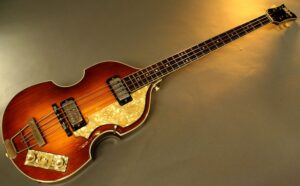
Its neck had become bowed to the point where it was completely unplayable above the sixth fret, and I was in constant fear of it breaking completely. I needed to get a new bass guitar, and quickly.
In the interim, I should mention that I’d finally found a decent full-time job as a computer operator at a Great Big Insurance Company, a job which not only paid well but which included many, many hours of overtime — so much so that at one point I was actually earning as much as my father — and this money was now going to help the band out, big time.
Anyway, I went to one of the few music stores that catered to professional musicians, Bothners Music in the downtown Carlton Center mall, and there I met Eddie (“Eds”) Boyle, who was not only a superb salesman but also the bassist for The Rising Sons, one of the country’s biggest name bands. (Keep Eds in mind, because he will feature a great deal, further on in this tale.)
I ended up with a new bass — a Fender Mustang:
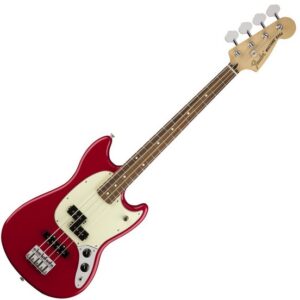
Like the Beatle bass, the Mustang didn’t have a full-size bass fretboard, but a ¾-scale one. (I was under the — mistaken — impression that my fingers were too short to handle a full-size bass, hence that choice. Also, it was the only one I could afford at the time.)
As a result of that trip to Bothner’s, the band also ended up with a PA system, or at least a PA amplifier, an 80-watt Dynacord Eminent II:
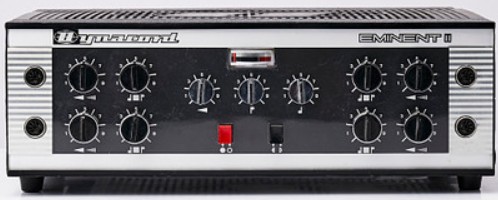
Like all German amps of the time, the Dynacord sounded wonderful: warm tones, with a splendid frequency response. Unfortunately, that 80-watt power amplifier would prove to be woefully inadequate for any large gig, as we were soon to find out. But we kept it for years, only finally replacing it many years later with a 2,000-watt amp (but that’s a story for a later date).
We couldn’t afford proper P.A. speakers, so we ended up buying eight cheap 50-watt speakers and building our own cabinets. (Actually, my father built the cabinets for us, but to our specifications.) For speaker cloth, we used some ghastly curtains from a thrift store.
Anyway, we carried on rehearsing, twice or three times a week, building up that repertoire, but we kept banging our heads against a wall — that wall being that we didn’t have a keyboards player, which not only restricted the kind of songs we could play, but also the type of gig we could play as well: you can’t play a wedding reception with a repertoire that includes Sweet Home Alabama but doesn’t include waltz tunes and songs of the kind I played with the Trio in Margate.
That didn’t matter all that much for our next gig, which was arranged by Knob. His old high school was putting on a fundraiser in the form of a dance marathon — the kind where the kids are “sponsored” by the number of hours that they can dance. This was to be our first actual paying gig, so we approached it with great anticipation; also with great trepidation because we learned that the actual marathon would last at least eight hours and we had, at best, enough material for three. This gave us all the incentive we needed to practice still harder: I think that by then we were doing three practices a week for the next three months. We ended up with over fifty songs, a number which would have been a lot greater, except did I mention? Donat was a filthy perfectionist and his attitude had spread to Knob and Kevin as well.
Well, it would all have to do; so on the appointed Saturday morning, off we went to that high school’s auditorium.
– 0 –
Chapter 6: Building Pussyfoot
Along the way, we’d decided on a name for the band: Pussyfoot Show Band, which was a triumph of 70s attitude over sound marketing principles. I have to admit that I don’t remember who came up with the name, but I do remember being its most ardent supporter. Knob was the first to voice an objection: “Who in their right mind,” he asked, “is going to book a band with a dirty-sounding name?” (Not many, as we were to find out.) Still, there we were.
Of course, we also didn’t have a “show” of any description, unless you counted the bassist leaping all over the stage like some demented animal while the other front three stood like statues, intent on getting their parts right.
And speaking of parts: one of the benefits of having Mr. Filthy Perfectionist in the band was that we were — considering we were a band who’d only been playing together for a few months — a tight sound, and quite well-rehearsed. It helped the others overcome their stage fright somewhat; I, on the other hand, was brimming with confidence — confidence being that feeling you have before you know any better, of course.
Anyway, we arrived at Rob’s (and Cliff’s) old high school a full hour and a half before we were due to start Because Kim Insisted We Did. (I had, and never lost, a dread of us arriving at a gig only to find out that we’d left something behind, or a car carrying gear broke down en route, or some piece of equipment didn’t work: I feared all the many things that would prevent us from starting at the time we’d agreed. And in my mind, not starting on time was the infallible mark of an unprofessional band, so we would always arrive very early for a gig, even years later when we’d got the off-loading / setup thing down to a fine art and could do it all within half an hour.)
So right at 10am, the MC of the show (who looked about nine years old) opened the proceedings with a couple of announcements, then handed the thing over to Pussyfoot. There was a massive crowd, nearly three hundred kids (with a lot more to come) and the auditorium was jam-packed.
We would go on to play countless gigs after that one; but nothing ever topped this high school party, for all sort of reasons. For starters, we could play anything, any song at all, even the ones we’d written off as unsuitable gig material, and whatever we played, the kids danced their asses off. A couple of honorable mentions: Golden Earring’s Radar Love (which had taken us ages to learn, not because the music was difficult, but because all the tempo changes and different phrases were complex, confusing and difficult to remember in sequence), Santana’s Soul Sacrifice — the Woodstock version, sans Hammond organ(!), but complete with drum solo from Rob — and of course songs like the Doobie Brothers’ Long Train Running and Listen To The Music, Fleetwood Mac’s Albatross and Man Of The World, and Sweet’s Fox On The Run (which nearly caused a riot, and which we performed exactly like the original, complete with castrati harmonies).
Of course, you can have too much of a good thing, and we soon learned why. After the third hour, my fingertips were so painful that every note was torture: I half-expected to see blood running out from under my fingernails. Donat and Kevin were likewise stricken, because we had not prepared for this kind of thing and we were, to put it mildly, taken aback by the strain of prolonged playing (fifty minutes on, ten minutes off, according to the rules of the dance marathon).
And here, the aforementioned Soul Sacrifice deserves a line or two. We’d learned it so that we could feature Rob’s fine drumming, even though drum solos, in a gig context, are generally death to any dance floor activity. However, on this occasion, I figured that the kids wouldn’t mind too much, so I called the song (to the utter consternation of the others), and off we went. However, the version we played that day was a little different from Woodstock in that during the drum solo, I motioned Ken and Donat off the stage and setting down our guitars we went off for a pee break, leaving Knob and Cliff on stage (the latter beating the hell out of a pair of congas) for what seemed like ages. Then we finally sauntered back on stage, picked up our guitars and at the appropriate time launched into the finale of the song. Fortunately, its extended length ran right up to the fifty-minute mark, so we took a break.
I had never seen the normally-cool, unflappable Knob sweat like that. Nor had I ever heard him cuss us out so profusely.
It wasn’t all smooth sailing, of course. Cliff’s voice gave out completely early during the third hour, which meant that the three of us had to carry the vocal load together for the rest of the performance. This was not something we’d rehearsed, and it put a level of mental strain onto us that persisted for years, and not to our benefit either, as you will see later. For my part, I was absolutely furious at Cliff, as much for his attitude as for his failure at his only job. He seemed to just shrug it off with a “What can I do about it?” expression. Not for the first (or last) time, I wanted to punch him in the face. But the band couldn’t quit; that would have been the height of unprofessionalism, so we soldiered on. From that day on, however, Cliff’s days in the band were numbered, although I was the only one who knew it at the time.
The final hour of the gig saw five exhausted musicians pretty much going through the motions — we were more tired than the dancers — and indeed the last set list was just a rerun of all the songs I judged had been the biggest crowd-pleasers so far. Anyway, we played the last song, whereupon the 9-year-old MC bounded back on stage and said simply, “We’d like to thank Pussyfoot — ” and his voice disappeared into an earsplitting storm of screams from the three hundred-odd girls in the audience. Good grief, it sounded like the Beatles had just finished a concert. On and on it went, and when I glanced over at the other guys I saw just the same reaction from all of them: astonishment, and embarrassment. Kevin was blushing so deeply that his skin was the same color as his hair, and Donat was looking at the ground, shuffling his feet. Even Knob just sat behind his drums, his mouth open.
So that’s what it was like to be rock stars.
After the excitement of that gig we took a week off from practice, as much out of exhaustion as to give our aching fingers a chance to recover. (Knob, by the way, hadn’t escaped unscathed: he had four massive blisters on his fingers courtesy of his drumsticks.)
But when we did finally get back together, we were faced with an inescapable fact: we needed a keyboards player. But we had no clue where to get one.
Here’s what had happened. The guys in the band had become friends (well, except for me and Cliff), and without ever talking about it, I think we shrank subconsciously from inviting a stranger to share our little partnership in case it didn’t work out. From my time with the Trio in Margate, I knew what it was like when nobody in the band liked the others, and I’d shared that with the guys much earlier on. It was all very frustrating; but in the end it was Cliff (!) who came to the rescue. Apparently, he had a buddy who’d just finished his draft commitment in the Army, and said buddy knew a guy in his unit who was a keyboards player. So the phone lines hummed, and at our very next practice came Mike (“Pussfaze”, a play on his surname), complete with a massive Hammond organ and Leslie speaker.
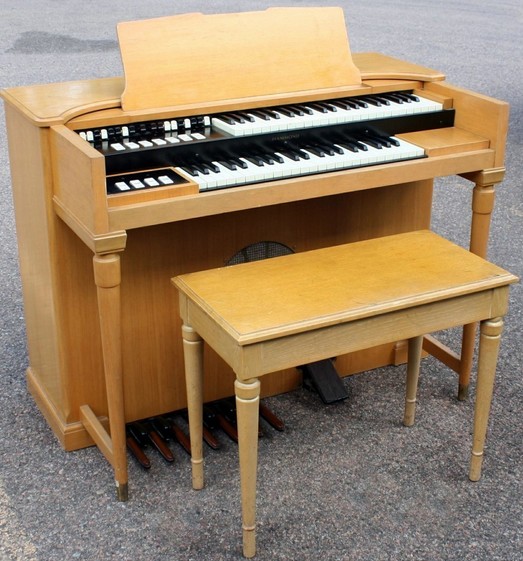
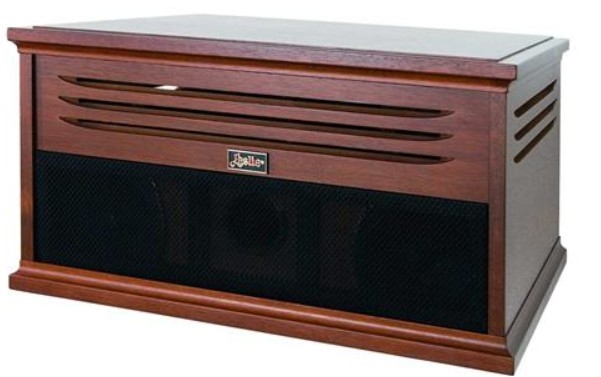
Mike was a very short, wiry guy with, we were to discover, a sharp and incisive sense of humor and a no-nonsense way of looking at the world that was something quite different from the rest of us dreamers. While not the most creative of keyboards players, he was absolutely rock solid when it came to playing what we’d rehearsed, and in fact I do not recall a single occasion, ever, when he made a mistake during a gig — I mean, he never once played a dud note over the next decade or so that we were to play together. And he was a brilliant organist: there was not a single organ part, from Deep Purple’s John Lord to Uriah Heep’s Ken Hensley to Santana’s Greg Rolie that Mike couldn’t play, note-perfect. In that regard, he was a monster.
Way back, I’d learned to play Booker T’s Time Is Tight, and so on this day, without any preamble, I launched into the bass intro. To my delighted astonishment, Mike just started playing the organ part, perfectly, and Knob, who’d not been expecting anything like this, picked up the drum part. Then we stopped to let Kevin figure out the lead solo — he knew the song, but he’d just never played it before — and of course within a few minutes he had it down pat. So we played the whole song from beginning to end, then played it again, and it too became a permanent part of our repertoire.
There were a couple of songs I remembered from the Margate gig, and wonderfully, Mike knew them too. So Gershwin’s Summertime and Nat King Cole’s Fascination came up and were dealt with, with almost contemptuous ease.
We knew after that very first practice that Mike was going to be a keeper, and even though I got some astonished looks from the others, at the end of the practice I said, “So Mike… do you wanna join us?” He thought for a moment, then nodded. And that was that. We had a keyboards player.
Which led us to the next issue. Up until now, we’d been able to carry all the band’s gear in each of our cars (Knob borrowed his mother’s Passat station wagon to carry his drum kit because his own car was a Daimler 250 2-seater). But with Mike’s Hammond and Leslie speaker… he’d borrowed a small truck to get his gear over to my house for this first practice, but he wouldn’t be able to do that in the future.
Clearly, we were going to need a van… but how could we afford one? Well, we couldn’t; but fortunately, there would be a couple of months before we would get our next gig. Then I saw the answer to our dreams. Brazil had started making cheap copies of the early-1950s VW panel vans, and VW South Africa saw the success of that business and started importing them, and selling them at a ridiculously low price. It didn’t matter because none of us could afford the deposit, and as students / low-paid workers, none of us had a credit rating that would enable us to finance the thing.
My father had been listening to us play — he could hardly have not heard us without leaving the house and going far away — so one night I was talking to him about our troubles with the gear when he said, “You boys have been working really hard, and it’s a shame that you might not be able to get around to play at parties and such. So here’s what I’ll do: I’ll take care of the deposit for you, if you’ll handle the monthly payments. And after it’s paid off, you can just continue the payments until the deposit is repaid.”
Thus: Fred joined the band.
 (not the actual Fred, but the color is correct and yes, there were swing-open back doors, sliding windows and a split windscreen)
I think that it was at this time that both Donat and Kevin decided to get bigger amps, and no doubt spoiled by Fred’s capacious interior, they each got the same amp: the huge Fender Dual Showman stack, which stood almost head-high and contained four giant 15″ speakers:
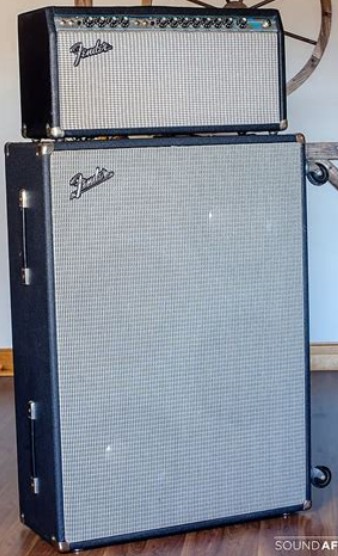
I too had splurged, and got a Fender Bassman 100 stack, which was almost as big, containing as it did four 12″ speakers in its cab:
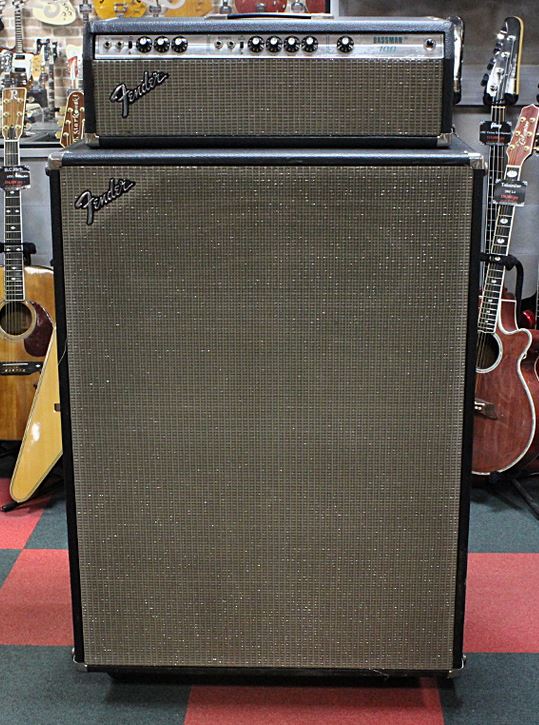
Now we could play loud, baby. And we did.
But the greatest change came when Kevin and Don started complaining about my bass sound — not sharply, but like after practice when we were having our customary hamburger at the local steakhouse, one or the other would sigh and say things like “I just wish your bass sound was more… punchy.” Then one day I got sick of it all, and said, “Okay, what bass, exactly, do you think would make my sound better? I already have the right amp.” There was a long pause, then from Donat: “The Rickenbacker, like Chris Squire plays.” I thought about it for a moment, then said, “Okay; I’ll see if I can get one. Just don’t expect me to play as well as Chris Squire.”
When I went into Bothners and asked Eds Boyle about a Rickenbacker, he just grinned. “You’re not going to believe it, Kims… one just came in. I haven’t even taken it out of its packing case yet.”
And thus did I get — at huge expense that I couldn’t really afford — my next (and last) bass guitar:
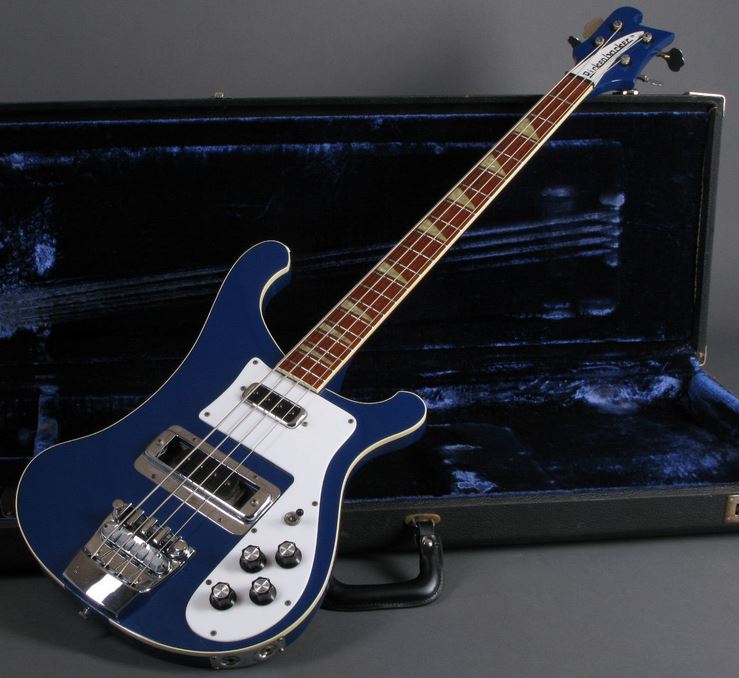
(Okay, Kim, you may ask: how expensive was it? Answer: it cost
only a couple hundred dollars less than Fred.)
But the change the Rick brought to the band’s sound was immediate and life-changing. Finally, we were starting to get our own unique sound.
With all that taken care of, we started to expand our repertoire, big time, and were no longer constrained by the lack of a keyboard player. First came Santana, and most of the songs off his Abraxus album — a permanent fixture was the exquisite Samba Pa Ti — and then we taught Mike Soul Sacrifice — minus the extended drum solo — and to our amazement, he nailed the organ part after only a few repeats. So we could finally play Soul Sacrifice in the manner it deserved.
But without any gigs on the horizon, we concentrated on playing music that would extend us as musicians, and so along came songs like Camel’s Six Ate and Uriah Heep’s July Morning. (We were never to play the latter at any gig because it was just not a “gig” song: too many stops and starts, too many tempo changes — but that never stopped us from learning it, or playing it for months thereafter.)
Side note: I don’t think that people nowadays can tell how difficult it was to gather material back then. There was no YouTube, no Spotify, no kind of streaming music whatsoever. Basically, what we (and I think other bands) used to do was either buy the 7″ single record or tape the song off the radio, if you could get to it in time, and then we’d pass the tape or record around the band for each member to learn their specific parts: a long and time-consuming effort. (Remember too that back then, even cassette tapes were A New Thing — my old Fiat had had an 8-track cassette installed, for example.)
Paradoxically, I quietly started to steer the band towards gig songs that wouldn’t tax Cliff’s voice: stuff like Hedgehoppers Anonymous’s Hey and Stevie Wonder’s Isn’t She Lovely (suitably lowered in key, of course).
Still: no gigs.
One day I was in Bothners — trying hard not to spend any more money that I didn’t have — and when I complained to Eds about the no-gig thing, he looked shocked. “Have you spoken to an agent yet? No? Why the hell not?” and he produced a card with “Morris Fresco (The Don Hughes Organization)” printed on it.
So the telephone wires hummed, and we arranged for Morris to come and listen to us. For the occasion, as my parents had taken off for a long weekend’s vacation, we cleared out the living room and set up on the one side, playing towards the couch we’d left at the other for Morris to sit on. And when he arrived, we launched into what we thought was a good sample of our repertoire.
And we blew it.
Not because of our playing, mind you: everything we played, we played flawlessly despite our considerable nervousness. But instead of playing the kind of songs that would get us gigs — the dance tunes, the pop songs, the ones people would recognize, we were too good for that, oh yes we were — we played all the heavy stuff, the complex songs because, you see, we wanted to impress this Great Big Important Agent and dazzle him with our musical ability.
Had we been auditioning for a club gig, mind you, this might have been a decent approach. But none of the stuff we played would have worked at a wedding reception, or office party, or any kind of mainstream occasion.
So at the end of it all, Morris complimented us on our sound and our ability, and took his leave, saying he’d be in touch.
We ended up getting a few small gigs from the Don Hughes Organization, and one important one (to be explored in the next chapter).
But we didn’t know that at the time, of course, so we carried on rehearsing. And now I think it’s time for everyone to see this Pussyfoot Show Band:
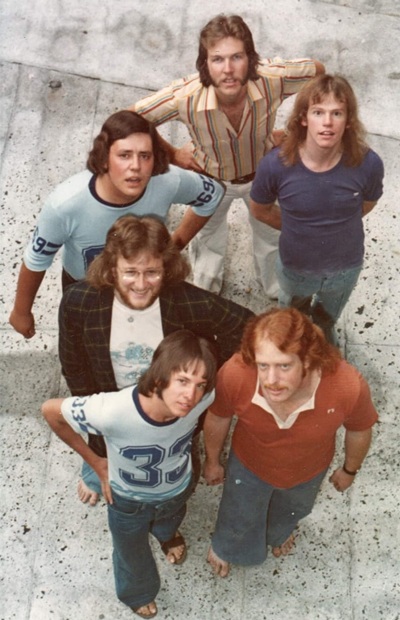
(from top left, clockwise: Cliff, Knob, Donat, Kevin,
Mike and Kim)
Yeah, we didn’t look much like a rock band, but at least we sounded like one. And our next gig was not at some party or other: it was a residency, in a restaurant.
– 0 –
Chapter 7: Changing Pussyfoot
One of the better things that happened to me that year was that I discovered that Shalima had left their favorite coastal venues and were now playing at the OK Corral, a well-known club just to the east of Pretoria. So I drove up there (about forty miles), met up with the guys, and the result of that reunion was that they came over to my parents’ house on their off night (Monday) for a massive braai (barbecue), during which time vocalist Tommy distinguished himself on two occasions by saying of my mother, “Oh hell, I’d do her,” followed by referring to my father as a “Dutchie” (derogatory term for Afrikaner); one of the other guys bonked a groupie (don’t ask, I don’t know how she got there either) in the downstairs bathroom, and Max had a long and very interesting discussion with my dad. Of course, some of Pussyfoot were also there — Knob, Kevin, Donat, as I recall, although Mike might also have come over. (Clifford hadn’t been invited.) There was much carousing, eating and drunkenness, as any band party worthy of the name would include, and I was really glad to introduce my guys to the band which had so influenced me. Tommy also regaled the Pussyfoot guys with the story of how they’d surprised me that night back in the dining room at the Margate Hotel (“I swear, I thought it would just be the usual nightclub shit, but they played some serious jazz, and I’ll never forget trying to put Kim off reading his music, and failing” ). I went back up to “Okies” a couple more times to hang out with Shalima, then their contract ended and they went back off to the Natal South Coast once more, and I got back into getting Pussyfoot “gig-ready”.
As I’ve said before, there wasn’t much “show” in the Pussyfoot Show Band. Knob and Mike were trapped behind the drums and keyboards respectively, and Kevin and Donat were not showmen, being mostly concerned with playing the music perfectly — thank goodness. Which left the whole thing up to the bassist and vocalist. Unfortunately, while the bassist had no problem temperamentally with leaping insanely around on stage, he was often kept in check by a.) having to concentrate on playing his instrument — still very much a problem — and b.) singing harmonies in songs which required them, i.e. most.
Which left the vocalist. Sadly, not only was the vocalist not interested in performing on stage, he was not (to be honest) of the physique and appearance which could enable him to do same without looking like some kind of performing elephant.
Clearly, though, something had to be done about this problem (the “show” part, not the vocalist — yet), and so I set about designing a light system to help things along.
Some words of explanation are necessary at this point. Unlike in the U.S., most South African venues did not have a house P.A. system, and only actual theaters had any form of stage lighting — not that this would have helped, because that would have involved getting stage hands involved and we couldn’t afford to pay them. We’d sort-of addressed the P.A. issue, but there was no question about getting lighting: it was up to us. So I set about building a light system, trying to copy what other bands were doing at their gigs.
It was obvious, though, that whatever system we designed would have to be both portable and easy to set up/break down, by every member of the band. This meant no overhead lights (all those tall stands? not going to happen), and therefore floor mounts were the only solution. So I built wedge-shaped floor stands — one for each of us — with each stand containing two light sockets. For the actual lights, I used 100w Par-38 floods in various colors. (The Par-38s were fantastic: while very expensive, they were long-lasting, very robust and survived being kicked by Clumsy Kevin on more than one occasion. They also gave off incredible heat, so by the end of only the first set we were generally drenched with sweat.)
The problem was that I wanted to control the power so that I could manipulate which lights were on at any given time: two lights for the lead singer, one each for everyone else, or else two for everyone, or just one for everyone, or just a couple at random (for quieter songs). I’d also found a strobe light, which required all other lights to be off, for maximum effect. And of course, the power had to be controlled by a series of foot switches because I wasn’t going to be able to play bass and manually flip switches on and off — hell, it was hard enough for me just to play the bass semi-competently, let alone do all that other stuff simultaneously.
Where were we going to find a switching board that could do all that? Well, there was no such thing on the market. So I told Donat to build one and wire it together. (You will recall that said rhythm guitarist was studying electrical engineering, so duh.) And he did. I even managed to find foot switches that had a little light to indicate whether it was on or off, although they weren’t very robust.
We were to use this lighting system for the next eight years.
The next thing we had to do was be more showmanlike, which was problematic for the reasons I’ve noted earlier. So I decided to start including more comedic material in our repertoire.
Side note: When I say “I decided”, it was absolutely not a case of me coming up with a decision and the band following it obediently. We were no Shalima, and I was certainly no Max. Every single idea that came up — whether mine or someone else’s — had to be supported by all if not almost all of us before we adopted it. The lighting was an easy one; but the choice of songs and such? Unbelievably difficult. In the end, we didn’t succumb to “minority veto” issues unless one or more of us absolutely hated the song. (We had discovered that if someone felt that strongly about it, the song always sounded like crap.) All our material had to be “blessed by the Pope” in that a.) we had to like it and enjoy playing it or b.) we decided jointly that while we might not especially care for it, if inclusion of that material was important for the performance, we’d go ahead and learn it, and commit to playing it well. Because that was the professional attitude, after all. Which is how we came to play utter crap like the Pina Colada song and anything by Wings. (Okay, I’m being flippant: we actually enjoyed playing Jet.)
We had expanded our repertoire to include many “soft” popular ballads — Engelbert Humperdinck’s Last Waltz, Spanish Eyes, and Tom Jones’s Green Green Grass of Home and Delilah, for example — but the problem was that over time, we got heartily sick of playing them. (It’s the curse of playing in a band: as much as audiences may enjoy hearing a song, they’re probably hearing it only once — as performed by the band — whereas the band may have been playing it for years. And it’s not just the ballads like the above; even popular rockers like Proud Mary can get old over time, and get dropped from the playlist.)
Anyway, we started messing with the lyrics because to be quite honest, most people on the dance floor either don’t know or aren’t listening to the lyrics anyway, and it gave us an inside joke to chortle over. Paul McCartney’s Silly Love Songs, for example, became Sticky Love Songs, and “Sometimes it comes within a minute / Sometimes it doesn’t come at all” was transformed into “Sometimes I come within a minute / Sometimes she doesn’t come at all”, and so on. Occasionally we got carried away, such as when we changed the old rock ‘n roll refrain from “Awop-doowop, awop-pop-doowop” into “cock-sucker / mother-motherfucker” but in all the many times we played that particular little lyrical game over the years, I think we were only ever caught out once, which goes to show).
I’ll give a couple more examples of this as the story unfolds.
As I recall, we did a couple of small gigs — wedding receptions — and then we got our Big Break (or so we thought).
I think it was Knob who learned that a Portuguese dinner/dance club was looking for a band — he vaguely remembers it as coming from The Don Hughes people — and arranged an audition. By this time, we’d left my parents’ house — my dad had passed away, and my mom was in the process of selling it — and we had rented space in an unoccupied office building in downtown Johannesburg. This was great because while the central business district (CBD) was busy during weekdays, it emptied out at night and was almost deserted over the weekends, so we could practice as loudly as we wanted, unlike back at my parents’ house where we had to be careful of complaining neighbors.
Anyway, came the day of the audition, and we met Silvinho Pereira, the owner of Una Casa Portuguesa. Of course, he preferred that we played Portuguese music, of which we knew not a note, but we somewhat mollified him by playing all sorts of “Latin” stuff (thank you, Carlos Santana!) and of course standards like Girl From Ipanema and Quando Quando Quando. He seemed satisfied, and agreed to sign us to a three-month contract for Fridays and Saturday nights — the proviso for extension being that we learned some Portuguese songs (which we never did). Our only proviso was that we could practice on Monday nights, when the restaurant was closed, which was fine by him. Oh, and he wanted to pay us by having us take the door covers as salary, but Knob nixed that idea (thank gawd) and insisted on us being paid a salary — we agreed to a reduced per-night fee compared to our standard gig charge (about R400), because with all the gear permanently set up in the room, it was a huge relief for us not to have to do the gig thing by packing it into Fred, setting it up at the venue, then taking it all apart, repacking it in Fred and then driving it back to the practice room and setting it up all over again for the next practice. The lack of hassle more than made up for the lowered income.
So after signing the contract, Knob and I went to the club one night to check it out. It was in an upstairs location on the seedier side of Johannesburg’s CBD, but the restaurant itself was small and intimate, and we could see to our dismay that our repertoire was going to have to be nightclub music only. We decided to try the menu out and ordered dinner, and while we were eating the current house band arrived and started to play, and we discovered that they played loud club music almost exclusively. Oh, that looked good for us; and when I chatted to the band’s leader during a break, he told me that the usual format was soft stuff during the first two hours during the dining period, and then the band could cut loose for the remaining two sets. When I asked him why his band was leaving, he just grinned and said, “You’ll find out”, which made both Knob and me very nervous. Still, we’d signed the contract, so that was that. And so began our very first club gig at Vasco Da Gama: Una Casa Portuguesa.
Kevin
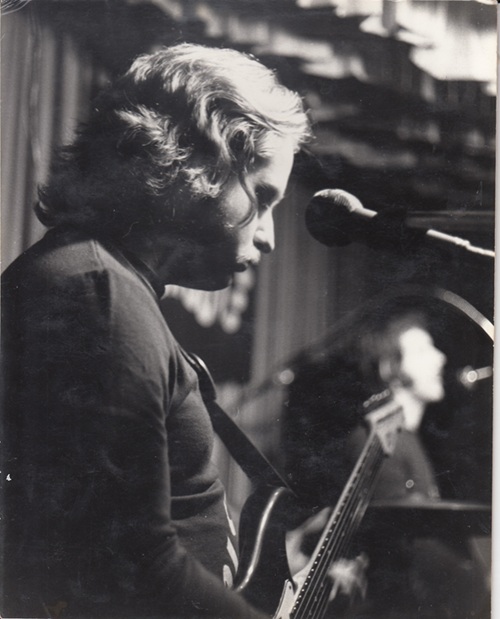
Kim
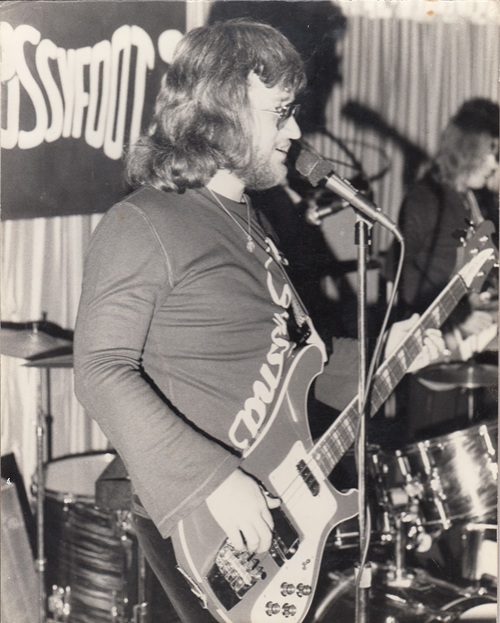
Knob
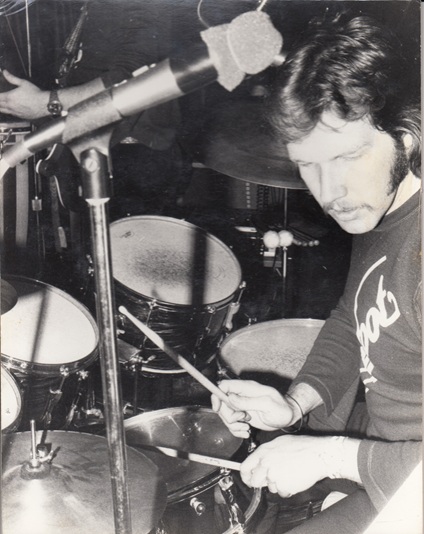
Donat
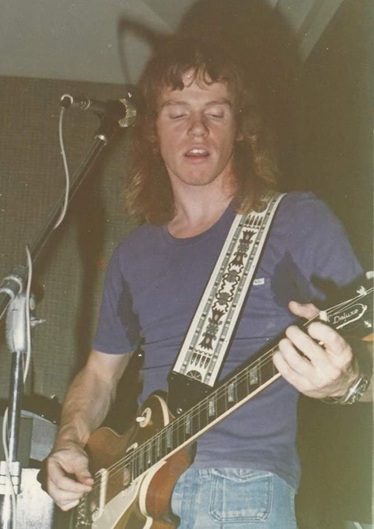
(at practice — his Vasco’s pic has been lost in the mists of time)
Mike
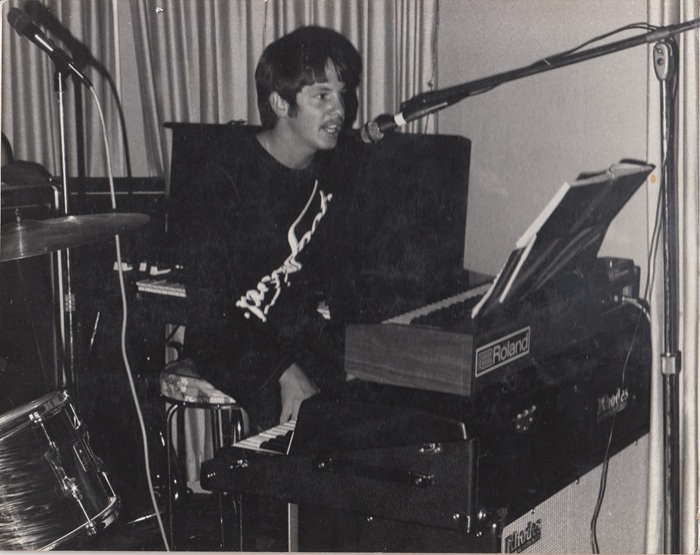
(with his post-Army hairstyle, see below)
There are so many things to be said about Vasco’s. Chief among them was that we could eat anything on the menu, provided that we paid for it — and the food was not cheap. The “staff meal”, though, was a free option. In Silvinho’s words: “It’s a kind of a… a Portuguese casserole, made with pork and a creamy sauce.” (Translated: tripe stew, and pretty much inedible.) We tried it once, and thereafter either ate at home beforehand (which was most of the time), or else the cheapest item on the menu (fish soup and Portuguese bread, which was actually quite delicious, but far from filling).
Another noteworthy thing about Una Casa Portuguesa: no customers. Silvinho seemed to think that a monthly classified ad in the local Porro weekly newspaper (circulation: dozens) sufficed as “advertising”, and when we complained, he upped the ad to a weekly event (what he called, “Going heavy into advertising”). It was a rare night when the customer count ran over two dozen, and most often it was less than that. I have no idea how he stayed in business — probably by laundering cash for the local Portuguese criminal gangs, it wouldn’t surprise me.
At first we didn’t care too much, because we were getting paid regardless. But it was a little soul-destroying to play a new song (that we’d spent three whole practices getting right) to an audience of three couples. Most of the time, though, all the diners left right after dinner, and we were thus free to play the stuff we really wanted to play, which was not Spanish Eyes.
What we did, though, was sharpen up our playing, and our act. I worked out a lighting “set” for every song on the playlist, and it changed the ambience of the stage completely — once I got it to work, it made playing much more pleasurable for everyone. And while it may seem that playing a show only twice a week wouldn’t make the band tighter and more disciplined, it did; that, and the weekly practice (and sometimes two weekly practices) made us better: a lot better.
A fat lot of good that was, however, when we were constantly playing to an empty room. And the consequence of that situation was, as we discovered, getting Silvinho to pay us was like pulling teeth. The terms of the agreement were that we were to be paid weekly, at the end of the Saturday night set; but somehow Silvinho always found some excuse not to do so, with the result that we were getting paid a week and sometimes even two weeks in arrears. (When I bumped into the previous band’s leader one day at Bothner’s and complained, he just laughed and, “Now you know why we quit the gig.”)
But we soldiered on, because that was the professional thing to do and all told, it wasn’t all that bad — as it turned out, we were not offered a single one-night gig during our residency at Vasco’s, so it’s not like we were passing up anything.
Then: calamity. With three weeks to go on the contract, Mike informed us that he’d been called up for an Army Reserve commitment (known colloquially as “camps”). Oh how nice: four nights without a keyboards player. But there was help on the horizon, and it appeared in the form of my old high school buddy and bandmate, Gibby.
At this point, I need to talk a little bit about Gibby, because he warrants it.
(about the groupie: I have no idea, and nor does his wife)
Gibby came from a very musical family, and could play pretty much any instrument you care to name: piano, organ, guitar, bass guitar, bugle (from the school cadet band days)… put in his hands, and he could play it, often with incredible skill. Of course, having been like me a Leading Chorister in the College choir, he could read music like he was reading the newspaper, and his vocal skills… well, unlike me, he was still singing in the Old Boys’ choir, so no more need be said.
As it happened, he was living just outside Johannesburg at the time, and so I asked him to come and help us out on keyboards. When I broached the substitution to the band, they were of course very apprehensive. Fortunately, Mike hadn’t yet left for his camp so he coached Gibby on our playlist for a couple of practices, which was all the rehearsal my talented friend needed, so we continued to perform without a hiccup and barely any difference in our sound.
The one night we became a true show band. We’d learned the wonderful Sweet Transvestite song from Rocky Horror Picture Show, and it was really popular (to the few Vasco’s patrons who ever heard it, that is). Then we heard that Gibby’s older brother Martin had rounded up six of his buddies and their wives, and was coming for dinner to see what his Kid Brother was doing with his “little band”. Unfortunately, he happened to say the latter in my presence… so we changed it up a little.
Instead of doing the piece just as a straight song, we got Gibby to don a Tim Curry-type outfit and sing the main vocals. Then, as Big Brother was sitting at the stable amidst his group of friends, Gibby strutted across the dance floor, plonked himself in Martin’s lap, and sang the whole song in that position. Of course, the whole restaurant got in on the joke, and I will never forget Martin’s clenched jaw and fixed smile as Gibby draped himself all over him and hammed it up in true Frank-N-Furter style.
And here’s where the whole thing got a little messy.
You see, Gibby had essentially played Cliff off the stage with his performance — and most especially his voice. Frankly, he could have taken Cliff’s job right then, and we’d have had not only an excellent singer but another instrumentalist to boot.
So one day when Knob and I were alone together, we got to talking about just that. Unfortunately, Gibby had just been offered a job in Durban — he was an architect — so he wouldn’t be able to take the gig (and playing professional rock music had never been in his life plan anyway). But as I said to Knob, it was clear that at this point Cliff was more of a burden on the band than a valuable member. And playing for as little money as we were, the already-paltry weekly salary was being split six ways, which meant that we were in essence playing for almost nothing.
I was really nervous about saying all this, because Cliff was his good friend. But to my surprise, Knob didn’t argue the point but said simply: “Let’s discuss it with the other guys.”
So a few days later we took a clandestine vote, and Cliff lost. We fired him at the next practice. He was not pleased about the firing, and made it a lot more unpleasant than it needed to be — in fact, he and I nearly came to blows, but luckily (for him) he backed off, because I detested him so much I might have killed him.
In the ordinary scheme of things, we’d have been left with a gaping hole in our repertoire; but after Cliff’s departure it was almost as though he’d never been in the band. Between Knob, Kevin and I we picked up the vocals for all but a couple of Cliff’s songs, and in fact a number of songs were actually improved by the substitution. (Here’s one example: Cliff had always hated doing the Spanish Eyes-type ballads, and so he had always just gone through the motions in singing them. But when Knob picked up the vocals for Spanish Eyes, the song actually became excellent: his warm tone was far more melodious than Cliff’s tortured tobacco rasp, and the song became a permanent early-night fixture on our playlist.)
When the Vasco’s contract came to an end, Silvinho told us he wasn’t going to extend it, and he was actually aghast when I snarled at him that we wouldn’t have accepted the extension because we were sick of begging him to pay our salary all the time, and we were sick of playing to an empty room anyway. We still had one weekend to play, and either Knob or I made it very plain to Silvinho that we expected to get paid the full amount owed immediately after the last set ended on the Saturday night. (I might have said, “And if you don’t pay us, we’re going to fuck your restaurant up.” Sometimes, you just gotta.)
And on that final night at Vasco’s we got a surprise. I’d told Eds Boyle at Bothners about our gig there, and he’d told a few other pro musicians about us: with the result that on that night at about 11, the normally-somnolent Portuguese restaurant was invaded by over a dozen loud and raucous musicians, who proceeded to drink all the beer in the bar as they listened to us play not only our final set but an extra one thereafter — and believe me, we really cut loose.
The other musicians refused to let Silvinho close the place afterwards, so we all sat around and got shitfaced drunk until about 3am (and yes, Silvinho paid us out in full — helped undoubtedly by his enormous bar take for the evening). We then packed up all the gear — “we” being Pussyfoot; no way were the other musicians going to help us, oh no perish the thought — and thus ended our first club gig. It was also our last club gig… as Pussyfoot.
However, one lovely surprise was that playing at Vasco’s gave us a chance to get booked for later gigs.
Because Pussyfoot was an unknown (and raher salacious) name on the Johannesburg gig circuit, people were usually reluctant to book an unknown quantity for their Big Day (wedding reception, office party and so on), so when we did get an inquiry, it was always coupled with a request for an audition. We had nowhere for people to come and listen to us, so often we’d ask them to come to a gig to hear us, or else to our practice room where we’d play just about anything they asked us to play. But at Vasco’s, there was an excellent venue for prospective customers to come and listen to us, and I don’t remember the exact number of gigs we landed as a result of that, but it was at least a dozen. So we were going to be busy for the foreseeable future — and I’m pretty sure that this was no small factor in our decision to fire Cliff. Money talks, and to an impoverished semi-professional band, it spoke extremely loudly.
The usual scheme of booking a “name” band was as follows: contact said bands (maybe through an agency), and see who was free, and who was affordable. The number of gig bands was actually quite small: from memory, the main ones were The Rising Sons (Eds Boyle’s band), the Bats, Four Jacks And A Jill, the Staccatos, Black Ice (more on them later), Hudson Show Band, The Bassmen and one or two others whose names escape me. All those bands were unbelievably busy, playing every single weekend night of the year as well as a couple of other days on special occasions. Some (the Sons, Four Jacks, the Bats and the Staccatos especially) had actually had Top Ten hit parade songs, so everyone knew their names. If none of those bands were available, then people would have to cast around and look for someone else — and this was not an easy task.
What started to happen, though, was that as more musicians came to know Pussyfoot and the fact that we were a serious band, we would get referrals from those bigger bands, from Eds and The Rising Sons especially. Why Eds, especially?
My sister’s senior prom night (known back then as the “Matric Dance”) was coming up, and as it happened, Kevin had been invited as my sister’s partner and Donat as her best friend’s. My sister knew a girl in her class who was an “international” student — her parents were living in Italy, as I recall, because her father’s job had taken them there — and of course, being a recent arrival at the school, she had no date. So my sister set the poor girl up with me: and when we arrived at the dance, who was playing the gig but The Rising Sons?
Of course, the three girls got huge boosts to their social standing by their dates knowing the famous Rising Sons, and the boost was raised still higher when the three of us were invited to play a couple of songs with the band’s drummer and keyboards player. By now, we were seasoned veterans at this kind of thing so we blew the doors off the place — Dave Campbell the drummer being the most impressed — and when it came time for the after-dance party (held at our house because it was only about a half-mile from the school), the Sons came along, and a fabulous time was had by all.
Thereafter, whenever the Sons got a request for a gig but were already booked, Eds passed the gig off to us. I lost count of how many there were, but it was a considerable number.
Then one day Eds came to me and offered me a job at the Bothners music shop, where he was the manager of the musical instrument department. The job carried a basic salary plus a commission on sales I’d make. Wait… work with musical instruments and musicians all day and every day, for only a tad less money than I was making as a lousy computer operator at an insurance company? Was there even a question what I’d do?
And it was then that I got to know all the professional musicians in the whole country — the whole country because every pro band ended up playing in Johannesburg at some time or another, and they’d come to Bothners for their instruments and accessories — and Eds knew all of them because he’d been part of that scene since the late 1960s.
The job also required going to all the clubs in Johannesburg, Pretoria and the surrounding area known as the Witwatersrand: hanging out with the bands, talking music to them and of course telling them about the cool new gear we had in stock or were about to get from the warehouse (hint, hint). As much fun as that sounded (and it was), there was of course serious business involved — but as Eds advised me: “These guys have pretty much got all the gear they need, so don’t try to sell them anything. That’ll just piss them off. Treat it as a PR thing: keep our name out there, make them your friends, and of course they’ll come to us if they need to.”
On one occasion, Alan Hanekom from Hudson Show Band ran into the shop on a Saturday morning right as we were opening and told us breathlessly that all three of their guitars had been stolen after their gig the previous night, they needed new ones for their gig that same night, and could we help them? Well, of course we could, except that we didn’t have two of the three — a Fender Telecaster and a Gibson Les Paul Custom Deluxe — in stock at that particular moment. But Eds made a quick call to the warehouse, and they did have them on hand. So I jumped into Fred and raced over to pick the things up while Eds took care of the paperwork. Alan was truly astonished that we would help him out so quickly and with such an effort, but Eds just laughed and said, “Both Kims and I play gigs, Al — we know what’s important here.” And another longtime and loyal customer was born.
And so the next six months or so passed pleasantly by, marred only by the fact that Donat announced that he was leaving the band.
– 0 –
Chapter 8: The End Of Pussyfoot
I think that one of the definitions of a band is that it’s an association of people who are loosely attracted to each other by a love of music, bound together by affection and respect for each other’s musical ability, and driven by a common goal.
Now let’s parse those terms a little.
“Love of music” — What kind of music, exactly? Classical musicians don’t form bands with rock musicians unless they’re called ELO, Jethro Tull or Genesis, etc. Jazz musicians tend to group together with other jazz musicians and not blues- or rock musicians unless they’re called Blood, Sweat & Tears or Chicago. Or if they do, they don’t last too long. Country musicians… well, if you ain’t authentic, you ain’t country. Rock musicians prefer to play with other rock musicians, but they’re all mostly scum, morons and psychopaths. (Serious boffins like guitar virtuoso Brian May and his astrophysics doctorate are so far off the musical universe bell curve that they’re more scarce on the ground than unicorns. The typical rock musician is going to be someone like Axl Rose, to be honest.)
“Affection and respect” — You can play with other folks whom you don’t like, but respect their capabilities; and you can like the other guys despite the fact that they aren’t as good as you are. But to find a group of guys whom you both like and respect — i.e. you’re more or less at the same level musically and you don’t want to punch them in the face every time you get together on stage or in the practice room — trust me, it’s a rare mixture indeed.
“Common goal” — Do you want to play together just as a hobby, jamming in someone’s basement or garage? Or do you want to play one-night gigs, and if so, are you confined to a specific area by other life issues like jobs, family and so on? Or do you want to play semi-professional, playing club gigs with lengthy contracts, but keeping your day jobs for the steady (or more remunerative) income? Or do you want to become full-time musicians and dedicate your lives to playing music and looking for fame, success and wealth?
When you look at all the above — and there are probably a lot more combinations and permutations, by the way — it’s an absolute wonder that any band can stay together for any longer than a few weeks. Even the Beatles went through a drummer (Pete Best) and a bass player (Stu Sutcliffe) before they settled on George, Paul, Ringo and John. And even all that musical talent, artistic development, fame, success and wealth that the Beatles thing provided weren’t enough, at the end, to keep the band together for more than a decade.
In the case of Pussyfoot, I was the one driven to become a full-time professional musician, to play clubs all over the country, as was Kevin, I think (and future events would prove me right). I think Mike would have come along with us, had the opportunity been enough to offset his day job’s income. Knob might have gone along with the plan, provided that we only played in and around Johannesburg; but he was driven by business success and not much else, so he wasn’t ever going to go along with that, long term. Pro music in a small market like South Africa was never going to make anyone rich, unless the band was extremely talented and lucky enough to get the break they needed.
As it turned out, Donat didn’t want to do any of the above. He wasn’t interested in turning pro (of any description) or playing gigs as often as we planned on doing, and I think with the routine of practice and time that the band was eating up, he had other plans.
So he quit. But unlike with Cliff’s departure, there was genuine regret from the rest of us, because we’d all become friends at that point, and who wants to lose a friend? (Just in the band sense, of course. Sure, we were going to miss that lovely sound of his Gibson Les Paul and his excellent rhythm guitar, but that was just part of it.) Now, of course, we had to rejigger the band a little, to replace his contribution.
We briefly discussed finding another rhythm guitarist, but ultimately decided against it because we’d earn more money individually, but not replacing Donat’s contribution just meant that Kevin and Mike had to play more comprehensively: which they did, although our choice of new songs was necessarily more limited. What helped was that Mike bought more equipment, notably a strings keyboard and later a massive synthesizer, which filled out our sound very well indeed.
And the gigs started increasing, too: we were playing at country clubs, wedding receptions and towards the end of the year, even a couple of office parties, and our first New Year’s Eve gig. The great thing about NYE was that there weren’t enough bands in town to fill the need: everyone threw a bang-up New Year’s Eve party, and it seemed that every hotel was looking for a band for the occasion. I don’t remember where we played, but it lasted until the wee hours, which meant a substantial overtime bonus.
Side note: I forgot to mention that very early on I’d drawn up our gig contract so that we had some kind of legal protection in case the client stiffed us. It took me an hour or two, and when I’d finished I showed it to my buddy Leosh, who was just wrapping up his law degree. He read it, went pale and said:
“I wouldn’t sign this.”
“Why not?”
“Well, basically it says that you can play whatever the hell you want. And the client has no say over anything you might not want to do.”
“Yeah, but it does guarantee that we’ll play 45 minutes of the hour, for four hours.”
“Yeah, and past four hours he has to pay through the nose.”
“That’s because if the gig ends at midnight we only get home well after 3, what with packing up and unpacking. Truthfully, we don’t want to play after midnight; so if they want us to play for longer, it’s got to be worth our while.”
“Uh huh. Basically, if I read this right, when you play two extra hours, you double your take for the night.”
“That’s right.”
Most New Year’s Eve gigs, we played two and sometimes three extra hours. And with Don quitting, that bonus was going to be split four ways instead of five.
And at long last, we were each starting to make money from the band — at least to the point where the income more than covered the monthly cost of the equipment payments to Bothners. And speaking of Bothners, there were a couple of clouds coming over the horizon.
The manager at Bothners was a weaselly little shit named Rob Cameron. Over the past year or so, Eds Boyle and I had become good friends, and he’d persuaded the manager that he needed an assistant in the department, but I suspected he’d kind of oversold me so that I could get the job — and the proof of that was soon forthcoming. My take on my role was that I’d be the guy who would take care of all the one-time customers and small transactions that would free Eds up to take care of the professional musos. But after only a few months at Bothners I was called into The Weasel’s office and basically told off for my poor performance in sales. When I pointed out that my sales numbers were pretty much the same as Eddy’s, only made up with much more transactions, Cameron yelled that I hadn’t brought in any of the “new, young bands”. I was of course surprised, because this had never been part of my hiring — but it was, because that was how Eds had pitched me to Cameron; he’d just forgotten to tell me about it.
Oh, shit.
Whenever I’m blindsided by events, my normal attitude is to respond aggressively; and so it was in this case. I snarled back at Cameron that I was doing the job I’d been hired for, my sales figures were good — the profits from all those “small” sales were far greater than my salary, for one thing — and the way I was going, I expected to make even more over the next couple of months, “And I’m going to beat Eddy’s sales figures for the first time.”
The result was that I was put on notice — basically, The Weasel told me that if I didn’t do what I said I would, he’d fire me on the turn. My prospects, then, were looking bleak and I left his office steaming.
Three days later some young guys came into Bothners with an older man. Eds pointed to them and said, “Some customers for you, Kims,” and scuttled off to “do a stock check” (our shorthand for “These idiots will be a waste of time — you deal with them”). Well, it turned out that these four kids had started a band, and had worked so hard that their respective fathers had agreed to sponsor them and buy them all the gear they needed to put the band together, because they’d been booked to play at a small rock concert in a town to the west of Johannesburg and couldn’t do the gig with the paltry equipment they had on hand.
I told the father that they’d come to the right place, because my band had suffered through the same problems — only we hadn’t lucked out with a sponsor so we’d had to buy the whole band’s gear ourselves, pretty much from scratch. And because we’d had to pay for it, we’d bought cheap equipment, then later finding out that we had to to replace it with better gear — in essence, buying everything twice. (I was only exaggerating a little, but the crux of the story was quite true.) The older man seemed impressed by my analysis, and said, “Well, I and the other dads aren’t going to pay twice. What do you recommend?”
So I took the guys through the whole setup I thought they’d need, member by member: bass guitar, amp, lead guitar, amp, keyboards, amp, and the PA system to bring the whole thing together — all top-of-the-range equipment. (The drummer had a decent kit, so I told him not to replace it but just add to it with better cymbals and a quality snare drum.) The father’s eyes widened when he saw the total, but I reminded him of buying everything twice; and after showing Eds the total, he approved a five percent discount on the spot.
The total of this single transaction was greater than the department’s total sales had been for the past two months.
Even better, after the kids played their concert, a couple of other young bands from the concert came to me for help in improving their gear, with the result that my sales for the following month were equally impressive.
So after the dust had settled and the numbers added to the balance sheet, Cameron called me into his office to congratulate me on my success, and was stunned when I handed in my resignation. Why?
I don’t respond too well to an ultimatum at the best of times, so when I’d been told to sell more or I’d be fired, I’d started sniffing around at the other music stores in town for an alternative job. And the manager of one such store — much smaller than Bothners, but wanting to grow — was extremely interested in having Bothners’ “top” salesman come to work at his little shop (yeah, I showed my sales results over the past two months, skipping over the earlier ones and making out that this was my normal performance: remember I was a salesman). I told him that I would have to work out my notice through the month of January 1977, but I could start in February.
What I didn’t tell him was that I’d just received my call-up papers for my National Service commitment — yes, the Army had caught up with me at last, and I’d been informed that I would get no more deferments: “We’ll see you in July 1977, and that’s that!” was the gist of it. So I’d only be working for the small store for a few months until mid-year.
Anyway, when I presented my resignation to Cameron, he took it kinda badly. In fact, he let me go on the spot. So I’d miss the Christmas sales boom and the commission thereof. Even though that was a shitty thing to do, I didn’t care too much; my bonus for the past two very successful months would be more than sufficient to tide me over until I started my new job.
I’d heard through the grapevine that Shalima were once more playing at the Palm Grove in Margate, so as Pussyfoot was going through a bleak period with only two office parties booked for early December, and then no gigs until New Year’s Eve, mid-December found yours truly setting out for Natal’s South Coast in Fred — so my accommodation needs therefore quite adequate. (I’d slept in the back on several occasions in the past, when visiting my girlfriend out of town, over long weekends camping, and so on.)
I met up with the Shalima guys, Max and I renewed our acquaintance with great joy, and a vast quantity of beer was consumed. As it happened, I’d been misinformed: the band playing at the Palm Grove was an Irish band called Kelly Green, who played mostly R&B songs. They were brilliant, and I was most impressed by their vocalist — who had a voice that sounded like Dave Ruffin of the Temptations — and the lead guitarist, a Scottish guy named Alex Dawson who played like jazz great Larry Carlton. Anyway, I spent a week down there, listening to Kelly Green and drinking with Max. It was my first actual holiday in close to four years.
After that little trip, I went back up to Johannesburg for the New Year’s Eve gig with Pussyfoot — a great success in every sense because not only did our performance go down well, but we played until dawn, swelling that night’s fee almost indecently. It’s a good thing too, because our bookings for the first part of 1977 were… let’s just say unimpressive — okay, pretty much nonexistent.
Anyway, flushed with all that earlier success, money and the fun and games of the South Coast, I went to see my new employers in early January to tell them I could start work before the agreed date in February — and was told they’d declared bankruptcy and were about to close the shop.
Oh shit, again.
For the first time since my student days, I was unemployed, with no prospects for another job — no one was going to hire me with a looming call-up in my future — and I had very little chance of earning enough to pay my bills with Pussyfoot gigs because as I’ve said, we hadn’t any bookings for at least the first three months of 1977. Also for the first time in my life, I was on my own, with no prospects whatsoever.
I panicked.
The only thing I could think of doing was finding a pro band to play with — at this point, playing bass was pretty much my only marketable skill — and so I called Morris Fresco (remember him?) at The Don Hughes Organization. I told him everything that had happened to me with absolute candor, and ended up by saying, “Morris, you’ve heard me play and sing before, so you know I can handle myself on stage. I’ll take any gig, anywhere in the country, with any band, as long as the money’s okay.”
Morris thought for a moment and said:
“Actually, I do have something for you, if you want the gig. Ever hear of a band called Kelly Green?”
“Yes — I’ve just seen them at the Palm Grove. They’re great.”
“Well, their bassist had to leave the band — something about his work permit no longer being valid. Think you could fill his position?”
Fuck, no.
“Of course I can. Are they still in Margate?”
“Actually, not. They’re in Rhodesia — Bulawayo, at the Las Vegas nightclub.”
“Ummmm… okay. What about a work permit for me?”
“Don’t need one seeing as it’s a short-term gig, only until the end of their contract. Longer than three months, we’d have a problem, but not for this. So… can I book you?”
I called Knob to tell him I was taking leave of absence from Pussyfoot, and two days later I found myself at the Las Vegas nightclub in Bulawayo, playing with Kelly Green.
Except that it wasn’t Kelly Green, at least, not as I knew them. Apparently, the work permit problem had affected not just the bassist, but also the lead vocalist and keyboards player. What was left was the drummer (Ivan), who for some reason no longer wanted to play drums, but be the lead vocalist, and the Larry Carlton-like lead guitarist, Alex Dawson.
Who, I soon found out, was even worse than Dick The Prick from the Mike du Preez Trio.
Okay, this was the situation I found myself in. Not only was the band essentially a three-piece affair — Ivan had found a drummer to replace him, except that the new guy was nowhere near Ivan’s level — but I had to learn (again) a whole new repertoire of utterly unfamiliar songs. It was Margate 1974 all over again, only this time I wasn’t going to play to an empty room in a sleepy little hotel restaurant in a remote vacation spot; Bulawayo was a city, and the Las Vegas a serious nightclub that was open for business six nights a week from 9pm until 3am.
It was, in short, the worst experience of my life. My bass playing was totally inadequate for the sophisticated R&B and modern jazz music — I was moving from playing Credence Clearwater Revival and Uriah Heep to Stevie Wonder, Gino Vanelli and Tower of Power, for gawd’s sake — and I had to learn it all in a tearing hurry, and fucking Alex was being an absolute shit about it all.
He was a dour, unpleasant asshole, who regarded every other musician in southern Africa as “crap” (even those musicians I knew were anything but), and he was very much unimpressed by me. Worse yet, he had the ear of the nightclub’s owner, another unpleasant piece of work named Bobby Fraser, who not only owned the club but who thought of himself as a Frank Sinatra-type singing star (he wasn’t), and on top of everything else I had to learn his material because he did a set every night at the club.
So all my efforts at playing bass at the Las Vegas club were not only being subjected to constant ridicule and scorn from Alex, but that opprobrium was being relayed to the club’s owner, constantly.
Still, I was under contract for at least a month so everyone had to put up with it. I was in a strange country on my own, no way to contact any friends or family (no Internet, of course, and the phone service was appallingly expensive and unreliable), and for the first time in my life I was lonely. I couldn’t just mail in my performances at the club every night: pride, and that stubborn credo of professionalism just made that impossible. But when I wasn’t playing, there was nothing to do, nobody to hang out with and nobody to share in my misery.
Then, to my great joy, South Africa’s superstar rock band came to town on their tour of Rhodesia. I knew all the guys from Rabbitt, of course, especially their (genuine) superstar lead guitarist Trevor Rabin (later of Yes and composer of Owner Of A Lonely Heart). They played two nights over three days in Bulawayo, playing two concerts a night: an early one from 6pm to 8pm, and a second one from 10pm to midnight. I wangled a ticket from their manager Simon Fuller (whom I also knew quite well, thank you Bothners) for an early show, and went off to see them. I’d seen them long before that when they were still the house band at the Take It Easy nightclub in Johannesburg, and they were good back then. I remember having a jam with Trevor and a couple of other guys some time later at the club, and was blown over by their musicianship; but now, some three years later, the band was an absolute powerhouse.
Of course, after their second show the guys had to “come down” and drink a few (okay a lot of) beers somewhere, and as the Las Vegas was literally across the road from their hotel, my place of torture and hell was a natural stop.
Aaaargh. So that one night I stumbled through a set, and then went and sat with Trevor at a table. Thanks to the booze, I was completely uninhibited, and I poured out all my troubles to Rabbitt’s virtuoso lead guitarist, telling him that I was total shit, and that this was probably going to be my last gig.
Trevor listened patiently, then said something that would change everything.
“Kims, listen to me. You’re a bloody good bass player — I’ve seen you play, and I’m not lying now. And I know you hate this shit music you have to play here — you’re a rock musician, not some R&B guy. And you’re being an absolute pro: let me tell you, I wouldn’t want to do what you’re doing, filling in with these other guys, playing music that you hate. But you’re doing it, and you’re doing a damn good job of it.”
Here’s the thing. Trevor didn’t have to say that. He was a big rock star, and ten times the musician I was (and would ever be). He could have just fobbed me off with some polite bullshit; but he didn’t. He sympathized with my situation, made me feel better about myself and my playing, and restored my badly-damaged self-confidence. In retrospect, he gave me a second life and added eight years onto my musical career, and for that he will always be a special human being to me. He has probably (and understandably) forgotten who I am, but I will never forget him.
All that didn’t matter, though. The very next day Kelly Green (in its last iteration) was replaced by a new band called, I think, Tricycle; Alex joined them — doubtless with the assistance of Bobby Fraser — and everyone else was canned. The only good thing to come out of that was that I was paid in full for the duration of the contract. (Thanks, Morris.)
So I flew back to Johannesburg, filled with excitement to be going home and rejoining my band…
…only to find that in my absence they had changed the name of the band to Atlantic Show Band, added a new guitarist from a well-known club band, replaced me with some other bassist, and were now playing a club gig at the prestigious Boulevard Hotel in Pretoria.
Now what?
– 0 –
Chapter 9: Club Work
Here’s the thing about Pussyfoot. Yeah, we were a band, and a fairly competent one. Certainly, when the opportunity came, we were often re-booked to play again for the same crowd for the next year (office parties and so on). But our principle opportunities had always been wedding receptions and some school dances, and there’s very little “repeat” business there, of course.
So why did we stay together all that time, while we were struggling to make it work? Most other bands would have called it quits, or broken up to join other bands, as so many did.
But we were more than just a group of musicians. We were friends, and so we did what friends did — we hung out together, all the time. It helped that we shared so many interests and hobbies outside music, of course; Kev, Knob and I all played golf, so Saturdays and Sundays often saw us at Huddle Park, the local municipal course, struggling away at our game. (Knob was the best of us, Kevin the worst, and I was sometimes the best, and sometimes the worst. No wonder I gave up the stupid game later.) Mike was Mr. Hobby Man, only he did it seriously. I had a giant Scalextric slot car racing set which featured a 15-foot straight, powered by two transformers (one per lane), and many was the evening we spent together, racing furiously, teasing each other and trying hard to crash the other guy’s car off the track. Mike, however, although he raced with us, used to race Pix cars, which was almost semi-professional, so fanatical were its players. He also got his private pilot’s license and built an ultralight aircraft — and taught me how to fly it. Knob was (and still is) more into boats, so we’d sometimes join him in that activity at Vaal Dam, the enormous reservoir south of Johannesburg. And those were just some of the shared fun times; we’d go on double- or triple dates together with the Girl Of The Month / Week / Weekend, sometimes with all the band members and a bevy of hapless girlfriends who were pretty much sidelined while we messed around and behaved like stupid boys. We were good friends, close friends.
So when I got back from the horrible Kelly Green gig in Bulawayo, only to find that I’d been replaced, there was no way I was going to let that be permanent. I went up to “visit” the guys at the Boulevard Hotel in Pretoria, to see what was going on and how I could undo it.
The Boulevard Hotel was quite a swanky hotel, and their second-floor restaurant was a nice room. While the first two musical sets were generally quiet affairs, the management were quite happy to let the band cut loose after the dinner hour. It was a fairly popular place, and blessedly free from the low-class scum that were so destructive a feature of Pretoria crowds.
But I wanted to see the new Pussyfoot — or “Atlantic” as they were now called — and most especially keen to see the new members of the band.
The new guitarist, Martin (“Farty Marty”) had been a member of Gate Show Band, one of the most popular club bands in South Africa. The reason he left them was because he’d tired of the professional music life: the constant uprooting and travel, the uncertainty that followed the end of each contract, and most especially, he’d been married (and since divorced) and he didn’t want to spend maybe months away from his baby son. So he’d got a day job, and looked around for another band, a part-time band this time, and he ended up with the guys. (I think he’d actually landed the Boulevard gig, and needed a band to play it with him. It was a fortunate confluence of opportunity, there.)
Farty Marty, looking sexy
Marty was an indifferent guitarist — just barely competent — but he made up for it by having a tremendous voice. Truly, it was golden, and he quickly became the principal vocalist in the band — the first among equals, so to speak, because Knob and Kevin had pretty decent voices themselves.
The same was not true of my replacement, Phil. He was an okay bassist, but his voice was terrible — not that this stopped him from singing out-of-tune harmonies, by the way — and he was also one of those dorky musicians with zero stage presence. Amazingly, he had rather a pretty wife (they lived in Pretoria) who used to work the door to collect the cover charges. Well, she worked the door some of the time, anyway.
Side note: We dealt with two managers at the Boulevard, a young blond Brit named Simon Totnes (whom we nicknamed “Simon Toothbrush” because of his spiky hairstyle) who was the assistant general manager, and the restaurant manager, an Irishman named Jerry Joyce (whose nickname was “Jerry Juice” because of his love of Teh Booze). Well, Jerry took a shine to Phil’s wife Celia, and she to him. And with Phil guaranteed to be on stage for forty-five minutes of every hour, that meant that Jerry and Celia could sneak off for a little quiet adultery in an empty hotel room, four times a night — Jerry having arranged for a hotel staff member to take Celia’s place at the door while she was otherwise occupied. Their little fling turned out to be not so quiet in that he confided the affair to Knob (because he didn’t know better), and the next time he came into the restaurant looking all flushed, the band broke into that popular Sutherland Brothers song, Lying In The Arms Of Mary — only the lyrics had changed to “Lying ‘tween the legs of Celia”, with “Mary” changed to “Celia” all the way through the song. Jerry nearly died of embarrassment. But he was saved by the fact that Phil The Retard was completely oblivious of the change to the lyrics, and of the affair… for a while. And just to mess with Jerry, the band didn’t always sing the Celia version — only when he was in the room.
Phil’s other problem, although he didn’t know it yet, was that he wasn’t working the lights; in fact, nobody was, and the light “show” consisted of a couple of the lights shining permanently, without any change all the way through the evening.
Anyway, I watched this new Atlantic Show Band, and then at the end of the evening, after Phil and his thoroughly-shagged wife had gone home, I went over to be introduced to Marty, and we all sat around and talked music for an hour or so. When I was asked for my opinion of the band, I said bluntly, “You need a new bassist.” Howls of laughter from Kevin, Knob and Mike, with Knob saying to the others, “I told you he’d say that.” Marty, however, wasn’t clear on the concept, even though they’d told him I was the ex-bassist, and asked me why I’d said that.
“I’m a better bassist than Phil is, and I’m the fucking founding member of this band,” I told him. “And I have a better voice than he does, and can sing better harmonies.”
“You think?” he asked.
“When’s your next rehearsal?”
“Tomorrow afternoon.”
“Call Phil and tell him the practice is canceled,” I said. “If I can’t play every single song on the playlist (and sing better harmonies too) by the end of the practice, you can tell me to fuck off.”
So they did that, and I did just as I said I would — discovering along the way that Marty’s and my voice blended wonderfully, to his great joy; and just like that, I was back in the band.
Phil didn’t take his firing well, of course, and took the news of his wife’s bonking the restaurant manager even less well, some weeks later when she blurted it out to him. Needless to say, her job ended because her husband had no sense of humor. So we lost a door collector, but nobody cared.
Of course, I wasn’t just boasting about being able to play the band’s entire repertoire: most of the songs were from the old Pussyfoot playlist anyway, and Marty had only had a chance to add maybe half a dozen songs of his own to the list during his brief stay with the band; and I knew all but one of those. Of course, there were more than a dozen or so of “my” old songs (like this one) that the band could now play again, so the playlist was expanded considerably.
So the band was able to carry on seamlessly, the light show reappeared, and even Jerry Juice was impressed by how much the show had improved. (Not bragging; that’s what he told us after my first night back.) We settled into the routine, playing comfortably together again, and the only hassle was that because all the others (apart from me) had day jobs, we had to schlep from Johannesburg to Pretoria — about sixty miles — every weekend, playing Friday and Saturday nights only, and therefore for not much in the way of compensation. (I don’t remember how much we made at the Boulevard, but I think it was a combination of the door and a make-up amount, similar to the arrangement that Knob had negotiated with Vasco’s. It ended up being more than that, but not by much. Once again, though, we accepted it because we didn’t have to pack the gear up every night.) Simon Toothbrush was kind enough to give us each a room for the Friday and Saturday night, and as the restaurant was closed on Sundays (blue laws, in ultra-Christian Pretoria), we could rehearse on Sunday before heading back to Johannesburg (and Marty all the way back to his home in Springs, a little town about sixty miles east of Joburg; but his job included a company car, so he didn’t care much about the miles, and he was a traveling salesman for a tire company, so he spent all his time on the road anyway).
The way the club scene worked in South Africa back then was actually pretty good for bands, if you could break into the circuit. House bands signed a three-month contract, and if management (and the crowd) liked the band, the contract might be extended for another three-month stint; and if the band was really popular, it could be extended almost indefinitely. (One of the top club bands was called Ballyhoo, and they were so popular that they seldom played any club for less than a year, and often longer than that.) Most bands, however, did the three-month contract and maybe one extension, mostly because they wanted to play somewhere else or management decided it was time for a change. The contracts were therefore quarterly: January through March, April through June, and so on.
Atlantic had been signed for the Boulevard gig in about mid-January 1977, so the contract was due to expire at the end of March. I would have been quite happy to stay there for another stint through June, because:
My National Service in the Army was due to start in July.
But fate had other plans in store for us. Halfway through March, Marty told us that a gig had opened up: a band named Circus (another well-known club band) was breaking up, and so their April-June contract was going begging. The venue: the O.K. Corral outside Pretoria — the place where I’d seen Shalima play all those months earlier.
Holy hell: this was not some sleepy hotel restaurant gig; this was a proper, well-known and respected club, with salaries and accommodation included. (“Okies” was actually connected to a motel poetically called the “Silverton Motel”, thus named because the town was named Silverton.)
Originally, we’d expected to be paid the same as Circus’s contract had stipulated, but management decided that they weren’t going to pay us like Circus because, well, we weren’t Circus. Whereupon we told them that if they were going to pay us less, then we were going to play less — Friday and Saturday nights only, to be precise. To our amazement, instead of telling us to take a hike, they agreed to our terms — largely, I think, because they weren’t going to be able to find another band at such short notice, especially as the booking cycle was now closed. Sure, they might have been able to find another band — just none of the “name” bands because they’d already been booked. So they were stuck with us, and to their great surprise we were pretty damn good: maybe not quite as good as Circus, but not far off either. The proof was in the size of the crowds, which over the weekends were not far below those that Circus had attracted.
There was only one small problem. Our keyboards player Mike told us that he’d suddenly been called up for a fucking Army camp for the months of April through August. So we’d either have to play the gig as a guitar band — not a pleasant prospect because so much of our material now had a keyboard foundation — or else we’d need to find a replacement keyboards player, and right quickly because we’d need to rehearse intensively for him to learn the playlist.
Bloody hell.
For about a week we all wandered around in a daze. I think that had we not become serious professional musicians, we might just have walked away from the thing, contract or not. But we were never going to do that, not only because it would have been unprofessional and a shitty thing to do to the club, we didn’t want to become known as a band who would do such a thing: the pro music world in South Africa was small, all the club owners knew each other, and all the bands knew each other too. Nope: we had no choice.
One day I went off to my old stomping ground, Bothners Music Store, to see if perhaps Eds Boyle knew a keyboards player who could help us out. He didn’t — which was amazing because he knew everybody in the business — so we settled in to chat for a while. I moaned that I was going to go off to the Army, and didn’t fancy the thought of running around parade grounds and going off to fight South Africa’s shitty war against terrorists. Eds looked at me quizzically.
“Why don’t you join the Entertainment Group?”
“The what?”
“The Army has a unit called the Entertainment Group.”
“You mean the Army Band? Eds, I can’t play Army band instruments!”
“No, it’s separate from the Army Band. It’s a bunch of pro musos, some PF [Permanent Force a.k.a. Regular Army in the U.S.] and some national servicemen. You could go there.”
“Eds,” thinking that this was another of his well-known pranks, “I’ve never heard of them.”
“Kims… Trevor Rabin was there just a few years ago.”
“Seriously? Wow… but how do I get in?”
Eds smiled. “Relax, my son. I know the Group’s commanding officer — George Hayden.” (George Hayden was a well-known leader of a big band — I mean, TV appearances, records played on the radio, government functions, the full deal. At the time, he could truthfully have been called the South African equivalent of Artie Shaw or Glenn Miller.)
“George Hayden’s in the Army?”
“Yup. Here: let me write you a letter of introduction, and organize an audition. You’ll walk it, I know you will.”
And there and then, Eds wrote a letter for me, on the company letterhead. (I used to have the original, but it’s been lost in the mists of time so this is the gist of it.)
“Dear George:
This is to introduce you to Kim du Toit, who is a professional bass guitarist and whom I’ve known for years. He is due to be called up in the July draft of this year, and I have no doubt he would be an excellent asset to your Entertainment Group. Please give him an audition. — Eddy Boyle.”
Of course, I had no idea how to go about getting an appointment with someone in the Army; but I decided just to show up and see what happened. So I found out where the unit was stationed (a huge military complex known as Voortrekkerhoogte, don’t bother trying to pronounce it), and one morning I set off to see what the future might bring me.
Major George Hayden was (to say the least) somewhat taken aback at my unannounced appearance at his office door, but he read the letter and said, “Okay, you come well recommended. Let’s see if this is all true, and Eddy’s not pulling one of his terrible jokes on me.” (Clearly, he knew Eds very well.)
The Entertainment Group was an interesting place. It consisted of an old farm house, which held the admin offices and Hayden’s own office, as well as a large practice room for the Big Band and some other smaller rooms. Then there was a row of corrugated-iron sheds (like Quonset huts), each of which was the permanent practice room for the four or five full-time PF bands.
Hayden took me to the first practice room, and introduced me to the band leader, Neil Herbert.
Oh, hell. Neil Herbert was a pop musician and recording star: he’d had several Top 20 hits over the years, and was very highly regarded as a musician. So this was the guy I’d have to play with, and his band?
Anyway, I was introduced to him, and after I’d plugged the Rickenbacker (which got some admiring looks from the band) into an amp, he asked me: “What do you want to play?”
I actually didn’t know what to say, so I just blurted out, “Can you play Chuck Berry’s Johnny B. Goode?”
He chuckled, “Of course”, and just like that, the drummer counted us in and off we went.
Now I’d played and sung Johnny B. Goode at least a hundred times before, and when it came time for the vocals to begin, Neil looked at me quizzically (“You going to sing the song?”) and I launched into it.
The nice thing about that Chuck Berry ditty is that it has a wonderful running bass line, and because I knew the song so well I didn’t have to look down at the fretboard at any point. That, plus my vocals, must have made quite an impression because when the song ended, the guys in the band actually applauded me.
“That was fun. Can we do one more?” asked Neil. This time, I had no idea what to suggest, so I asked to see his playlist. And then some damn mischievous imp made me say, “How about this one?”
“Do you know it?”
“I know it, but I’ve never played it before, and I’ve always wanted to. Just tell me what key you play it in.”
So once again, the drummer counted us in, and off we went into ELO’s Living Thing. And yes, I sang it, too, because the bass part isn’t that difficult and I knew the lyrics. When the song finished, Hayden said to me, “You’ve never played that before? Are you serious?”
“Scout’s Honor, Major,” I said, and crossed my heart.
He looked at Neil Herbert, who nodded. “Well, that’s enough. Let’s go back to my office.”
He scribbled a note, and gave it to his clerk to type up on the Unit’s letterhead.
“To the O.C.*, Services School Regiment (my designated unit):
I have provided NSM* Private Kim du Toit (704-xxx-xxx-BG) with this letter to give to you. I have auditioned him, and it is quite clear that he is an accomplished professional musician. I have no doubt that he would be a very valuable asset to the Entertainment Group, and I therefore request that you transfer him to my unit as soon as you are able. — George Hayden (Maj)
*O.C.: Officer Commanding and NSM: National Serviceman. I’ll explain the “BG” later.
So that looked promising; although this was the South African Army, so there was still a good chance that the transfer letter might result in me ending up as a cook in some foul artillery regiment. (All veterans will understand this circumstance completely.)
But Atlantic still didn’t have a keyboards player, and the gig date was drawing ever nearer. Then suddenly, I had a flash of inspiration:
GIBBY !!!!!
Yes, my old school buddy and Mike’s previous substitute had finished his post-grad degree and was now working for a firm of architects in Johannesburg. Could this work? I called him up — or maybe I went to his house, I don’t remember — and put the proposition to him. I was by no means sure that he’d be able or even want to help us out because by now, of course, he was married with a baby son. And the Okies gig was not a case of messing around on stage like we had at Vasco’s either: this was a serious situation.
I had no reservations about whether Gibby could manage the gig, of course; some intensive rehearsals and he’d be good to go. But would family life allow him to take on the gig for three whole months, even if only on weekends?
Side note: Gibby had married his high school sweetheart Sue, whom I adored (and still do: they’ve been happily married for over forty-five years as I write this). But she was very definitely the boss when it came to this kind of thing, because… well, the talented and artistic Gibby was and still is extraordinarily prone to making impulsive decisions, so from the beginning he’d designated her as the gatekeeper to all his plans and ideas. So no matter how much he might like the idea of a pro gig, there was no doubt who would have the final say.
Of course, I ended up pitching the whole thing to Sue as well as her husband; and to my indescribable relief she just smiled and said, “That sounds like a good time.”
Needless to say, the rest of the band was ecstatic at the news. Now all we had to do was bring Gibby up to speed with the playlist, which had indeed changed considerably since he’d last seen it. But times had changed, and we not only had a playlist, but we’d committed it all to a series of cassette tapes, which we presented to our new keyboards player (and guitarist — Gibby insisted on playing guitar if a song didn’t contain piano, organ or synthesizer). As I knew he would, he learned to play all the songs in just over a week, and we therefore needed only a couple of rehearsals before the opening night.
So here we were: at last, a club band gig as I’d always dreamed.
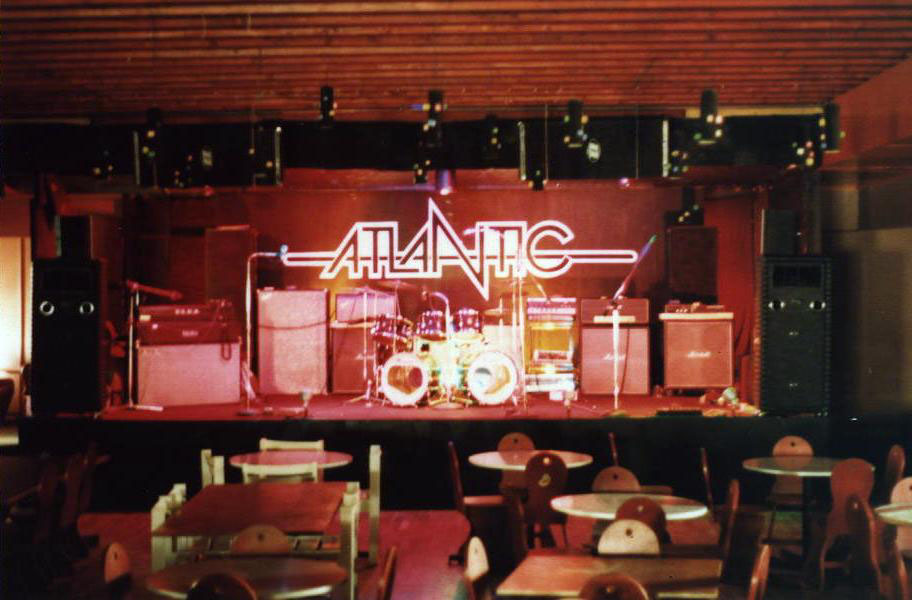
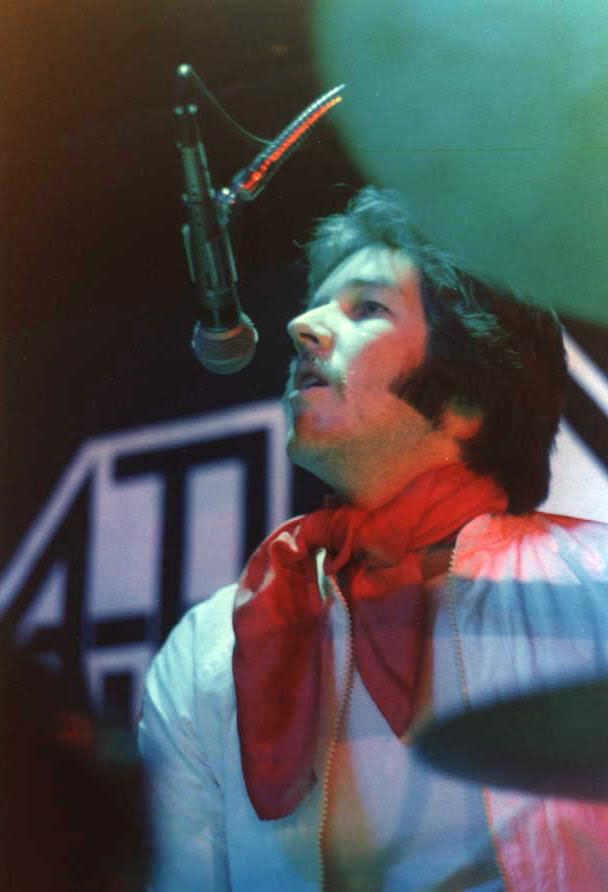
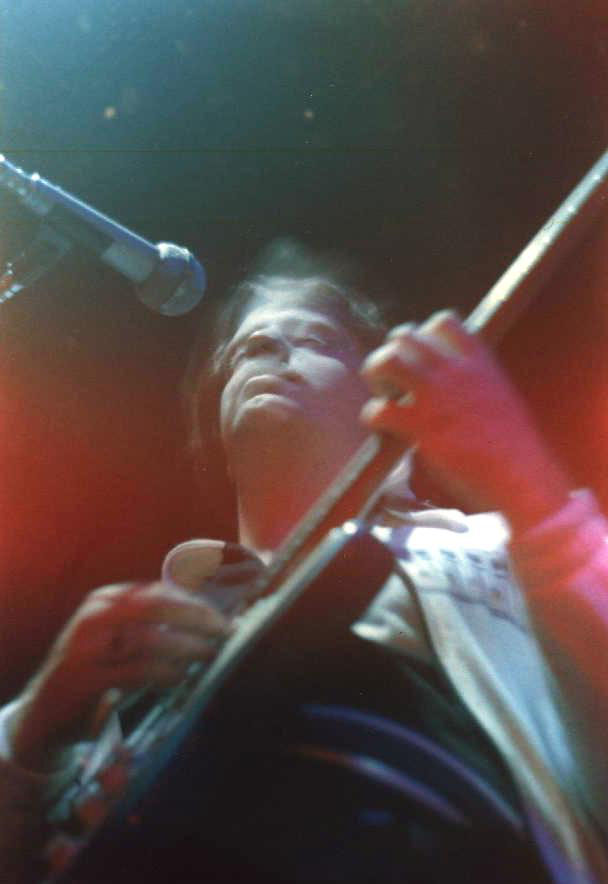
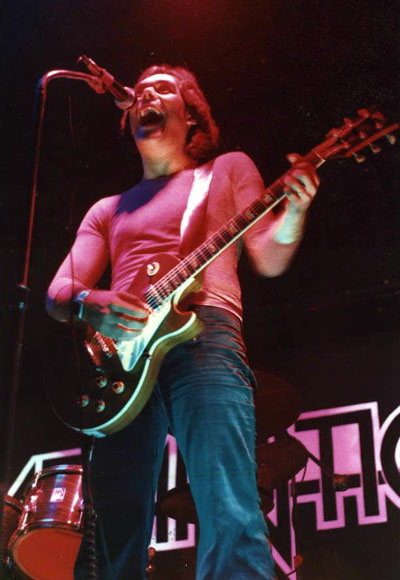
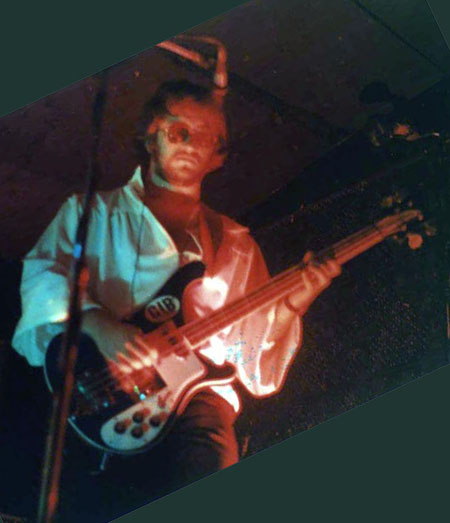
…and the new guy:
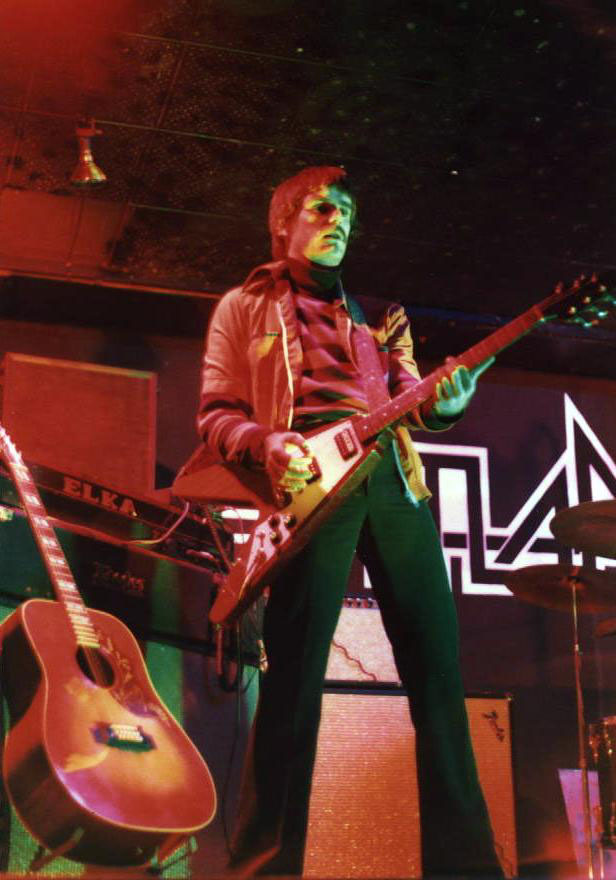
We blew the doors off the place, for three months. Along the way, we tightened not just our sound, but our whole act. When you open up the evening with Billy Cobham’s Stratus and then straight away launch into ELO’s Do Ya?, followed shortly thereafter by Bloomfield-Kooper-Stills’s You Don’t Love Me… and then at some point, I put on a girl’s pale blue nightie (to perform Sticky Love Songs), Knob became Far Ting, our Chinese drummer complete with Fu Manchu mask and three-foot-long drumsticks as we hurtled through a heavy metal version of the venerable Pipeline, and Kevin played not like some humble gig guitarist, but like a Guitar God when we blasted out Jumpin’ Jack Flash — no, not that one, this one — and Black Magic Woman — no, not that one, this one. Then Marty slowed everything down with a slowed-down soul-drenched version of Dave Mason’s Feeling Alright? and then we filled the dance floor with Listen To The Music.)
Yeah, we were definitely not Pussyfoot anymore; we were The Atlantic Show Band.
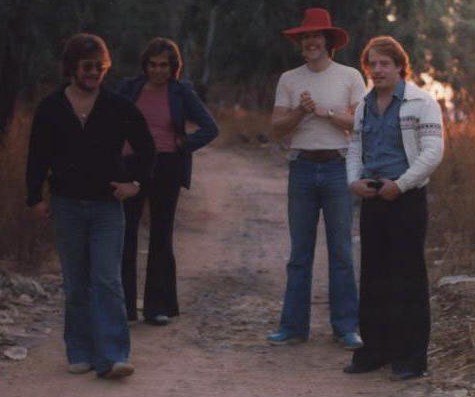
(pic taken by Gibby)
Now all I had to do was deal with the fucking Army, in a few months’ time.
– 0 –
Chapter 10: Serving The Nation
So we packed up the gear at the end of our O.K. Corral contract and went our separate ways. (I was given a very warm send-off by Linda, the motel’s night-time receptionist — so warm that we repeated the exercise some time later when I got my first overnight pass.)
It was a very somber occasion — the split-up, not the send-off — because none of us knew whether we’d ever play together again. My call-up was for a year of National Service and a year, at that stage, was a very long time for a band to be apart — and especially in our case, because of Mike’s frequent Army call-ups and Knob’s increasingly-frequent business trips overseas.
I had only a couple of weeks before the dreaded date, so I spent it responsibly: calling up every name in the little black book and using the “I’m going to the Army and who knows what could happen to me” line — and to my astonishment, it worked on just about every occasion. All that accomplished, the last thing I did was to have a very short haircut; I’d heard many horror stories of what Army barbers did to people who arrived with long hair, and my hair was quite long after about two years since it was last cut.
So duly shorn, I arrived at the mandated time at the gates of the Army Services School camp in Voortrekkerhoogte (the nearest English translation I can give it is “Pioneer Heights”, by the way), and this being the Army, all 2,000 inductees had to sit in a long line along the camp fence and wait, because they’d only known we were coming for about six months, and previous drafts had been occurring every six months for well over a decade.
Side note: I should mention at this point that Services School was a training unit which put recruits through Basic Training (boot camp, as it’s known in the U.S.). Then the newly-trained soldiers were given further training in specific areas of expertise: clerks, cooks, basic automotive mechanics, basic electrical, carpentry, truck driving and so on. At that point they would be sent to wherever they were needed: mechanics, electricians and carpenters to the Technical Regiment (“Tiffies”), and drivers, clerks and cooks to any regiment or facility which needed them. Guys with specific expertise — law- and medical school graduates, for example — were then sent to Officers Training School (OTS), because having a university degree granted you an immediate officer’s commission. After that, they too were sent off to wherever they were needed.
I don’t know why, but I’d brought a guitar with me — that battered old Hofner acoustic on which I’d learned my first chords back in College — and so, being bored out of my mind after waiting for over three hours, I serenaded the guys with a few old tunes. At some point, I was aware of someone taking pictures of this impromptu concert, but I paid it no attention. I should have.
Because at our very first parade the next day, at 3am, the regimental sergeant major, a terrifying individual with coal-black eyes that signaled “pure psychopathic hatred”, roared out: “Where’s the guitarist? Where’s that fucking guitar player?”
Yeah, that would be me.
I held up my hand shakily, and he called me over. In that same roar (even though I was standing only a couple of feet away), he asked: “Did you want to become famous?” And then he opened a copy of the evening newspaper from the day before, which featured a front-page photo of Yours Truly entertaining the other draftees, and shook it angrily in my face.
One of the first things that all veterans tell you is that when you get to the Army, you keep your head down and don’t stand out from the rest, because not doing that gets you all sorts of unwanted and unpleasant attention from psychopathic NCOs — like this one. He looked me up and down with an expression of utter disgust and shouted: “I can see you, Roof.” [rookie]. “You look like a naughty bastard, so I’m going to be looking out for you from now on.”
Dead man walking, that was me.
How I made it through Basics is a mystery for the ages. The only thing that kept me sane was the fact that at the end of the first week, I’d gone on Commandant’s Orders to hand in my transfer request from Major George Hayden. The Commandant looked at it curiously, as though I’d just given him something written in Sanskrit, and handed it off without comment to a clerk for inclusion in my Army file, that mystical and mysterious thing that contained every single detail of a young man’s life (and not just in the Army, either).
Anyway, on the Friday morning after the end of Basics we were called into the RSM’s office, platoon by platoon, where the RSM held a clipboard like he was going to beat each of us to death with it. Written on the clipboard were our various postings, which he proceeded to call out, in a normal conversational tone — the first time any of us had ever heard him speak in anything but a feral roar.
“Albrecht: OTS (Albie was a lawyer, as was Elias Leos, my old university buddy);
“Aswegen: cook, 3 SAI; (3rd Infantry Regiment)
“Boland: clerk, DHQ (Defense Headquarters, like the U.S. Pentagon);
“Dirksen: cook, 5 SAI (5th Infantry Regiment);
“Du Toit: Entertainment Gr — DU TOIT!!!! What the fuck is this entertainment bullshit?”
“Ummm I’m the guitar player, Sar’ Major, remember?”
He looked at me with murder in his eyes. “Just get the fuck out of my regiment, Du Toit, and if I ever see you again, I’m going to shit your eyes closed.”
I got the fuck out of his regiment and never saw him again.
With the usual Army organizational efficiency, there was no transport laid on to take me to my posting, a single troopie probably judged as not being worthy of such special treatment. Fortunately, the Entertainment Group (and for brevity’s sake I’m going to call it the EG from now on) was only a few miles down the road from Services School, so I hitched a ride with a corporal going in my general direction.
When I arrived at the EG in mid-afternoon, the place was almost deserted. So I found my way to the admin office — it was across the hallway from the Major’s office, I remembered — and when I presented my transfer form to the clerk, a strange look came over his face. “Wait here,” he said, and left the room quickly. I waited for about fifteen minutes, whereupon he came back and said, “Captain Bridgens is waiting for you in the Big Band Room for your audition.”
Audition? Another one? I stammered something about that, but the clerk brushed it off. “Major Hayden is retiring, and Captain Bridgens will be taking over command of the unit from next week. He’s ordered that all newcomers have to give a second audition.”
Oh, shit. All sorts of scenarios flashed through my brain. With the man who’d heard me play and got me into the EG now out of the picture, what if I failed this audition? Would I be transferred out of the EG and off to gawd-knows-where? Anyway, there was nothing for it but to make my way to a now-uncertain future.
Bridgens seemed young to be a captain, but he exuded an air of tough competence. “You’re a bass player?” he said briskly. “There’s a bass guitar; plug it into that amp and wait.” Then he walked over to the door. “Manning? Sergeant Manning? Get Sergeant Matheus and report here for an audition.” He came back. “Sergeant Manning is the best jazz drummer in the unit, and Matheus is a genius lead guitarist.”
“What will I be playing?” I asked nervously.
“Oh, probably one of Manning’s compositions,” he said carelessly, not seeing my expression of utter terror.
While waiting, I took stock of the instruments that held my future. The bass was of uncertain manufacture — I guessed it was some Japanese thing — and the amp was not a bass amp, but an old Farfisa organ’s amp/speaker combination. At least I wasn’t going to be playing too loudly, I thought.
Then Manning and Matheus came in, and hell began.
The composition, such as it was, was impossible to play. With all my experience, I couldn’t figure out the key, so I figured I’d at least get the rhythm right – except that Manning’s bass drum strikes were all over the place. Clearly this was a very experimental piece — Matheus’s strange chords made playing with Alex Dawson in Bulawayo a cakewalk by comparison — and I was soon enveloped with a cold sweat of impending doom.
At last, the song ended (taking me completely by surprise, incidentally) and I turned my frightened eyes towards the captain.
What I saw was a private — Bridgens minus his three captain’s stars — holding out his hand to me with a broad grin.
“Hey, Kim,” he said genially, “welcome to the unit.”
It turned out that the entire audition was a complete setup, a hazing of the newcomers by the longtime National Servicemen (NSMs, as opposed to the Permanent Force — PF) . Craig Manning (much more of him later) was actually a keyboards player who had not the slightest idea of how to play the drums, and Deon Matheus was a bass player with, like me, only a rudimentary grasp of guitar chords (which explained his astonishing “jazz” chords, none of which I’d ever seen or heard before). And “Captain” Danny Bridgens was, like me and both the others, just an ordinary private. All three of them had come in from different units: Craig from SSB (Armored Cars, in Bloemfontein), Deon from 2 SAI and Danny from some other infantry unit which I’ve forgotten.
Then I discovered the next thing, which was also good. There was no weekend duty in the EG, which meant that I would get a weekend pass right away, to return only before Monday morning parade at… 8am (not 5.30am, like I was used to in Basics). I had no way of getting home, but a phone call recruited my sister’s boyfriend for the task. The weekend also gave me the chance to get the Rickenbacker and the Fender Bassman amp both loaded into Fred; so I was quite ready to play that Monday morning when it was time to show up for morning parade. I’d like to say that I was bright-eyed and bushy-tailed, but the fact was that I’d spent the Sunday night enjoying that second energetic send-off from Linda at the O.K. Corral, and could barely see straight.
The problem, I discovered, was that there was nowhere for me to play. All the bands seemed to have a full complement — at least as far as bass players were concerned — and there was only one “NSM” band, a four-piece whose individual players seemed pretty good, but the band’s sound (to my professional ears) was rather ragged.
So I found a corner of an empty room somewhere, and spent the next week or so practicing scales. Understand that I was terrified of being regarded as a slacker by any of the NCOs in the place, and not having a band to play in, I was still afraid that I’d just be transferred out of the EG. So I was determined to show one and all that a.) I wasn’t a slacker and b.) I would be ready to play anywhere, if and when needed. On one occasion, a unknown NCO stuck his head around the door, listened to me playing my scales for a few minutes, then nodded and left, without saying a word.
Then one day I got summoned to the Major’s office. When I got there, Hayden looked at me.
“Du Toit, we’ve got a small problem.”
My heart sank. Here we go, I thought.
Hayden went on: “The problem is that the gig was originally allocated to one of the regular — Permanent Force (PF) — bands, but three of their members have come down with, of all things, measles and so they can’t do the gig. So I’ve dropped the NSM band into the slot.” I nodded, foolishly, wondering why he was telling me all this. “Anyway,” he said, and to my surprise a look of embarrassment came over his face, “The engagement is tonight , and it’s the NCOs’ dance at the Military Police camp. But the NSM band’s bassist can’t do the gig. Can you stand in for him?”
There was only one possible answer. “Of course, Major. No problem.”
I later found out that the bassist in question was a guy named Raymond Johnson, and he was a member of the well-known “Johnson Family” musical group (like the Partridge Family, only these family members could actually play their instruments). Anyway, because they were so well known, Hayden had taken pity on Ray and given him the night off, excusing him because (I also discovered later) he knew I could take his place.
So I went off the the NSM band’s practice room, and made my acquaintance with my new bandmates.
Danny Bridgens (the “captain” at my fake audition) was on guitar. He was a dark, Portuguese-looking guy, no doubt caused by the fact that he was Portuguese. He was also an excellent guitarist with a lovely voice.
Craig (“Boze”) Manning (the fake sergeant on the drums at the same audition) was the keyboards player, and I blessed the day I met him. Not only was he a brilliant keyboards player, likewise with an incredible voice, but he knew just about every pop ballad ever recorded — lyrics and music — which would save our bacon on more than one occasion.
Franco Del Mei couldn’t sing. But he was an absolute monster drummer — he reminded me of Led Zeppelin’s John Bonham. There was no rhythm he could not pick up immediately, no part too complex to play, and all at thunderous volume. To my amazement, he was also schooled in all the dance disciplines: foxtrot, tango, quickstep, waltz, cha-cha, rumba and samba and all the others, and unlike many loud drummers, he could adjust his volume to the level of the music.
To say there was panic in the air would be a huge understatement, because while all three of them were accomplished musicians, they were not experienced gig players, and the situation they now found themselves in was terrifying — to them. None was older than nineteen, and all had come to the Army straight out of high school. (By comparison, I at twenty-two was a grizzled old veteran.)
Even worse, there was no time for even a rudimentary rehearsal. A frantic scramble followed for the others to get some band equipment together — only I had brought my own gear into camp, so everyone else had to content themselves with equipment that none of the other unit bands wanted. At least it all functioned, more or less, when we tested it.
We had to pack the gear into the Army truck and leave within the hour if we were going to make the gig on time. In typical Army fashion, we’d found out at 3.30pm that we would be playing at 8pm, and it was a two-hour drive to the venue, way on the far side of Pretoria.
As we were setting up, I saw that the guys looked both stunned and nervous. The only way we were going to make the gig work was if I took control on the stage, so I said, “Guys: leave everything to me. I’ve done this a hundred times. Here’s how it’ll work. If you know a song well enough to play and sing it, tell me and the key it’s written in, and I’ll call it out to the audience.” When I saw their dubious expressions, I added, “I promise you, it’ll be fine.”
This situation was not unfamiliar to me, nor to anyone who’d ever played in a “pick-up” band. So that’s what we did; I would announce the songs, joke with the audience (all Afrikaners, and I was the only one in the band who spoke Afrikaans fluently), and count the music in… and the evening went like velvet.
We were saved by the fact that we were all good musicians — the others, to be frank, quite a lot better than I — and as Boze knew the lyrics and music to a jillion popular songs, the rest of us just followed him along. (“How about Leaving On A Jet Plane ?” he’d ask, to which my only question was: “What key?”) Of course, I also knew a bunch more, of the Credence Clearwater type and early rock ‘n roll genres — at some point in the past, I’d familiarized myself with practically all the songs on the American Graffiti movie soundtrack — so we busked our way through five hours of music. Along the way, the others started to relax, whereupon the anxiety level dropped, we started to enjoy ourselves and the music began to improve. It’s actually one of my fondest band memories from that time (and I have a ton of them).
We got a loud ovation from the audience after we finished our last song — and we in the band had enjoyed the experience so much that then and there we decided to make the band a permanent one (or at least for the remaining time of our draft). When we told Ray that he was out, he was a little disappointed, but then he said, “The Johnson Family is pretty much booked up for the rest of the year, so at least I won’t have to go and beg Hayden to excuse me all the time.” So everything was settled.
We found an empty practice room, set up the gear, and started putting together a repertoire that ended up being astonishing in its variety. And because our whole job was to play music, we played all day and every day, five days a week — sometimes taking two or more days to master a complex song.
Then only a couple of weeks later, a new guy came to the EG. Stan Greenberg was a passable singer and he’d been to the same high school as Boze. He also wouldn’t stop pestering us to join the band, so in the end we gave in — who can say no to an extra voice? — and we were to discover that Stan, unlike so many vocalists, was not content just to sing: he became completely professional about the whole thing, learning his parts and the lyrics to perfection.
The interesting thing was that while the others could sing, they couldn’t arrange the vocals — allocating parts to each individual according to their vocal range and sound. Ha! but I could, and did, all that remembered training from the College choir, musical theater and countless band practices coming to the fore.
We would go on to play gigs at military bases all over South Africa. And we rocked. We were better than a lot of professional club house bands, all but Franco could sing, and gorgeous harmonies became our stock-in-trade: nobody could sing with us, not even the pros. As we already had a good list of oldies and party songs, we could concentrate on playing stuff that we wanted to play, which made us all better musicians.
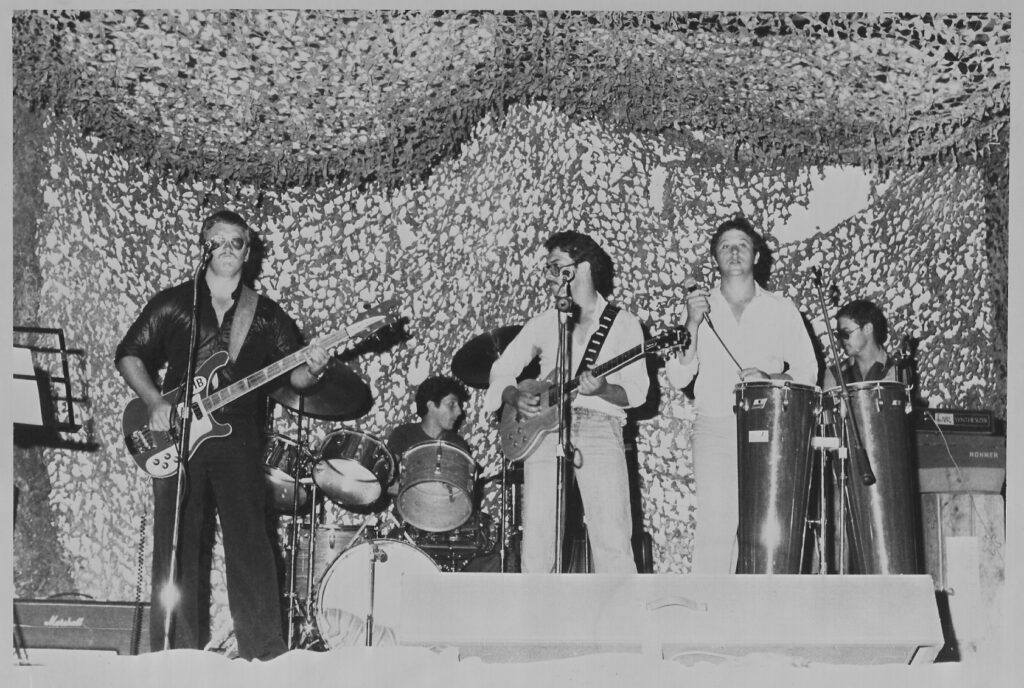
(Kim, Franco, Danny, Stan and Boze)
Of course, as our repertoire expanded from the simple to the complex (from Bad Moon Rising to Who Loves You, and from John Denver to Steely Dan) the one who struggled most was, of course, the bass player. And I could see that often the other guys got frustrated when I just couldn’t pick up the part as written, but had to adapt it to something I could play. What I did do was work on those bass parts on my own when no one was around, late at night or over weekends, and then play the original part the next time we performed the song, getting surprised looks from Danny especially.
Then Stan came up with a name for the “NSM band”: Hogwash. It was tongue-in-cheek, especially as our music was anything but and, as Boze cheekily pointed out, it was ironic that our “Token Jew” had come up with a non-kosher name.
We even had it painted on the side of Fred, replacing the old “Pussyfoot” designation.
The Hogwash experience was quite honestly one of the happiest times of my life. We had no responsibilities and nothing else to do but play, and play, and play — and when we weren’t playing music, it was like being in Monty Python, with wicked humor, outrageous behavior and general mischief in abundance. Boze especially had a dark, abstract sense of absurd humor which never failed to render me bent over with laughter.
But it was all going to come to an end soon, because our National Service commitment was for only one year, and Boze, Danny and Franco had come in on the draft six months prior to Stan’s and mine — which meant that Hogwash would cease to exist only a few months after its foundation. We’d got together in early August 1977, and the three guys’ demob (in Afrikaans, uitklaring ) in December 1977 was looming.
Then fate struck. Remember I said earlier that I’d explain my Army number? Here it is.
The “BG” designation was a strange one. We knew that some guys’ numbers ended with “BA” or BC” (nobody knew what had happened to “BB”, if it ever existed), but everyone in the band had the “BG” designation. What we discovered was that the embedded meaning in “BG” meant to the Army that “If we need more men, we’ll just extend their commitment to two years instead of one.”
Which the Army did, issuing the order a scant three weeks before the demob date of December 17, 1977. Which meant that Boze, Danny and Franco would now be leaving in December 1978, and therefore Hogwash had been given an extended stay of execution. Of course, they were thunderstruck by the news — I think that Boze had actually landed a job to begin in January ’78, which he now had to call off — but after the shock wore off, we carried on.
The only good thing about this extended service was that, to our great joy, we were going to be booked to play at forward combat bases in the “Operational Area” of South West Africa (later Namibia), where South African troops had been deployed to prevent incursions of terrorist cadres into the country.

(underlined are the bases we played at, most more than once)
These tours were like the Bob Hope shows in Vietnam: a band (Hogwash) and a headline act of some singer or another (to be explained later) would set up on a makeshift stage in the camp, and perform for the troops. Not always the troops, however; sometimes we’d play for an audience consisting mostly of the local (White) families and officers’ wives. We hated those shows; we wanted to play for the guys doing the actual fighting, not a bunch of REMFs. But we gritted our teeth and played our best because, as I explained to the others, we were professionals and had to. The guys took it to heart, and I can truthfully say that we never once mailed in a performance. I don’t remember exactly how many tours we did, but I think it was five or six over the course of 1978. I think our favorite gig was at Ruacana (extreme left) because it was (in U.S. terms) a forward fire base, a scant couple of miles from the Angolan border and subject to rocket- or mortar fire at any given moment. I’m pretty sure that the bad guys on the other side of the border could hear us, because that night we played as loudly as I’ve ever heard us play, and the reception from the troops was equally raucous.
Something else happened: Stan’s father, who was in the hotel business, bought a well-known hotel called Taylor’s Travelodge just south of Johannesburg, and needed a restaurant band for weekend nights. Of course we got the job; and so for the first time, the other guys in Hogwash got to experience what it was like to play a steady gig. Like most restaurant setups, it was soft dance music for the first two sets until 10pm, and then came time to cut loose, which we did with gusto. Two songs from that period come to mind: Earth Wind & Fire’s Fantasy (in which Stan found — to his own surprise — that he could sing a very creditable falsetto; and in Steely Dan’s Don’t Take Me Alive, where I managed to play Chuck Rainey’s fiendish bass line and sing the lead vocal, to my utter surprise. (Danny, of course, absolutely killed Larry Carlton’s lead solos, because genius.)
So we passed the rest of the year, gig after gig, tour after tour, weekend after weekend at the Travelodge, and the question came as to whether we should go professional after the Army. There was no question that we were good enough. There was also no question but that I’d be able to get us a gig; with my contacts among the various club owners and managers, I was confident that I could get us a contract somewhere.
Now we knew that if we did that, Stan would be unlikely to stay with the band: he was already working in sundry jobs at his father’s various hotels at night, and would never be able to join us if we landed a gig in, say, Durban or even Pretoria. But we made it very clear to him that if and when we landed a club contract in Johannesburg or thereabouts, he would always be welcome to come back and do the gig with us. All the band had to do was wait those few months until my draft ended, in July 1979 — and even if we did land a gig in Johannesburg or Pretoria before then, I was confident that I’d be able to get away at nights to play. So we started making plans for “civvie street”: a fresh, updated repertoire, ditching songs that weren’t good enough or current enough to play in clubs, finding places where we could get uniforms (if needed), talking to various electrical establishments to build a decent light show (guess whose idea that was), and drawing up a list of equipment that we’d need to play a large club (as opposed to a small room).
Then, about a month before the three guys were due to leave the Army, Boze announced that he didn’t want to go professional. He was quite positive about his decision, and no amount of discussion or pleading could sway him to do otherwise.
Immediately, all our plans and dreams were dashed, because) Hogwash was a unit (and I hate to even make the comparison), a band like The Beatles. Each of us brought something specific to the party, and because of that, the whole was infinitely greater than the sum of its parts. So losing Boze didn’t just mean we lost a lovely voice and an excellent keyboards player: part of the soul of the band vanished as well. Danny was especially angry. “We turned Boze from a casual living room piano player into a keyboards player who could do any gig anywhere, with any band… and he’s just turning his back on us?” It took a while for that feeling of betrayal to die down.
It had a huge impact on me, too. When Hogwash (as was) ceased to exist, Danny and Franco decided that if they were going to start afresh, they could do it with a more accomplished bassist (actually, Dion Matheus, the “guitarist” from my fake audition, who was admittedly an excellent bassist, far better than I was).
So I was out, too, and Hogwash essentially ceased to exist.
The only good thing was that during those last few weeks together in the EG, we didn’t have to play a single gig. So Boze, Danny and Franco left the EG in December 1978, and Stan and I were on our own for the last six months of our commitment.
What next?
– 0 –
Chapter 11: Full-time Gigging
Despite my fears, it turned out that the first six months of 1979 (the final months of my draft commitment) and indeed the rest of the year in total would turn out to be great, both in terms of playing music and to a certain degree, financial as well.
The first thing that happened was that I was promoted to corporal — the highest rank a draftee could achieve without going to OTS and getting commissioned — and that made me the senior NSM NCO in the Entertainment Group. This meant that I had to do admin stuff like take morning roll call, drill the rest of the NSMs and handle all the crap details of typical Army life, such as manage the parade ground cleanup, keeping the main building clean and tidy and vehicle maintenance (we had two Bedford trucks, a Greyhound-size bus (for the Big Band), two large pickup trucks (think: Ford F-100, with caps), some trailers and two VW passenger vans. All this meant that I didn’t have to do any of the actual shit work myself (like washing windows or sweeping floors), but simply order the others around.
And I did as little with the guys as I could possibly get away with. A lot of the time, I’d take the platoon out for a “route march”, which involved marching them out of the camp and down the road until the EG was out of sight, then taking the guys away from the road where we’d lie in the shade in a grove of trees for about half an hour, smoking and buggering around. Then I’d march everyone back until just before the EG camp came into view, whereupon I’d get everyone to double-time it back the last quarter-mile or so. Because the climate in Voortrekker was sub-tropical — that is to say, blisteringly hot — it didn’t take long for everyone to break a sweat, which meant we’d arrive back in camp looking as though we’d finished a twenty-mile forced march. Whereupon I’d give everyone half an hour to “recover”, and then detail the duties for the day.
As the officers and senior NCOs (the PF personnel) left camp around midday, that meant that the guys only had to do the shit work for about two hours instead of the four or so. And neither the Major nor his Executive Officer (Captain Bornman) ever caught on.
However, I wasn’t in the EG to bugger around with Army nonsense, I was there to play music. So I started to hang around the Permanent Force (PF) bands, trying to cadge a gig here or there and sometimes succeeding. In fact, of the four such bands, the only one I didn’t get to play with was Neil Herbert’s band — the one with whom I’d given my first audition before call-up — but I played at least half a dozen gigs with the others, collectively. I even got to go on a Border tour with one of them, backing a famous opera singer named Gé Korsten.
There were two NSM bands, but I didn’t care for the guys in one, and the others were absolutely terrible musicians. (How had they got into the EG?) Frankly, I just wasn’t up to the hard work in building a new band, and especially so since my Army days were numbered. There were however three younger guys in that draft who were not just good, but incredibly good: Joe Runde, a tall blonde German kid who played an amazing blues lead guitar; Selwyn “Zell” Shandel, a shy Jewish kid who was a wonderful pianist (more on him later), and a skinny redhead kid named Freddy Crooks, a lead guitarist who would have been an asset to any band, anywhere. (There’s one interesting factoid here: Freddy, Hogwash’s Danny and Atlantic’s Kevin all shared a birth date, and all three were brilliant guitarists.) Freddy had actually heard me play with Atlantic at the O.K. Corral, and his opinion was that we rocked as hard as any band he’d ever heard play at Okies, which was rather gratifying to hear.
But mostly, I hung around with the PF guys; and this proved to be a life-changing event for me.
I played several fill-in gigs with a couple of the EG’s Permanent Force bands, all headed by musicians who were well known to the Afrikaans public – some had appeared on TV, others had record contracts, most played as studio session musicians and all played those “private gigs” pretty much every weekend. Names like Flippie van Vuuren (who played about seven instruments, all very well indeed), Gerrit Viljoen and Ollie Viljoen (no relation) were as well known to Afrikaners as country stars like Garth Brooks and Waylon Jennings would have been in the U.S.
Side note: Ollie Viljoen forced me to brush up on my musical theory, big time. He would call a song, and when I asked him the key, he would just gesture to me with his fingers: two fingers pointing upward meant two sharps (i.e. the key of D major or B minor), three fingers down meant three flats (E-flat major or C minor), etc. Fortunately, his favorite keys were E flat and B flat so after a while I could settle down and enjoy myself, even adding a vocal harmony or two occasionally.
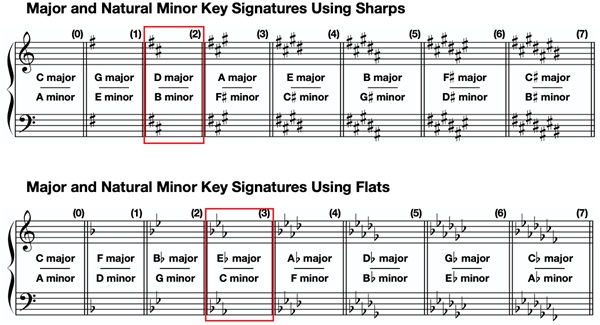
It had been literally years since I’d read key signatures, but somehow I managed to dredge them up from the Stygian blackness of my memory. So after the first few fumbles, I started to get them right. It didn’t help that, almost to a man, all the Permanent Force musicians were insanely good sight readers – far better than I was, for sure – but as with all things, practice made perfect. And with the constant daily rehearsals with Hogwash, I discovered that I’d reacquired my perfect pitch from College choir days, so it all got progressively easier.
Gradually over time, though, I came to realize a couple of really important things. The first, and the most important, was that I was not talented enough a bass player to be a full-time professional. I could probably get better through some assiduous practice, but not better enough to earn a respectable (and consistent) living. I was a good musician, as a sum of my parts: I could sing well, both lead and in the chorus; I was very disciplined; I could read music — perfectly when it came to vocals, and reasonably well on bass — and I was at least competent on the bass guitar, but no more than that. I could probably have played with most club bands, as long as the other members were about on my level, but there was no way I would ever be good enough to earn a living as a session musician (the only other avenue to earning a living as a professional musician).
What I could have done was join the Army’s Permanent Force in the Entertainment Group, something that more than a couple of the established PF bandleaders told me. (The above-mentioned Flippie van Vuuren, who was one of the best-known Afrikaans musicians in the country, actually leaned on me quite hard to do just that, telling me that I’d probably be promoted to sergeant immediately, getting a big bump in take-home pay, and hinting broadly that I’d become the bassist in his band.) It was a career option, and for a lazy man like me it was not an unattractive option; but my rebellious nature quailed at the thought of submitting to Army authority.
Because there was another side to the equation. One of the trombonists in George Hayden’s Big Band was a sergeant-major named Vic Wilkinson, an enormously fat and unpleasant individual who disliked me intensely (for no reason I could ever ascertain); and he could (and did) fuck with me harshly and endlessly for no reason other than I couldn’t retaliate or fight back just because he outranked me. It’s one of the sad downsides to any rigid hierarchical entity, and the Army still more so: bullies of a higher rank are to a large degree invulnerable to the lower ranks and the bad ones are prone to abuse their position.
So no; that second thing was that I was not going to join the Permanent Force. But what was I going to do, if professional music was not going to be my future career? At that point, I didn’t know; but what I did know was that whatever I did, I was going to be really good at it. And I wasn’t going to stop playing in a band, either.
Then I got lucky. Atlantic had more or less folded after I left for the Army. The guys had either hooked up with other bands, or just recruited others to play with. Drummer Knob, by the way, had started to become a really successful businessman: his pattern was to work for a big company, identify what their weaknesses were, then leave them and set up a business which addressed those weaknesses, calling on their clients to sell them his services. Then his company would get bought out (often by the same corporation he’d worked for previously), and he’d join another big company and repeat the exercise. He did that twice or three times, I don’t remember. Much later on he set up a company which imported personal computers, made a huge success of it, and when that company was bought out he went into property development and started to make serious money. But that would come later. More importantly for me, though, was that I knew he was never going to drop all that to become a professional musician, even if by some miracle we could get the band back together.
Kevin had ended up joining one of Johannesburg’s premier gig bands, Black Ice, who’d been together for well over a decade and were pretty much always in the top five groups that came to mind when people were looking to book a band for a function. I mean, they even ran daily ads in all the big Johannesburg and Pretoria newspapers. They made me ashamed of our marketing incompetence.
One day in April 1979 Kevin contacted me and said:
“What do you think about playing for Black Ice?”
I was taken aback. “What about Traz?” (their current bassist and founding member)
“He’s had enough of gigging, and he’s quit the band. We need a bass player right away.”
“Wow. Well, yes I’d love to play with you guys, then. Does Adrian [the band leader and keyboards player] want me to audition?”
Kevin snorted. “Are you kidding? You’re three times better than Traz ever was, and Adrian knows it. But he wants to know: will you be able to get away from the Army to play gigs?”
I thought furiously ahead to remember if I’d been booked for any tours with a PF band, and I hadn’t.
“It won’t be a problem. I can always get away, especially if it’s going to be over weekends. When do you want me to start?” (It was now Monday.)
“This weekend.”
“Fucking hell, Kev, that’s a little tight. Can we at least have a couple rehearsals before then?”
“That was going to be my next question. Can you come over to my place tonight? Adrian made a tape of our whole playlist, and wants me to give it to you. Then he wants to rehearse on Wednesday and Thursday so we can be more or less ready to play on Friday night.”
“Bloody hell: two days to learn a band’s entire playlist. Okay, I’ll see you tonight.”
So I took the Rickenbacker and went over to Kevin’s. We stayed up till well after midnight listening to the music, giving me a chance to listen to the songs and with Kevin’s help, work out at least a rudimentary understanding of how Black Ice played them. Then I took the tape (actually, tapes: there were five of them, about seven or eight hours’ worth of music) back to camp and spent the entire Tuesday and Wednesday (day and night) listening to, working out and playing along with every song. Freddy Crooks — with whom I shared sleeping quarters during the week, in one of those huge Army tents — helped me work out some of the more complex bass parts, which helped immensely.
Fortunately, the songs were mostly current hit parade stuff, and were pretty easy. The ones that weren’t pop songs comprised a slew of ELO material, which was no real problem for me because I loved ELO (still do) and knew pretty much all those songs already. I hadn’t actually played any of them before, but that wasn’t much of a issue; just as if you know a song you can sing along with it quite easily, the same is true if you’re able to busk along with an instrument, once you know the key it’s written in. Which I figured out for all the songs on the tapes, and duly wrote down on an index card which I taped to the back of the Rickenbacker, something I’d learned to do when playing with the PF bands. And of course there were a number of songs — about a third of the total — which I had played before anyway, so I knew both the bass and the vocal harmony parts.
Rehearsal time came, and I arrived at the Black Ice rehearsal room with amp and Rickenbacker. (The huge Fender Bassman stack had been replaced with a Roland Studio Bass amp — same power output, much smaller and a better sound.) We set up, and Adrian said, “What do you want to start off with?” I just shrugged nonchalantly (although I was feeling anything but nonchalant) and replied, “You pick it.”
I don’t remember which song he chose, but it happened to be one Hogwash had played, so of course I knew it well, and nailed it like a two-by-four. I even did a vocal harmony. The end of the first practice, Brian said, “Well done,” but Adrian was non-committal. When I asked Kevin what he thought, he just grinned. Then at the end of the second practice/audition, Adrian just said: “See you tomorrow night. Kevin knows where the gig is.” I was in the band, just like that.
This was Black Ice:
Adrian was the founding member, bandleader and keyboards player. He was a decent enough player, but he could only play what he’d rehearsed: he could not improvise at all. He was also somewhat unpleasant, with a mean streak often resulting in cruelty.
On drums was another founding member, Brian. He was a Brit from the northeast of England with an absolutely impenetrable Geordie accent. He also had an incapacitating stammer, which I only discovered after a month or so. He was a lovely man, but a terrible drummer. (After having played with many drummers, mostly with the creative and capable Knob in Atlantic, the fiery and dynamic Franco in Hogwash, and not to mention the masterful drummers in the PF bands, I was somewhat spoiled.)
Our vocalist was a Brit kid of about nineteen also named Adrian, whom I’d seen play before with a minor band named Sheriff. He had a lovely voice, and we got over the “two Adrians” thing by nicknaming him “Little Adrian” (which he hated, but had no choice in the matter).
And of course on lead guitar was Kevin, who had, if anything, improved since the Pussyfoot / Atlantic days, which made him even more of a monster guitarist.
Those first two gigs went off very well, and when I showed up for practice the following Wednesday, I was somewhat surprised when Adrian handed me a tape and said, “Here are the next two songs we’ll be learning at practice next week.” There was no discussion or negotiation: what Adrian decided, we were going to play. I didn’t always agree with his selections, but I kept my mouth shut because I was the new guy, and I had to admit, the Black Ice way made us tremendously popular and we played as many as half a dozen gigs per month, every month.
The routine seldom varied and was a well-oiled machine: practice on Wednesday, load up the VW van (not mine; Brian’s) immediately after, meet up at the gig on Friday no later than a hour before the start time, set up (in half an hour) and play the gig, then strike the stage and load all the gear back into the van. Ditto on Saturday. Then we’d all meet at the practice room the following Wednesday, unpack and set up the gear (essentially giving us three gigs a week in terms of work). Then Adrian would read out the latest gigs we’d been booked for, which we wrote in our calendars; and then it was time to learn the two new songs, which had to be ready for the next gig in two days’ time. Rinse and repeat, ad infinitum.
It was actually exhausting work, no less for the physical exertion than for the effort required to learn two new songs, each and every week. But oh man, did we make money. Little Adrian actually had no day job and lived off his Black Ice income (easy when you’re unmarried and still living at home with your parents). Kevin had found work as a rep for a pharmaceutical company, Brian had his own construction business making and installing saunas, and Big Adrian had my old job at Bothners, working with Eds Boyle. How Adrian and Brian managed to have day jobs and families and learn all those new songs remained a mystery to me. I was now less surprised that Traz (the original bassist) had quit. Black Ice was very close to being a full-time job.
One of the songs we played was one I’d always wanted to, but never had because it had a prominent saxophone part: Gerry Rafferty’s Baker Street (one of my all-time favorites, and certainly one of the greatest pop songs ever recorded). To my surprise, when Adrian wanted to rehearse it — for some reason, he’d left it off my “introduction” tapes — I raised my eyebrows and said, “And the sax?”
Silly rabbit: Adrian had a synthesizer (one of his five onstage keyboards, incidentally) which played a perfect rendition of a sax. So I learned it — it wasn’t too difficult, especially at this stage of my musical career — and of course, Kevin nailed the song’s fantastic lead solo, as he did every lead solo. It turned out that Traz had always had a problem playing the bass part, but I didn’t: so Baker Street became one of our signature songs. (This will be important later.)
Then Adrian announced that he would be taking the month of July off because he wanted to take his wife to Europe on vacation. He’d canceled three scheduled gigs and found replacement bands, but he couldn’t find a band for the fourth, and did we know any bands who could help?
Needless to say, this pissed the rest of us off, as much for the reduced income as well as for the high-handed manner in which he’d sprung this on us. So I said, “Never mind, we’ll do the gig” (which was on the first weekend of July). I didn’t actually know how we were going to do it, but the hell with Adrian.
First I called the old standby, Gibby, because if anyone could do the gig, he could. Sadly, however, he was going to be out of the country (permanently, as it turned out) setting up a new job.
Then I had a brainwave: Zell (Selwyn Shandel, from the Entertainment Group). He was at once astonished that I’d offer him a gig with the famous Black Ice, and terrified that he’d screw it up. To be honest, I wasn’t quite sure he could handle it either, but I also knew that he was a brilliant pianist and if I could stand next to him and offer advice all the way through the gig, he’d pull it off — at least, well enough to fool the audience. The problem? There was no time to rehearse, at all, so he’d have to go into the gig cold, with only Black Ice’s master tapes to help him for the couple days before the gig. Mischievously, I told him to memorize the “sax” part in Baker Street, and I’d just signal when he was to play it. I thought he was going to pass out.
Came the day of the gig, and everyone was nervous because keyboards was so critical to Black Ice’s playlist.
Selwyn blew the doors off. Specifically, he handled Baker Street like he’d been playing it all his life. He did such a good job that Brian told me afterwards, “If Adrian ever decides to leave the band, make sure to hire this guy.”
That little thing done, I had just one more problem to take care of: the end of my time in the Army, and how I was going to earn a living.
At the end of my National Service, therefore, I had no job, no prospects, no money and in one of my more stupid moments had rented an apartment without having more than the first month’s (Black Ice) rent money in my bank account. So there I was: in an expensive (for the time) apartment right in the middle of downtown Johannesburg, a few cans of food and even fewer sticks of furniture, going to job interviews on pretty much a full-time basis — as I recall, about three a day — and all for entry-level positions that had no guarantee of a salary that could pay the next month’s rent, let alone anything else.
And I made it even worse for myself by consistently turning down job offers because they were shitty clerical jobs with institutions like insurance companies. Oh, and the gig prospects were non-existent at that moment either — no idea why, it was just in a fallow patch for the next couple of weeks.
Then I got a call from Gerrit Viljoen in the Entertainment Group, in whose band I’d played a couple of times before during the past six months.
“Kim! Are you playing anywhere for the next two weekends?”
“Nope.”
“I have a problem. I’ve got a private gig at a dinner dance club in Pretoria, but our bassist just learned he has a kidney problem, so he’s unavailable for the next three weeks — hospital, operations, recovery and so on. Can you fill in?”
“Of course I can, Gerrit. Where’s the gig, and what time do you start?”
So for the next two weekends I would be earning enough to pay the next month’s rent, playing in this Pretoria nightclub with a trio (Gerrit on keyboards and a drummer whose name I’ve forgotten), backing a female singer named Amanda, a tall brunette who was terribly sexy, but (I discovered) a lesbian.
Not that there’s anything wrong with that.
And she had a terrific voice. Nothing wrong with that, either.
Fortunately, the music wasn’t that difficult — nightclub-type jazz standards and popular ballads: the stuff I’d cut my professional musician’s teeth on. I knew most of the songs, and the ones I didn’t I could easily busk my way through.
One of the songs that Amanda could really kill was Leo Sayer’s Can’t Stop Loving You. So the first time we played it, I got to the refrain and sidled up to the mike, waiting for someone to sing a harmony so that I could add another one, but… nothing. She had to sing it without any vocal harmonies to back her up – apparently, the other two guys couldn’t sing them. So the second time the refrain came up, I added a harmony – the top one above the melody she was singing.
I’ll never forget the look on Amanda’s face. She gave me this huge smile as she sang, and walked over to me so we could share her mike, turning it into a duet and staring into each others’ eyes as we sang. It was incredibly sexy: we must have looked like lovers to the crowd, and when we finished, there was a storm of applause. During the break, she said:
“Can you do more harmonies?”
“Anything you want.”
“Linda Ronstadt? Blue Bayou?”
“Whatever you want. You sing it, honey, and I’ll back you.”
So she did, and so did I. It turned a simple fill-in gig into a wonderful time.
Side note: On the Friday afternoon before the second-to-last gig with Gerrit’s band, I went for a job interview and not only nailed the interview but got a start date for the very next Monday. (Even better was that I felt as though I’d come home, and I was right: I was to work at the A.C. Nielsen Research Company for ten years, over two continents, with only a few detours at other companies — a story to be told some other time.)
So now, like the other older guys in the band, I now had a day job and could concentrate on using the Black Ice gig income to (finally) pay off all the gear I’d bought over the past five years or so.
One of the better times we had was how much time we spent with other musicians. Whether it was band picnics with the guys from two or more other bands, or late nights spent at all-night dance clubs (more on that later), or just after-midnight meals at some of the all-night steakhouses restaurants and coffee bars, it was a giddy time of my life. One of the bands who had become very popular was an all-girl band named Clout, who were to go on to become a huge hit in Europe, especially in Germany. To my great joy, their drummer was none other than my old buddy, the pint-sized Ingrid Herbst (“Ingy”) who had won that talent competition at the Palm Grove as a teenage schoolgirl. We met up, and our bands hung out together a lot during those late-night hours, they and a couple of the Black Ice guys as well as some of the other pro musicians. (I had the total hots not for Ingy but for their bassist, Lee; but she wasn’t interested in my story. Bummer.)
Anyway, we ground on after Adrian’s return from his European Vacation, and as I recall, we played every single Friday and Saturday night from the beginning of August through the end of December. It worked out to over fifty gigs — we even played a couple of “double features” — a gig on Saturday afternoon followed by a different gig that same night — and a slew of weeknights (office Christmas parties) in December. The job was so punishing that in mid-October Adrian declared an end to the Wednesday night rehearsals (“I think we have enough fucking songs to carry us through the rest of the year”, and he was right).
So New Year’s Eve 1979 came, and we approached it with a certain amount of exhausted relief because Adrian said there were no gigs booked for January, and I think we all wanted the time off. The party went off with a huge bang — the crowd went wild, and we played, I think, better than we’d ever played before.
After the gig ended (at about 3am), Adrian called a band meeting. It was short, and brutal.
“I’m shutting down Black Ice as of right now. I’m going pro — oh, and I’m taking Kevin and Adrian with me to the new band.”
I was thunderstruck, of course, but I will never forget the look of pain and betrayal on Brian’s face. He’d been the drummer in Black Ice from the beginning and had not missed a single gig in well over a decade. Adrian hadn’t even had the courtesy to tell him the news beforehand — why, I don’t know — and for that matter, he could have told me too: I wouldn’t have caused any problems because if anyone knew the itch to play professionally, it was me.
And all those non-practice Wednesdays? Adrian had been rehearsing with the new bandmates — including Kevin, of course, having sworn one of my best friends to secrecy — and they would be starting their club gig in Durban the very next weekend.
So that was that. Once again, I had found myself without a band, and I couldn’t think of what was going to happen next.
– 0 –
Chapter 12 – Side Gigs & Cabaret
Back when we first started Pussyfoot, I was contacted by an acquaintance who was playing in his own band, but they had a problem with an upcoming gig: their bassist wasn’t available for some reason or other, and could I help them out? Well, of course I could: the gig was for a Friday night, and Pussyfoot wasn’t yet up to the point where people knew who we were, let alone beating down our door to hire us, so we weren’t booked for that date.
So I did the gig, which went down well – the band ‘s playlist was pretty much like that of the Mike Du Preez Trio, with a couple of popular songs (by the Hollies, Credence, and so on) so I could pretty much handle all the songs they threw at me. They were grateful that I’d been able to help them out and that, I thought, was that.
Not really. I casually mentioned the side gig to the Pussyfoot guys at our next practice, and the following week Donat told me that they’d talked about it, and didn’t want me to play with other bands. In vain did I tell them that side gigs did not in any way mean that I was going to leave Pussyfoot or anything like that – they were just fill-ins, after all – and I couldn’t see why this would be a problem. Nevertheless, it appeared that it was a problem for the others, so in the interests of keeping everyone happy, I just shrugged and said okay…
…and kept doing side gigs, because I liked getting the extra money, and more than anything else, I loved playing music. I just kept my mouth shut about it.
Over the years to come, I would play literally dozens upon dozens of them, learning the craft, sharpening up my busking skills, and even learning which songs were really popular with the public – at that time, songs that Pussyfoot didn’t already play – and on more than one occasion, I suggested that we learn a couple of them, and surprise surprise they went down pretty well with audiences.
Here’s the story of one such side gig.
I got a call from Eds Boyle. Apparently, a dance band needed a bassist for a one-night gig, so he’d given them my name. As it happened, this came right after the Black Ice breakup, so I was free.
This gig was priceless. It was a seniors’ mixer, one of those things that were a feature in the pre-Internet days when older widows, widowers and divorcees joined a club and got together for an evening’s dancing and meeting. They were universally known rather cruelly as “Grab-A-Granny” gigs, but it was all in good fun and even the participants referred to them as such. What was nice was that given the ages of the members, the popular music was going to be Mike du Preez Trio material: jazz- and dance standards from the ’30s, ’40s and ’50s, which suited me down to the ground and I couldn’t wait to get to the gig.
The band I met for this particular gig was led by an older guy on saxophone, accompanied by a pianist, bassist and drummer. I don’t remember any of their names except that of the pianist, a weathered veteran named Dougie Sachs. The reason I remember him is that when we arrived at the gig (which was in some rather old and rundown hotel in downtown Johannesburg), we discovered that the house piano was absolutely knackered, with cigarette burns all over it and, more alarmingly, with lots of keys that made no sound when struck. Dougie was beside himself because there was no chance for us to get another piano, and when I called Mike to see if he could lend us his Fender Rhodes piano, I discovered that he and his girlfriend had gone out for the night. So no help there.
In desperation, I said to Dougie: “Is there any key signature that can play all the notes?” Well, upon going through all the keys, we discovered that A flat was the only one which yielded a full complement of notes in that key. So for that entire gig, whenever it came time for a piano solo, Dougie and I would swing into A flat, then revert to the song’s original key signature once done. Of course, for a sax player, A flat is almost unplayable – or at least, it was for our saxophonist – so it must have sounded truly strange to anyone who knew anything about music. But everybody in the audience seemed oblivious to what we were doing, so everything went down well.
At the end of the whole thing, Dougie came up to me and said, “I’m never going to play another song in A flat ever again,” and together we howled with laughter. A good time, that, and I did a couple more gigs with Dougie as a result of that Grab-A-Granny near-disaster.
And all those side gigs came into play when it came time to back cabaret artists.
The whole concept of cabaret singers is a strange one to Americans, I think. Mostly, people regard “cabaret” as an act one might see in Las Vegas or Atlantic City, as part of the casino marketing campaigns. In South Africa, there were only few such venues, so solo acts had very few opportunities to perform. Here’s one example.
There was a singer / actor named Richard Loring, originally from the U.K. but now a full-time resident in South Africa. He’d starred in a couple of musical movies, but his real claim to fame was having starred in Andrew Lloyd-Webber/Tim Rice’s Joseph and the Amazing Technicolor Dreamcoat, which ran for years all over the country. Loring was about as well-known as, say, Tony Bennett in the U.S.
I first ran into him in the Entertainment Group, when he needed a band to back him on one of his tours to the “Border”, and Hogwash was suggested to him – he wanted a rock ‘n roll band to back him, and not one of the Afrikaans bands. (I suspect that him being an Englishman, the Afrikaners didn’t much care for him anyway, so I’m pretty sure that they all turned him down, leaving him with… Hogwash.)
Anyway, he showed up at the EG with a few cassette tapes of his songs – no sheet music, thank goodness – and asked us to play them. Well, Craig knew all those songs (of course), so we put our heads down and played each of them a few times. As it turned out, Loring was not very impressed with us (and said so), but as the first show was scheduled for the following week, he didn’t have much choice. So he sighed and left, saying, “Please just practice the songs, and do your best.”
Well, that didn’t go down very well with us at all. Of course we could play those easy songs, we just needed to learn them. So we got stuck in, and three days later they were all polished like diamonds. We’d also come up with harmony arrangements to match the ones on the tape – actually, we were better than the backing singers in a couple of cases – so when the curtain went up on Richard Loring’s first show in, as I recall, Pretoria, we launched into his set with gusto. By the end of the gig, Loring was actually laughing with joy as we performed his songs, and at the end of the gig he came over to us and, to his credit, congratulated us on our performance, saying, “I was quite wrong about you boys – you’re really good.”
For the ensuing year, Hogwash became his regular backing band.
There was, however, one occasion which completed a circle for me, so to speak. Loring had booked us to back him at the Johannesburg Country Club – a very distinguished club – and when we showed up for the gig, who was the main band but the Mike du Preez Trio (now a quartet, incidentally, with his son Mike Jr. – “Mikey” — on bass). Of course, Mike and I had a great reunion, and when Hogwash finished the Loring set, I went over to him and said, “Not quite the fumbling kid anymore, am I?” and he just laughed his ass off.
And not long afterwards, Mike called me. “Mikey’s broken his hand, and can’t play this weekend. Are you free to help me out?”
I checked my gig calendar. “No problem. Do you want to have a quick rehearsal beforehand?”
He laughed. “I don’t think that will be necessary. I think you either know or can play anything I throw at you by now.”
It was a most enjoyable gig, and the guitarist, Ollie Rees, was another old pro musician with a truly wicked sense of humor, so we got on like longtime buddies. And Mike’s regular drummer Kenny was likewise a seasoned pro, so all went well.
During the EG years, Hogwash ended up backing a huge number of cabaret stars, mostly on tours to the Border, and it got to the point where if George Hayden got a call for a cabaret backing band, he’d just dump the gig on us. I think we backed maybe a dozen different cabaret acts after that, maybe more, and most of them more than once. The cabaret stars even booked us outside the Army for the much-sought-after “private” shows, which meant we got paid for them (instead of Army gigs, which didn’t ever pay anything, of course).
Anyway, it was now January 1980, Hogwash was long gone and Black Ice recently so, and one Saturday morning I slouched into Bothners to hang out with Eds Boyle. He was chatting to another guy, so I waited; but then he beckoned me over to join them.
“Kims! I’m so glad you’re here! This is Tom, he’s a drummer and his band needs a bassist for a few weeks. Toms, this is Kim; he did two years at the Entertainment Group, and he’s just left Black Ice. He can handle your gig, I promise you.”
I shook Tom’s hand. “Where’s the gig?”
“At the Krugersdorp Hotel.”
I shuddered, because the town of Krugersdorp lay about forty miles west of Johannesburg, and there was no freeway to get there: suburban and small-town roads only. Tom must have seen my expression because he looked worried.
“It’s just Friday and Saturday nights, and we each get our own room for both nights so we don’t have to drive back to Joburg all the time. The gig is in the restaurant, dinner-dance stuff plus a few pop songs. Oh, and the pay is excellent.” When he mentioned the number, it was indeed good pay.
“Tell me about the band.”
“Well, me on drums, a really good keyboards player and a brilliant guy on vocals.”
“When do you want me?”
“Can you start tonight?”
Here we go again.
When I arrived at the Krugersdorp Hotel, though, I got a huge and very pleasant surprise: the “brilliant pro vocalist” was none other than Tommy Sean from Shalima/Margate days. After we’d had our warm welcome and shared a beer or two (or three), Tommy turned to Tom and the keyboards player (Jim? John? I don’t remember) and said, “Don’t worry about a thing; this fucking guy’s a serious pro, so you guys had better get your shit together.”
Despite that somewhat alarming (and undeserved) endorsement, the gig turned out to be a delight — so much so that I was a little sorry when it came to an end after those two weeks — but when their regular bassist came back (from an Army camp, as it turned out), I had to go. Both Tommy and I lamented because we’d spent a whole lot of time together, playing Putt-Putt and darts (and hanging out with some lovely women), just like the old Margate days.
Then something happened which closed yet another circle. On my last Sunday in Krugersdorp, Mike du Preez called me up to offer me another fill-in gig (which I couldn’t take because I’d been booked by another band — sheesh). I mentioned that I’d been playing at the Krugersdorp Hotel, whereupon Mike got all excited and said, “You know, Dick — remember our Margate drummer? — well, he lives just down the road from there. Why don’t you swing by his place on your way home tonight? I’ll give him a call and tell him you’re coming.”
To be honest, I had little desire to see Dick The Prick again, but Mike seemed really insistent that I visit him, and who knew? maybe I’d get a side gig out of it.
So I went to visit Dick The Prick and his wife. At the time I had a casual girlfriend who had spent the weekend with me, so I took her along.
Amazingly, Dick seemed very glad to see me, and ditto his wife. In the latter case, she must have been very pleased to see me because on the way home afterwards, my girlfriend said, “Have you ever had a chance to have an affair with an older married woman?”
“No; why?”
“Because if you ever wanted to, Myra would be so available.”
Of course, I had no idea what she was talking about because Dense Kim; but several weeks later I phoned Myra just for the hell of it, and the result of that call was that I put quite a few miles on Fred over the following few months, sneaking around to meet Myra at the Krugersdorp Hotel whenever her husband wasn’t around to spoil the fun. (Yeah, I deflowered Dick The Prick’s daughter and had an affair with his wife. Oh well: as I’ve said before, Musicians Are Scum. And she divorced him a short time later anyway.)
Between Eds Boyle acting as my unpaid agent and my growing list of contacts in the music business, I was getting a number of side gigs — not regularly, of course, but at least one or two every couple of months. Mostly, they all went off without a hitch — the only bad one, I remember, was with a rather lousy band playing a steady gig at some restaurant outside Johannesburg. Because they were bad, I couldn’t get into the swing of it, so something that should have lasted a couple of weeks only lasted a single night, and ended on a very sour note. When I told Eds about it, he laughed himself sick. “Kims, they can’t get anyone to play with them because they’re so shit. Don’t worry about it.”
But while this was all very well, I missed playing in a full-time band. So I called Knob, and asked him what he was doing.
Kismet.
As it happened, Mike and Marty had just quit the band they’d been playing with over the past year. So round about the middle of 1980, we restarted The Atlantic Show Band (minus Kevin, whom we all referred to as “the traitor” for not quitting his pro band to an uncertain future with us, the bastard).
What fun. We had no gigs booked, nor did we really want any — at least, not right away — because we had to relearn how to play together again, and more importantly, to learn new material. Mike had found us a decent practice room in (of all places) his Army unit’s building near the Wits University campus, so we could leave all the gear set up. This made practice really simple, but of course because we all had good day jobs, we couldn’t really do weeknights, and it was too much to ask Farty Marty to drive all the way from Springs just for a practice. But weekends? No problem.
What was a problem was the lack of a lead guitarist. As I’ve said earlier, Martin was a terrible guitarist, sloppy and pretty much uninterested in playing anything but the most basic chords; so the search began for a Kevin-type player.
Which was when we discovered how thin on the ground good lead guitarists actually were. Our problem was an old one: the really good guitarists who weren’t already playing in bands weren’t interested in playing with an unknown band, especially a band with no gigs booked ergo no money coming in, and the guitarists who were good but not great were reasonably plentiful but, as we discovered, unreliable. Here are two such stories to illustrate both.
I was the first to come up with a guitarist, because I knew him from the Entertainment Group: Buddy Slater had played for a rock band named Snow in the late Sixties and early Seventies, but when the rock music scene could no longer sustain his family, he’d done what so many others had done and joined the EG. I hadn’t had a chance to play with him, but I knew he was excellent. So I called him up and invited him to come and jam with us, to see if there was a fit.
There was a fit, and a very good one, we thought; only Buddy (“Bloody Buddy” as Knob nicknamed him) didn’t seem to think so, and quit after only a month or so of practice and jamming (also because we had no gigs booked, and he needed the money). So no luck there.
Mike knew a guitarist named John who seemed to fill all the slots we needed: technically excellent, a good voice, a large repertoire of good songs — some of which we played already — and a very sexy wife. (Okay, that wasn’t really relevant, but we liked looking at her anyway.) So we practiced and practiced and put together about two dozen songs because… we’d been booked to play an outdoors gig — our first as the reconstituted Atlantic Show Band — at the Rand Showgrounds (think: the equivalent of say, the Texas State Fair). It was a short set, only half a dozen or so songs, and we were confident we could handle the gig easily.
Towards the end of the set on that fateful night, I called for Foreigner’s Double Vision, which we’d nailed in practice and were especially fond of because it featured John on lead vocals, and in which he’d proved to have a very good voice — in this song, quite the match of Lou Gramm’s — but when I called it, John pulled back on me.
“I can’t play that.”
“What?”
“I’m not going to play it.”
“Fucking hell, John, I just called it over the P.A. — we have to play it.”
“No.”
I blew up. “Play it, or get the fuck off the stage.” And to the shock of the whole band, he did just that.
So we finished the gig with, mercifully, a couple more songs which I made sure didn’t require a lead guitarist — Kris Kristofferson’s Sunday Morning Coming Down comes to mind, and Marty sang it better than Kris anyway — and we finished with something from our O.K. Corral playlist, our a capella version of the Bachelor’s I Believe, which we’d all loved performing. Of course, we hadn’t played it in over two years, and had never ended a set with the thing before, so I was a little apprehensive, but I needn’t have been. We remembered our parts, it sounded terrific and was a huge smash with the audience. A couple of people came up to us afterwards and told us they’d been moved to tears during the ballad’s performance. So that ended well.
What didn’t end well was the firing of John, which was pretty brutal, because for the first time ever in my musical career, I was furious, steaming-hot angry, and there was no way to talk me out of it. The little shit knew he’d screwed up badly, and he tried to soften the blow by bringing his wife to the next practice. Unfortunately for him, that didn’t work because I let him have it in no uncertain terms, and he was fired on the spot, with all the venom I could muster (which was quite substantial — even Mike was quite appalled).
But now we were still without a lead guitarist… until one day I got a phone call from Kevin.
“The band’s broken up, and I’m moving back to Johannesburg.”
“What happened?”
“Ummm the other guys got sick of Adrian, which you’d know all about of course. But because he turned out to be not that good on keyboards, they wanted to get someone else in, so Adrian just broke up the band like he did with Black Ice. And because it was his name on all the contracts, we had nowhere to go.”
“Shit, man, I’m sorry.” No, I wasn’t. “Have you got anything else lined up?”
“Not yet.”
“Well, we’ve got Atlantic back together… do you want to come round to the practice room and jam a little with us?”
“Sure.”
The very first song we played at that fateful “jam” was Pink Floyd’s Shine On You Crazy Diamond, which we’d practiced with John but which Kevin had never played before, but claimed he’d worked it out as a practice exercise. So there was no warmup, no testing of the song, we just launched into it. (I urge you to take a few minutes and listen to it now, because it’ll help you appreciate what follows.)
Unbelievably, Kevin absolutely nailed both Dave Gilmour’s intro and solos, playing them almost to perfection; and then to make matters worse, he added his own improv solo towards the end, substituting his lead guitar for the sax solo which ends the song, and the thing lasted twice as long as the original quarter-hour runtime. Good grief, the boy had always been good, but he’d come a long, long way since we’d last played together. At some point I happened to catch Mike’s eye, and was met with the broadest grin in Christendom. Knob played the song with his eyes closed all the way through, just revelling in what turned out to be a wonderful musical experience, maybe the best any of us had ever had before in this band.
Kevin didn’t know it yet; but just as I’d more or less talked him into it back when Pussyfoot had held its first-ever practice, I sure as hell wasn’t going to let him slip away now, either. And we had more than a few gigs booked over the next few months.
And so began the next, and most fun chapter of my musical career.
– 0 –
Chapter 13: That Hotel Band
One of the areas where both the old Pussyfoot and Atlantic bands did well was at hotels. We showed up on time, set up quickly with minimum fuss, didn’t play too loudly, behaved ourselves (more or less) by not getting wasted and whoever was throwing the party — wedding reception, office Christmas party, special function, you name it, we played it — went away having had a good time because we played all the popular songs people wanted to hear and dance to; and most importantly, we weren’t too expensive. As one hotel manager put it, we were very good value for the money.
We’ve seen how well we got on with the managers at the Boulevard in Pretoria, but there were two others that require special mention because both were responsible for a large percentage of our band’s income.
The first was the Rosebank Hotel in Johannesburg. It was a very classy hotel, located in a toney neighborhood in the northern suburbs. Once the managers got to know us, they acted almost as our agents. Typically, when they were working with nervous bridal couples and were asked if they could recommend a band, Paddy Donnelly or Chris Najbicz (“Nebbish” to us) would recommend us without hesitation or reservation, saying things like “Atlantic plays more wedding receptions here at the Rosebank than all the other bands put together.” The party thus reassured, Paddy or Chris would call Knob and book us, usually right then and there. (Needless to say that when Chris himself got married, we played his reception and comped the gig. Oh and by the way, when I myself got married in 1982, they comped me a function room for the reception — and the first three rounds of drinks — as well as the honeymoon suite for the night. We were friends, not just business associates.) I think that over five years, we played New Year’s Eve at the Rosebank three times, each year charging more for the gig at their suggestion because more than a few guests came back two or three years in a row because they’d enjoyed the band. In addition, we got to play several companies’ Christmas parties again and again — the CEO of one commenting that he knew us better than he knew a lot of his employees — and another saying, “You know, sometimes when we’re planning these things, someone will suggest we try another band, but we always come back to you — and you guys just get better and better every year.” Very gratifying.
Then there was the Hunter’s Rest Hotel northwest of Johannesburg, near the huge Sun City Casino & Resort. Hunter’s was a lovely place, very much a regular destination of choice for families looking for a long weekend or week away from their daily routine, and mostly because instead of hotel rooms, there were a number of large cottages scattered around the 300-acre grounds which gave plenty of privacy if needed. The hotel also offered childcare and kids’ activities during the day so that the parents could kick back and play bridge, or lie by the pool and get wasted; and there was always something going on every night, most especially on weekends, which is where we came in.
I don’t know how we first got booked to play there, but once owner Dave Varney got the full Atlantic treatment at our first gig in his restaurant/ballroom, he took a serious shine to us (and in fact, Dave and I became very good friends on a personal level). As a result, we played at Hunter’s Rest innumerable times, and even a couple of New Year’s Eve gigs as well (before the Rosebank got in on the act and monopolized us). Sometimes it was a two-nighter (Friday and Saturday), other times just the Saturday night, but always with a large cottage for the band to share so we didn’t have to drive back to Joburg at three in the morning. (We always seemed to play overtime at Hunter’s, and on at least two occasions until dawn, I forget why.)
One year Dave and I were sitting in his Italian restaurant in Rosebank — yes, he owned more than just Hunter’s Rest — and coincidentally, my post-divorce apartment was literally across the road from his establishment — when he asked, “Do you know somebody, a guitarist and singer, who could play in the Hunter’s cocktail bar for the last two weeks of this December?”
I have absolutely no idea what came over me, but I said, “Well, I could do it.” And after a quick check on my work- and band calendars for that December, I got the gig. As it happened, I had accumulated two weeks of paid vacation from my job which had to be taken that calendar year or else I’d just forfeit it, and by pure coincidence Atlantic was indeed booked for one night late in December — at Hunter’s Rest. It was, as they say, written in the stars.
What wasn’t written in the stars was that there was no way I was going to be able to play the gig, because I hadn’t touched a six-string guitar since before my Army days — you may remember the circumstances — and I wasn’t that good a guitarist to start off with. But I’d agreed to the gig (made with a friend withal), and so I was just going to have to find a way to do it. At first, I thought I could just resort to that copy of Ricky Hammond-Tooke’s songbook, but it had been nearly a decade and I’d lost the blessed thing. So off I went to Tradelius, a music shop in downtown Johannesburg to see what I could find there. At first, I got no joy. Buying the sheet music (we called them “charts” or “dots”) for quite a few songs — the number I’d need to do the gig properly, anyway — was going to be hellishly expensive. But then I found a compendium of sheet music, all nicely bound in a spring-back book called “101 Hits For Buskers”. Wonderfully, it contained one song per page — the melody line, all the lyrics and (yes!!!!) the guitar chord charts as well. I was off to the races…
…except that I had to learn about forty songs — especially the chords, most of which I’d never played before and had to learn the proper fingering on the fretboard — in the three or so weeks before I had to report to the Hunter’s Rest.
Nothing for it but to get stuck in, and let’s just say that I had very little sleep over those three weeks. Fortunately, I had a lovely Ibanez acoustic guitar, a very good copy of a Gibson Hummingbird Jumbo like this one:
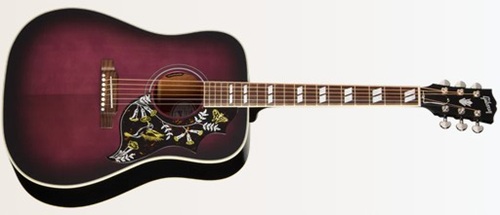
…which I’d bought years before despite my lack of skill because Musicians Are Idiots As Well As Scum. All I had to do was affix an electronic pickup to the bridge, and I was good to go. The songs, however, were another story altogether; in the end, I could only play about thirty of the “101” with any degree of proficiency, but then lightning struck and I found Hammond-Tooke’s songbook (!) so I could add a dozen or so songs to the 30/101. Also, for no reason at all, I included a couple of songs by Bread in the playlist. Now ordinarily I hate and despise David Gates’s beta-male whining, but there are a couple songs that don’t have dire lyrics like Diary and Everything I Own — namely, Mother Freedom and Guitar Man (with some careful rearranging) — and to my surprise, they would go over really well. Better still, my voice suited those songs better than Gates’s plaintive near-contralto.
So I showed up at Hunter’s with the utmost trepidation and set up my gear (I’d borrowed the band’s P.A. system which was way more than I needed for the cocktail bar, but it was going to have to find its way to Hunter’s anyway for the coming band gig. Some effects pedals to disguise my terrible 6-string guitar playing:
 …and off I went.
What saved me, I think, was that I wasn’t putting on a performance, as such: I was, essentially, background music in a quiet cocktail lounge, so nobody seemed to notice my fumblings — I was even complimented a few times — which just proves that you can fool some of the people some of the time. Certainly, Dave Varney was well pleased with my efforts.
But it was a lovely gig. I played every night, and drank all through the day by the side of the pool, flirting with the wives whose husbands were playing bridge in the hotel, or with the off-duty receptionists matching me drink for drink. (Don’t even ask how all that generally ended up.) Then I’d take a quick nap in the late afternoon to help me sober up, and start playing in the bar at 7pm till closing time at 1am.
It was also good to have a break for one night when the other guys from Atlantic showed up for the party, and I could go back to playing with a band — to the consternation of many of the guests, who only knew me as “the guy playing guitar in the cocktail lounge”.
At the end of the two-week gig, therefore, my pay didn’t come even close to covering my bar bill; but Dave forgave the balance because I’d gone well and truly past my job description. On one occasion I played Santa for all the kiddies, to his great amusement and to the astonishment of kids’ parents, and on another, I hosted a golf game at Sun City with three of the guests, one of whom was former Wimbledon doubles’ champion Frew MacMillan. Neither of these activities was part of my contract, to be sure, but I did it because Dave and I were friends and I wanted to help him out.
At the end of it all, I had to pack up the gear and race to Johannesburg because Atlantic had been booked to play a New Year’s Eve party, not at the Rosebank this time — which would have been fine — but at another resort hotel in a town some two hundred miles south of the city. And the party was, of course, an all-nighter. Trust me when I say that when I shambled back into the office on January 2, I was a shattered shell of a human being.
There was another place we played at more than once, but not a hotel. There was a club in Hillbrow called “Geordies International”, a home-from-home for homesick Brits mostly hailing from the northeast of England, as well as the usual crowd of scum from Manchester, Liverpool and so on. Kevin and I had actually played the gig with Black Ice, but later on he got contacted by the club owners for a booking, and so Atlantic took their place. Of course, I made sure that we expanded our repertoire to include several popular Geordie songs like Fog On The Tyne and the like — which is why we got rebooked after that. (The club was interesting because in true Brit fashion, the guys would all sit around drinking and talking football with their mates, while their wives and girlfriends danced with each other. Brits are weird.) What I remember most about the first weekend we played there was that the club had no ventilation or air conditioning, so the Friday night was played in an atmosphere which actually threatened us with heat exhaustion by the end of the evening; and thus that Saturday morning we raced out and bought some serious office fans, which helped some. Thereafter, those fans became an integral part of our stage gear, and most especially when we went back to Geordies.
Something else happened during this time which gave me enormous pleasure, and it came in the pint-sized form of Gilly Lloyd. Martin had discovered her in the little town of Springs (I don’t remember the circumstances), and he got us to agree to an audition. So this little twelfth-grader blonde English girl showed up, and blew us away with her fabulous voice. Of course we added her to the lineup, and she became part of the band quite effortlessly.
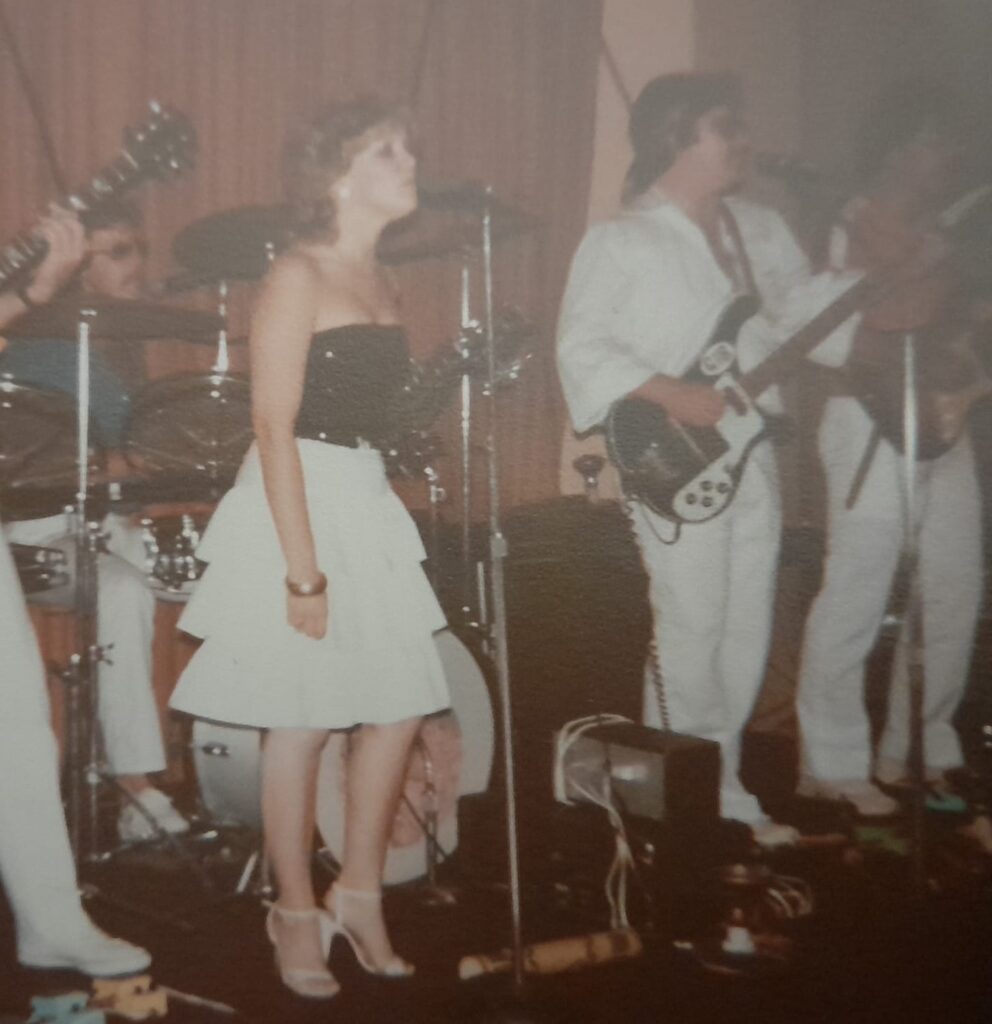
Apart from the legs, what Gilly brought to the band was her consummate professionalism: when we decided on a song, she would learn the lyrics perfectly, no cheat sheets (unlike Marty, who, being too lazy to memorize lyrics sang from a songbook all the time), and her lovely voice added a dimension to the band which we’d never had before.
And after all this time, I must admit with the deepest chagrin that we didn’t use Gilly enough.
You see, I’d seen what happens to bands when a vocalist leaves — and vocalists are notorious for quitting bands to find the Next Best Thing — and I think we’d all been bitten by Cliff’s departure during the Pussyfoot days. So we were always terrified that if we gave Gilly (say) two-thirds of the new songs we learned and she decided to quit, we’d be in deep trouble. In addition, Marty — who had become the primary vocalist in the band — was, I think, jealous of the effect she had on the rest of us, even though he’d been the one to introduce her to the band. So whenever I (or any of the others) came up with a new song for her to sing, Marty would often find a way to get a different song that (surprise, surprise) featured his voice instead of hers.
And her voice was terrific. Amazingly, she would tackle tough male vocal parts (like Loverboy’s Turn Me Loose) and absolutely kill them. Her duets with any of us guys were amazing (e.g. Stop Dragging My Heart Around with Kevin), and her renderings of ballads (Juice Newton’s Angel Of The Morning) were spectacular.
Side note: It should come as no surprise that Gilly would eventually end up as a star in her own right, with TV appearances and a cabaret act which featured her uncanny ability to mimic other singers’ voices — and often, her cover would be better, a lot better than the original artist’s rendition.
I adored Gilly — we all did — and now in retrospect I (and all the other guys) deeply regret not making her a feature of the band instead of just another member. Nostra maxima culpa.
I’ve talked a little bit about how a band goes about selecting which songs to add to the repertoire, and by this stage in Atlantic’s history we had it down to a fine art. I’d learned from the Black Ice time the best way to do this, so we adopted that for ourselves. The only difference was that unlike Black Ice, where Adrian decided on the new songs’ inclusion unilaterally, ours was very much a democratic business. Anyone could suggest a new song — bring a cassette tape to the next practice session, and we’d listen to it, trying to see if there were any reasons why we couldn’t play it — for example, most early Chicago songs would have been beyond our reach because of the brass sections, and the synthesizers of the time weren’t complex enough to recreate the sound. Then once we decided to learn the new one, I’d take the cassette home with me, and aided by a double-cassette player I’d bought which enabled me to do a tape-to-tape recording, make individual copies for each of the guys. Then I’d hand them out, the guys would take a week to learn their parts, and then we’d put the whole thing together at the next meeting, rehearse it for a couple of weeks thereafter to get the sound really tight and professional, and then perform it. It sounds complicated, but it wasn’t because only the most complex songs caused us time to perfect their rendition; Dire Straits’s Sultans Of Swing, for example, took us only fifteen minutes to master the first time we played it, and it went onto the playlist that very next weekend, whereas Police’s Message In A Bottle took us two full practices before we played it live. (I have to admit that the latter song’s delayed performance was caused by the bassist’s problems in mastering the vocal part while simultaneously playing Sting’s fearsome bass line. I should have just let Gilly sing the damn thing. She probably would have sounded better than I did, too.)
On another occasion, we noted that we’d had more than a few requests for Golden Earring’s Radar Love – the song which had given us so much trouble to master back in the Pussyfoot days. So someone unearthed a tape of the piece, we listened to it just once; and then proceeded to play it all the way through without pause or mistake. Clearly, we had come a long way since Pussyfoot — and Radar Love became a popular fixture on the playlist from then on (but only when playing to an older or rougher audience, and never at wedding receptions).
Another song we played which never failed to draw a reaction from the audience was the dire D-I-S-C-O (by Ottowan), which we performed as follows: we’d play it through the P.A. as the last song of our break, then gradually fade out the recorded audio while fading in our instruments until we were playing it at full volume. It was easy enough to play (like most disco songs), but the audience would generally burst out in loud applause at the end, amazed that we could replicate an actual hit parade song. Little did they know how easy it was. Another such song was Gloria Gaynor’s I Will Survive, which Gilly nailed (as she did all her songs, anyway), and which likewise drew cries of admiration afterwards.
And just to underline our professionalism at that stage: we absolutely loathed playing disco music. But we played it anyway, because that’s what people wanted to dance to back then, we’d been hired to get people on the dance floor, and we owed them a good performance.
Of course, it wasn’t all plain sailing for us. Rob’s business interests were pulling him away from a full-time commitment, which sometimes meant he couldn’t make a gig or two. Fortunately, I happened to know a very good, solid drummer named Neil Fox:
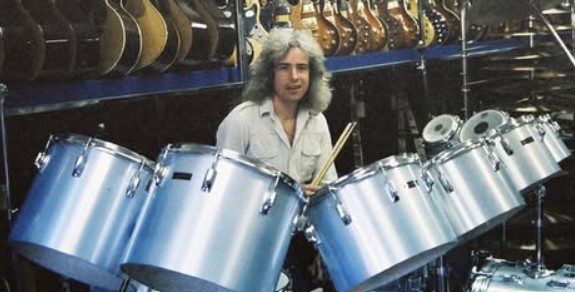
…a dour Scot who had a dry, wicked sense of humor – so of course he got on famously with us, and thus the only thing we missed was Rob’s vocal part. (Rob was no mean mimic himself, by the way: his rendition of Spandau Ballet’s Only When You Leave sounded exactly like Tony Hadley.)
Fortunately, by then Mike no longer had his Army reserve problem (and could finally grow his hair).
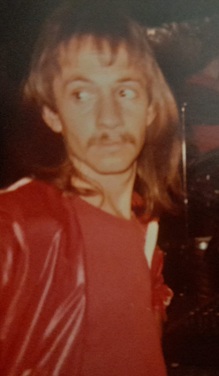
I think the two-year change in the draft which had ensnared me had had the happy result of freeing him up from his reserve commitment, so we never thereafter had to get a replacement for him.
The same was not true of Kevin, unfortunately, because his wife (acquired back when he was still playing professionally) was turning out to be a real stone in the band’s shoe because it seemed she could always find a good reason for him not to show up for a gig. Had this not been Kevin, our friend, founding bandmember and brilliant lead guitarist, we would have fired him eventually. But he was all that, so we didn’t. And as I indicated earlier, decent lead guitarists were thin on the ground.
Then I learned through the grapevine that Danny, our old lead guitarist from Hogwash, happened to be free, so of course I contacted him to see if he could help us out. (I knew he’d never be a full-time choice for us because he’d set his mind towards playing professionally. But his band plans with Franco and Dion had fallen through, hence his availability.) Anyway, he showed up for a rehearsal, and it was a breeze: he knew most of the songs, had played several of them with me in Hogwash, and just to make things interesting I suggested that we learn a new song then and there, so we could feature him at our next gig. So we did that, whereupon Danny uttered the line that became immortal: “Okay, Marty; you’ve got all the chords right — now we just have to get you to play them in the right order.” Which summed Marty up perfectly.
Anyway, the gig came up and we played it, and all went well right up until we had to play the new song we’d worked out with Danny. He nearly pulled a “John” on us, confessing to me that he was unbelievably nervous about playing it, and from the way his hands were shaking, I could see that he wasn’t exaggerating. But I reassured him, we played the song and he powered through without a single mistake.
What all this did, though, was make me realize how professional we’d become and how intimidating this must have been to anyone wanting to play with us. Understand this, though: it wasn’t that we were a great band — not by most measures — but we were relentless. (Neil Fox later told me that playing with us was like riding a giant wave: it was at once easy and also rather frightening.)
Before I talk about the other guitarist we used, I need to step back a little.
We landed an actual club gig in Johannesburg. It was called Just For Kicks, and the room was a renovated movie theater which had a maximum capacity of 900 people. The band before us had taken it to 1,100; but two weeks after our first appearance, we played to 1,500 people, and by the end of the contract to 1,700 a night. We took half the door receipts (from memory, the cover was two bucks per head or three bucks a couple), so on average we were clearing about R1,500 a night, split six ways.
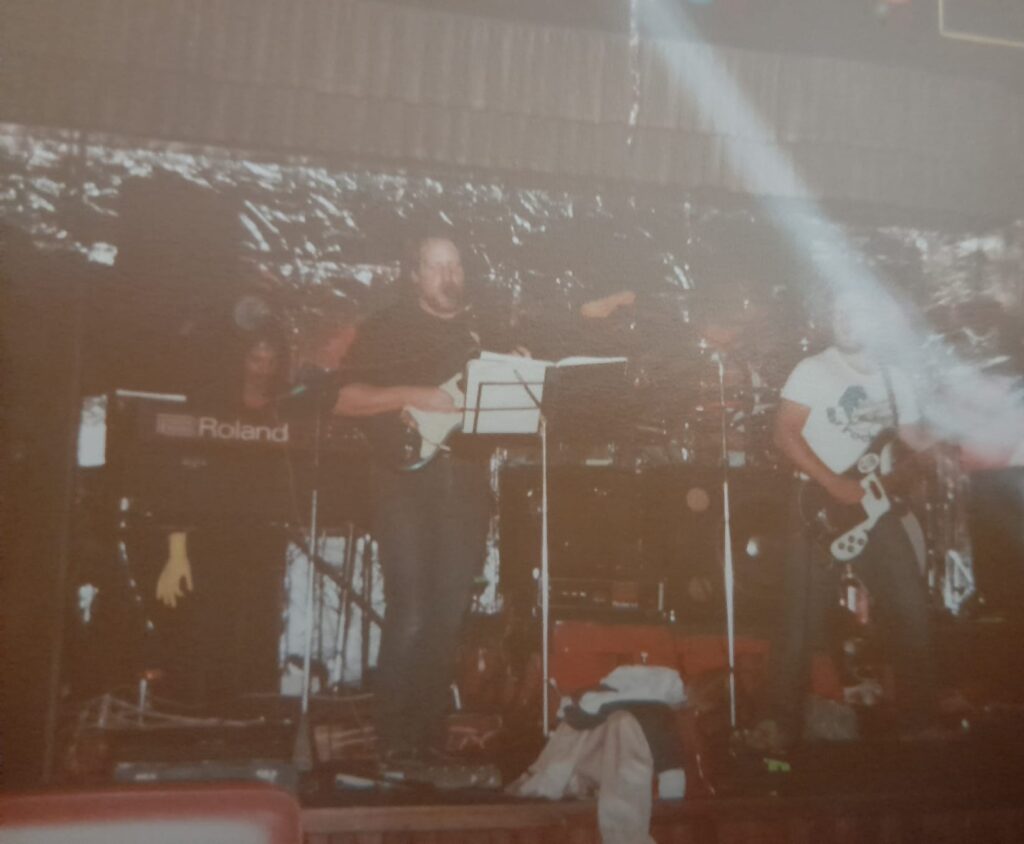
(rehearsal pic — no way we ever played a gig looking like that)
The only problem was that the contract was for three months, Thursday through Saturday nights from 9pm to 2am — and by then we all (except Gilly) had serious day jobs, executive-level stuff. The result was that by the time Sunday came round, we were exhausted — but still had to rehearse new material on Sunday afternoons.
But we were finally doing what we would have killed to be doing back when we first got together: playing full-time in a Johannesburg club. And whoa, was it fun. Of course, we did it like pros: absolutely no pauses between songs while we decided what to play next (before starting, and during each break, I would write out the playlist for each set on a large Post-It notepad, then pass it around to the others to write one out for themselves), and we played only the most current hit songs (such as Genesis’s Abacab) so that we had at least four hundred people on the (two-hundred capacity) dance floor at any given time.
We’d also joined the big boys, gear-wise: the old 80-watt Dynacord P.A. had been replaced by a 12-channel desk and 2,000-watt monster amp. (We used the Dynacord to power just the monitor speakers, and it was barely up to the job.) We rocked the place, put on a show, and not just with music. Remembering how back in the Margate days that Shalima had staged talent competitions, I decided to do it at Just For Kicks as well, and it became a Saturday night regular feature. And herein lies not one, but two stories.
There was a Hell’s Angels-type band (I think they called themselves the “Devils”) who used to come in most Saturday nights, always with their wives and girlfriends (because, as Eric the gangleader told me, the JfK owner refused to let them in without the girls because they caused too much trouble). Even though they were a rough-‘n-tough crowd, they always behaved themselves in the club during their weekly visit, dancing with their ladies and drinking up a storm (which is why the management allowed them in — their bar bill was the equivalent of the GDP of a small country). They were actually a lovely bunch of guys, despite their fearsome appearance, and of course they became staunch fans of Atlantic because we played very hard rock music for them: Steppenwolf’s Born To Be Wild would cause a near-riot, and the aforementioned Radar Love ditto.
Anyway, one night I became aware of a guy wearing a red shirt who was intent on reaching up to the stage and getting his hand up Gilly’s skirt while she was singing. I growled at him once and he went away, but came back after a while and tried again. Gilly managed to avoid his groping, and unfortunately for him, he chose the last song of the set to play his little game.
During our break, I went over to the Devils’ tables and sat down next to Eric.
“Hey Eric,” I said, “do you see that guy over there in the red shirt?”
“Yeah.”
“Man, that bastard’s been trying to finger Gilly, right there on the stage while we’re playing. I can’t deal with it because we’re employees here and I don’t want us to get fired. Can you do something to help her out?”
He scowled, beckoned to two of his guys and whispered something to them. They stood up, pulled on their gang colors, walked over to Mr. Redshirt Groper and dragged him out of the club.
I have no idea what they said (or did) to him, but I never saw him again. When I asked Eric what had happened — I mean, these were serious biker tough guys, and they might easily have killed him — he just grinned and muttered something about “teaching him a lesson”.
We sometimes invited someone in the gang to perform a song with us, and Long John — a tall, skinny guy with long, greasy black hair and the worst teeth in the Western Hemisphere — would enthrall the audience with his version of Pink Floyd’s Another Brick In The Wall (“We don’t need no sex education!” delivered in a hoarse bellow) which always brought the house down, and earned John a bottle of rum for the first talent competition. It became a weekly fixture for him, our “guest vocalist”, only without the bottle of rum.
Another feature of Just For Kicks was that Thursday was Ladies Night, literally: from 7.30 till 11.30pm, only women were allowed in the club; and at a rough guess, we would get close to six hundred unaccompanied women in the place. And oh boy, did they ever cut loose. Talk about wild ‘n crazy guys? This lot would dance, scream and shout, flash their boobs at each other (and sometimes at the band, which nearly caused Farty to have a heart attack), and drink as heartily as any guy. Then at 11.30, the doors would be open to the men (all looking to score with drunken chicks), whereupon at least three quarters or more of the girls would head for the exit.
Anyway, I told you all that about Just For Kicks so I could tell you this. In the last chapter, I told you how we’d invited the Entertainment Group’s Buddy Slater to join us on guitar, but he’d turned us down. One night at the club, who should I see in the audience but Bluddy Buddy himself, staring at us like he’d seen a ghost. When I caught up with him afterwards, he said, “You know, I had no idea you guys were this good. I shouldn’t have walked out on you.”
So when Kevin’s wife gave us trouble later, I called Buddy up and offered him the chance to stand in with us, and this time he jumped at the chance. He ended up doing more than one gig with us, too.
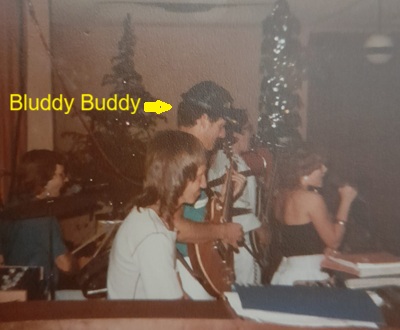
So thereafter, whenever Kevin’s wife threw a hissy fit, in would come Mr. Slater. (Although he wasn’t a singer, there were a couple of songs he could sing, and sing well. ZZ Top’s La Grange, featuring Bluddy Buddy on lead vocals — and of course lead guitar — remains a treasured memory.)
At the end of the contract period, JfK management of course wanted to extend the thing for another three months — one of the barmen told me that they’d never seen crowds this large, nor had greater bar profits — but we turned them down.
Why?
Because we had day jobs, and frankly, the sheer physical exhaustion of the gig — not to mention the fact that it was becoming increasingly difficult for both me and Rob to fit our respective day jobs into a Monday-Thursday time frame — made our refusal inevitable. Just For Kicks even offered us all the door money, and still we refused. It was, inevitably, because we’d all grown up, and playing music was now really just our hobby.
But very soon, it all started to wobble and eventually, fall apart.
– 0 –
Chapter 14: The Last Gig
As time went on, it became clear that Marty was really holding the band back, in a musical sense. He was uninterested in learning any new material (unless it featured him on lead vocals) and when we dragged him into playing anything else, he was totally disinterested. And yes, he had a great voice, but we were moving on from playing mostly older classics (his favorite and perhaps only interest), and just as importantly, his indifferent guitar playing was not helping the band grow, either. I was perhaps the least enthusiastic about it because I loved Marty’s voice, and loved singing with him. But when your audiences want to hear Shout and all you can give them is Let It Be Me, it’s not a good thing.
We were also a little apprehensive about the decision because it was Marty who’d been driving Gilly all the way from their homes in Springs to band practices in Johannesburg, and indeed to wherever we’d been booked to play gigs. Would she want to stay in the band, and drive herself around, all by herself? (She had just got old enough to get her driver’s license, by the way.) When Gilly had joined the band, we’d decided to pay her a set amount per gig because she didn’t have to hump gear around, just perform on stage, and nor had we asked her to contribute towards the cost of the gear we’d purchased. Knob suggested that we start giving her an equal share of the money, in no small part because if she were to stay in the band, she’d have to pay a fairly considerable amount for fuel — and fuel in South Africa was always expensive (still is). That was a no-brainer, so we called her to tell her what we were thinking, and whether or not she’d want to stay. To our surprise and delight, she agreed to stay in the band.
So after a long and gloomy discussion between the original four (Mike, Knob, Kevin and myself) we finally decided to can him. Of course, because I was kinda-sorta the leader of the band (and unlike any of the others, I’d actually had experience in firing people as part of my day job) it fell to me to drop the axe on him. I had to do it face to face, because a lot of water had passed under the bridge we’d all been standing on, and it would be grossly disrespectful to do it over the phone. So I did it, and it was terrible, not least because I was actually very fond of Marty — we all were — but from an artistic and business perspective it just had to happen. And there it was.
So we were back almost to where we’d ended with Pussyfoot, plus Gilly. However, as I’d feared, while Atlantic was still a powerhouse band, our vocal sound had changed without Martin, with the result that we all had to work just a little harder. What had become easier was practice and rehearsal. No longer did we have to set up most of the gear in a practice room; now we just sat around with our instruments and microphones plugged into the mixing desk, and instead of speakers we used headphones. We didn’t even need a practice room — anyone’s living room would do. Knob used a drum pad and wonderfully, his voice to mimic the drum sound (using a microphone, you just have to say “DISH!” to sound like a cymbal, for example, and “Dubba-dubba-dubba-DISH!” served as a drum roll). Once we stopped laughing, we just got on with it.
For me, though, it was starting to get less fun, for an unrelated reason.
I mentioned earlier that I’d got married (back in late 1982): a business lunch that had turned into breakfast, and things went on from there. For our honeymoon, we decided to go and spend a month touring the Eastern United States, a decision that was to prove pivotal to me: I instantly fell in love with the United States, and more gradually fell out of love with my wife. We got divorced in early 1985, and I decided to go back over to the U.S., ostensibly on a month’s vacation, but really to scope out the place and see where I’d like to live. At some art gallery opening one night, I happened to bump into my old buddy Trevor, with whom I’d worked at a small ad agency (he as a copywriter, me as the marketing / new business manager). We’d always got on well together, and in chatting with him that night, I learned that he too was planning on going back to America — the only difference being was that he’d had several job offers from agencies over there, by dint of his winning some international award for one of his ad campaigns, and so he was going over to a.) get his award and b.) talk to a couple of agencies who were interested in his work. So we coordinated our schedules, and flew over together. For me, the only difference in this trip compared to my first was that instead of Florida, we went west to Texas where he had some family friends living. So we did that, and at some party or other I met a guy who owned a food brokerage business, and who became very interested in my Nielsen-grounded data analysis abilities. So he offered me a job, and said he’d take care of all the visa issues (it was a lot easier back in the early 1980s than it is today). I just had to show up, collect my visa after the Immigration interviews, and start work. I went back to South Africa in a daze: my dream of starting a new life in the States was going to happen.
Except that when I got back, my biggest client — at the time, the largest retail organization in the Southern Hemisphere — offered me a job as Group Marketing Manager. It was a huge job, and I’d have been a fool not to take it. I called my putative boss in Texas and told him the news. To his credit, while disappointed, he said he understood and agreed with my decision. So I started my new job: and cocked the thing up horribly.
There’s no need to go into details, but at 31, I was the youngest executive at my pay scale by some twenty years, I made all sorts of stupid corporate mistakes and therefore a lot of enemies in the executive offices, and I was miserable.
What made things worse was that Atlantic wasn’t going as well as I’d expected it would. Gilly ended up leaving after only a few more months with us, and the whole thing looked like falling apart.
Then Donat (Mr. Filthy Perfectionist from the Pussyfoot days) decided he’d like to rejoin the band.
Well, that was a shot in the arm for the rest of us. (To his surprise, though, Donat soon discovered that instead of being the only Filthy Perfectionist in the band, he was now just one of five. Playing professionally will do that for ya.) Our sound immediately improved, not the least because Donat’s guitar skills were exponentially higher than his predecessor’s, and we became in essence a tighter and far more competent Pussyfoot, able to play pretty much any song we wanted, no matter how difficult and complex. So while our vocal sound had arguably worsened a bit, our musical sound was fantastic and made up a lot for the change
It was great. Now we could do songs like Careless Whisper (sax solo courtesy of one of Mike’s new synthesizers), Money For Nothing, Easy Lover, The Heat Is On, Run To You and so on; the list was endless, and we delivered them with gusto.
After hours, things were also great. There was a dance club in Johannesburg called “Plumb Crazy” that was a mecca for musicians. Basically, while the “club” part was typical — a giant dance floor, a bar and dozens of tables and booths scattered around — there was also a little bar in an annex or side room called “Prompt Corner”. This had been started as a place where actors and other theater people could “come down” after their shows had ended, and that facility was soon opened to musicians as well. It was a members-only affair, and you had to be a professional musician or actor to be allowed in. As the club was open until 5am, therefore, Prompt Corner was usually full to the brim by about 2am. It was a place for musicians to hang out, chat with other musicians, find out (in those pre-Internet days) which band was looking for a new member, which clubs were looking for a new band, and so on. All very cozy and collegial. Basically, when the DJ was playing dance music, the Corner was full; but when the band started to play, the bar emptied because all the musos wanted to catch the show.
One night I went to Plumb Crazy after a gig. It turned out that Ballyhoo — the most popular club band in the country, by far — had left their usual Cape Town haunt and taken up residence at Plumb Crazy. Now, I knew all the guys thanks to my time at Bothners with Eddie Boyle, so that night I went straight into the Corner to get a beer and see who else was there. Scarcely had I walked in, though, when Ballyhoo started their next set. Of course, the room emptied quickly, and I joined the crowd. From where I came into the dance area, I couldn’t see the whole band. Then I heard a virtuoso drum roll, and craned my neck to see… none other than Franco, my former bandmate from Hogwash. Of course, I thought, there was no way that Ballyhoo were going to let Franco escape: he was probably the best rock drummer in South Africa at that point. Anyway, when they finished their set, we all trooped back into the bar and started chatting away. Then Franco came into the room and when I made the secret Hogwash greeting noise, he started, saw me, shouted “KIM!” and raced over to our table. After we’d finished punching each other on the arm — another old Hogwash custom — he sat down and we chatted away about this and that. Danny, it turned out, had joined the reformed Circus — the band we’d followed at the O.K Corral all that time ago — and Boze the keyboards player had emigrated to the U.K. after marrying his high school sweetheart.
Not for the first time, I marveled at how small a world it was that we professional musos lived in.
About three weeks later I got fired from my job. (Actually, it was more of a mutual agreement that I wasn’t happy doing the job and my boss wasn’t happy with me either, so I got three months’ severance and use of my company car for the same period, while I looked for another job.)
Of course I had no job to go to… except perhaps that one in Texas? I called the company’s owner, who sounded really excited when I told him I was free. “When can you get here?” he asked. I looked at my calendar. Atlantic had two more gigs to play in the next couple of weeks, and then it looked like there was a period of about two months that were inexplicably open. So I gave the guy a date when I could get there, and went off to tell the band the news.
Even though I was as excited as all hell at my upcoming emigration, I felt terrible when I sprang the news on them. We had played together, off and on, since 1974. Worse yet, we were not just bandmates but friends, the very best of friends. Mike had taught me how to fly an ultralight aircraft. I’d been Kevin’s best man at his wedding, and he’d returned the favor at mine. I’d been the photographer at Mike’s wedding, and Knob and I had slept with at least two of the same women (that I knew of) — not simultaneously, of course, but sequentially. I’d borrowed Donat’s apartment to deflower a high school girl several years before (and you just don’t forget favors like that), not to mention the fact that Donat had dated my own sister for about three years.
I loved these guys more than I loved most of my actual family, in other words.
Nevertheless, there it was: two more gigs, and then good-bye. The second-last gig went off okay: just a simple party at one of the country clubs, which we handled easily. Then came the dreaded last one, which was to take place on my last night in South Africa (the next afternoon: Big Silver Bird Time.)
Of course, after a decade of planning for equipment failure and never having had a problem, my ever-reliable Roland bass amp chose that night to die on me, right as we were doing our pre-gig sound check.
Disaster.
I tried calling Eddie Boyle to see if he had a spare amp to lend me, but no answer. There was really only one thing we could do, and that was play the bass guitar through the P.A. system. Now this would have been impossible in the old days with our teeny Dynacord amp; but our new amp handled the job easily (although Knob did say that he missed the sound and feel of my speaker behind him, its customary location on the stage).
What I also didn’t know was that one of the guys had set up a tape recorder, and taped the entire gig. (This will be discussed later.)
Well, the gig came to an end and we just stood around like tailor’s dummies. I mean, it was over, really over. Our ten-year joyride, with its many ups and so few downs, had come to an end. We packed up in total silence — I gave the Rickenbacker to Knob or Kevin, I don’t remember, left all my other gear (amps, pedals, lighting system, microphone and stand) with them, and for the first time ever, drove home after a gig with an empty car.
The next day I got a lift to Johannesburg’s Jan Smuts Airport, and was standing disconsolately at the Departures area when Donat and Kevin showed up. “We just couldn’t let you go without saying goodbye,” Kevin said, and explained that Mike was flying in some ultralight cross-country competition, while Knob had to be at a business function somewhere else. We shook hands, hugged each other, and I left.
Some months after emigrating to the U.S., I went with a friend to a club on Sixth Street in Austin. She had a friend who was married to the guitarist in a band, so we went to listen to them. While chatting during one of their breaks, my lady friend told this guy that I’d played professionally for a band in South Africa — so of course he invited me to jam with them, and of course I said yes.
And of course we played one of my oldest companions and go-to songs, Johnny B. Goode, the song I’d performed countless times before, not the least as the audition song for George Hayden at the Army’s Entertainment Group. Afterwards, the guitarist said to me, “Are you looking for a band? I think I know at least a couple where you’d fit in pretty well.” Beat. “They’re both country bands.”
I thought about it for a few seconds. Did I want to buy all-new gear, join another band, get to know the guys, get to like them, see if our tastes coincided, see if our respective skill levels would make for a good fit? Those are a lot of criteria, and some musicians can go an entire career with only two or three of them together, and hardly ever when all of them were. You see, I’d been spoiled by having played with two bands — but especially with Atlantic — where all those criteria had been met, tested and enjoyed over years of playing together.
And that was only half of it. At the moment I was in Austin, but I’d recently had a job offer from — you guessed it — A.C. Nielsen in Chicago (their head office) and was flying out in a few days’ time to hammer out the details.
So no, I didn’t want to play in an Austin country band. Would I be prepared to go looking for a band to play in, and go through that whole rigmarole in Chicago?
Which led to a more serious question: did I want to play bass anymore at all?
“No,” I said firmly.
My rock band days were over, and I’d never play again.
There’s only one more thing to say about all this.
I had developed a theory about the role of the bassist in a band. I actually loathed listening to a song where the bassist played up a storm, because to my classically-trained ears it sounded like noise, a musical expression akin to a Jackson Pollock painting: undisciplined, messy and unpredictable (like in this song, which turns into a total morass soon after it begins). That might work well in modern jazz, which is pretty much a thing where everyone plays at the same time, but not necessarily together; but I don’t think it’s ever worked for rock music. In fact, my own bass playing tended more to the basic kind, and not just because I felt technically limited, either. I genuinely didn’t want to “get busy”, especially in a song that didn’t need such embellishment, and I wanted to give the other musicians a chance to play in the space that I provided. In other words, I regarded the bass guitar as part of the rhythm unit, and not as a lead instrument. I know that this attitude probably cost me a chance to play pro with the Hogwash guys; but even though I was hurt at the time, after a while I realized that it didn’t matter. So I just concentrated on providing a solid platform for the band’s sound — and I made sure that every time the drummer hit the bass drum with his pedal, there would be a strong and punchy bass note to accompany it.
Many years later I met up again with Kevin, this time in New York where he’d settled after leaving South Africa. We were chatting about this and that, playing catchup and all that good stuff, when suddenly he reached into his pocket and pulled out a tape. “It’s the one I made when we played our last gig together,” he said, and popped it into a Sony Walkman for us to listen to together.
I listened, amazed. Because I’d played my bass through the P.A. instead of that damn busted Roland amp, it came through far more prominently than it would have otherwise. When we got to Billy Ocean’s When The Going Gets Tough, with its rolling, complicated bass line, I shook my head.
“Did I really play that?”
My old friend and bandmate Kevin smiled and said, “You were always a better bass player than you thought you were.”
– 0 –
Epilogue
For several years after we emigrated, my South African buddy Trevor and I would pick a random part of the United States every year – somewhere neither of us had been before, and drive around for a few days with no planned route or plan, looking at this part of our adopted country with new eyes, and reminding ourselves just why we’d taken that big step across the ocean to start our lives all over again.
On one occasion, we found ourselves in Maine, traveling up and down the coast. On our last night we ended up at some hotel on the coast, with an outside bar.
Turns out there was a family reunion or maybe a class reunion of some sort, and their party was loud and raucous, as these things are, the participants were all about my age — mid-thirties — and letting loose without the kids to hold them back. At one point, a couple of guitars were brought out and they started singing songs.
The problem was that the two guys playing the guitars knew hardly any songs: in fact, I think they ran dry after only three or four.
When they started repeating songs, Trevor nudged me and said, “Why don’t you go and play some?” I started to protest, but the skunk went over to one of the guitarists and said, “Hey, my buddy can play guitar and he knows a whole bunch of songs. D’you mind if he plays a bit?”
Well, the guitar was handed to me and thus, after not having touched a guitar of any sort, nor having sung a note outside the shower pretty much since I’d left South Africa, I started playing.
I have no idea how it happened, but somehow the old songs all started coming back to me: the ones I’d learned from Ricky Hammond-Tooke’s songbook back at the College, a whole bunch of the old rock ‘n roll songs from American Graffiti, and more than a few of the songs out of 101 Hits For Buskers that I’d played in the cocktail bar at the Hunter’s Rest Hotel. They all flowed out of me as though I’d only just played them the day before: I remembered the music, the lyrics, the little touches I’d devised to make them sound different: it turned into a real show, and I ended up playing nonstop for two whole hours.
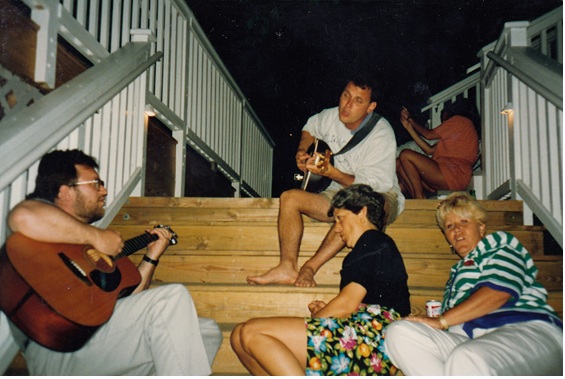
(note the groupies)
And so, after nearly a decade of silence, I played my last gig pretty much as I’d played my first: busking away like I knew what I was doing, on an instrument I could barely play — but this time (thanks to many years’ experience) I did manage to fool pretty much everyone.
The End
Afterword
Since then: a few people have written to me to ask if I know what happened to all the people I knew and played with over the time these memoirs covered. Indeed I do, although not very much on some of them. I’ll start with the bit players.
Mike du Preez, who gave me my first gig as a bassist, is at time of writing still alive (!) and still teaching.
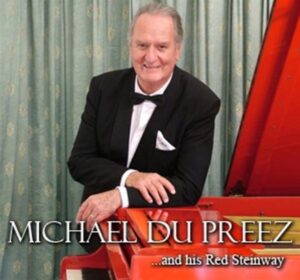
Robbie Kallenbach, who was responsible for me and Knob getting Pussyfoot together, ended up as president of EMI Records, and passed away in 2009.
Stand-in keyboards player Selwyn (“Zell”) Shandel ended up running a recording company.
Stand-in guitarist Buddy (“Bluddy Buddy”) Slater now lives, I think, somewhere in the U.S.
Stand-in drummer Neil Fox played music for the rest of his life, and died of a heart attack in 2020, much loved by everyone who ever knew him.
Hogwash drummer Franco del Mei played for Circus, and then with Ballyhoo until 1989, and I think he still sits in with them occasionally. To this day, he’s one of the best drummers I’ve ever heard, let alone played with.
Hogwash guitarist Danny Bridgens played with Circus for a long time. He’d studied music at Oklahoma U. (or maybe Oklahoma State), and he now lives in California. Danny was likewise one of the best guitarists around, an absolute wizard.
Hogwash keyboards player Craig (“Boze”) Manning married Isobel, his high school sweetheart and ended up as an accountant for an ice cream company in the U.K.
Hogwash vocalist Stan Greenberg married Billie, his high school sweetheart, and stayed in the hotel business.
Martin (“Farty Marty”) Coetzer moved to Durban and when last heard from, plays solo gigs in bars.
My dear friend Eddie (“Eds”) Boyle played bass for Stingray, then quit and opened his own music shop in Johannesburg’s northern suburbs. He died of a heart attack in, I think, 2013.
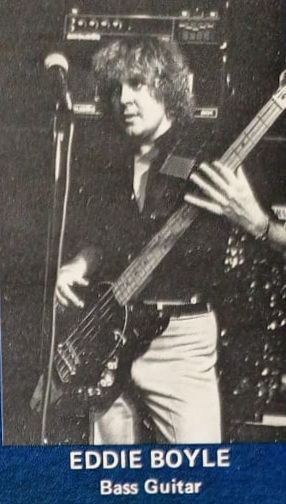
And finally, Rory (“Max”) McKenzie from Shalima emigrated to Oz and now lives in Perth. His account of his days with Shalima inspired me to write my own story.
Now for the main players:
I’ve written about Kevin here.
Mr. Filthy Perfectionist Donat still lives in Johannesburg.
Keyboards wizard Mike does likewise, just across the road from my old (pre-St. John’s) primary school.
Gilly had a serious career in South Africa (I talked about her here), and now lives near Salisbury Plain in England.
Gibby moved to the Cayman Islands, where he still lives today with Sue, his high school sweetheart/wife. Although we correspond often, we’ve only met up in person a couple of times over the past many years: once in London for dinner (pure coincidence that we happened to be there at the same time), and once in Dallas when he came over here on business:
(at Hard Eight BBQ, 2019)
Knob lives in the south of France, just outside Monaco. He and I correspond pretty much on a daily basis.
(Knob and me, somewhere on the Italian Riviera, December 2017)
Although the Atlantic Survivors, as we call ourselves, hardly ever see each other, we still keep in touch often via a chat group, to which we contribute stuff every day — new (“don’t you wish we could have played this?”) songs, old memory lane songs, foul jokes and insults. In other words, nothing has changed.
But for the fact that we all live on different continents together (Seffrica, Britishland, France and the U.S.), if by some miracle we could snag a gig whereby we could play some nightclub dance music (Mike du Preez Trio stuff), with Gilly on vocals, Mike and Gibby on keyboards/guitar, Donat on guitar, Knob on drums and me on bass, we would not only grab it with both hands, but we would be the best frigging dance band ever.

And we all think Kevin’s a total dickhead for dying on us before we could put it all back together, one last time.
– 0 –