Let me kick off this piece about guitars by talking for a moment about pianos.
I know that classical concert pianists, for example, will only use certain pianos: Valentina Lisitsa her “Bosie” (Bosendorfer), Glenn Gould his ancient Steinway, Claude Debussy his Bechstein and Maurizio Pollini his Fazioli — and not more than a few hundred people in the world would be able to tell the difference in sound between any of these instruments unless they heard them side by side, being played by the same pianist playing the same piece of music. (a.k.a. “testing”). (I can tell the difference between a Fazioli and a Steinway, but only if I’m told before the music starts that the pianos are a Fazioli and a Steinway. If you were to cheat and slip in a Bechstein instead of the Steinway, I’d say it was a Steinway.)
Guitarists are far more finicky than pianists.
I have to say up front that I can’t play guitar — the six-string kind — worth a damn. However, I know quite a bit about how they function, and more importantly, how they sound. For a long time, I worked in a music store in Johannesburg which catered to the professional musician crowd, and just by listening to the guys talking, and demonstrating what they were talking about, I gradually learned all about the topic. And of course, playing in a rock band for a decade didn’t hurt, either.
Guitarists are impossibly self-critical when it comes to both their ability and the way their instruments sound, so I generally view their preference for humbucker- over single-coil pickups (pickup info here), Ernie Ball strings over D’Addario strings and ’64 Strats over ’59 Les Paul guitars, all with amused indulgence.
It’s all about personal choice and taste, in other words. And when it comes to the quality of instruments, I’m pretty sure that you could give Eric Clapton the cheapest Mexican-made Fender Stratocaster, and he’ll still make it sound better than you will your ’63 pre-CBS-sellout Precioussss. (For those non-musicians bemused by all the above terms, don’t worry: none of this means that much except to anal-retentive musicians.)
All that said, I have some very strong preferences when it comes to off-the-rack lead guitars (once the guitarists starts tinkering with the thing, swapping out pickups, changing tone controls and so on, it’s all over). Even so, I know that many Mexican-made Fender Stratocasters, for example, are not horrible, just as Squier “entry-level” Stratocaster knockoffs are not the worst way to get into music at all. I used to own one of the latter, as it happens, and once I’d put decent strings on it and acquired a couple of effects pedals, nobody could tell the sonic difference between it and a Strat. What works for you, the guitarist, is what’s most important, but I have to tell you, there are certain guitars which no guitarist is going to sneer at, or turn his nose up at when you open your case and plug it in. Here they are, in no specific order.
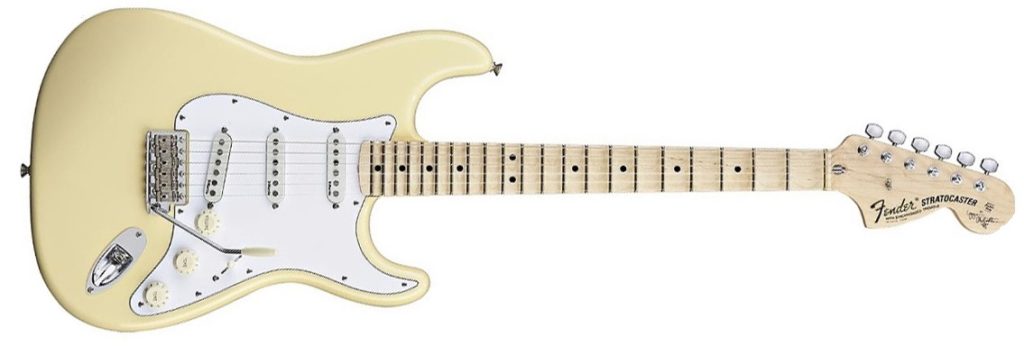
Fender Stratocaster. Clapton, Hendrix, Stevie Ray Vaughan, Trevor Rabin… the list goes on and on. I love Strats.
(Here’s its Squier counterpart:)
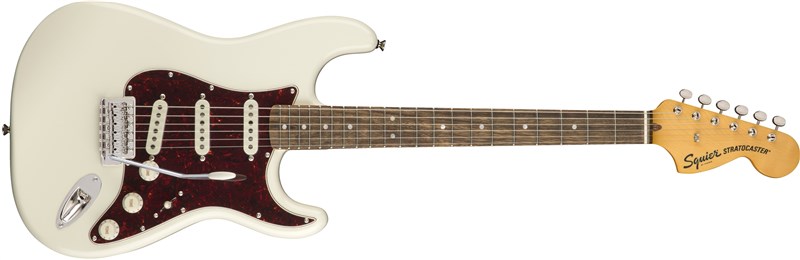
Cost of the Fender: anywhere up to $2,000 for the “Ultra” line; the Squier: $400.
Gibson Les Paul Standard. Gibson has a dizzying variety of Les Paul variants (more than I care to list or even look up), but nobody ever went wrong with a Standard, including Les Paul himself. This one is a maple-top cherry sunburst, none of which makes any difference to the sound except to people who play them:
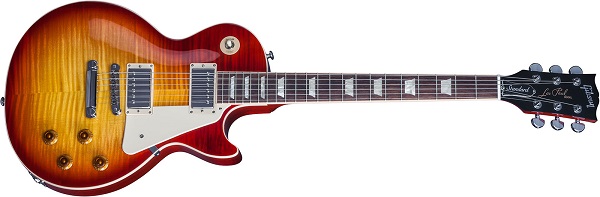
If you want to hear how the Les Paul sounds, then listen also to Billy Gibbons and Joe Walsh. Now let Joe explain how he sets up his Les Paul, for a lesson in Extreme Guitar Dorkery.
Gibson also has a “budget” line (because Gibson-brand guitars are quite spendy) called Epiphone, and a constant buzz resonates among the YouChoob “testers” as to the difference in sound between the two, Here’s the Epi Les Paul:
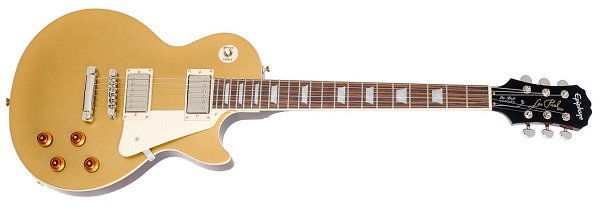
Cost of the Gibson: $2,700; the Epiphone: $450.
- Now before I go any further, allow me to state that in this matter, as in all others, such a difference in price has to be paid for by a reduction in quality — in the case of guitars, of the components. (My own Epiphone SG bass guitar is a case in point; it played perfectly well for about a month, whereupon the pickup selector switch suffered a catastrophic failure and the guitar fell silent.) The issue is not how the guitars function brand new, it’s how they’ll play in five years’ time — which is when the neck will warp because of cheap green wood used in its manufacture, the tuning heads made of tin will be rusted into immobility, etc. etc. TANSTAAFL.
All that said, I can say without fear of contradiction that if your band’s guitarist (or guitarists) can have only those two guitars (a Strat and a Les Paul), all will be well and your band will sound as good as any of the pros, subject of course to talent and decent amplification. I can say this with absolute certainty because in my old band, those are the two guitars we used for over a decade, and we sounded just fine.
Certainly, nobody is going to curl a lip when you take either of the two out of the case, and your sound will be as consistent as is possible to achieve; so when trying out a new amp, for instance, you could tell almost immediately whether your sound has improved because the if the guitar now doesn’t sound great, it’s the fault of the amp.
Now I’m going to wander off into the Guitar Dork Forest and mention a couple more of my favorites.
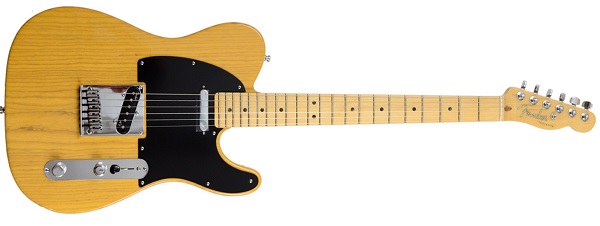
As far as rock music is concerned, I also like the venerable Fender Telecaster (Keith Richards, Samantha Fish, etc.) because it is a stripped-down, honest guitar that if not set on fire, will outlive Keith Richards because of its supreme simplicity:
Likewise, Gibson’s SG (in this configuration, as played by AC/DC’s Angus Young, for instance):
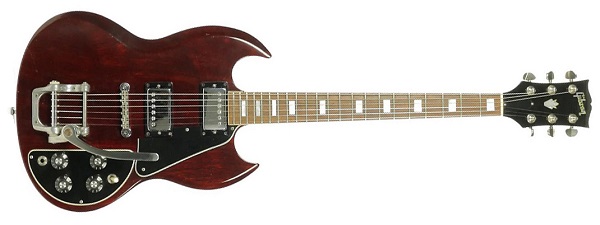
If the Les Paul and Strat are your first-choice, then the Tele and SG could be your #1a, and I will venture to suggest that your band will still sound incredible.
My choice #2 would be the Rickenbacker 300 series (305/325/360) as played by John Lennon/George Harrison, and David Crosby:
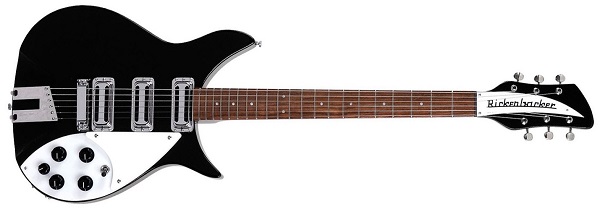
No other guitar sounds quite like the Rickenbacker, with its jangly, bright tone (the Byrds’ Mr. Tambourine Man, the Beatles’ Words Of Love), and if I were a competent guitarist with any band pretensions, I’d give the 300 series a long, hard look. As would I do for the next one, the Guild Stratford:
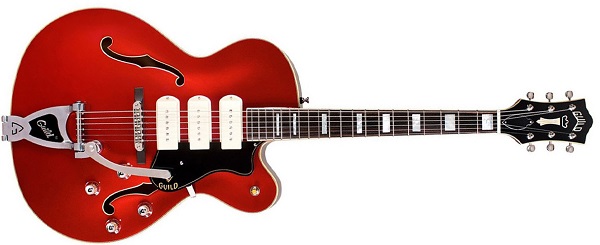
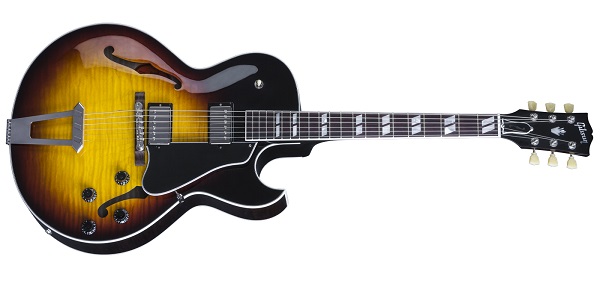
…but to be honest, this guitar (the hollow-body type, as compared to the above which all have solid bodies) is best used to play traditional jazz — and when in comes to this kind of music, nothing but nothing compares to the wonderful Gibson guitars, either the Model 175 (Steve Howe of Yes)
…or the Gibson (semi-hollow body) 335 (B.B. King):
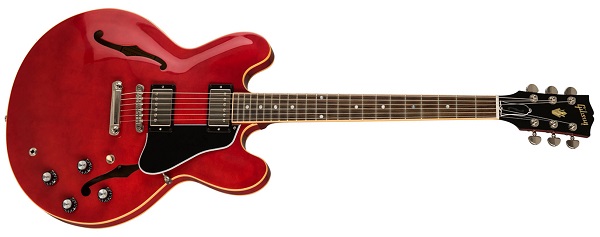
To be honest, if someone were to tell me I’d only be able to play a 335 for the rest of my life, I’d be a happy man (and Rhett Shull agrees).
As long as I could play the 335 like this guy can.
And then, of course, you get Paul Reed Smith (PRS) guitars… and Carlos Santana.
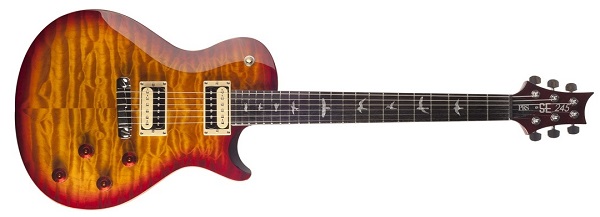
If you’ve gotta ask how much they cost… get a Les Paul.
There are literally thousands of electric guitars out there (basically proving what a fussy bunch guitarists are), and if I’ve left out your own guitar, or favorite guitar, well… sorry. But the above are my favorites, for all sorts of different reasons. And in case you’re still interested after all this, here’s Watchmojo’s top ten guitars. (Most of their lists are total shit, but this one isn’t too bad.)
All the great guitarists of modern times have played, or still play, a version of these guitars, and not one could ever argue with your choice if you stuck with only one. And all the top guitarists have played just about every guitar ever produced, because that’s what they do. Then you have guys like this one…
But you never will. And it all depends what kind of musical genre you want to play — and even then, the guitar doesn’t really matter that much, as this guy demonstrates.
Now, about acoustic guitars… till next time.