Perils Of Illiteracy

Here’s a thought which starts off well, and ends in unintentional hilarity.

“Meanwhile, moving to an unknown place is far from out of character. This time four years ago, I packed up my car in Ohio and drove out west with no plans for two months. In 2018 I hitchhiked around south Peru. Later that summer I landed in Bali with no agenda and a month to spare. While island hopping in Gili, I was caught near the center of an earthquake when I was far from sober prompting me to evacuate.”

You see, “to evacuate” means to empty out, or to be emptied out.  Towns and buildings may be evacuated (by emptying them of people, for instance), but people aren’t evacuated, unless some form of laxative, diuretic or similar are in the picture.

So when the idiot quoted says “I was caught near the center of an earthquake when I was far from sober prompting me to evacuate”, what comes across is actually “I was caught near the center of an earthquake when I was far from sober prompting me to shit myself”  — funny, but I don’t think that’s quite what he was trying to say.

And in The Federalist, too… [sigh]

Grammar, Grandma

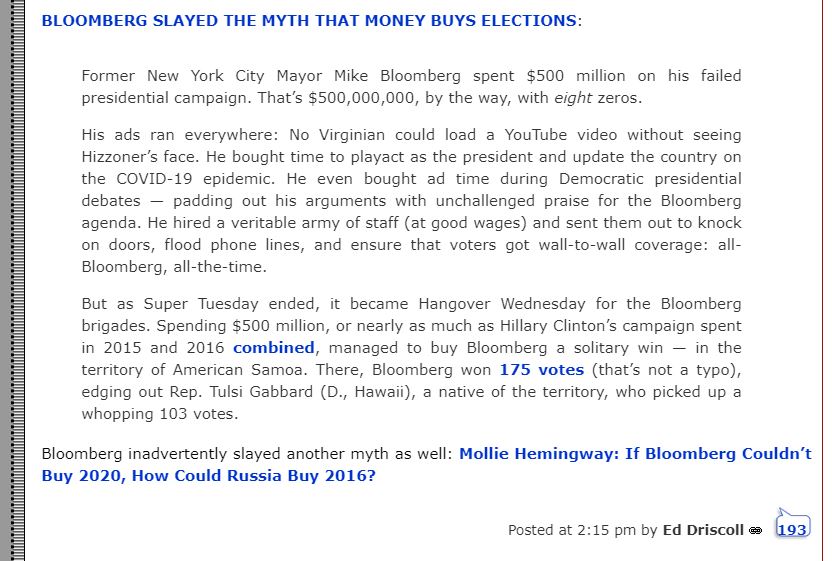
I have often noted that poor grammar acts as a comprehension speed-bump — when one is reading something, a mistake makes one stop and say, “Whut?”  Here’s an example.  In an otherwise-fine examination of a politician’s fuckup, Driscoll made me say “Whut?”  (twice), viz.:

The past tense of “slay” is “slew”.  As in:  ♫ ♪ ♫ ♪ “Lil’ David slew Golia’ an’ shouted for joy”.  ♫ ♪ ♫ ♪

Maybe Not

I followed a link from Insty to Amazon (“Top Books In Military History”) and found this:

Priceless.

That said, given the Smithsonian’s increasing descent into woke-based illiteracy, it wouldn’t surprise me at all if the cover was printed incorrectly, the book is about WWI, and nobody in the layers and layers of fact-checkers picked it up.

Or else it’s the Ockham principle, which would simply say that Amazon done fucked up.

Language Beef

One of my major beefs with European languages is that stupid custom of giving everything a gender — in Latin, a table  is feminine but a house  is masculine (sometimes, depending on the sense of the sentence);  in French a car  is feminine but a horse  is masculine;  and in German, a train  is masculine but a railway  is feminine, and so on.

No wonder they’ve had to declare war on each other every decade or so.

Basically, it’s Latin’s fault.  That Roman nonsense gave every word a gender (with the wonderful addition of a neuter gender which wasn’t very common).  Additionally, Latin has no articles (the, a, an etc.) — which I think is why words had  to have a gender, so that the listener could determine to which word an adjective was being applied to.  Here’s a little summary:

There is a stark difference between English and Latin’s treatment of gender. Only words in English that indicate a biological sex have a masculine or feminine gender. All others are considered neuter. Latin, however, applies gender to many words even when biological sex is not intimated.

No wonder the bloody thing died off.

But that’s not the end of the story, oh no.

As European languages modernized, they added articles — except that with gendered nouns, the articles had to change to continue the form.  Hence la roche  (rock), le matin  (morning) and so on.  German went the same way:  der Zug (train), die Eisenbahn (railway), etc.

All that, so that this little meme would make sense to everybody who’s not a language dork like I am:
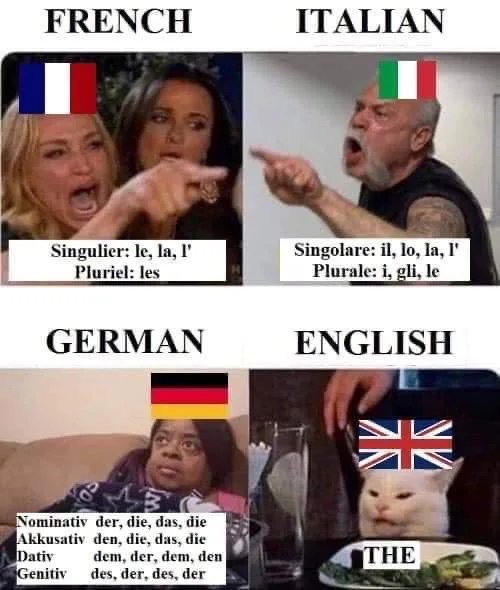
Of course, as can be seen in the above, the Germans took the thing to its logical conclusion and over-complicated their language almost to the point of impossibility, making the article also reflect the nouns’s declension case  as well as its gender.  Don’t get me started.

At least the Germans are usually too polite to correct you when you screw up, and will sometimes even switch to English if they can.  The French, however, have no such scruples and will correct your grammar, loudly and often with a smirk — which makes my already-fragile temper turn homicidal in a millisecond.

Thank goodness English is gradually taking over as the international language of business, and is the backbone of this here Intarwebz thingy.

I still read Le Parisien  once a week, though.

Irritant

As the late Denis Farina said so memorably in the movie Snatch, “You Brits invented English;  why don’t you fucking speak it?”

“I am stood watching as a man uses a metal lever to break into a wooden door.”

I am stood?  Really?  As opposed to “I’m standing watching as a man…” (and standing is also superfluous unless it’s relevant to the story — “I’m watching as a man…” would have worked just as well, if not better).

Don’t even get me started on “I was sat looking at the painting…”

In grammatical terms, it’s incorrectly using the past perfect tense (stood, as in “He stood on the roof”) instead of a participle (e.g. he was standing on the roof).

I suppose it’s all part of the general societal slide down to illiteracy, but that doesn’t mean I can’t get angry about it.

Quite Rightly So

Perry De Havilland has a few choice words to say about this little situation:

Japan aims to change the way Japanese names are written in English by putting the family name first, the same way they are written in Japanese, in a triumph for conservatives keen to preserve traditional ways in a fast-changing world. Education Minister Masahiko Shibayama proposed the change to Cabinet ministers on Friday and the government will now study how to implement it, the top government spokesman said […] Foreign Minister Taro Kono raised the suggestion in May saying foreign media should write the prime minister’s name in the traditional way – Abe Shinzo.

And Perry’s response:

Shinzo Abe can fuck right off, because that is not correct when using English. Follow your own heathen customs when using Japanese, old chap, but no government gets to decide how English is used, that sort of bullshit only happens in France and Japan.

Perry and I have had our issues in the past because I’m conservative and he’s a librarian, but on this topic we are 100% in accord.