Your suggestions in Comments.

Your suggestions in Comments.
For those who’ve seen Band of Brothers, there’s a very telling conversation between Carville and Winters, as the sergeant complains about his platoon commander, Lt. Dyke:
“It’s not that he makes bad decisions; it’s that he doesn’t make any decisions at all.”
Any time you see that situation in a manager, any manager, it is a flashing neon sign of incompetence.
One of the reasons why Marxists make such poor managers is that if they are presented with a situation which cannot be addressed by Party doctrine, they are largely indecisive. Even worse, if that doctrine runs counter to good management, they will use that as the underpinning for their indecisiveness. We saw this a lot under Obama, who was pathetically underqualified as a manager, having had no executive experience in his entire life before becoming POTUS. More often than not, when faced with a decision, he simply froze and allowed events to dictate the outcome, even if that outcome was inimical to the interests of the country he was supposed to be governing. (And to prove my point above, his Marxist doctrine held that the United States was a malignant force in world affairs, so allowing harm to befall the country was — to his mind — actually the proper thing to do as it “corrected” or atoned for America’s past sins.)
And of course, today we see the same thing happening in New York City, where the doctrinaire Marxist Mayor De Blasio faces a situation of riots, looting and general lawlessness and mayhem on the city’s streets. Bob McManus at the NY Post sums it up perfectly:
In 1991, anti-Semitic rioting in Crown Heights took two lives and then ran for three full days and nights — allegedly with the approval of then-Mayor David Dinkins. He denies he let it run, but the fact is that when he finally ordered his deputy police commissioner, Raymond Kelly, to end it, it ended.
So even belated firmness works.
But in December 2014, ever-escalating anti-cop protest turmoil was tolerated — even wink-and-nod encouraged — by de Blasio’s City Hall. Each day was more violent than the one before — and it didn’t end until a suicidal lunatic drawn by the disorder opened fire on two cops sitting in a patrol car in Brooklyn, killing them both.
Feckless acquiescence of the sort we’re seeing now bred tragedy — and worked only insofar as the shock of the assassinations took the steam out of the demonstrations, and they faded on their own.
So there are two models here.– De Blasio can go the firmness route — and Cuomo, who has never before hesitated to interfere in the mayor’s business, can back him up. That is, if need be, he can force de Blasio’s hand.
– Or they both can stand by and let the rioters roll.Then there will be more looting, more burning, more victims — and an ever-escalating sense that the city is incapable of preserving the public peace and that it lacks the courage even to try.
I’ll take “stand by and let the rioters roll” for $10,000, Alex.
And the reason I can be so confident of my prediction is that De Blasio’s Marxism puts him on the side of the “people” — in this case, the rioters and looters who are either protesting racism — which he has to support — or else going after The Man (looting Macy’s and redistributing wealth) — which he also supports. (That he would have the tacit support of his state’s neo-Marxist Governor Cuomo is likewise a given.)
I should point out, seeing as I started with a historical anecdote, that the situation we now face in New York and other socialist-Democrat cities is pretty much the same as Chile faced during the presidency of Marxist Salvador Allende. Unfortunately, Donald Trump is no Augusto Pinochet (as much as his Marxist opponents would like to paint him as such), so it is unlikely that what saved Chile from Communism will be replayed here, to save the United States.
But tell me that the thought of Mayor De Blasio being tossed out of a helicopter at 2,000 feet over Long Island Sound doesn’t give you at least a mild frisson of pleasure…
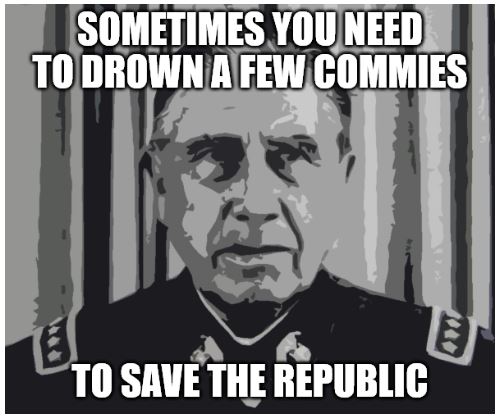
Lest anyone think I’m being too radical, let me point out that if the Marxists could do it, they’d do it to you. Except that they don’t do small stuff like helicopters; no, they have things like gulags, “education camps” and insane asylums for their opposition — i.e. oppression and suppression on a mass scale.
And if you don’t believe me, I have a New York City bridge to sell you — if it’s still standing and hasn’t been burned up yet, that is.
Interestingly enough, what we need now is not leadership of the Dick Winters type: cool, cerebral and logical. No, what we need is more Lt. Ronald Speirs: get in and get the job done, regardless of how many assholes you have to kill.
Chatting with New Wife about this and that on the way to the liquor store gun store supermarket; and it appears that in South Africa, people running charity missions to deliver food parcels to the elderly and incapacitated were being robbed and their parcels taken by roving gangs of “teenagers”.
So the Government stepped in and had police officers take charge of the deliveries… wait, wait, don’t spoil the punchline…
…whereupon the police officers stole the food parcels for themselves.
New Wife was tut-tutting about the lawlessness of the people supposedly tasked with maintaining law and order, whereupon I added:
“Over Here, we had senior officers in the FBI — supposedly, one of the most ethical police forces in the world, whose motto is Fidelity, Bravery, Integrity — cooking up evidence to spy on a political campaign, intending to overturn a president elected in a fair and lawful election.
“Compared to that, nicking a couple of food parcels is minor-league stuff.”
And it is.
So with the Chinkvirus thing winding down in Britishland, thousands flocked to the outdoors when the weather warmed up.
With predictable consequences.
Try not to wince.
In the wake of all the Pantifa / Black Lives Suck Matter riots and protests and such, the airwaves and presses are full of earnest pleas to “start a national conversation” or “address the racial strife” or “deliver justice” for those whose lives have been so horribly afflicted by the daily misery of living in modern-day America.
But what if we — that is, the people who are the targets of such tropes — don’t want to have a conversation with these people anymore? What if we look around us and see things like minority set-asides, preferential hiring- or admissions practices, creation of the various bureaucracies that purport to address all these supposed iniquities (e.g. Offices Of Race Relations, Equality Commissions, etc.), and realize that despite all these efforts, many Black people are still mired in slums, are still enslaved by criminal lifestyle, are still hobbled by sub-standard education establishments and continue to behave in ways that, in the immortal words of Chris Rock, still end up with their asses getting beaten by the cops?
What if we — we, the suffering middle classes who form the backbone of this nation — just say, “Fuck you, and your conversation.”
And before anyone gets all bent out of shape about the above, let me remind you all that when the Chink Wuhan virus hit our shores, the people who kept this country together were not academics, or politicians, or journalists, or community organizers; and for damn sure they were not the people now rioting and looting, nor the shadowy organizations who are organizing the unrest. The country was kept going by people like truck drivers, doctors/nurses, supermarket workers, maintenance technicians, farmers and trash collectors, to name but a few. Not glamorous people, not members of the “elite” set, just people who are not a part of “systemic racism”, nor of “class privilege” and especially — considering that many of them are Blacks and Hispanics themselves — are not benefactors of the so-called “White privilege”.
What if these people, these ordinary hardworking people just said to all these demands, “No. We’re not going to pander to you anymore.”
What then?
Short and messy, kinda like this. And now a quick look at some relevant news:
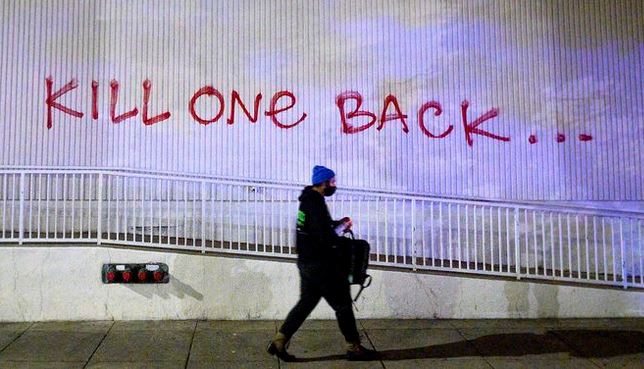
…just remember that it cuts both ways, assholes.
 (no link because why waste Readers’ time?)
…hey George: stick to banging yer lawyer wife or making Oceans movies. And speaking of lawyers:

…like anyone cares what this bunch of Commie shysters thinks.
Here’s one news item that doesn’t even need a comment from me, ol’ Tuck says it all:
Tucker Carlson Hauls Off On Asshole Republicans (my headline).

…sounds okay to me, especially on seeing this:

…so, Mr. Law-And-Order President: when, exactly, will the 82nd Airborne be sent in with orders to shoot to kill?

…and I agree. Let’s start by eliminating no-knock raids, asset forfeiture and your fucking armored cars.

…
And finally, on a much lighter note:

…that’s okay. A lot of women can’t measure up to a good wank, either.