
Several Readers (thankee) have pointed me to this article at American Thinker:
There was a time — not very long ago — when the automobile represented one of the clearest expressions of individual choice in a free society. Limited only by fuel, roads, and imagination, a person could choose where to go, when to go, and how to get there. The car was not merely a machine. It was mobility made personal — an extension of autonomy and freedom.
Sadly, that is no longer the case. Increasingly, this same instrument, once a tool to facilitate individual independence, has been repurposed into a system of monitoring and control. Though advertised as safety measures for the consumer, these measures were clearly designed to empower the state.
Modern vehicles are no longer just mechanical devices; they are computers on wheels. Embedded sensors track speed, braking patterns, seatbelt usage, location, and even driver attention. Event Data Recorders — commonly referred to as “black boxes” — have been standard in most new vehicles for years. Originally justified as instruments to reconstruct accidents, these devices record data in the moments before a crash. Few object to understanding the causes of collisions. But it is worth noting that once data exists, its use rarely remains confined to its original purpose.
Insurance companies now seek access to driving data to adjust premiums. Law enforcement agencies have used vehicle data in criminal investigations. Courts have admitted such data as evidence. Each of these developments can be justified in isolation. Together, they represent a quiet but unmistakable shift: the automobile is no longer simply your property — it is a source of information about you.
More recently, legislative developments have accelerated this trend. The federal infrastructure legislation passed in 2021 includes a mandate for advanced impaired driving prevention technology to be installed in all new vehicles within the coming years. While often described in benign terms — systems that passively detect intoxication or driver impairment — the practical reality is that these systems must continuously monitor driver behavior in order to function. Monitoring creates data. And data, once created, rarely remains unused. It takes on a life of its own.
Proposals and discussions around remote vehicle disablement — popularly referred to as “kill switches” — have raised further concerns. While proponents argue that such features could prevent high-speed chases or stop stolen vehicles, the existence of remote-control capabilities introduces a fundamentally different relationship between the individual and the machine. A car that can be disabled remotely is clearly not under the control of its owner.
I’ve ranted about this little bit of rampant evil on many occasion, and the gist of all my screeds has been all around this concept: giving up control — to anyone, for even the most laudable purposes — will, inevitably, end your freedom.
I’m unlikely ever to buy a new car, and certainly not a “modern” car which would contain all the electronic snoopery and filth as discussed above, and most especially at today’s bloated and excessive prices. But if I were ever to be forced into buying a replacement for the Tiguan or the Fiat, and given that no matter what I buy, it would carry a horrible price tag withal, then why would I just not get a much older car that while expensive, at least allows me the freedom that cars of yore gave me? Something like this one, for instance:
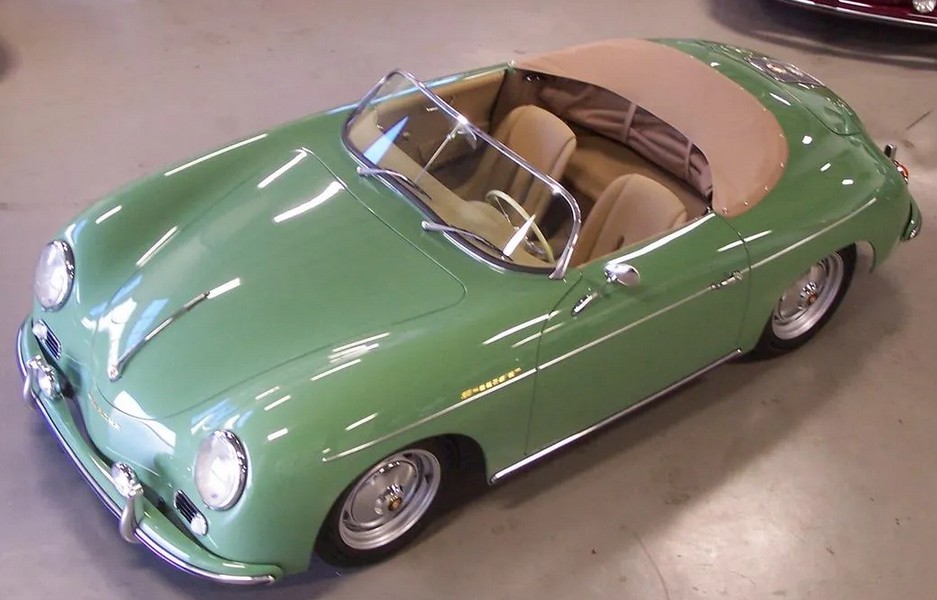
I know, fifty-odd grand for what is in essence a gift-wrapped VW 2300cc engine may seem excessive to some; but I don’t need much more than 145hp (especially on that featherweight chassis), and it least it doesn’t look like every other car on the road (#WindTunnel). But most of all:
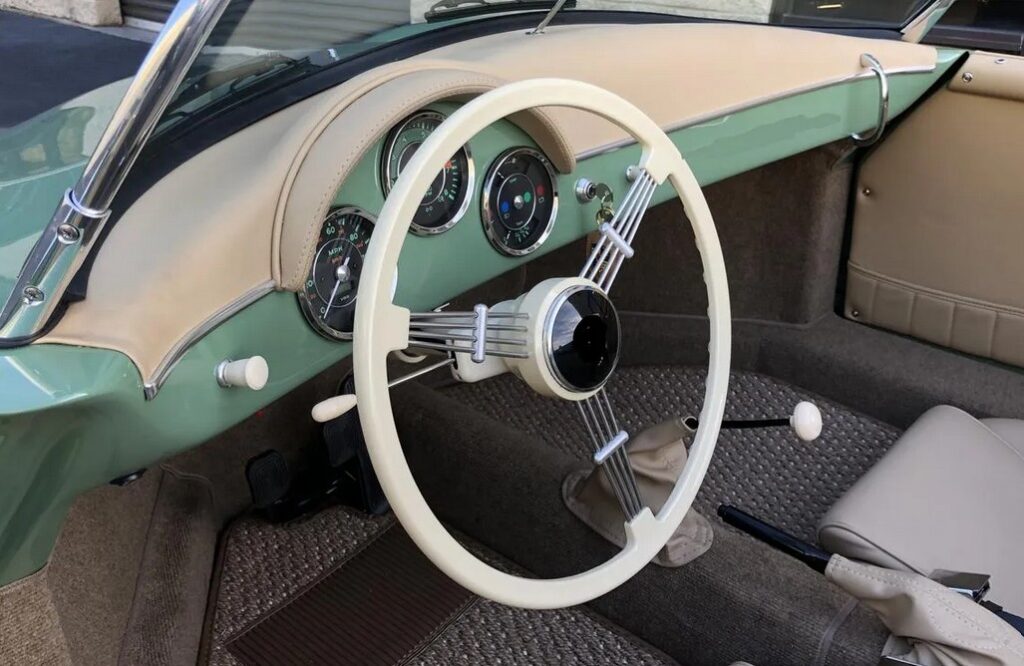
…please note the refreshing absence of all the modern electronic geegaws which bedevil today’s automotive offerings. The only thing missing (which I’d add with alacrity) is air conditioning. (#TexasSummer)
For the faint of heart, let me point out that a new VW Tiguan base model will set you back close to $40,000, and a Jetta (with a stick shift!) only five grand less. And you can bet your ass that both the VWs will come equipped with all the latest in snoop-‘n-control electronics.
Sorry, but no. To hell with all that. I want simple, and I want freedom.
I’m going to assume this post is not an April fool’s prank, and assume you just didn’t know that what you picked out is not a real Porsche Speedster for the bargain price of $ 40K. That’s a Beck Speedster. a fiberglass kit car replica. It does look like a well done one and admittedly it is basically the same thing as a pre-A Speedster. ( minus the hand formed steel body work )
Here a link to a recently sold example of the real thing. https://bid.goodingco.com/lots/view/1-BZAWFF/1955-porsche-356-speedster of course this barn find ( sold at $145K ) is going to need some work to make it road worthy. It only needs…… well…….everything. ( see all the detail Photos ) and it still won’t have roll up windows, or A/C and only pretend weather protection and heat.
….. and one more thing. These are actually very small cars, make sure you fit in one before buying it.
……… and forget about adding A/C Driving the compressor is going to use up a lot of what HP is available and since it’s not even remotely a closed car even with the side curtains and the erector set “Top” in place you are still attempting to cool all of Texas in the summer. …. and where exactly do you intend to put the Heat exchanger. It normally goes in front of the nonexistent engine radiator.
I should point out that a lot of these replicas — and yes, I know quite well it’s a replica — come with A/C installed, so clearly it doesn’t affect the car’s performance too badly.
“A car that can be disabled remotely is clearly not under the control of its owner.”
Not really in line with your topic, but as someone who only drove what I could afford back in the day, I’m more than a little familiar with cars that could be disabled randomly (as opposed to remotely). Engines that suddenly decided to stop working, brake lines that decided today’s the day to blow out, tranny’s that up and puke gears for no good reason, all that taught me to instantly deduct what fucked up and make sufficient steering input to get out of traffic and somewhere safe while there was still enough momentum left in the rolling chassis. Fun times, that. Something to think about if you are serious about buying 50 year old vehicles.
Me, I’m thinking Toyota Hi-Lux. With a toolbox full of baling wire and duct tape.
Got a 1995 YJ in the driveway for just such occasions. Have a 2024 Colorado next to it. The Colorado has nice features and turning off the trace feature would kill about half of them so I will wait, I guess, till it stops. Should have the YJ road worth by then so back up plan.
Some of the old iron would be good. I would think anything made prior to 2005 or so should be free of the worst of the nanny bits.
Most cars already had the ADR function added during the late 1990s… VW, by the way, was not one of them, but the Detroit cadre were already well advanced in that hellishness.
My first Wrangler was a ’92 YJ. Oh, I miss it! Every time Jeep updates the Wrangler they can only do so much to the exterior, like rounding off, and bending bits, but the really went and made the interior more car-like every time. By now the insides look ghastly. I’m almost to the point of looking for an old YJ or TJ , and fixing it up like you. Carry on PaulB!
Manual transmission, heater, A/C, radio, 4WD, no solonoid to activate the 4WD. Adjustable seats, mechanical gas pedal and mechanical brakes. what else do I need? Backup camera is nice but I’m sure I could adjust to it missing.
I have a backup camera on the car I bought used last year, and after fifty + years of driving without one, I’m still getting used to using it.
I think the only purpose of one is to give the automobile stylists a little freedom to design cars with gigantic “C” pillars that would otherwise make changing lanes and backing up difficult without cameras.
There are a lot of people in the automotive ‘cartuber’ and other social media car channels that are driving people to get older cars, generally from the early-mid ’60s to late ’80s, and making them their ‘forever cars’. Avoid the collectible muscle/pony cars, and there’s a huge selection available. Obviously want one with a body/frame in very good or better condition. Depending on the state you are in and their dedication to the minutia of every teeny bit of emissions control equipment being retained and functional, might need to move that cutoff back to the mid-late ’70s. The early end are still cars developed after the interstate highway system and were developed or evolved to be safely capable of that usage.
They are immensely more maintainable. Mechanical parts remain fairly readily available for the popular engines and drivetrains. The late ’70s – ’80s cars can often readily be freed from their early horrible emission baggage. Many if not most can get upgraded brakes using components standard on other models and again, usually readily available. Rebuild the suspension, refresh the engine, replace all the hoses and belts, fix what needs fixing. Many can have upgrades like anti-sway bars, urethane bushings, tighter steering, etc using aftermarket parts made for the more popular collectible models.
A mid ’60s or newer Ford Falcon, Dodge Dart, or whatever chevy made in that class, or the larger intermediates if preferred. Want a station wagon? Available, though lately their prices have been going up fast.
Odds are you can end up with a great car for quite a bit less than a remote-controllable datalogging new car.