Follow me on this one.
Let’s assume that all your life you’ve been a plinker-and-handgun kinda guy, whereby you own a handgun for protection, and inherited a .22 rifle from yer Dad… and that’s pretty much it. (Don’t laugh, I know they’re out there.)
But with all the crap that’s been going down recently, you decide that you should get a centerfire rifle… just because. Or maybe one of your old classmates invited you to join him on a pig- or deer hunting trip somewhere, you get my drift. Whatever the reason, you need a rifle.
The problem is that you are a little broke [insert Biden reason here] and your budget will not stretch to anything that costs more than a grand — and much lower would be even better.
Forget any of those AR-15 “assault rifle” things — they’re so far out of reach you may as well look for a ray-gun. In fact, most rifles now cost so much that the job seems impossible. Unless you lower your sights [sic] and get a second-hand rifle.
You discover a place that sells many second-hand rifles — some even quite affordable. It’s called Collector’s Firearms, and even though all your buddies warn you about their “collector’s prices”, you’re still able to find a few that will suit your needs.
Here’s one:
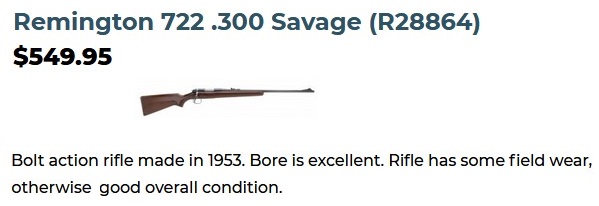
You ask around among your gun buddies, and yeah, that’s a decent rifle and a fine cartridge.
But you remember reading something about ammo scarcity, so you visit places like AmmoSeek to see whether you can get say, 100 rounds for practice and the hunt. Sorry. Only a couple of places have .300 Savage available, it’s expensive and all of them have “Limit: 1” in their conditions of sale.
So you try another rifle in a different chambering:
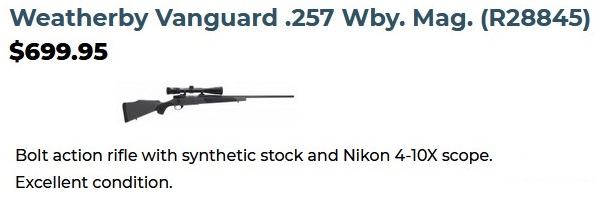
Once again, lovely rifle (plus a scope!) for an okay price, and the cartridge is excellent.
Except AmmoSeek shows that nobody has .257 Weatherby Mag ammo in stock. Damn. Oh well, on to the next choice:
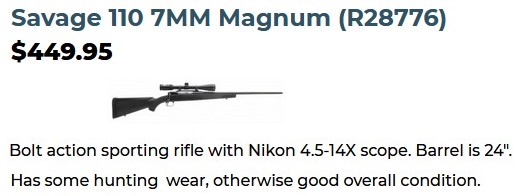
Oh yeah baby, now we’re talking. Inexpensive, highly-regarded rifle, scope included, and a hard-hitting cartridge…
…but although AmmoSeek shows quite a few people actually have the cartridge in stock, it’ll cost you about $3 / trigger-pull. Ouch. Maybe another gun…?
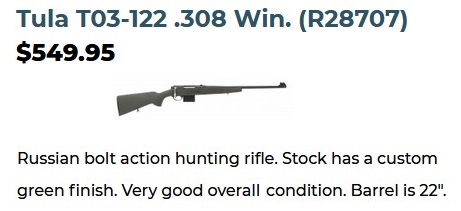
Okay, this rifle is something of an unknown quantity, and there’s no scope; but at least it’s chambered for a common and popular cartridge, right?
…and you’re greeted with peals of mocking laughter, so to speak, as you discover that .308 Win is so popular that it’s no longer common — at almost any price. More distressing still is that the stuff that’s remotely available and affordable is full metal jacket — not yer optimal hunting cartridge — and a typical hunting cartridge purchase situation looks like this:

I could go on and on, but I think everyone gets the point, here.
I remember writing about buying guns and ammo during the G.W. Bush presidency, and saying that “these are the good times for gunnies”… and boy, was I ever right: guns were cheap and readily available, and you could buy ammo of any caliber by the (multiple) case load from a choice of sellers.
We live in different times now, and as much as I love the fact that more and more people are becoming first-time gun owners — the goal of the Nation of Riflemen, remember? — the result is that even I have to count the rounds when I go to the range (every other week, now, instead of weekly and even twice-weekly before).
Hell, my buddies and I used to give each other Christmas presents of 200-round bulk packs of .45 ACP; now, you can’t afford to do that not just because of the outrageous cost, but because you need the damn ammo for your own dwindling supplies. Without being sarky about the thing, I discovered over the past weekend that Ye Olde Ammoe Locquere is down to about 1,800 rounds of .45 ACP FMJ, and 200 rounds of self-defense stuff. Never mind holding off the Chinese Army (as someone once taunted me); I couldn’t hold off a piddly Antifa riot.
Aaaargh.