Belated Recognition

I have to say that I have not been remiss in not talking about Othias and Mae at C&Rsenal before, simply because I only recently discovered this outstanding EeeewwChoob channel.

That said, an impossibly-long amount of watching has since followed — I probably spend about two hours a day watching this pair talking about, and shooting, the old rifles that I love so much.  Between Othias’s historical background on the guns’ development and manufacture, and Mae’s well-informed opinions on the guns’ actual operation, it’s just about a perfect show for an old gun geek like myself.  And when they’re talking about a gun which I own, I feel an irresistible urge to get it out of the safe and work the action while I’m watching.  (I won’t even talk about the irresistible urge to go to the range afterwards.)

Between this show and Ian McCollum’s Forgotten Weapons series, there is a veritable encyclopedia of information about guns — so much so that from now on, I’m not going to do any lengthy exposition on the guns I feature in my Gratuitous Gun pics, but simply hand them over to one or the other of these two channels where they are covered.  (If I do a range report, however, I’ll put my two cents into the mix.)

Damn, I love this gun thing.

Three Old Farts Walk Into The Range…

So I took myself off to the range yesterday, accompanied by these two other old guys:

Here’s the final five-round string for the Mauser, at 100 yards, bench rest (elbows, not sandbag), shooting Sellier & Bellot 195-gr FMJ:
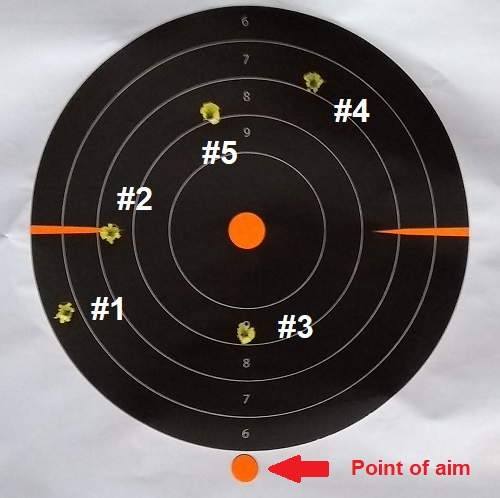
I’d noted in earlier targets that the gun was shooting high, hence the low hold.  However:  while I could sort of make out the front sight, the back V sight (tiny, as all Mauser shooters know) was simply an amorphous blur, and I had absolutely no idea whether I had the sight picture properly aligned, or not.  Here’s a rough idea of what I’m talking about:


…only the rear V was even more blurred than that, making it impossible to get a clear and consistent sight picture.

It’s not the rifle;  it’s me;  although I am a little concerned that it’s shooting so high, it might just be that I was shooting with sight pictures #2 or #5.

I need to get my eyes fixed, pronto.

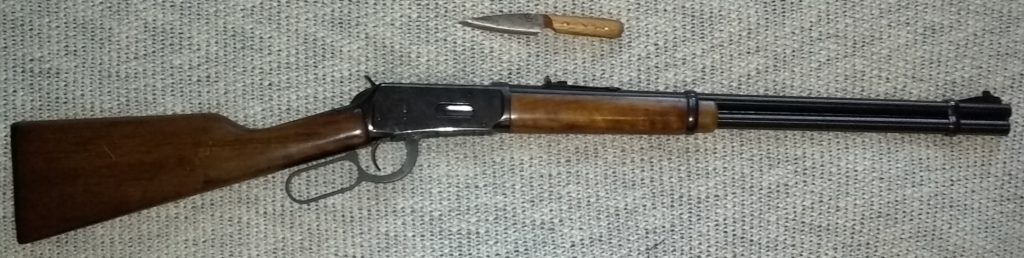
Anyway, on to the (post-’64) Winchester 94.  This time, I set the target at 50 yards, and figuring that it would shoot high, I held the same point of aim.  These were all fired offhand (standing, unsupported), because I doubt very much whether I’ll ever benchrest it.  Ammo was Winchester Super-X 170gr SP:
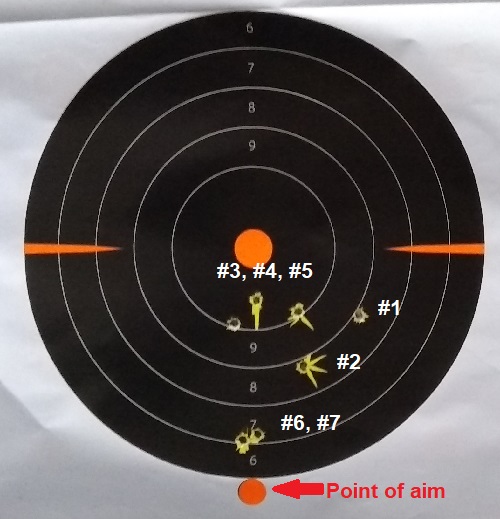
Unlike for the Mauser, I fired no “warm-up” shots, just loaded some rounds into the tube and let fly:  I know how to shoot a lever rifle.

Just not this one.  The first five shots were all over the place because I discovered that there’s absolutely no take-up in the trigger:  once the hammer is cocked, apply about 3lbs of pressure, and off she goes.  So I took my time with the last two (#6 and #7) and was amply rewarded.

For some reason, the little “buckhorn” rear- and brass bead front sights were a lot easier to line up properly, compared to the Mauser’s V/conical setup.  Also, the Winchester’s sight radius (distance between back- and front sights) is 17″, compared to the Mauser’s 20″, which means that when I’m focusing on the front sight, the lever gun’s rear sight is a lot more in focus than that of the K98.

I should also admit that twenty rounds of 8x57mm took quote a toll on my shoulder, whereas the .30-30 was an absolute breeze by comparison.  Next time I shoot the Mauser, I’ll use either a shoulder pad or a removable rubber pad to help my ancient shoulder handle the recoil.

What fun.


Note:  Ammo for both rifles came from J&G Sales.  I paid a small premium for the S&B for two reasons:  I hate shooting corrosive ammo, and I trust the Czech ammo to be consistent (as it has been for me in the past).  Likewise, I bought the Winchester ammo because the thought of shooting Winchester ammo through a Winchester rifle gave me a warm & fuzzy feeling.

Questionable Choice?

I have to say that while I’m intrigued by this new cartridge development, I’m more than a little skeptical, in principle:

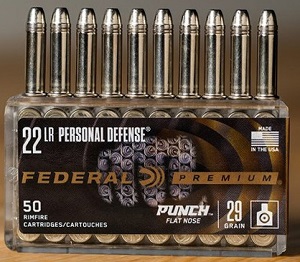
Featuring a deep-penetrating bullet that Federal says “makes the popular rimfire cartridge a viable self-defense option,” the company’s new .22 LR Punch Personal Defense has hit the market.
Part of a 2021 expansion to Federal’s ammo line, the rimfire Punch uses a 29-grain nickel-plated lead-core bullet, pushed at maximum velocities (1,070 fps through 2-inch barrel handguns) for the deepest penetration when coupled with short-barrel handguns.

The concept comes from the fact that people have carried .22s for personal protection for generations. After all, the cartridge dates to the 19th Century, so why not actually provide said mouse gun users with a valid option to stoke their carry piece with?
“We’ve talked about making a 22 LR defensive load for some time. We finally decided that people are already carrying 22 LRs, so we might as well build a .22 bullet optimized for protection,” said Compton. “After much research, we decided that for a .22 LR defense bullet, penetration was more important than expansion.”

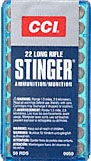
Watch too the embedded video from .22Plinkster.  (When he says “Stanger”, he is of course referring to the venerable CCI Stinger.)

Ordinarily, I would dismiss the entire concept out of hand, mostly because if you shoot someone with a little-bitty 29gr (!) bullet, he’s going to get really angry at you once he realizes he’s been shot.

However, I want you to note how quickly Dave was able to get the shots off, and how accurate he was because his target reacquisition time was minimal.  And here’s the thing.  I once taught a lady how to shoot (hi, Dee!) and after a single one-hour training session, she was able to empty a 10-round magazine into the head of a silhouette target in about 2.5 seconds, at seven yards.  While a single round of .22 LR may not stop a goblin, I would suggest that five or six (let alone ten) rounds of .22 buzzing around in his skull cavity like angry bees may cause a change in his plans for a weekend picnic.

And going back the Plinkster’s video, note the penetration and wound cavity made by the Federal Punch bullet fired from a longer-barreled handgun, which is what I’d choose over a 2″-barreled mouse gun.


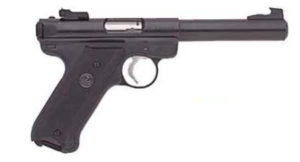
I’m not going to drop the 1911 and start carrying a Ruger .22 pistol anytime soon, of course.  But if it ever comes to the point where I’m too old and feeble to work the 1911’s slide and handle the .45’s recoil, you can bet that there’s be some kind of .22 handgun strapped to my wheelchair.

Because any gun is better than no gun.

Food for thought, yes?


Update:  Peter Grant agrees with me.

Quote Of The Day

Last word on the .444 Marlin comes from Reader Mike S:

“I shot a TC Contender w/14-in. bbl. chambered in 444 Marlin.  Once.
I couldn’t feel my right hand for 5 minutes.  Then wished I couldn’t.
“Muzzle Flash” is such an inadequate phrase.”

The .444 is not a pistol cartridge, no matter what you might be told.

The Swede

Longtime Readers will all know of my fondness for the venerable 6.5x55mm Swede (SE), and I happened on an article which gives chapter and verse to this wonderful cartridge.

With all due respect to its larger 7mm / .30 siblings, I stand firm in my belief that the Swede is quite possibly the perfect medium-game cartridge, the excellence of the .308 Win, .30-06 Springfield and so on notwithstanding.  When you take all the factors of shooting into account:  bullet velocity, flatness of trajectory, penetration, and most especially recoil, the sum of the Swede’s parts of this equation are probably higher than the bigger cartridges.  Here’s a pic I’ve posted before, comparing the Swede to its contemporaries:

Here it us with some other “quarter-inchers”:

And finally, vs. the .308 Win (my “1.a” choice for a do-it-all cartridge):

I will say unreservedly that if I were limited to only one cartridge for “ordinary” (i.e. excluding African large game) hunting whether human or animal, the Swede would get my vote ahead of every other cartridge I’ve ever fired.

The only caveat I have is that the Swede doesn’t seem to do as well in shorter-barreled rifles.  I think that in standard loadings — and certainly with the Hirtenberg mil-surp stuff — the bullet needs a longer barrel to get that bullet spinning towards its performance apex.  And the ultimate expression of that is in the wonderful Mauser Mod 96 with its 29″ barrel, as never used (in combat) by the Swedish Army:

In my earlier post on Great War Rifles, I said:

But of all the rifles issued to soldiers of that era, the one I’d have chosen to go to war with would have been the Swedish Model 1896 Mauser.  It has moderate recoil, yet the bullet travels flat and hits hard.  The rifle is also fantastically accurate: consistently-placed head shots at 400 meters and torso shots at 600 meters are quite possible even for an average shot like myself.

I haven’t changed my mind since.

That said, I have old eyes and the iron sights would be problematic — but mounting a scope on the old M96 can be tricky, with that 90-degree-lift straight bolt.  So I’d have to take instead my current love, the CZ 550 with its 24″ barrel:

Compromises… we all have to make them.