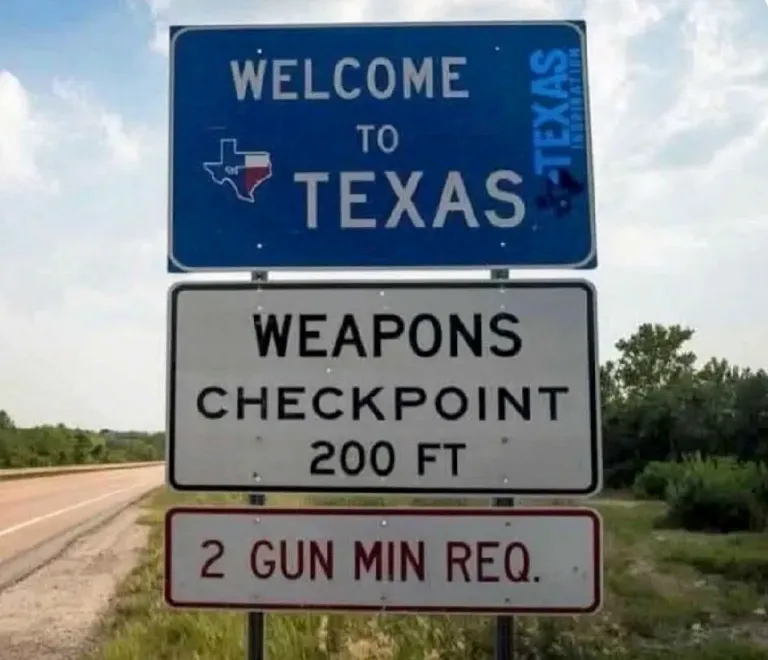
Texas Man?

This is priceless.  Some mope armed himself with a .22 pistol and a couple boxes of ammo, and headed off to a church in Houston with the avowed aim of whacking the pastor thereof.

You can read the details of how he failed here, but please note the description of our would-be assassin in the headline:

Texas man with loaded gun, 100 rounds tackled by security at Houston church

You might think, after reading the above headline, that this was a simple case of ol’ Joe Bob getting upset with the pastor because the man of God was giving Joe Bob’s wife some extra-special pastoral counseling, if you get my drift.

Well, you’d probably be wrong because the scrote’s actual name is Emmanuel Ahsono Mbwavi, which — and y’all will forgive me for thinking this — does not sound like yer average Texas name:  Billy Bob Johnson, yup;  Jorge Morales, okay (especially in Houston);  La’Marquis Washington, fer shurr (ditto).

Also, at time of writing we have no word on Mr. Mbwavi’s actual motive, but my immediate guess would be that it’s of an African nature.

Kudos, by the way, to the security guard for tackling the asshole and holding him for the cops.

No prizes for guessing, though, what my preferred outcome would have been (see the next post).

Dept. Of Righteous Shootings

Sent to me once more by Reader Brad_In_IL, news of this happy event:

A licensed concealed carry holder shot and killed a man who broke into his home and charged at him early Monday.

The 33-year-old concealed carry license holder called 911 at 1:24 a.m. and told dispatchers he had shot an intruder inside his home in the 2200 block of East 103rd Street and had already begun performing CPR on the man, who had suffered a gunshot wound to the chest.

Good news:

Officers arrived and took over lifesaving measures, but the intruder, who remained a “John Doe” as of Monday evening, was pronounced dead at 1:43 a.m.

Even better news:

[Our Hero’s] home is across the street from the South Chicago (4th) District station.

Look, I know that there are few PhD candidates among the Violent Burglary Set, but even so… dude?

Anyway, a one-shot kill:

…and some applause, please:

Finally, according to the report:

Detectives are investigating the shooting.

Even in Chicago, I bet it’s going to set a record for “fastest investigation and clearing, ever.”

Close Enough For Government Work

We gun owners often  waste our time  talk earnestly about the concept known as the “BBQ gun” (or “Governor’s BBQ gun”).  In essence, this would be a nice-looking, quality handgun that would “show well” in a fancy holster — in other words, a description that no gun named “Glock” could ever satisfy.

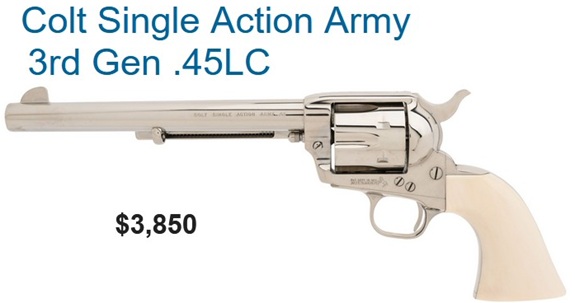
Of course, people will suggest something like a shiny nickel Colt Single Action Army (Peacemaker) as the sine qua non:

…and I would be the last to disagree with that, to be sure, because it’s as pretty as a picture and would make a fine addition to one’s formal attire.

However, there are a few drawbacks to this, from a practical perspective.  Firstly, there’s the price… yikes, and that’s for a new manufacture.  Step back to a First Generation piece and well, you don’t wanna know.  Next, we all know that while the SAA shoots the manly .45 Long Colt, as a self-defense gun it’s not what we’d call an optimal choice in terms of both capacity (6) and reloading speed (measured in geological time by comparison to the usual self-defense choices).

But that doesn’t matter because this is a “dress” gun — one could even be unkind and say it’s “ornamental”.  There’s nothing wrong with that, of course;  thinking from a girlie perspective, a pair of sexy Christian Louboutin shoes might be a perfect choice for the Governor’s BBQ Party, much less so for hiking in the mountains.

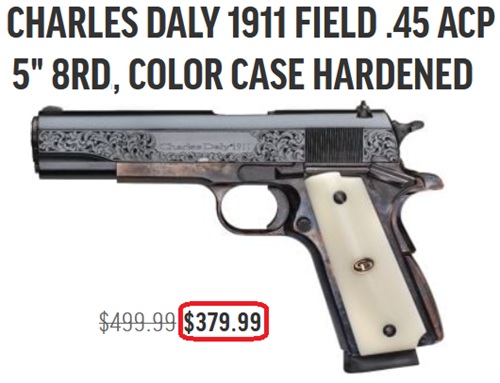
So getting back to the gun thing:  all this was brought to mind when I got the latest sales promotion from the kids at Palmetto State Armory, which featured this:

Granted, this might be a little too show-offy for some (it certainly is for me), but you can’t deny that it’s not the worst-looking handgun you could carry on your hip at said event.  Certainly, it’s more affordable than the nickel SAA above — like 10% of the SAA’s price — and yes I know, cheap guns don’t always make the very best choice for self-defense.  But remember, the main thing about a BBQ gun is that it looks good on a formal occasion, not necessarily that it works that well as a self-defense piece.

See where I’m going, here?  Discuss.

No Immunity

I think I’ve been ranting about this topic since I were but a Baby Blogger, even pre-Pussification-Instalanche-fame/infamy.

To recap:  under Hammurabic Law (which pre-dates the Hebraic Pentateuch  by a couple of centuries or so), if a judge freed an accused murderer, only for said murderer to go on to commit another murder, then the judge would face the same fate as the murderer (once captured), i.e. execution.  I don’t have access to any relevant stats, but I cannot help but think that judges became extremely leery about giving some obviously-violent scrote a slap on the wrist and sending him home for tea with his Mum, instead of helping him up the stairs to the gallows.

Then some legal  asshole  mind said, “Oh noes!  This is a terrible idea!” and thus was born an even worse idea, that of “qualified immunity” whereby a judge who made a piss-poor decision was now shielded from any kind of retribution.

Kevin Finn at American Thinker  puts it far more eloquently than I:

Politicians, bureaucrats, and judges routinely issue rulings and enact policies that carry enormous ripple effects on society — yet they are insulated from the human and financial costs incurred when those choices prove misguided. We see this being played out in the criminal justice system, where decisions about release, bail, and sentencing directly shape public safety.

Judges exercise considerable discretion in pretrial releases, sentencing guidelines, and immigration-related detentions. Meanwhile, politicians shape the statutory frameworks that govern these processes, from sanctuary policies to sentencing reforms. When an individual with a documented history of violence is released and later commits additional crimes, the consequences fall squarely on their victims, their families and communities. The decision-makers themselves face no equivalent personal stake. Federal judges enjoy lifetime tenure, which brings its own issues. State judges may face infrequent retention elections, and elected officials can pivot to new priorities or blame systemic factors.

Then later down the page of said article comes this little ray of sunshine:

Florida Chief Financial Officer Blaise Ingoglia has publicly broached a direct and startling, albeit satisfying response to this dynamic. In a recent statement addressing sanctuary policies, he advocated treating politicians who enact or defend such measures as accessories to crimes committed by those shielded under them — charging them with complicity in resulting murders, rapes, or other offenses. “The easiest way to get rid of sanctuary policies,” he argued, “is to start charging the politicians that support sanctuary policies as accessories to murder, rape, and pedophilia.”

His formal legislation targets fiscal accountability — codifying oversight mechanisms like the aptly-named Florida Agency for Fiscal Oversight (FAFO), allowing recommendations for removal of local officials for financial abuse, malfeasance, or misfeasance — the accessory principle he mentioned suggests a broader framework. Were this to be applied thoughtfully to criminal justice, it suggests that judges or politicians whose actions foreseeably enable violent recidivism could face similar scrutiny, transforming enablers into accountable parties rather than distant observers.

Once again, Florida has beaten Texas to the punch — as least as far as I know — because if ever there’s an idea which should resonate with all right-thinking Texans, it’s this one.

I have little reason for optimism that this worthy initiative will become law — nobody wants to be shielded more for their actions than a politician, and lawyers [with some considerable overlap]  will likewise strive with might and main to protect their own, both using all the political- and legal legerdemains at their disposal.  Politicians, at least, have some accountability in that they are exposed to electoral consequence;  but judges, as noted above, face little such accountability other than at the local level.

But the very horror that would greet Ingoglia’s initiative imposed at the federal level makes me think that it’s a really good idea, and very much an idea whose time has come.

And I’m pretty sure that King Hammurabi would agree with me.