
Okay, I need some Murkin aficionado to ‘splain this one to me. It’s a 1963 Plymouth Sport Fury:
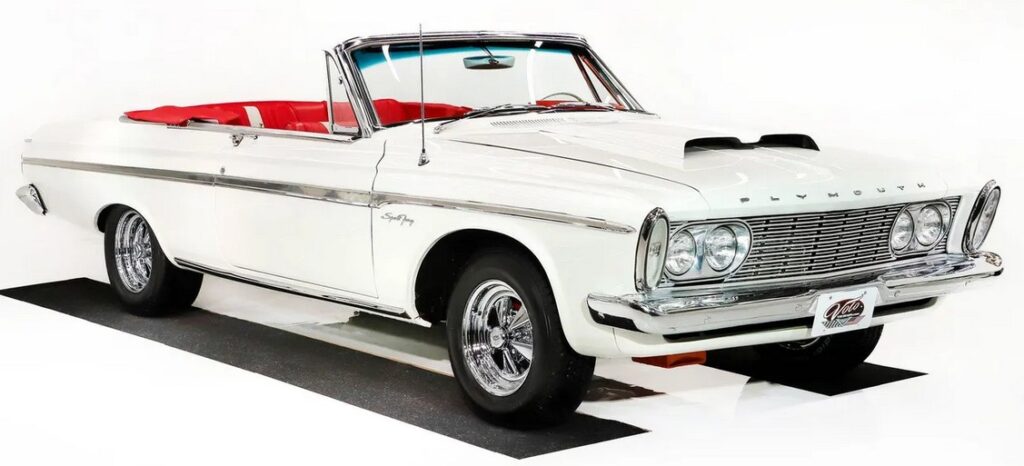
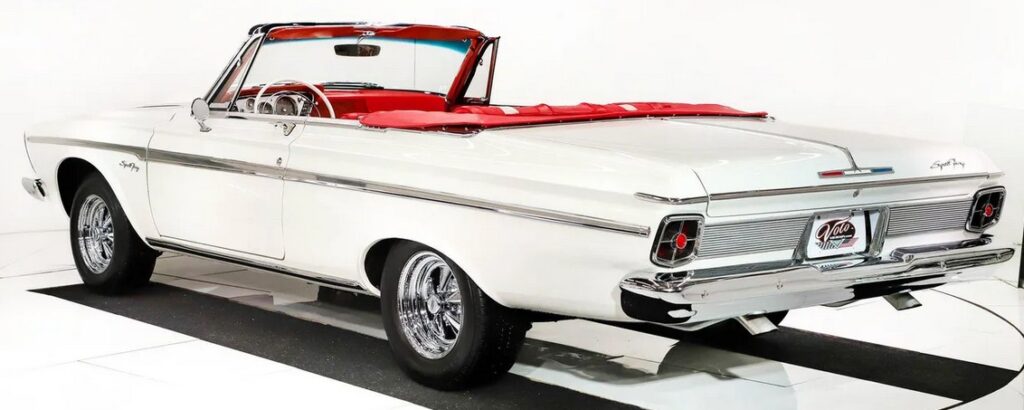
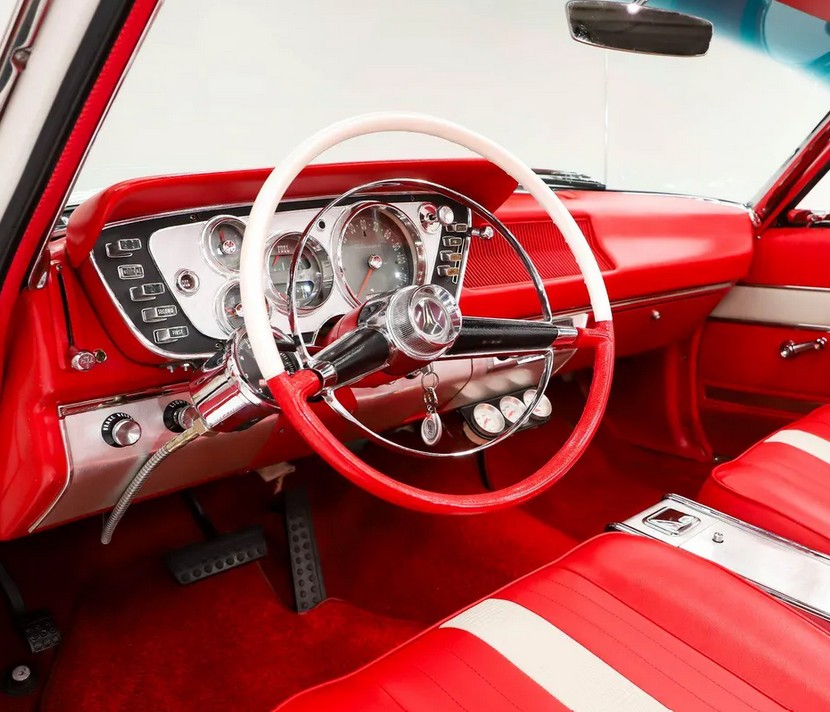
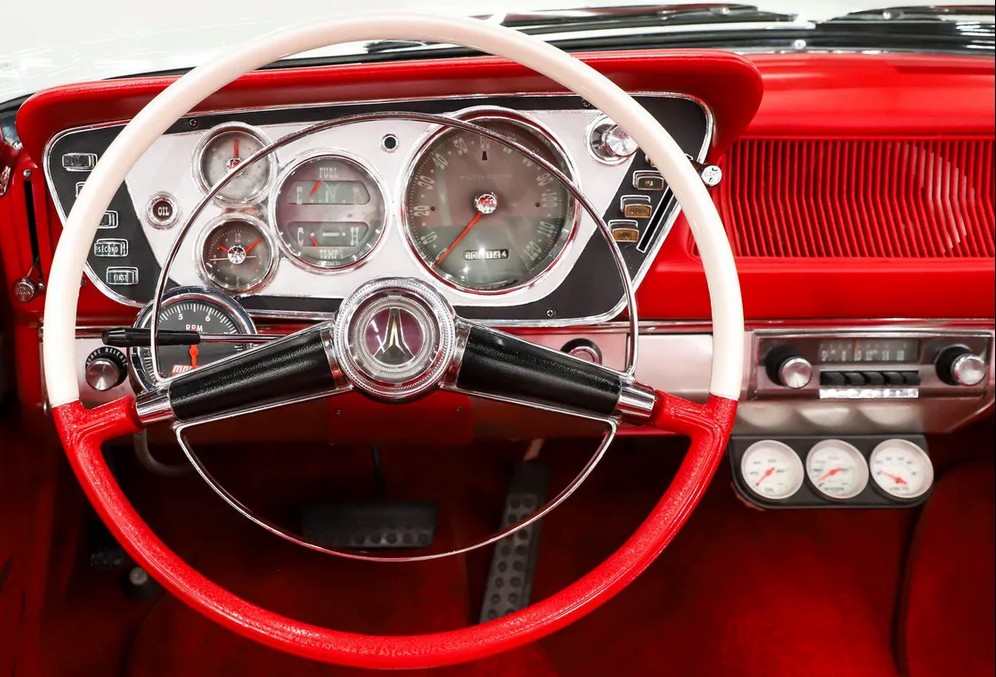
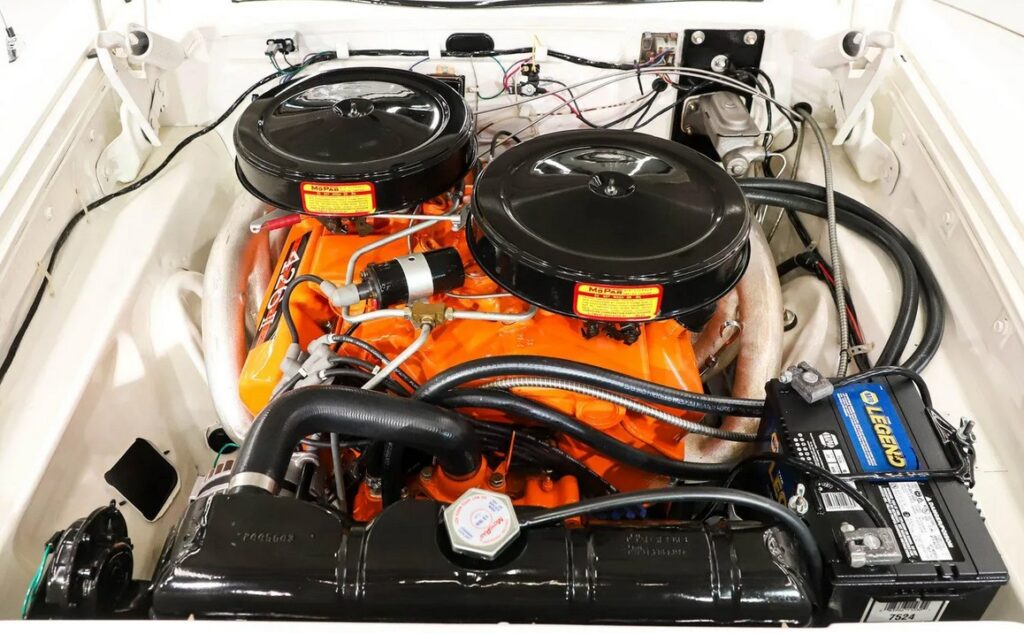
The engine is 512 c.i., and creates 656 hp with 662 ft-lbs of torque, while the rev counter goes up to 9,500rpm, all of which seems stratospheric for a car of this vintage.
The questions flow thick and fast, e.g. why did this beast not take over the world, did it ever race and win everything it raced in, etc.
All educated comments welcome.
At the time of manufacture the engine specs were The 1963 Plymouth 426 Max Wedge is a 7.0-liter (426 ci) V8 “RB” block engine producing 415 hp (11:1 compression) or 425 hp (13.5 compression) and 480 lb-ft of torque. Key features include a signature cross-ram intake manifold, dual 4-barrel carburetors, high-flow cylinder heads, and reinforced internals designed for drag racing.
This one was coupled to a Torqueflight three-speed automatic transmission (one of Chryler’s best.). This car was not considered a beauty at the time by us youts in comparison to the slightly larger Chevrolet Impalas and Ford Galaxies. It was made to go but it didn’t stop very well (You might notice the small single master brake cylinder on the firewall without a booster. It connected to four drum brakes).
I was thirteen at the time. I appreciate that car a great deal more now than I did then.
The stock Max Wedge Mopars won a lot at the drag races, but couldn’t compete with the 427 Fords in NASCAR. So, the following year, Chrysler came out with the Hemi. And other than NHRA Stock Eliminator, the Max Wedge faded into the background.
….. and that particular one has been bored and stroked. (and balanced and has lots of later pieces and parts that didn’t exist in the period that allow it to rev much higher than it ever did in its original form ).
Not quite a resto mod but its engine, and the rest of the car is much more carefully built than they were at the factory. It’s your typical project car that cost way more to build than they can sell it for on the best day. The engine rebuild alone probably has $ 75,000 or more in parts. Or maybe they are just lying.
Reason I asked is that for some reason I find the car quite alluring, and the price quite reasonable (by today’s car price standards, that is). It’s gone into Kim’s Car Bucket List, thanks to the above helpful comments.
I don’t care about stopping it because I would only be puttering around the suburbs, not tracking it.
According to Top Gear and Jeremy Clarkson (the authority on all things motoring) a car can never be art, because by definition art has no practical use other than as enjoyment, therefore a car can’t be art.
Whether the above statement is bullshit or not I’ll leave it to the judgement of the reader. For my $0.02 this falls into the art category. Its a gorgeous pic of a gorgeous car.
Then there’s the Chevy Volt which is styled like the cars I drew when I was 4 years old. Not to pick on the Volt, any Duracell car and most modern ones can fit into that category.
> a car can never be art, because by definition art has no practical use other than as enjoyment
Clarkson is an entertainer, and one who’s schtick often involves making shit up on the spot.
Which is to say that I know a lot of people with way more experience and knowledge in the field who would call that definition “bunk”.
Larry and Ted pretty much summed it up, none of that is even close to original. The engine block is a 440 (not available until 66 or 67), and everything inside has been replaced. The original specs were much more realistic to the time period of roughly 415 horsepower and maybe 5000 rpm max. I sincerely doubt that thing could do 9500 rpm more than once, and that was on a dyno to get those numbers. And I’m pretty sure they made very very few of those cars – I think at the time they only had to make maybe 500 to qualify it for Nascar racing. If you were to walk into a dealer in 1963 with cash, the chances of you being able to buy one of those things is between slim and none. You’d probably end up with the much more common 318 or maybe the 383.
And like Larry said, both Ford and Chevy had big blocks that could match or even beat it. And the Hemi that came out 2 years later actually made much better power (although the reported numbers were, shall we say, fudged down a bit).
But honestly, we know you love it only because of the whore-house red interior!
I’m just happy that Kim is developing a taste for muscle cars, especially Mopars. 😀
According to the video, the tach and temp gauges do not work. I seriously doubt that a 440 bored and stroked to 512 would be able to spin to 9500rpm.
It does sound really nice, and it looks like it pulls like a freight train. Front brakes have been converted to disc, and the automatic transmission has the manual valve body installed, so it’s manually shiftable using Chrysler’s push-button shift on the dash.
“…spin to 9500rpm”
Absolutely no way. Even if the rods and rings could stand that, the valve gear would be long gone in an engine that big.
In 1970, I had a Chevy 427 435HP engine (more or less same size as the Mopar) and to get 7,200 rpm, where I had the rev limiter set, I replaced rods, rod bolts, pistons, cam, pushrods, rockers and valve springs with a very expensive mix of Chevy and aftermarket heavy duty parts. At a time when stock Chevy valve springs for that stock motor in a 69 Corvette cost 87 cents each, the springs that would not break and keep the valves from floating at 7,200 rpm cost me $7.00 each. You can imagine what the rest cost. Maybe someone does have $75K in that Mopar engine, but it isn’t going to run at 9,500 rpm, at least not more than maybe 10 seconds. Anyhow, that’s an aftermarket, one size fits all tach and just because it goes to 9,500 rpm doesn’t mean the engine will do that. Note that it doesn’t come with a red line.
My local hot rod shop had a sign on the wall behind the counter containing a law of the universe:
SPEED COSTS MONEY.
HOW FAST DO YOU WANT TO GO?
Why a “Sport Fury”? Because they need something on the showroom floor to compete against the Impala SS,
I was trying to explain The Beach Boys to my 12 year old son and I played “409” for him. We then spent an enjoyable 10 minutes looking at pictures of the 63 Impala SS. This all came about because he commented on an old hot rod he saw on the way home from school, which led to a discussion of deuce coupes, which led to The Beach Boys. My dad was a teenager in the early ‘60s and had a huge love of muscle cars and drag racing.
I had a 1965 tempest with a bone stock 326 cu engine. I added a tach to it and stuck the rev counter at 10k. Shocked the crap right out of me. Motor did not blow, amazingly. That was on hard running car.
The Plymouth fury was a fast name plate. It would make a good suburban cruiser.
It’s the engine. In 1963 and 1964, this was the Chrysler’s engine for drag strip cars. They also made an street version, same displacement, with a single 4 barrel carburetor. This motor was put in a number of cars, some of them very light weight. It was good for one thing, going fast in a straight line. No modern handling and manual drum brakes. YouTube has some videos showing the various cars and some drag strip videos. Search 426 Max Wedge.
Here’s one. https://youtu.be/E7qIdzKbWGk?si=7G0hrpB_1LVN0E7A&t=170
No frills, just max horsepower and torque.