In talking about old cartridges yesterday, I made brief reference to an article I wrote many years ago. How old can be seen by its date, and here’s the thing, in its entirety.
Nothing Good Since 1955
February 26, 2003
10:00 AM CDT
I was asked the other day what I have against certain cartridges, specifically the .40 Smith & Wesson and the .357 SIG for handguns, and the plethora of new rifle cartridges (Ultra Mags, Short Mags and so on).
Simple answer: I have nothing against them. Our culture and economy flourish because we insist on choice. I refuse to get into a discussion of “need” for choices, because when you talk about “need”, the unanswerable question is, ”Who decides what you need, and when?” It’s unanswerable, because no one should decide what we need — the market decides what stays and what goes, and we make our choices as part of the “market”.
However, one of the problems we face is that in the relentless pursuit of choice, some excellent options may get lost, just because they’re old and no longer worthy of production.
A while back, I read an article written by Ross Seyfried, entitled “Cartridges We Can Live Without”. Now I know that writers seldom pick their own topics — they’re usually assigned them by editors — but this article prompted me to write a seething letter to the editor of the magazine, the subject of my letter being “Gun Writers We Can Do Without”. (Unsurprisingly, they declined to publish it, the craven wussies.)
What raised my ire on this specific occasion was Seyfried’s assertion that the venerable 7x57mm (“7mm Mauser”) cartridge was passé, being no longer on a par with some of the new “wonder” cartridges.
Well, excuse me. Considering that the late Great White Hunter Walter “Karamojo” Bell used to hunt elephant with the 7×57, it’s a little silly to think that the slow-moving, long bullet won’t do pretty much anything you ask of it. I once went hunting with an old surplus Mauser in 7x57mm, and the professional hunter (PH) nearly refused to take me out with such an “underpowered” rifle. One dead eland later, killed with a single shot, changed his mind. (The eland typically weighs well over half a ton.)
Now I know that new products are a good thing. Research and development make for improvement, on just about anything. But there is an implicit danger in this, that being that the “tried-and-true” can sometimes be forced out simply because of economics. Indeed, were it not for the fact that the European shooting market still enjoys the 7×57, I doubt very much whether any U.S. company would still make the old girl today. The fact remains, though, that the 7×57, while admittedly inefficient by today’s cartridge standards, still has many attributes (low recoil, astounding penetration) which endear it to many shooters, myself included.
The problem with new cartridges is that you need new rifles to shoot them with — and over the past few years I think that most new cartridge development has been done to sell new rifles, rather than to improve a similar cartridge’s shortcomings. And the market being what it is, a number of fine old cartridges have been simply lost, because they weren’t popular enough. In the cold light of capitalism, this is a good thing. In the gun world, well, I’m not so sure.
Because when a cartridge is no longer made, unless you learn to handload your own, your rifle becomes an expensive club, or mantelpiece ornament. And that just plain sucks. If the newer cartridges were that much better than the ones they’d replaced, that would be one thing. But, since 1950, most newer cartridges are only marginally better than some they’ve “replaced.”
Here’s a short list of cartridges developed since the advent of the metallic cartridge, with their dates of introduction. And please don’t write to me and ask me how come I left off your favorite .278-08 Ackley Improved—the list is indicative, not comprehensive or definitive. (* = rare and can be difficult to find these days, bold = Kim’s favorites)
Rifle Cartridges:
.45-70 Government: 1873
.32-20 Win: 1882
8mm Lebel: 1886
.22 Long Rifle: 1887
.303 British: 1888
8x50Rmm Mannlicher: 1888
7.5x55mm Swiss: 1889
7.62x54Rmm Russian: 1891
7x57mm Mauser: 1892
.30-40 Krag: 1892
6.5x55mm Swedish Mauser: 1894
.30-30 WCF: 1895
And here’s a partial list of the military cartridges in the above- and below lists:
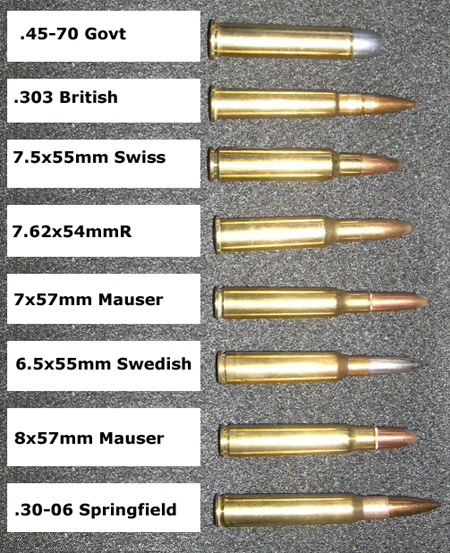
Actually, I could argue that a rifleman would do just fine with cartridges developed before 1900 (unless hunting Cape buffalo or elephant, perhaps), but let’s be charitable and give the first half of the 20th century its due:
.32 Win Special: 1902
8x57mm Mauser: 1905
9.3x62mm Mauser: 1905
6.5x50mm Arisaka: 1905
.30-06 Springfield: 1906
.35 Remington: 1906*
.470 Nitro Express: 1907*
.404 Jeffery: 1909*
.35 Whelen: 1910 (?)
.416 Rigby: 1911
.375 H&H Magnum: 1912
.250 Savage: 1915*
.300 Savage: 1920*
.25-06 Remington: 1920
.50 Browning: 1923
.270 Win: 1925
.300 H&H Magnum: 1925*
.22 Hornet: 1930
.257 Roberts: 1934*
.220 Swift: 1935
.22-250: 1937 (as a wildcat; later, as a production item, in 1965)
.270 Weatherby Mag: 1943
7.62x39mm Russian: 1943 (as a combat round only)
.257 Weatherby Mag: 1944
.284 Weatherby Mag: 1944*
.300 Weatherby Mag: 1948
.222 Rem: 1950
.308 Winchester: 1952 (aka. 7.62x51mm NATO)
.243 Win: 1955
That’s it: two world wars, countless other conflicts, and millions of game animals would all attest to the power and value of those cartridges.
All other rifle cartridges made since 1955 have been attempts to gild the lily, with the possible exception of the following:
.458 Winchester Magnum: 1956
.223 Rem: 1957
.338 Winchester Magnum: 1958
.22 Win Magnum: 1959
7mm Remington Magnum: 1962
.300 Winchester Magnum: 1963
7mm-08 Remington: 1980
There have been dozens of others introduced, but truthfully, the only ones really worth the trouble are the ones listed. I’ve left off the “experimental” cartridges like those of John Lazzeroni, Rick Jamison, Layne Simpson and J.D. Jones, because they have a limited following (so far). Here are a few pics, comparing the relative size of various cartridges, by category:
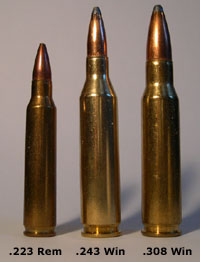
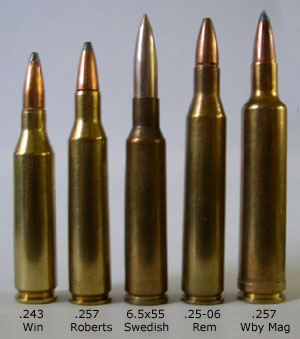
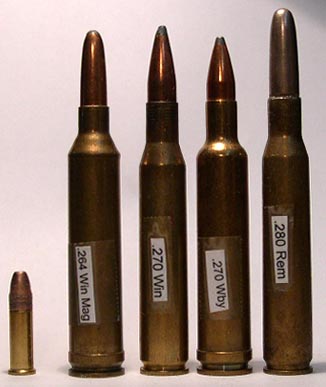
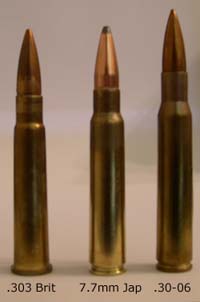
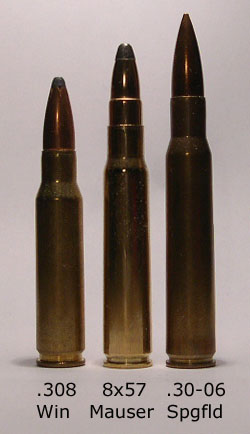
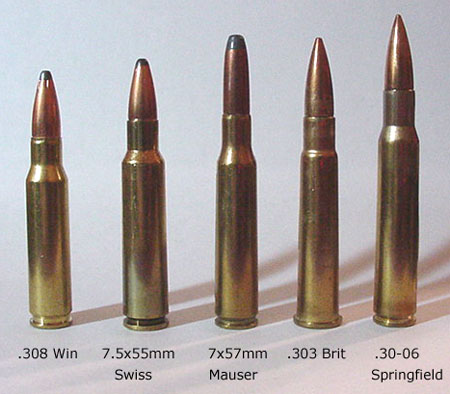
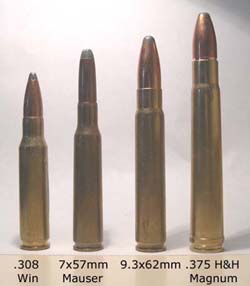
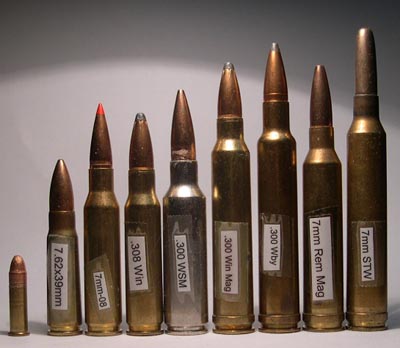
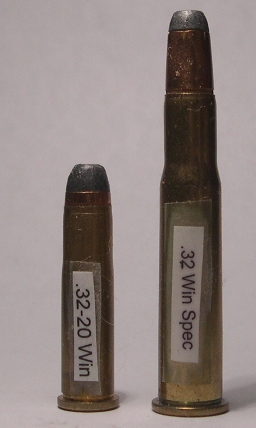
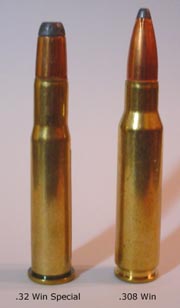
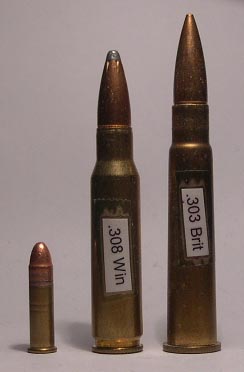
The fact that the U.S. Armed Forces’ current main battle rifle is chambered in .223 (5.56mm) doesn’t mean anything. The fine gun writer Chuck Hawks makes a powerful case that the .243 (6mm) would be a better compromise between portability and knockdown power than the .223 varmint round (and let’s face it, military high command decisions have a pretty spotty track record on this topic anyway). Even the 7mm-08 was just an attempt to tame the recoil of the .308, and the venerable 7x57mm fills that slot more than adequately, as would the .300 Savage, which, lamentably, has almost disappeared.
I consider the latest flock of “Short Magnum” and “Ultra Magnum” rifle cartridges to be essentially marketing ploys, whose sole purpose is to drive new-gun sales. Not one of them really brings anything new to the party, the writings of the manufacturers’ pimps (aka. gun magazine writers) notwithstanding.
It’s even worse for handguns. With the exception of the .44 Magnum, which was essentially an improvement of the .44 Special cartridge for handgun hunting purposes, we could have ended all handgun cartridge development in 1940. The improvement of bullet and propellant performance, of course, is another thing — improved bullet design has turned a marginal cartridge like the .380 ACP, for example, into an acceptable self-defense one.
Handgun Cartridges:
.45 Colt: 1873
.38 Long Colt: 1892*
.30 Mauser: 1893*
.32 ACP (7.65mm Browning): 1899
9x19mm Parabellum: 1902
.38 Special: 1902
.45 ACP: 1905
.44 Special: 1907
.25 ACP: 1908
.380 ACP: 1912
.38 Super: 1929
7.62x25mm Tokarev: 1930
.357 S&W Magnum: 1935
That’s just about all you’d ever need, right there, for almost any handgun purpose, especially if you add the .22 LR to the list as a dual-purpose round. The only other major handgun cartridges worthy of mention since 1950 have been:
.44 Remington Magnum: 1955
.454 Casull: 1957
.41 Rem Magnum: 1964
10mm Auto: 1983
.32 H&R Magnum: 1984
.40 S&W: 1989
.357 SIG: 1998
.480 Ruger: 2001
.500 S&W Mag: 2002
…and I’m not so sure about the last half-dozen, either. As Jeff Cooper has put it (talking about the .40 S&W), they are a solution to a non-existent problem, or the answer to an unasked question. Once again, some comparative pics:
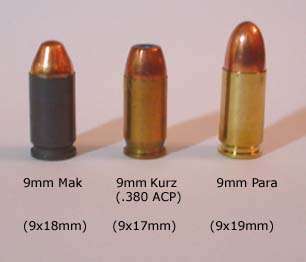
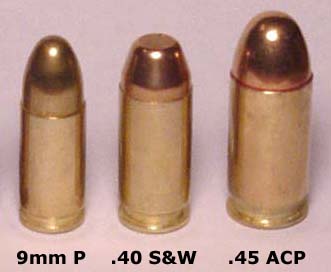
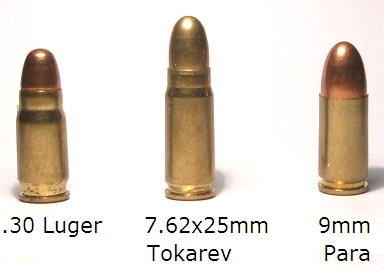
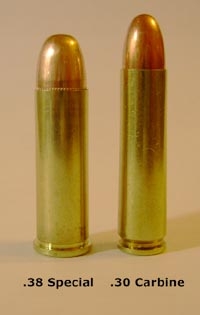
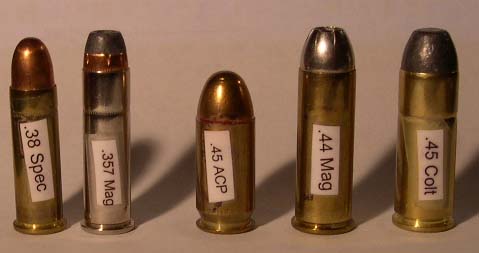
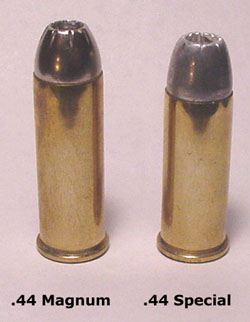
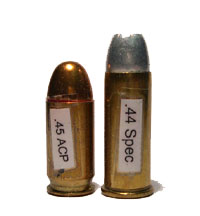
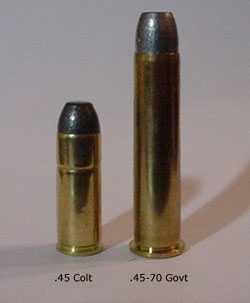
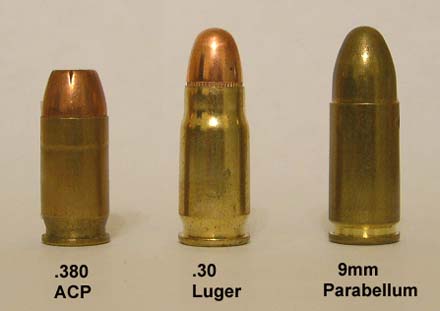
Here’s the critical conclusion to be drawn from all this: it seems quite clear that in the confines of physics, cartridges have about topped out in terms of capability. In other words, we’ve climbed the steep curve of performance improvement, and are now on the flat slope of diminishing returns.
Bullet design and development of propellant have the only real chance of making serious improvements to cartridge efficiency, but it’s clear that if the gun business is going to grow, the change will have to come from a different kind of gun altogether, or a different kind of bullet.
In the meantime, leave my precious 7x57mm alone.
And this is the point. While I’m all for cartridge development, it’s clear that the continuing drive to improve gun sales by new cartridge introduction (for that is what it has become) may result in many fine old cartridges losing favor and being discontinued — meaning that at some point in the future, if you want to keep your 8mm Mauser rifle in ammo, you’ll have to reload them yourself.
Or maybe I’m just a fuddy-duddy who should been alive in about 1910. [loud chorus of “Yes, you are, you old fart” in the background]
Update: since this was written, I think the only “new” rifle cartridge that has any chance of longevity is the 6.5mm Creedmoor — and that longevity will depend on whether the .dotmil adopts it as their main battle rifle cartridge.
Later next week I’ll post a list of my favorite rifles in all the bold chamberings above.