Gratuitous Gun Pic – CZ Upland 20ga

Oh man… just saw this beauty at Collectors:

Last time I looked, CZ doesn’t make their shotguns, still outsourcing their manufacture to Huglu in Turkey.  That’s not a knock, by the way:  I’ve fired many actual Huglu-branded shotguns, and they’re excellent.

Just so everyone’s on the same page as I am, note Kim’s Must-Haves list:

  • side-by-side barrels no less than 28″ in length
  • double trigger
  • straight “English” stock (no revolver grip)
  • splinter forend
  • pretty wood

And all the above for quite a bit less than a grand… ooooh mommy, I hate being poor.


Afterthought:  compare the above to the Italian-made Weatherby for sale at the same shop.  The Weatherby may be a better shotgun than the CZ… but in no way is it nearly three times  better.

Handgun Feedback

I love emails like this one.  As Longtime Readers know well, I’m always on the side of people with lengthy experience with specific guns, and Reader Mike L’s opinions fall well into this category.  Enjoy.


I saw your posting today (2/22/20) regarding revolvers for everyday carry. I used to work for a major firearm manufacturer (though I do NOT speak for them, this is strictly MY opinion). When I worked there, firearms were 50% off MSRP.

627 – S&W makes 3 models of the 627. A 2.6 inch Performance Center, a 4 inch Pro series and a 5 inch Performance Center. ALL of these are built on the N frame, the same frame that the .44 Magnum revolvers are generally built on (there are a few .44 Magnums built on the K/L frames like the model 69 – those have the new fangled 2 piece sleeved barrels).

I have shot all of these model 627s. The 2.6 inch has slightly more recoil than the 4 and 5 inch, but not as much as you would think. That large frame soaks up recoil well. I personally like the 4 and 5 inch models. My father has a 4 inch 627. Great firearm. His is a Pro Series. Performance Center is built with decent care by a specialty department, the “Performance Center”. The Pro Series is Performance Center parts put together on the standard assembly line.

The 4 inch has a great balance overall, however this is a HEAVY firearm. Feels bulky. However even with full power .357 loads and HOT .38 +P loads this gun is a BEAST and handles them very well. Your hand won’t hurt after. There are a MULTITUDE of grips available (N frame) aftermarket so you can change them to your hearts content.

However, it might be worth you checking out the 686 PLUS models… There are 2.5 inch, 3 inch, and 4, 5 and 6 inch models as well. Standard barrels and heavy-weighted barrels, standard, Pro series and Performance Center. The one I might suggest to you is the 3 inch 686 PLUS model

The 3 or 4 inch 686 PLUS model will give you a smaller frame than the 627, but offer 7 rounds of .357 / .38. In addition, the 3 and 4 inch barrels are long enough for accuracy and great for carry and with 3 and 4 inch you get a great velocity even out of MOST 357 loads. The recoil is not awful even with hot loads, and there are a multitude of aftermarket grips for this gun available.

I myself prefer Ruger revolvers. I have a stainless GP100 4 inch. I put a fiber front sight on it and it wears hogue tamer rubber grips. But the 627 and 686 are great guns!

RELIABILITY – So let me tell you from my experience working at one of the ranges and doing a lot of shooting when I worked for this major manufacturer which models were the most reliable:

M&P – VERY RELIABLE. YES I KNOW, PLASTIC “FANTASTIC” – These RARELY broke. If they did it was a MIM part like the slide stop or the recoil spring. And let me clarify, the recoil springs were captured, so when I say the spring “broke”, at around 15,000 to 20,000 rounds I would see the spring tip pop out and the rod and spring became 2 piece. GUN STILL FIRED! And you could use it like that until you obtained a replacement spring. Slide stop breaking would just mean the slide didn’t lock back on these. They still worked. I personally saw a Shield 9 with over 50,000 rounds through it, an M&P 45 full size with over 100,000 rounds through it and I saw an M&P 40 with 50,000-plus rounds through it. You will spend more money in ammo many times over than this gun is worth.

K/L and N frame Revolvers – AWESOME! The VERY BEST! One gun was a stainless 686 built in the early 90’s. Burn rings that were baked on (front of cylinder was black). Grips that were worn smooth. It turned out this gun was from a rental counter. Smith gives a lifetime warranty to individuals, but 1 year to rental guns. Management decided to honor the warranty on this one if it was told how many rounds were through it. The owner said “at least 500,000”. Thing was worn, that was for sure! But it finally had the firing pin break and the leaf spring style mainspring was loose. All Mechanical things wear.

I also had a fleet of these at the range I was in charge of. These rarely broke. If they did it was the screw for the cylinder release or a sight coming loose (roll pin working loose). They had thousands and thousands of rounds through them. I have heard 3rd hand of the internal lock sticking when firing and had seen some examples of customer guns coming back, but I didn’t ever witness a lock up in person. Usually when that lock locked up, it was something else wrong, like someone doing home gun smithing, or a defect from the get go. If you shoot very hot loads, the forcing cones on the 686 wear a little faster than the Ruger’s, but not at some insane rate either though. I myself prefer the Ruger GP100, but it’s FORD VS CHEVY debate here… Both the 686 and the GP100 are solid guns, and they last a LONG TIME! If you like the 686 but want blue, check out the 586, which is a pretty sweet piece. If you do go with the 627, that holds up without issue. That frame can handle .44 Magnum. You are NOT going to wear that thing out with .357 rounds. Might put some wear on the forcing cone with hot loads, but any revolver, even Ruger can have that happen.

J frames – Mixed results. Majority of these were VERY reliable. The .357 models HURT LIKE HELL to shoot [yup — K.]  and the forcing cones would wear out. The 360 PD seemed like a good idea, but not the best to use. It is beefed up from the .38 J frames, but that thing doesn’t hold up with .357 loads non stop.

The .38 J frames are generally bullet proof. Of course, .38 +P loads hurt a little to shoot, but hey, it’s a backup gun. What do you want? You can even get a 442 (Black) or 642 (silver) without that damned internal lock if you like.

For the recoil shy or if your hands aren’t up to the .38, check out the 351 PD, which is a .22 Win Mag model, 7 rounds. Very light recoil. External hammer. GREAT backup piece. FUN to shoot.

.45 ACP revolvers – These held up well. Barely any wear on these. I saw one with over 10,000 rounds. Grips were a little smooth on it from handling but other than that functioned well. The .45 ACP doesn’t wear a revolver all that much. Recoil is not that bad. JUST MAKE SURE YOU ARE OK WITH MOON CLIPS. I do not mind moon clips, but some people hate them. Moon clips are generally much cheaper than magazines for semi-autos.

1911’s – Generally reliable. But as you saw, I saw the same thing. 3 pieces usually broke on 1911’s:
1 – the safety plunger and safety catch
2 – the magazine catch –
3 the slide stop catch and pin that held the slide on.
Usually when one of these parts broke, the gun went down hard. They shoot great, but they were the least reliable of all of the models. Not that they sucked, they just didn’t have the reliability of the revolvers or the plastic stuff is all. Overall revolvers held up better than 1911 models. Plastic stuff held up surprisingly well too.

Oh, and the 4 inch S&W model 19 is a VERY sweet piece. If you want a little lighter frame than the 686, but still something substantial. I saw recently there is a 3 inch ported version available too. I like the SP101, but the SP101 holds 5 rounds, Model 19 is 6 rounds and is blued, which is damn nice!

FOOD FOR THOUGHT.
If you go with a 627, 686 or 586 (cuz blue is just so classic and awesome!), you could use .38 +P in both your main and your backup 637. This way, you carry one type of ammo for both. So no matter what piece you are using to fend off the goblins, you don’t need to think about which ammo goes with which boomstick.

New Colt Python? Um, yeah, right lol! Read the many issues with these… Lemons. They are too new and too expensive.

Hope this long long long rant helped…


Anytime, Mike… and that goes for the rest of you too.

Comparing Old Warhorses

I am often mocked because of my fondness (if not favoritism) of things of yore over their modern counterparts.  This is especially true of gun stuff, and cartridges especially.  (Executive summary:  not many cartridges developed since 1955 are that much better than their predecessors.)

One of my all-time favorites is the venerable .300 Holland & Holland Magnum, which was essentially put out of business by the .300 Winchester Magnum.  Why am I so enamored of this old warhorse (launched 1925)?

I once hunted with a borrowed rifle thus chambered many, many years ago in South Africa (I think it was either a Sako or a Sauer, can’t remember which) and in a single day’s shooting accounted for two or three impala, all of which were absolutely flattened by the heavy 180gr solid bullet.  I found the recoil far less punishing than other magnums (both the .300 WinMag and the monster .458 WinMag), and the effect on small- to medium-sized game was little different from either of the two others.

It’s not as hard-hitting as the other two, of course, when one looks at the raw numbers;  rather, the .300 H&H should be compared to the .30-06 Springfield.  Here’s a side-by-side of the Nosler offerings for each cartridge with the same bullet weight:

The Holland’s longer case holds more powder, I think, hence the slight velocity/energy difference.  Likewise, the rifle’s action needs to be a little longer than that of the .30-06 (which is already longer than, say the short-action .308 Win).

Of course, because so few rifles are made in the .300 H&H chambering nowadays, the ammo is filthy-expensive — usually over $50 / box for the cheap stuff, and it climbs into the stratosphere faster than the bullet it shoots.  By way of comparison, a box of the .300 H&H Noslers in the pic above costs just over $83/box, while the .300 Win Mag tops out at ~$70 (and the .30-06 pictured is $50).  Granted, these are all premium offerings from Nosler — but while one can find “cheap” .300 Win Mag and even cheaper .30-06, there is no cheap .300 H&H ammo.

And finally, here’s the .300 Win Mag which replaced the .300 H&H (sigh):

It’s not quite a like-for-like comparison because of the greater bullet weight, but where the difference becomes apparent is at ranges long than 200 yards (.300 H&H 2,490 vs the .300 Win Mag 2,520, and the differential widens at longer distances).

That said:  if I had to shoot twenty rounds rapid of each, I’d be okay after the .300 H&H, but would require some kind of medical attention with the .300 Win Mag.

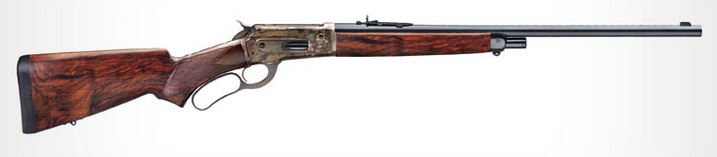
And I’d sell a non-essential body part to be able to shoot them through one of these.  (“P.O.A.” stands for “piss off, arsehole” i.e. “if you have to ask, you can’t afford it, peasant”.)

Carry Revolver Followup

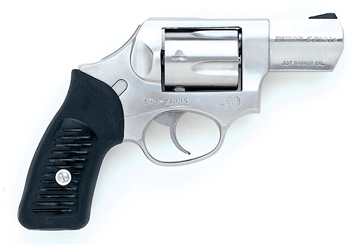
Following my meandering post last weekend about carrying a revolver rather than a 1911, I was wandering about the Internets when I saw this little beauty:

I know, I know… “beauty” and “Ruger” are not often sentence-mates, but I think that this particular GP100 model qualifies.  And as for Ruger’s ruggedness and reliability… we’re all on the same page there, I think.

Here’s the thing.  I’ve actually owned a GP100 before, and I loved the gun, except for the trigger.  Oh man, that trigger was awful:  sticky, stiff (it felt like a 50-lb break), and it only sorta-smoothed out after over a thousand dry-fires.  (Don’t laugh;  in those days I was a lot more serious about testing guns, so I kept a fairly close count.)  In the end, I got sick of the finger-cramp, decided it wasn’t worth the hassle, and traded it for a Ruger Blackhawk in .30 Carbine (a story for another time).

However, in reading the various comments from people who’ve recently bought this model, only a very few complained about the trigger.  So maybe Ruger has fixed that problem.  What I do know is that before I would actually drop the $900-odd on the gun, I’d bring along some dummy .357 snap caps, test it right there in the store, and let its trigger make the final purchase decision.

I do know, however, that I would have absolutely no qualms about strapping this puppy onto my hip every time I left the house.

ULD Reminder

The deadline for entries to the ULD rifle draw is this Saturday (Feb 29).  Details are back here, for those who’ve been living on the planet Manhattan till now.

All entries postmarked after this date will be returned, so get things rolling if you still want to participate.

If anyone would like to contribute further to my Boomershoot expedition this year (ammo, travel costs, shooting shelter, etc.), feel free to do so.  Just send your check with “BS Fund” on the Memo line, and I will accept your contribution with thanks.

Old Gunnies’ Tales

Sheriff Jim talks about the myths of self-defense carry, and a couple of times I found myself nodding in agreement along with him.  Here’s one of them.

On long trips I carry a backup S&W 637, but it’s not all that easy to get to (certainly not as easy as my 1911), but I always had that nagging feeling about that “Two is one, one is none” trope — specifically, if you’re carrying a second gun in case your primary gun fails, then perhaps you need to have more faith in your choice of primary in the first place, and get a better gun.

That said:  even my faithful Springfield 1911 has failed, twice, and fortunately, both times at the range.  The first time (at around the 25,000-round mark) was when the slide stop broke (snapped halfway through), but the remnant of the pin still held the gun together through the rest of the shot string when the mag was empty.  So in a self-defense situation, that might not have been so bad.

The second failure was more substantial:  at the 35,000-round point the safety catch broke, almost literally disintegrated in the gun, and the gun became inoperable.  (Fun fact:  when that happens, the grip safety also becomes inoperable, so the 1911 is not safe to carry with a round in the chamber.)  It didn’t matter about the rarity of this event — not only had I never heard of it happening, but the gunsmith hadn’t, either;  nevertheless, it did happen, and I have to admit that it left me quite shaken.

So maybe, just maybe, Old Faithful isn’t that faithful after all — which makes an argument in favor of carrying a backup.

OR:

Maybe a revolver makes a better choice for a primary carry gun — I know, six, seven or even eight rounds aren’t the same as the fifteen-round mag in yer Glock — but revolvers are inherently more reliable than semi-autos, so…

Here’s the big “but” (and it’s bigger than Kim Kardashian’s):  would (say) a S&W 686 have been as reliable as my 1911 after 25,000 full-power loads, or is that an apples-oranges comparison?  What about a S&W 625 (which is chambered in .45 ACP like the 1911)?  Would that have lasted longer without a breakage (at, say, 25,000 rounds) than the 1911?

I have to tell you, after the 1911’s safety broke, I first started thinking about carrying a revolver instead of a semi-auto, and it’s something that weighs on me to this day.  I am very much tempted by the 8-shot Mod 627:

Eight rounds is what I carry in my 1911 anyway, and while a revolver loads a little slower with a speedloader than a mag-fed semi-auto, it’s not that  much slower (after considerable practice, which I’ve had).

This is what happens when you start looking at the carry myths (thanks, Sheriff Jim) — you start to rethink all sorts of long-held habits and beliefs.

“The one thing that I got from the professional hunters is that they don’t plan for when everything works right—they plan for when everything goes wrong.  And, just like the smart defensive shooter, it effects their choice of guns, gear and tactics.  And that, I submit, is a good way to stay alive.”

There you have it.