Peppery

Via Insty, I found this fascinating article about how America’s food is becoming more spicy:

Consider spicy-hot food — and consider how recent it is as a mainstream phenomenon in the U.S. In 2002 many of us cheerfully chow down on Szechuan and Thai, habaneros and rellenos, nam pla and sambal ulek. Salsa outsells ketchup. But it wasn’t always that way.

When I first came over in 1982, I found American food to be kinda like what I’d left behind in South Africa:  kinda bland, almost-English in fact, and diner food very much so.  Only when I went south to New Orleans and Florida did the food start to spice up a little — in the Big Easy, quite alarmingly so.

Back in Johannesburg, although I’d grown up with at least one curry meal a week, spicy food was definitely not an everyday fare.

Imagine my surprise, then, when I moved Over Here in The Great Wetback Episode of 1986 I found out that over that short period, food in general had spiced up considerably (what the article refers to as “capsaicinization”), and frankly, I wasn’t prepared for it.  It took me a while to get used to it, but I did.

Now?  I eat nachos with one slice of jalapeño pepper per mouthful.  (Without the jalapeño, nachos are pretty awful — close to what Richard Hammond once described as “sick on a plate”.)

What made me realize how my own taste had become so capsaicinized was when New Wife came over from Seffrica to become part of my life Over Here.  Now granted, she’d never been that fond of spicy food — even curry, so much a staple of SA menu, was conspicuous by its absence on her table — and in fact, that was generally true of many Seffricans back in the day, myself included.  So when she came here, her taste buds were set on fire.  And it’s when I prepare meals for her that I realize how much I’ve become used to that increase in spice content;  I have to watch out even when using mild spices like Lawry’s steak salt or paprika.  What seems quite mild for me sets her mouth on fire.  So I make meals accordingly.

Ditto when we visit friends or family:  I have to remind them constantly to be careful of the spice quantity.  (The nice thing about having the kind of friends that I do is that they take such constraints in their stride, albeit with some gentle teasing.  Ditto Daughter and the Son&Heir when we visit them for dinner.)

I’m not going to try and change her tastes, by the way;  had someone tried to do that to me, back in the late 1980s, I’d have kicked back hard.  I may have gradually become accustomed to the modern American cuisine, but it took me well over a decade to do so.

I doubt that New Wife will do it in anything like the same time period, and that’s okay.  At home, we eat more traditional British food, anyway.  Sausage rolls, steak pies and roast beef, for example, were never spicy foods to begin with, and I for one have no problem tucking into the comfort foods of my youth.

I’ll just get the spice when we got out to eat.

Never Mind The Vampires

It all began shortly after I began my career at The Great Big Research Company, when I called on a client for the first time.  Our meeting had been scheduled immediately after lunch, and when I walked into his office and shook hands with him, I was nearly sick.

To say that his breath reeked would be an egregious understatement:  it smelled like he’d just eaten a dozen cloves of garlic.  And it got worse.  As the meeting progressed, he started to perspire (not unusual in midsummer Johannesburg back then, where offices seldom had A/C), and the smell of garlic permeated not only the entire room but even my clothing.

The reason I knew it had stuck to my clothes was when I walked back into the office and my secretary waved her hand in a fanning motion and asked whether I’d had Italian food for lunch.

I’ve hated garlic ever since.

Also, because I saw clients at least once a week, I decided that there was no way I would ever potentially offend them by smelling of garlic;  so I made a conscious effort to avoid garlic-laden foods.  Over time, I actually developed such a strong aversion to the stuff that my long-suffering wives had to take it out of any cooking recipes.

So what had started as a courtesy to clients turned out to be a lifelong aversion.  (I remember watching some cookery show, when the “chef”, in cooking two steaks, crushed five cloves of garlic in their preparation.  I was nearly sick at the very thought of how the meat would taste — and I love steak.)

Feel free to imagine my experiences in Paris and Rome — no doubt a factor in my always choosing to eat outdoors, now that I think of it.

This post was inspired by this article, which extols the virtues of garlic as a cure for just about everything, and by our dinner with the Son&Heir last week, where he and his girlfriend ordered snails as a shared starter.  I could smell the garlic from across the table, but fortunately, it was barely noticeable, even to my garlic-sensitive nostrils.

I know that this little preference (or rather, non-preference) of mine is going to cause outright mirth and shakes of the head, but there it is.  The stuff reeks and I want no part of it, despite all its purported health benefits.

Asking The Important Questions, Part 17

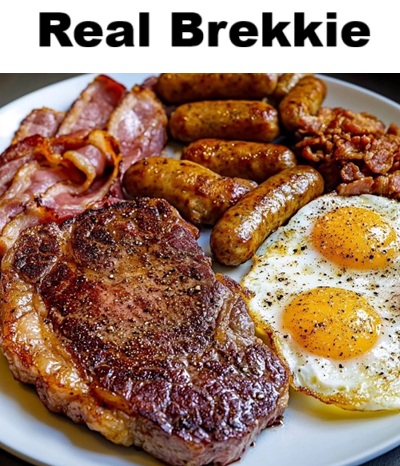
My suggestions:

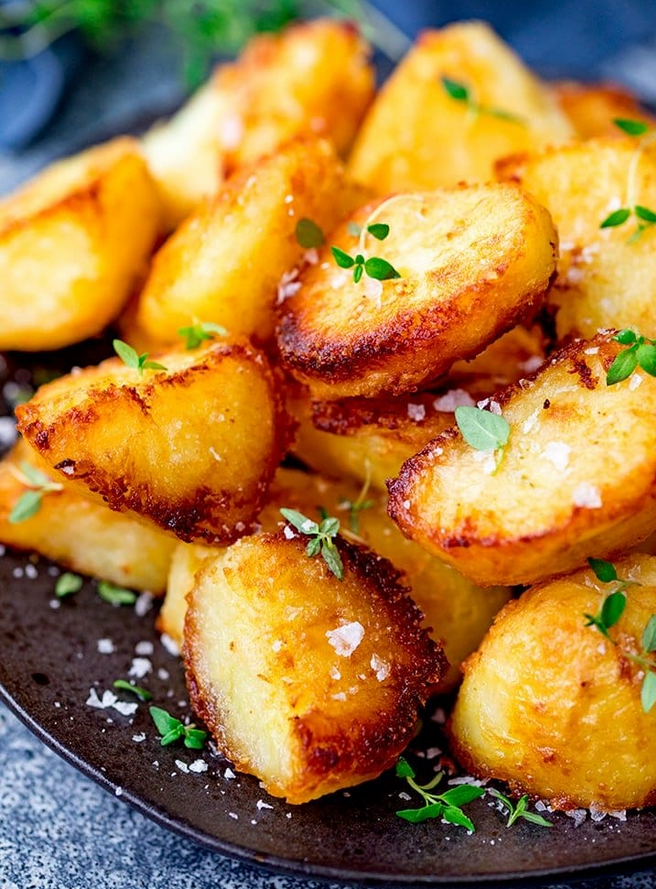
  • some kind of fried potato dish — hash browns, home fries, french fries, whatever*
  • mushrooms — fried in the bacon fat, of course
  • a proper pork sausage, or boerewors
  • a lamb chop
  • Heinz baked beans
  • French bread, toasted / croissant alternatively
  • HP sauce or Heinz 57 sauce (if some spiciness is needed)

I might want to substitute back bacon (English bacon) instead of the American streaky kind, but it’s not mandatory, of course.  Bacon, as they say, is bacon.

And now, if you’ll excuse me, I’m off to the kitchen.


*Some time ago, I spotted potato skins on a breakfast offering somewhere.

This may well be a groundbreaking innovation.

More Food Scolding

This time from some group I’ve never heard of before, the “2025 EAT-Lancet Commission”, who are “a coalition of experts in nutrition, climate, economics, health and agriculture from more than 35 countries.”

Needless to say, when this august body issues a report that contains this word garbage:

“The evidence laid out in our report is clear: the world must act boldly and equitably to ensure sustainable improvements.”

…you just know that it’s going to be total bullshit.

And so it is.

If people worldwide adopted their “Planetary Health Diet” (PHD), up to 15 million premature deaths could be avoided annually. 

Note the usual weaseling:  “up to” [some massive figure], and “could be” avoided.  No mention what the “premature” figure actually is and how it’s been derived.

Oh wait, I forgot this little snippet:

“Changing how the world eats could reduce premature deaths, save trillions of dollars and slow the impacts of climate change.”

Ah yes, the (by now thoroughly-debunked) bogeyman of Global Warming Climate Cooling Change©, and the promise of endless amounts of money to be saved — all undermined by the single word “could” — that would improve our world, if only yadda yadda yadda.

So what is this PHD master plan, exactly?

PHD is a plant-based menu that includes three to five daily servings of whole grains, at least five daily servings of fruits and vegetables and daily servings of nuts and legumes.  The diet doesn’t call for the complete elimination of animal proteins for those who wish to continue eating them, but instead encourages people to consume red meat, poultry, fish, eggs and dairy in moderation. For example, the group recommends only one serving of red meat, two servings of fish and poultry and three to four eggs per week. They also call for strict limits on added sugars, saturated fats and salt.

You mean we shouldn’t all go completely vegan, then?  Color me surprised.  So to sum up;  eat pretty much what you want, in moderation.  Well, except a lot less bacon, steaks and hamburgers, you filthy carnivores.

Whatever.

What gets up my nose, however, is the implicit meaning of the expression “act boldly” in the very first paragraph of this post.  To pricks like this, “act boldly” means that some authority should begin to dictate how we eat, and enforce this foul nonsense.

Because the stakes are so high, you see.

And exactly how does this new buzzword “equitable” feature in this, anyway?  (I’ll save you the trouble of thinking about it:  it’s just a fashionable way to add justification to the cause du jour.  Ditto “climate change”.)

Simple conclusion for us:  fuck right off, assholes.  You have as much credibility on this topic as the assholes who gave us the (tragically wrong) Food Pyramid:  i.e. none.

It amazes me that over the past half century or so, while we have undoubtedly been eating more junk food, the worldwide stats for death by starvation — surely to be included in any count of premature deaths — have plummeted.  In fact, if one were to exclude acts of deliberate starvation perpetrated by government (hello, Comrade Stalin and various African / Asian warlords), there’s a convincing case to be made that starvation has become far less of a worldwide calamity than it was even in, say, 1950.

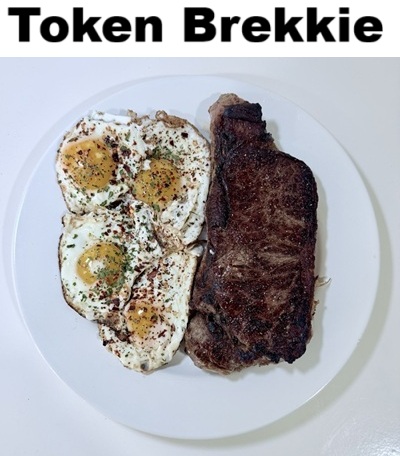
And now, if you’ll excuse me, I think I’m going to make myself a brekkie of bacon and (two) eggs with some toasted French bread on the side, and then head off to the range.

Exactly what I’m going to be shooting must await tomorrow’s range report.  It will, however, cause something of a stir.

Price Points

Snappy rejoinder #257:

I was reminded of this when I paid my monthly visit to the butchery (Hirsch’s Meats in Plano) a few days ago.

Some background:  Hirsch makes South African boerewors (farm sausage), and they make it really well, to a recipe provided to them by a South African customer as a special order, but which turned out to be a gold mine for them when they made more and put it for sale in the freezer.  Unsurprisingly, they have a large clientele of Seffricans, and one of the basket characteristics (told to me by Nancy Hirsch) is that it is the only product in their freezer which is bought in multiples — i.e. more than one pack per customer.  I usually buy four at a time, which yields 12 boerewors sausages for my monthly consumption (New Wife doesn’t eat boerewors, never has, so I have them all to myself yum yum).

Now these are not your typical skimpy things like Nathan’s or Oscar Meyer hotdogs.  Even after cooking, these are monsters and sometimes I can’t eat a whole one in a bread roll, but have to slice it longitudinally in half to be able to finish it.  (The other half goes into the fridge for next day’s brekkie.)

Now this stuff is not cheap.  A pack of three boerewors costs about $7.50 – $8.00, which sounds expensive and it is, but it’s a delicacy, made by hand (because of the very specific recipe) and as such very much worth the money.  So I typically buy those four packs with a total ring of about $32.

Until the last time I went into the butchery, and discovered that the packs now cost $11 each.

So from now on, I’ll only be buying three packs at a time, yielding nine sausages for the month instead of twelve.  Same amount of money, three-quarters of the product.

Which, by the way, is what I told the folks at Hirsch.

Look, I understand the business of retail product pricing;  when it comes to foods, I understand it as well as anyone on the world because I did little else but study things like price elasticity and promotion pricing, for well over forty years.

But the plain fact of the matter is that now in my sunset years, I can no longer afford just to pay whatever the price sticker demands.  I have a (very) fixed amount of money I can pay for groceries, which means that at some point, I have to cut back — as above — and make do with less.  Fortunately, New Wife is an outstanding cook, so making meals from scratch and eating stews, curries and pasta dishes instead of boerewors hot dogs is not that much of a sacrifice, believe me.

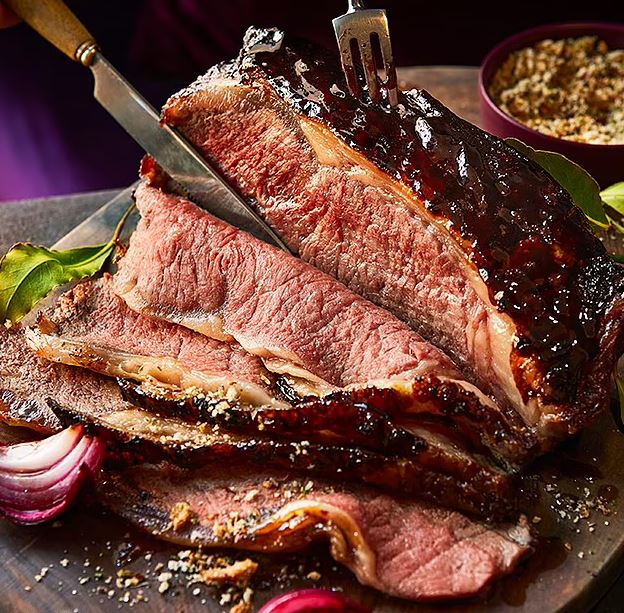
But here’s the thing:  once a year I host the family Christmas dinner (on Boxing Day and not the 25th), in which I myself prepare a prime rib roast.  In the past, that prime rib has always come from Hirsch’s Meats because I’m not prepared to stint on quality for what is, even more than Thanksgiving, our family’s premium gathering of the year.

Well, this year and probably for the entire future, that prime rib roast will be coming not from Hirsch but from Walmart — something which I also told the Hirsch people.

Sic transit emptor.