Perennial Question

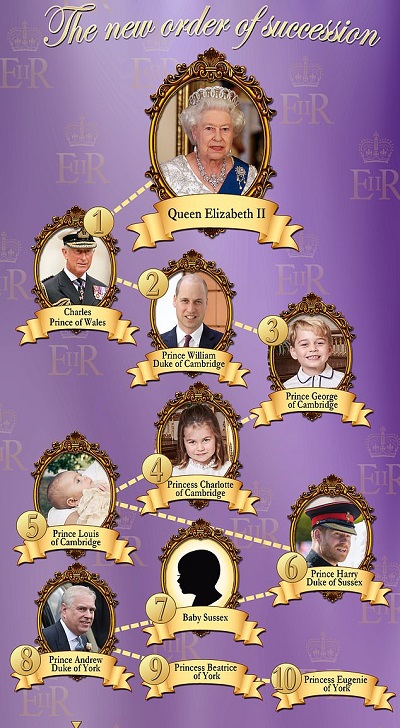
I was idly looking at the graphic below, which depicts Britain’s new royal line of succession:

Now like for most people, the succession thing is about as interesting to me as which rain droplet will reach the bottom of the windowpane first, but it does bring to mind a question which has bothered me since high school, and has never been satisfactorily answered.

It’s Shakespeare’s Hamlet.  Now as any fule kno, the plot is that Hamlet’s eeeevil uncle Claudius poisoned Hamlet’s father the king, then married Hamlet’s mother Gertrude to become the new king.

Given that Hamlet was alive when his father was murdered and was therefore first in the line of succession, why did Hamlet not become king?  If I understand the rules properly, when the king dies, his wife becomes irrelevant to the whole thing, and anyone she marries afterwards even less relevant.  Claudius, therefore, had absolutely no claim to the throne (despite being Hamlet’s father’s brother) and could never have become king, unless he’d had Hamlet killed beforehand.

Or does / did Denmark have a different succession plan?  I don’t think so.

So the entire plot of Hamlet, then, is a load of old bollocks:  the uncle’s accession to the throne being simply what Alfred Hitchcock called the “mcguffin” (a device upon which to hang a plot line, requiring the suspension of disbelief from the audience, e.g. John Huston’s stolen Maltese falcon, or Casablanca‘s “letters of transit signed by General de Gaulle”).

Not that I care, mind you;  without that Shakespearean mcguffin, we’d never have been given the deathless “To be, or not to be”  speech, or seen that old busybody Polonius get a rapier through his arras.

Seen At The Carwash

I never read celebrity trash [some overlap]  magazines unless I’m in a waiting room and there’s nothing else to read except for magazines that will make me grow breasts just by touching them.  And even then, I page quickly through crap like People, Us and Entertainment Weekly, playing a game with myself as to how few of the “celebrities” I can actually recognize.  (My current score is roughly 5%, and that only because some 70s musicians occasionally make the presses, see below.)

A couple of days ago I was waiting for the Mexicans to finish cleaning my car, and the only magazine to read was (I think) People, and I thought I’d share just a couple samples of their fare:

“I’ve never given 60 seconds of my life to those Housewives of Blah Blah and the Kardashians.  I don’t know their names.”  — Jon Bon Jovi

Me neither.  Well, to be honest, I do know some of the Kardashian coven (Kim, Kris and Kunty), but that’s about it.  But thankfully, all the “real” housewives are a complete blank to me.

Then there is a feature called “5 Things We’re Talking About“… oy.  Here are a couple examples:

1 )  Prince George is taking ballet lessons.  And according to his dad William, “he loves it”.  These, lest we forget, are the two future kings of Great Britain, King Gormless I and the Gay-King Georgie-Boy.  How special.

3 )  Some Australian billionaire is funding the building of a complete replica of the Titanic, only with (and I quote), “more lifeboats and modern navigation equipment”.  Just to be on the safe side, the new Titanic should still operate only in the Southern Pacific because of you-know-what.

There was more, oh so much more, but then Ricardo called out that my car was all done.  Boy, was it ever — it looked brand new.

I gave him a good tip*.  I told him never to read People magazine.  He’ll thank me for it one day.


*Also $10.  He did a great job.


In Other News, Dogs Chase Cats

I’ve never been involved in the movie business at all, so I’m not really qualified to comment on this story (not that this has ever stopped me before):

Alexa Chung has revealed how she was once ordered to strip by a movie producer while being auditioned for a role. In a worrying #MeToo moment, the model was told to remove her clothes so that the exec could see what she looked like naked.
Addressing the Oxford Union, Alexa said: ‘He told me to strip because he needed to see what I looked like naked for a scene that required it.’

Okay, let’s all accept the fact that the whole casting thing could just turn into an opportunity for men to catch a free look at naked women.  (In other news, Gen. Custer seems to be having some difficulties with the Sioux.)  And yeah yeah, that’s just awful and terrible etc. etc.

I have some parallel thoughts, however:  if you are auditioning for a part where you’re going to be filmed in the nude, don’t be shocked when you’re asked to show what you look like naked.  If you’re Julia Roberts, for example, you can turn down such demands because you’re going to get a body double anyway — they’re casting the face, not your ironing-board body.  But if you’re a nobody, you can’t really turn it down because appearing or performing in the nude is one of the reasons you’re being cast at all and if we’re going to be blunt about it, if you have some blemish (e.g. saggy boobs or a large birthmark), the producer is not going to hire a body double for a nobody.  

The other thought is that the director has to be sure that when he films a scene — any scene, let alone a nude one — he has to be sure that viewers concentrate on what he’s trying to show, not on the fact that Second Actress From The Left has one breast considerably larger than the other.

So while I can sympathize with this Alexa Chung (whoever she is) because of the voyeur thing, I can also see things from the other side of the desk, so to speak.  I should also point out that this woman is an ex-model, and didn’t seem to have too many qualms about being naked anyway:

And here’s another thought:  a producer asking to see what you look like on the nude is not a Harvey Weinstein/#MeToo moment;  a producer wanting you to fuck him to get the part, is.

We can also talk about why nude modelling or nude scenes in movies are necessary at all, but that’s a topic for another post.

The Other Schumann

I’ve always been a huge fan of Robert Schumann’s music.  I know all about his life story — the word “tragedy” comes to mind, and you can read all about it here — but while that knowledge provides some background, it doesn’t really matter because the music is beautiful beyond words.  In one of those extraordinary little coincidences which occasionally drive me crazy, when I discovered the linked article I just happened to be listening to Schubert’s Schumann’s First Symphony (“Spring”) in B-flat major, the second movement of which has one of the most most haunting melodies ever written (just after the 15.30-minute mark).  That the melody happens during a piece which celebrates the coming of the spring — traditionally a “happy” theme — is just one of the joys of listening to Schumann.

As for the “other” Schumann (his wife, virtuoso pianist Clara Wieck), the DM review of Judith Schernaik’s biography of Schumann pays eloquent praise to this extraordinary woman.  (The book itself has gone onto my Christmas list.)

Anyway, if  you want to enrich your life for a couple of hours on a chilly winter’s day or evening, you could do a LOT worse than listen to all four of Schumann’s symphonies, in order.  I’ve selected the performances of the Staatskapelle Dresden, conducted by the incomparable Wolfgang Sawallisch.

Then, if you feel the need for more Schumann (and well you might), help yourself to a few of his Etudes

No need to thank me;  it’s all part of the service.

Hidden Depths

Like many of my contemporaries — people who grew up in a British colony — my childhood literary upbringing was primarily that of the Mother Country:  Rudyard Kipling, Enid Blyton, Agatha Christie, C.S. Lewis and so on.

Another was a female author, E. (Edith) Nesbit, who wrote Victorian-era children’s classics such as The Railway Children and The Story Of The Treasure-Seekers.  As a child, I remember my parents reading both to me at bedtime.

One always thinks of the authors of children’s literature — especially female authors — as quiet, spinsterly or even virginal.  In the case of Edith Nesbit, it turns out, nothing could be further from the truth.

So far, Edith had been rather a passive participant in ‘free love’, but she now began to even the score with Hubert, embarking on a series of romantic affairs with young writers whom she mentored. Some of these relationships may have been platonic rather than passionate, such as her fling with George Bernard Shaw, who she met through the Fabian Society.

It’s likely her other lovers were less reserved.  The young poet Richard Le Gallienne was captivated by Edith’s beauty and unconventional style – she refused to wear a corset and cut her hair boyishly short, drifting around in flowing robes, her wrists jangling with bangles – and she contemplated leaving Hubert for him.
A young accountant, Noel Griffith, was the next to be dazzled by her, although he found her ménage à trois with Alice and Hubert bizarre, observing that Alice seemed uncomfortable and that Edith found Alice irritating.  The only real beneficiary was Hubert, who was ‘very hot-blooded’ and ‘abnormally sexual’ – which didn’t stop him moralising about the importance of fidelity in his newspaper columns.  Meanwhile, Edith let her children run wild, playing on the railway, and turned a blind eye to domestic chaos.

Sounds positively 21st-century, dunnit?

Actually, No

From some SJW / Millennial ingenue named Hannah Yasharoff:

National Lampoon’s raunchy frat house comedy “Animal House,” which celebrates its 40th anniversary Saturday, is widely regarded as an all-time great movie.  But four decades later, it feels less like a comedy classic and more like a toxic showcase of racism, homophobia and jokes about sexual assault.

As the title of this post suggests, Animal House actually feels more and more (not less) like a comedy classic precisely because it does make fun of racism and jokes about sexual assault*.  (Remember that Dean Wormer’s the mayor’s 13-year-old daughter is the one who comes to the toga party and gets pass-out drunk — and then much later, only after she finally has sex with Larry Kroger, does she shockingly admit her true age.  That’s what was so goddamn funny, you pearl-clutching asswipe.)

Animal House aimed at so many sacred cows it’s difficult to know where to start.  Now that the Left has created its own sacred cows, however, they’ve decreed somehow that while it’s perfectly okay to make fun of (say) religion or patriotism, heaven forbid that anyone make fun of (say) transgenderism (despite the latter’s self-identified social deviancy).

And duh!  National Lampoon’s entire raison d’être was toxic comedy in that they skewered and made fun of everything.  (The word “lampoon” right up there in the title should be sufficient warning, but clearly our SJW children’s liberal education never got that far in the lexicon.)

Good grief.  I need a gin & tonic.  Oh wait:  my love of booze would make me future SCOTUS Judge Brett Kavanaugh’s spiritual [sic] sidekick.

Excellent.


*I don’t recall any homophobic jokes in Animal House, but I could be wrong.