Charles Loxton was a small man, no taller than 5’6”, and was born in 1899. This means that when he fought in the muddy trenches of France during the First World War, he was no older than 17 years old — Delville Wood, where he was wounded, took place in July 1916.
Seventeen years old. That means he would have been a little over sixteen when he enlisted. In other words, Charles must have lied about his age to join the army — many did, in those days, and recruiting officers winked at the lies. After all, the meat grinder of the Western Front needed constant replenishment, and whether you died at 17, 18 or 19 made little difference.
Why did he do it? At the time, propaganda told of how the evil Kaiser Wilhelm was trying to conquer the world, and how evil Huns had raped Belgian nurses after executing whole villages. Where Charles lived as a young boy, however, the Kaiser was no danger to him, and no German Uhlans were going to set fire to his house, ever.
But Charles lied about his age and joined up because he felt that he was doing the right thing. That if good men did nothing, evil would most certainly win.
It’s not as though he didn’t know what was coming: every day, the newspapers would print whole pages of casualty lists, the black borders telling the world that France meant almost certain death. The verification could be found in all the houses’ windows which had black-crepe-lined photos of young men, killed on the Somme, in Flanders, in Ypres, and at Mons.
He would have seen with his own eyes the men who returned from France, with their missing limbs, shattered faces and shaky voices. He would have heard stories from other boys about their relatives coming back from France to other towns — either in spirit having died, or else with wounds so terrible that the imagination quailed at their description.
He would have seen the mothers of his friends weeping at the loss of a beloved husband. Perhaps it had been this man and not his father who had taught him how to fish, or how to shoot, or how to cut (from the branches of a peach tree) a “mik” (the “Y”) for his catapult.
But Charles, a 16-year-old boy, walked out of his home one day and went down to the recruiting center of the small mining town, and joined the Army.
When years later I asked him why he’d done it, he would just shrug, get a faraway look in his blue eyes, and change the subject. Words like duty, honor, country, I suspect, just embarrassed him. But that didn’t mean he was unaware of them.
So Charles joined the Army, was trained to fight, and went off to France. He was there for only four months before he was wounded. During the attack on the German trenches at Delville Wood, he was shot in the shoulder, and as he lay there in the mud, a German soldier speared him in the knee with his bayonet, before himself being shot and killed by another man in Charles’ squad. At least, I think that’s what happened — I only managed to get the story in bits and pieces over several years. But the scars on his body were eloquent witnesses to the horror: the ugly cicatrix on his leg, two actually (where the bayonet went in above the knee and out below it), and the star-shaped indentation in his shoulder.
The wounds were serious enough to require over a year’s worth of extensive rehabilitation, and they never really healed properly. But Charles was eventually passed as fit enough to fight, and back to the trenches he went. By now it was early 1918 — the Americans were in the war, and tiny, limping Private Charles Loxton was given the job as an officer’s batman: the man who polished the captain’s boots, cleaned his uniform, and heated up the water for his morning shave every day. It was a menial, and in today’s terms, demeaning job, and Charles fought against it with all his might. Eventually, the officer relented and released him for further line service, and back to the line he went.
Two months later came the Armistice, and Charles left France for home, by now a grizzled veteran of 19. Because he had been cleared for trench duty, he was no longer considered to be disabled, and so he did not qualify for a disabled veteran’s pension.
When he got back home, there were no jobs except for one, so he took it. Charles became, unbelievably, a miner. His crippled knee still troubled him, but he went to work every day, because he had to earn money to support his mother, by now widowed, and his younger brother John. The work was dangerous, and every month there’d be some disaster, some catastrophe which would claim the lives of miners. But Charles and his friends shrugged off the danger, because after the slaughter of the trenches, where life expectancy was measured in days or even hours, a whole month between deaths was a relief.
But he had done his duty, for God, King and country, and he never regretted it. Not once did he ever say things like “If I’d known what I was getting into, I’d never have done it.” As far as he was concerned, he’d had no choice — and that instinct to do good, to do the right thing, governed his entire life.
At age 32, Charles married a local beauty half his age. Elizabeth, or “Betty” as everyone called her, was his pride and joy, and he worshipped her his whole life. They had five children.
Every morning before going to work, Charles would get up before dawn and make a cup of coffee for Betty and each of the children, putting the coffee on the tables next to their beds. Then he’d kiss them, and leave for the rock face. Betty would die from multiple sclerosis, at age 43.
As a young boy, I first remembered Charles as an elderly man, although he was then in his late fifties, by today’s standards only middle-aged. His war wounds had made him old, and he had difficulty climbing stairs his whole life. But he was always immaculately dressed, always wore a tie and a hat, and his shoes were polished with such a gloss that you could tell the time in them if you held your watch close.
Charles taught me how to fish, how to cut a good “mik” for my catapult, and watched approvingly as I showed him what a good shot I was with my pellet gun. No matter how busy he was, he would drop whatever he was doing to help me — he was, without question, the kindest man I’ve ever known.
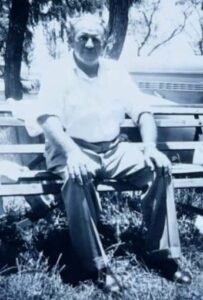
In 1964, Charles Loxton, my grandfather, died of phthisis, the “miner’s disease” caused by years of accumulated dust in the lungs. Even on his deathbed in the hospital, I never heard him complain — in fact, I never once heard him complain about anything, ever. From his hospital bed, all he wanted to hear about was what I had done that day, or how I was doing at school.
When he died, late one night, there was no fuss, no emergency, no noise; he just took one breath, and then no more. He died as he had lived, quietly and without complaint.
From him, I developed the saying, “The mark of a decent man is not how much he thinks about himself, but how much time he spends thinking about others.”
Charles Loxton thought only about other people his entire life.
In Memoriam