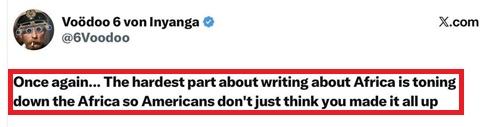
And what inspired it:
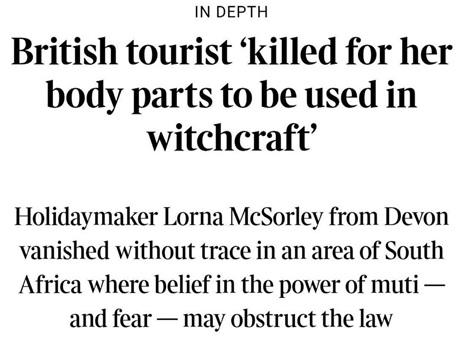
Now finish the sentence: “Africa…”
“Muti” means “magic” in most Bantu languages.

And what inspired it:
Now finish the sentence: “Africa…”
“Muti” means “magic” in most Bantu languages.
Last week I posted about putting the wood to an AR-15:

…whereupon Reader Butch B. sent me his treatment thereof, along similar lines:

Using Cerakote for the steel, and wood instead of plastic, he calls it his “Fudd-riffic AR-15” (right-click to embiggen).
I have to say, that looks rather fetching — kinda like a modern version of the venerable M1 Garand. (Butch, can you send me the details of where you found that wood furniture? I am really intrigued…)
Reader Brad_In_IL suggests that Palmetto State Armory has an overstock of the excellent S&W Model 686; that, or they’re just using it as a loss leader — the retail term that is used to describe an advertising campaign which features a product at a ridiculously-low price to attract customers into the store, where they’ll buy not just the featured loss leader but (hopefully) other products at regular retail prices (which carry higher profit margins).
Here’s the aforementioned S&W 686 from PSA:

Phew. Okay, that’s really tempting. [checks bank account]
Shit.
This isn’t about campfires, oh no. This is so much more satisfying than a roaring fire on a cold winter’s night:
Approximately 50,000 federal workers in “policy-influencing” positions will lose specific protections against firings and become more at-will employees in the next month, per a new Trump administration rule announced Thursday.
The new rule, published by the Office of Personnel Management, will move senior career civil servants in “confidential, policy-determining, policy-making or policy-advocating” positions into the Schedule Policy/Career category, formerly known as Schedule F.
Going forward, federal workers in those roles will lose their ability to appeal firings, suspensions or disciplinary action to an independent board.
Administration officials can dismiss those employees if they engage in “misconduct, poor performance or obstruct the democratic process by intentionally subverting Presidential directives.”
I think I speak for all my Readers when I say that while 50,000 is a nice round number, I’m thinking that 200,000 is a much nicer, rounder number. But I’m open to other, more ambitious suggestions.
Of course, the response has been predictable:
The American Federation of Government Employees, the largest union representing non-postal federal workers, said in a statement that the rule would “chill protected speech” and “weaken enforceable protections against retaliation.”
“This rule is a direct assault on a professional, nonpartisan, merit-based civil service and the government services the American people rely on every day,” AFGE President Everett Kelley said.
Two issues jump off the page.
Firstly, let’s just suggest that right off the bat, the very idea of a government-employee union is an abomination. It’s time the AFGE was abolished.
Secondly, if the current crop of bureaucrats had actually behaved like a “professional, nonpartisan, merit-based civil service” over the past, oh, eighty years then this action wouldn’t have been necessary. But they haven’t, so here we are.
The bitter joke is that the civil service has always been the structure whereby Democrat policy has been implemented regardless of which party is in the White House. This new Executive Order from DJT is simply rectifying that attitude, and it’s about damn time, too.

And from the Classics:
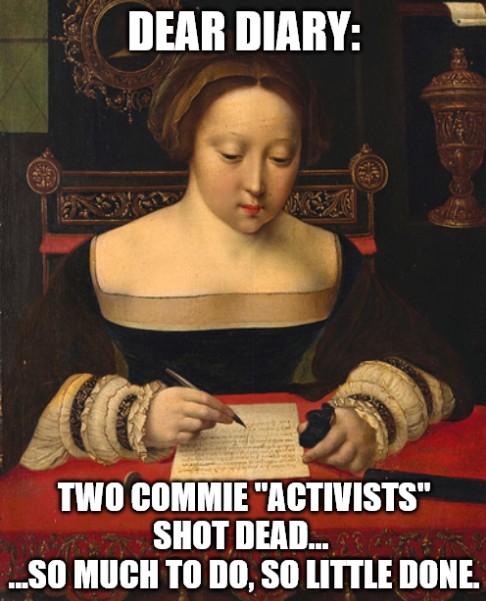
Let’s get on with it: 


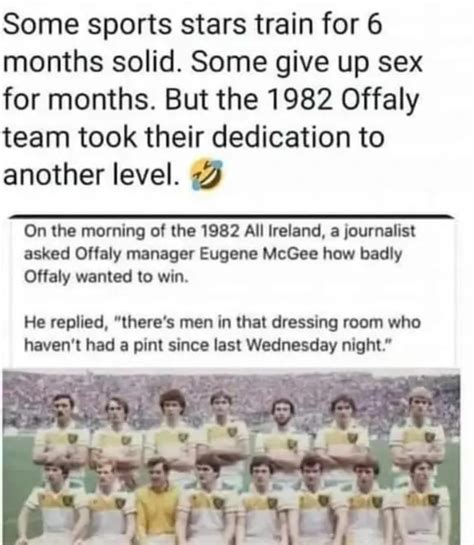



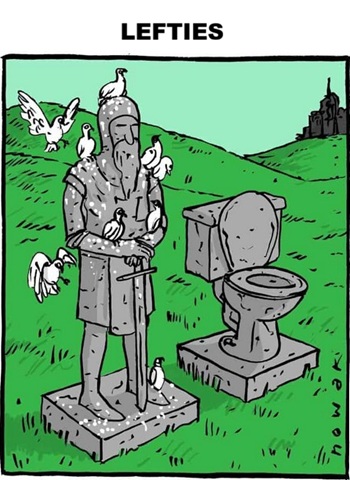



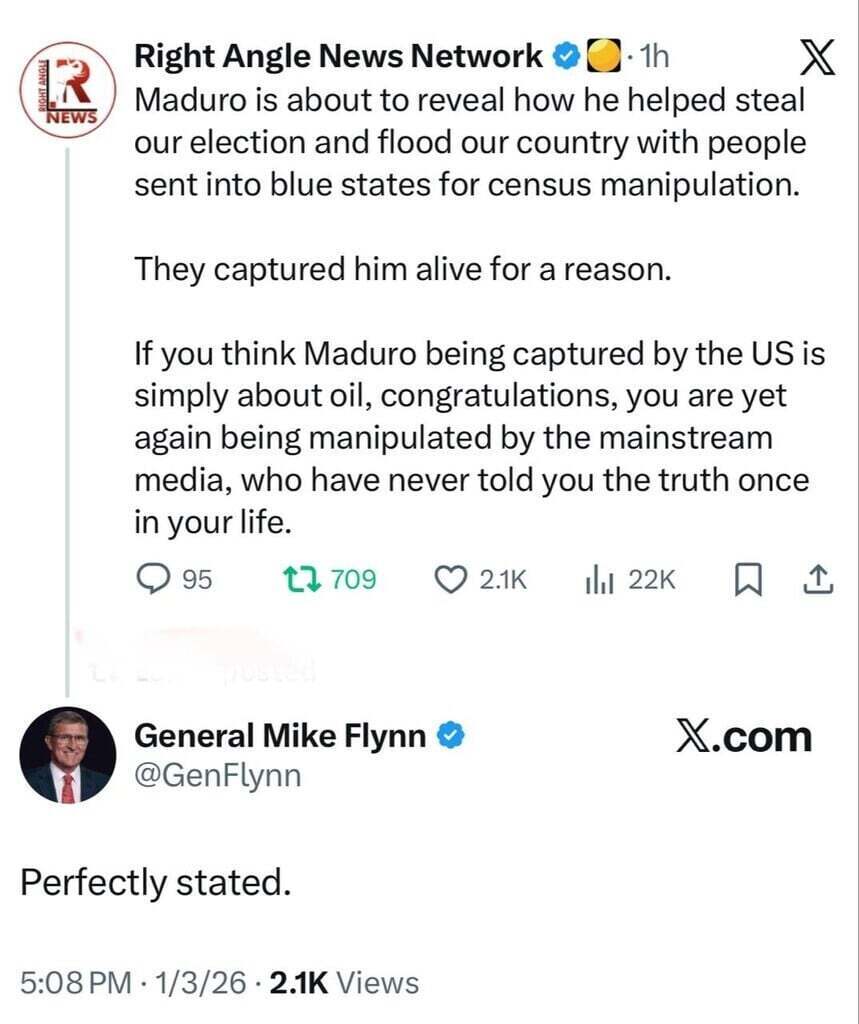

And speaking of that:



Now ride off into the rest of the week.
This lovely woman has often been called “the poor man’s Helen Hunt”. Myself, I think Helen Hunt is actually the poor man’s Leelee Sobieski. Why?









What makes Leelee remarkable is that she quit acting at a relatively young age, choosing instead to live a normal life. Here are the reasons she gave:
“Actors end up going from one role to another with all this energy behind them, and you just become emptier and emptier and emptier — you end up having no real experiences,” she explained. “To cry, you end up drawing on the experiences of another character you played.
“I would cry every time I had to kiss somebody; I couldn’t stomach it. I would think ‘I like this person, so I don’t think they should pay me to kiss them,’ or ‘I don’t like this person, so I don’t want to kiss them. Why is my kiss for sale?’ It made me feel really cheap.
“It might have been acting, but it was as real for me as my first or third kiss, so it was confusing for me.”

Good for her.