
Back when I was rebuilding a grocery chain’s loyalty program, I encountered a situation that was apparently not at all uncommon: astonishing incompetence. Here’s what happened.
I’d relaunched our loyalty card in our Long Island stores, in the face of fierce competition. Long Island, while geographically tiny, is densely populated and therefore had a huge number of grocery chains in the area at the time: A&P, Pathmark, ShopRite, Stop & Shop and our company Grand Union. In addition, there was any number of independent operators, ranging from bodegas to large stores located in a single town or area. It was, at the time, quite probably the most competitive grocery market in the world. No single chain had more than 3% market share, for example.
Which is why, when I joined Grand Union to fix their loyalty program, the management committee insisted that the relaunch take place in Long Island. (I’d suggested taking a small area such as Connecticut to test the program, but for strategic reasons, Long Island was the division in most trouble, so that was what I had.)
Anyway, I did the thing: redesigned the card’s appearance (to distinguish itself from the older card) and taking previous customer spending as a benchmark, stratified customers into “Platinum”, “Gold” and “Regular” groups.
This, by the way, was a cause of great consternation to the management group and to Operations, who for decades had treated every customer as equal. That was nonsense, of course; when I analyzed the data, it worked out that each store’s financial viability depended on a very few customers. In large stores, the per-store actual count was about 2,000 shoppers, and in smaller stores, much less — as little as 1,100 customers. As I put it to management, if I were to write a letter to all those top customers, telling them to stop shopping with us or they’d be murdered, we’d have to close all our stores inside a month. Not only did those 20%-odd account for about 72% of total sales, they accounted for nearly 90% of our gross profits. (Which makes sense, because those top customers shopped the whole store, most especially the high-margin departments such as Deli, Produce, Scratch Bakery and Butchery.)
I’d also redesigned our advertising approach. Instead of relying on those familiar weekly store “flyers” (distributed in newspapers and in the stores themselves), we would stop using flyers altogether and do direct mail offers only to our Platinum and Gold customers, sponsoring both production costs and markdowns by reallocating the print spend. I didn’t care about the “regular” customers, who not only shopped just the weekly discounted items (low margin) but hardly spent anything in the rest of the store. I didn’t even care if they stopped shopping with us altogether, because the benefits accrued (lower staff counts and more-profitable sales) would more than make up for the expected sales loss. (Just to be clear on this, it wasn’t just supposition on my part. In my previous consultancy job, I’d steered several chains into a similar direction, with almost universal success.)
Of course, the resistance I got from, well, just about everyone, was fierce. The only thing that saved me was that the CEO was on board with my plan, as was a key board member, who’d been a client from a previous job, as CEO of his supermarket company in Chicago.
Anyway, we launched the new program, and as the sales were reported weekly and not daily, I sat back confidently to await the results.
Which were catastrophic. Relaunch week showed sales down by nearly forty(!) percent. I nearly had a heart attack.
Then I went into the data, and started looking at the daily sales. Hmmm, what was this? No sales reported at all for the first three days of the promotion week (Wednesday through Friday) — I mean, zero sales, not a single dollar. Clearly, something was amiss.
So I went over to the IT department to see what had happened. It turned out that they had chosen that same week to test a new software product which collected the in-store returns, collapsed the data to make it all fit into the data pipe back to head office, then opened the zipped files once on the mainframe. Well, the program hadn’t worked at all, resulting in the loss of three days’ sales data.
I nearly had a heart attack, again. The most disturbing thing was the attitude of the IT department — essentially an insouciant shrug, accompanied by “Well, it’s working now so your data will get better.”
To say I was enraged would be the world’s largest understatement. My own boss was likewise angered, but not as much as I was because he was not a data person.
The CEO was unavailable, so I went off to see the CFO. (A little background: he was a recent arrival at Grand Union, but as luck would have it, we’d met before during my earlier career when I’d been advising his company — a Florida chain — with their own loyalty card program. He’d been very impressed with my input, his finance brain immediately understanding the financial implication of customer segmentation; but I’d been unable to implement the new program because I’d quit to join Grand Union.)
I walked into his office in a white-hot rage, but somehow managed to hold back. In calm, but very lucid tones, I outlined what had happened and what the effect had been on our data. To say he was appalled would also be a huge understatement. “The data is completely lost? We can’t retrieve it at all?”
Back in those days, data storage was not the simple and inexpensive task it is today, so at store level, once the data had been shipped off to head office, the space was cleared to make way for the next week.
He looked at me. “Of course, I’m going to make sure that Management knows all about this at our next meeting. But how did this happen?”
I thought about it for a moment, then said, “It is difficult to comprehend incompetence on this scale. I am not a paranoid person, but if I were, I would suspect sabotage.”
I told you all that, so you could look at this situation on the same basis.
New Jersey Gov. Mikie Sherrill had to confess that some 6,600 noncitizens landed on the Garden State’s voter rolls in 2023-24, and 400 voted.
And:
“I am appalled by the reckless failures that allowed this to happen and the lack of transparency shown by those in charge at the time,” Sherrill, just six months into her first term, said in a statement.
Yeah, I’m sure she is.
Sherrill blamed system software for the “error” and pledged an investigation into the alarming failure. She said she’s also canning the vendor involved.
Of course it’s the software’s fault. [eyecross] But the oversight of the data? That’s not the vendor’s job, it’s her state government’s remit, and that’s the biggest failure. More to the point:
New Jersey’s registration “glitch” is just the latest in a growing record of noncitizens doing what Democrats and their accomplice media friends say rarely happens: registering and voting in U.S. elections.
“The revelation comes as President Donald Trump and other Republicans continue to assert that voting by noncitizens is rampant in U.S. elections, even though it’s rare and, when caught, can be punished as a felony that can lead to deportation,” useful idiot Geoff Mulvhill wrote in his coverage of the scandal.
When caught? Such crimes are rarely caught due to lack of interest by many election and law enforcement officers on the front and back ends of the system. Democrat policymakers have bent over backwards to be “inclusive” and “equitable” in voter rights legislation, at the expense of election security.
Now let’s revisit my words to Grand Union’s CFO:
“It is difficult to comprehend incompetence on this scale. I am not a paranoid person, but if I were, I would suspect sabotage.”
It’s clear that Democrats, in New Jersey and indeed nationwide, are cooking the books everywhere:
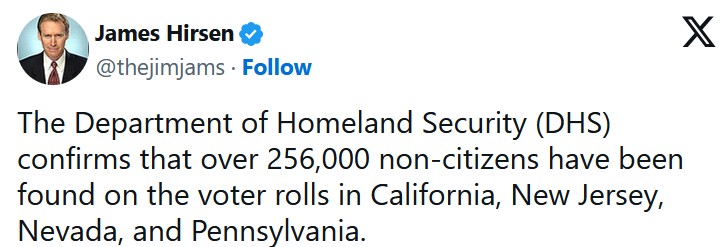
This is why they’re refusing to open their respective voters’ rolls to federal scrutiny and verification — not to hide their incompetence, but their sabotage of probably our most important institution: the vote.
Feel free to be as enraged now as I was back then.
Afterwards: The head of IT at Grand Union was fired couple of months after my meeting with the CFO. His replacement? The guy who had authorized the use of the new data-compression software. He was not only found to be truly incompetent (duh), but I was actually approached to head up the corporate IT department — an offer I declined, with thanks.
As for the relaunched program: the Long Island group became the most profitable of all Grand Union’s divisions, and sales grew every month thereafter, resulting in a full point of market share growth. Then the CEO retired, and his successor announced that the new loyalty program would not be allowed to roll out into the other areas (upstate New York, New Jersey, Connecticut and Vermont). More to the point, my advertising campaign was to be shut down and the company would revert to the old store flyer program.
I resigned immediately.
Grand Union went out of business three years later.
The subversives mistake was to assume you wouldn’t dig into the root of the problem, which most would not, only those who know their plan should be a success. PDJT and his Team are doing the same, which is why the Cheaters decry him and them at every turn; they are guilty of fraud and sedition an are being found out. The attempt for ‘Mikie’ to deflect is typical ‘hubris of the coddled young in an adult Lefty body’. This garbage is everywhere because no one has tried to stop them, well except Tina Peters, and look what Griswold and her Pals did to her to protect the fraud.
https://www.politico.com/news/2026/07/23/contractor-disputes-mikie-sherrills-claims-of-nj-voter-registration-software-error-01010689
As it turns out, the vendor did exactly what they were told to do, with the data they were given to do it. After specifically telling NJ to clean up the data. That makes this an ‘accidentally on purpose’ situation, just like Clinton’s ‘motor voter’ law.
Back under the reign of Slick Willie, a law was passed to have DMVs offer to register to vote everyone getting their DL; NJ just carried it further and automatically registered them. At that time, I was dating a Canadian nurse here on a work visa. When she went to renew her license the lady behind the counter gave her a voter registration card asking her to fill it out. When the Canuck said “I can’t vote, I’m not a US citizen,’ the functionary said ‘it’s ok, if you can get a drivers license, you can register to vote.’ The Canuck wisely refused, but think of how often this actually happened.
Which, of course, is by design. Just like what NJ did.
Relative to your activity at Grand Union, it is classic 82/20 process activity that ITW developed amd is used in lots of places. It is all based on the Pareto principle but developed into an easy understand package for the statistically disinclined (which is a lot of people).
Not sure you are directly familiar with that body of information or developed your ideas independently (certainly ITW was not the first, they just packaged it systematically which was helpful).
Actually, I based my methodology on “Customer-Specific Marketing” by the late Brian Woolf, who first introduced the concept of customer stratification to the grocery industry back in 1992.
And I bounced all my ideas off the members of a share group consisting of pioneers: the late Al Lees Jr. (Lees Market, MA), Marvin Imus (Paw Paw Shopping Center, MI) and Rob Winett (Giant Eagle, PA). All three were ex-clients, fellow speakers at CSM conferences, good friends and the finest dinner companions ever.
I am going to have a few comments today.
I am an IT guy who is in his early 40’s. Been working in IT since I was 18, and since high school if you count the vocational high school I attended.
Let’s start with the IT stuff
1 – Kim is SPOT ON about many IT departments. Within and among the leaders and rank and file IT people – BOTH in the PUBLIC and PRIVATE sector, there are hacks, bullshit artists, and even some talented people with the means who just simply do not give a fuck.
I have worked for state government at an indoctrination center for the last 8 years. Before that I worked in all private industry.
Private industry has hacks and bullshit, however the government takes the fucking cake for absolute bullshit.
– I would go to the boss with EVIDENCE of others not doing their job. I was told bullshit such as – worry about yourself, you are being rude, you should not question what others do, you are good at doing this so now you can cover this, and when I brought up these other people are the same title making more than me – i get the old “TITLES DON’T MATTER- WE CAN ASSIGN ANY WORK WE WANT TO”.
– People lie about things and cover things up. About 18 months ago a notice came in that Microsoft was changing how they license Office 365 for businesses. It would be cheaper for the new licenses – someone in IT & Business Office just had to enroll and make payment, and then we could assign the new licenses from the online “cloud” portal (Don’t get me started on the “cloud” – it simply means a physical server hosted somewhere else by someone else).
Guess what? The people responsible either did not read, did not care or just forgot. Now licensing errors were appearing for users like gangbusters.
You think the “Leadership” admitted these? NOPE! US peeps at the bottom are told to work with the users, even though until the Infrastructure team gets the new licenses and starts assigning them – the users will have problems.
Now we are told to just assign the licenses from the pool as users come in with issues.
A few years ago, they finally got rid a a CONsultant who was butt fucking the taxpayers for over $ 180,000 a year to work 3 and a half days a week. Someone in 2022 the place was hit with a cyber attack with ransomeware. The college still won’t show the report that tells exactly what happened. Rumors are out there. This guy got 86’d at the end of 2023. Arrogent cock sucker. He ended with his 3rd wife divorcing him around the time he got 86’d. Fuck him.
At my level, Technical Operations – a basic title for, DO FUCKING EVERYTHING – I am required to be onsite 5 days a week. Gas, Insurance, etc all expensive as fuck. My boss? HOme 2 days a week. Guess who determines who can work from home. It is NOT based on Job description, it is up to your boss.
ALL but 7 people are allowed to work from home out of a dept of 16
Out of a dept of 16 –
4 Directors
One CIO
Management is TOP HEAVY AS FUCK
The employees outside of iT whine and cry that Susie Creamcheese and Johnny Smith got 2 new bigger size monitors, so THEY should get one too.
Anyways, IT – Myself and my two team mates clean up everyone else’s messes. I WISH we had more responsible people like Kim to deal with.
WIthin and outside of our dept, BULLSHIT.
AND BOth in the private industry and in the public sector – TONS of arrogent, imcompetant assholes in the business.
The Director of infrastructure had his buddy interview for a job a while back. Guy interviewed terrible. they hired him anyways. Guy is a hack more makes well over 100,000 a year. Fucking joke.
One time guy came back to where me and my coworkers in tech ops sit, saying it was cold in there. He was wearing a coat and said his area was cold too.
I said, yea, we find it comfortable in here after we run around all day and do work, you get to sit with your buddy all day. Idiot did not know what the fuck to say. Stupid ass.
I am sorry for those of you that have to work with dipshit IT guys. There are many assholes and cock suckers in the IT world. I have had to deal with and cover for tons of them.
I complained one time about tickets that were entered incorrectly and not fixed by level 1 support.
What happened?
2 things
1 – I was pulled into my bosses office where he politely but directly told me “I feel that whoever the ticket goes to can fix this – and you do an excellent job”
2 – My next review, I got exceeds on a few categories. I was told verbally by my boss “I have never seen anyone here complete tickets as good as and with the detail you do. Please keep this up.
I was given the standard raise – and, the assholes who are lazy and fuck up, are paid more and i have to fix their fuck ups.
Assholes make it to the top. This one does not even need to be explained.
I’ll comment about voting in Massachusetts in a separate comment.
Oh almost forgot a story that happened within about a 10 or so ago.
One of the level 1 guys, fucked up big time. Took a laptop in – and didn’t back up any data
(NOW – USERS are SUPPOSED to backup their own data. Policy states:
“individual end users are personally responsible for their data backups and storage. ITD plays no role in the management of end user data, but will assist in migration and provide training, as requested.”
Let me tell you what that means. MAJORITY of jack asses – 99 percent – who work there (I use the term loosely)_have NO FUCKING CLUE where they are saving their shit.
So “assist” to them means – my computer broke – and my data is on their, ASSIST me.
Management then says us 3 in tech ops (me and my 2 coworkers) have to them move heaven and earth to backup peoples shit.
The level 1 guys USED to help a LITTLE. VERY little…
So this one lazy fuck – he fails to backup the data for a known asshole woman who works there. (THe cunt is retiring soon. GOOD RIDDANCE. A dumb ass math teacher who makes $ 125,000 a year, thats a whole nother level of bullshit).
Back to level 1 guy, the woman didn’t back up her shit, because she is stupid and fucking lazy
The level 1 guy wiped the fucking machine.
He then goes on vaca for 2 days.
Managment gives me the laptop.
I get her a new one with permission in case we can try to use tools to recover any data from her previous machine.
level 1 guy back from vaca, I tell him the laptop for the new lady is on the shelf for her and he can give it to her and i give him back her old machine.
He tries, without any luck cuz he is lazy and stupid and spends have his day making coffees and pastries – and he microwaves coffees 25 fucking times a day – he gets nowhere.
Management then tells me I need to continue to work on this.
AND
In general, when I am out on vaca for 2 days, a week whatever, WHEN I AM OUT AND OTHERS ARE WORKING – TICKETS GET PUT IN MY QUE.
I question this practice over and over, saying 1 how is this fair to me? 2 this makes a customer wait.
I also ask – can I put stuff into other people’s que when I am working and they are on vaca? Answer is NO
I am told
1 – Its not urgent you can do it when you get back (WHICH MEANS I CARRY MORE WORK LOAD THAN OTHERS
2 – It is “innapropriate for me to question others work loads”.
In other words, shut up and take it up the fucking ass
Oh and this level 1 guy that wiped the laptop? He makes more money than me and is the same title, to do less.
Some MINOR Karma – not great karma but minor.
The cunt YELLED AT ME for her laptop issues. My boss at the time (i got a new boss since, nicer, but still full of shit on many things) – was there whne I was yelled at. He did NOTHING.
I told him when she left, “If she yells at me like that again, I am NOT helping her”
He shut the door and sternly said “you ARE going to help her that is your job”
I then said back “YOu heard me. you want to take this up to HR like you have other times when you tried to jam me up? Next time she yells at me I wil NOT be helping her and I might even call the campus police. ”
He got silent but later came to check the status of her laptop.
Anyways, the cunt is leaving in a couple of weeks. She has spent her final weeks walking around campus asking to “take pictures with people for her scrapbook to have memories”
She approached me and asked me for a picture. I said NO THANKS
She muttered to someone else how I was rude for refusing.
FUCK YOU CUNT BAG.
HOPE YOU FUCKING PASS AWAY SHORTLY AFTER YOU RETIRE SO YOU CAN’T ENJOY THE 80% PENSION of your FUCKING 100 GRAND PLUS SALARY.
STUPID BITCH!
VOTING IN MASSACHUSSETTS
Been voting since I was 18 years old. I am in my early 40’s now.
Lived in a small town when I grew up, when I moved out in my 20’s, I moved to a mid size city with my then girlfriend now wife.
2013 rolls around. February. I move to the new city.
– In january of EVERY year, this city, along with many others, sends out a street listing survey.
I did NOT ever get that in 2013, because I moved to the city in FEBRUARY of 2013.
If you do not answer the survey, you end up being removed from the voter rolls
I registered to vote in the new city in february. in person. At the city hall
CITY voting for mayor and other local officials held in 2013 – Off odd years for mayoral elections in this town.
I go to vote… I am NOT on the list.
I am told I could cast a ballot and it MAY be counted.
I am NOT yelling but my voice is a little irritated raised.
Some lady comes out and explains that I was removed for not filling out the survey.
I explain I Would have NEVER gottten teh survey. I moved here in Frbuary.
She says survey is sent in january – but actions not taken until later.
I said I registered at city hall.
She goes back referencing the survey.
I pull my wall and show my license with my new address –
She then proceeds to tell me how it is ILLEGAL for an ID to be asked for / presented at a voting booth.
Someone gave me a ballot eventually and I voted. I have NO fucking idea if my ballot was counted that year.
NEXT
Covid comes along. I was sick of the mask bullshit. I ONLY Wore a mask 2 places. Doctor / Dentist (other wise they would kick you out and Work (They threatened to fire people who didnt wear masks).
Anywhere else, post office, walmart, stop and shop, I did NOT wear a mask. I had people who were allegedly scared of the virus come up to me and yell at me and one guy even threatened to kick my ass at a grocery store. He was standing many feet away. I said “cmon, come kick my fucking ass dude, PLEASE do”. Dude muttered some shit about masks are the law and left teh store after I BEGGED him to kick my ass.
Anyways, 2020 election. Ya know, the MOST FAIR AND MOST SECURE ELECTION EVER – I go to vote. I tell my wife, I am NOT wearing a mask. She does’t like the bullshit mask thing either, but, she said, hey, your going to get in trouble or arrested or something. I said no, nothing is going to happen.
I go to the voting place. A local school is the polling place I vote. Place has barely any people just a few. A few cops all wearing masks. And the city clerk at the time was there. I walk in ZERO mask.
Cops for the most part ignore me, one said “hello, thank you for coming to vote today”.
The city clerk and a lackey asked me my name and street address, and handed me a ballot.
NO problem at all voting WITH ZERO RITUALISTIC SHAME MUZZLE.
2022 Mid Terms
Covid fear is winding down at this point in 2022. I got to vote. MUCH larger crowd than 2022. I got there a few minutes before the polls opened at 7. About 10 to 12 people ahead of me.
I hear some mild commottion. A few people are being told “you cant vote again it says here you mailed in a ballot” those people argued and said NO WE DID NOT. WE DID NOT VOTE BY MAIL. (Things that make you go HMMMMMMM ). Could this be fraud? IN Massachusetts? “There is no evidence of voter fraid”, or so we are told…
I voted in 2022 no problem. I dont know what the fuck happened with those people ahead of me, but after seeing TONS of bullshit happen here in Massachusetts, I an VERY inclined to beleive that those people were telling the truth and did NOT vote.
ICING ON THE CAKE????
Massachusetts is a state that issues drivers licenses to illegals.
When you get a license or renew, the system checks if you are registered to vote, and if you are not, it will automatically ask you if you want to register to vote.
The OFFICIALS and POWERS THAT BE say there is no way to stop someone illegal from registering to vote when they get a license, but that there is no evidence of voter fraud.
THINGS THAT MAKE YOU GO HMMMMM…
Oh another IT story – DURING the HEIGHT of covid, I was allowed to work from home a couple of times a week, while 99 percernt of people worked 100 % remote.
(only a couple if us in IT and the janitors and the police worked onsite at that time).
There was a “policy” that once you got to your desk – you could remove your mask. If you were not in your immediate work area – you had to put the RITUALISTIC SHAME MUZZLE back on.
A coworker of mine, who since left the place and the state (i didnt get along great with him but he was an ok guy and a hard worker who was also in the military) – we sat 1 desk apart in the 3 in the back where we work. and across from us was a bench for working on computers.
We both kept our masks off in the back and ONLY put them on if we went up front to deal with someone who came in person for help or if we had to walk someone onsite.
One day, we BOTH get called into the office and told “someone saw you both away from your desks without masks on, we need to remind you both that wearing masks is a policy and we ask you to take this serioulsy and follow the policy”
We explained the whole while we are at the bench that is within a few feet of our desks.
Bla bla bla.
Same canned speech.
We didnt get written up or in any formal trouble, just a canned speech that I am sure some pussy cried about us and told the right person so we would get talked to.
We continued to do what we did anyways.
The managers that spoke to us were onsite less than we were at the time.
IT is a magical thing. Lots of FUCKING OVERPAID USELESS IDIOTS WHO FUCK UP AND TRY TO BLAME OTHERS.
I am sorry for those that had to deal with DICKHEADS from IT.
I try to be a fair guy.
It’s not really incompetence. Incompetence is the fig leaf. The bastards 100% know it’s going on, but because those overseeing it, benefit from it, why the hell stop it.
Only when it gets too obvious is any action taken, and that action is half-assed, slow, & pointless. Usually ending up with the one in charge “VOWING” to get to the bottom of it, hell maybe even a commission to investigate, gets created, staffed with cronies.
“Full of sound and fury, signifying nothing “
And the crooks will continue to get away with it, because by and large, The Pee-Pull, bless ’em, have no clue how the system works outside of the box (or phone) in their hands.
“Where is your backup stored?”
“I dunno; isn’t that your job?”
Back during a previous (Democrat) administration, a senior politician (Lois Lehrner?) was able to dodge charges by saying at a Congressional hearing “I can’t give you that information; my computer had a hard drive crash.”
It was pretty much like saying “I can’t give you my bank statements; my computer had a hard drive crash.”
All the opposistion had to do was bring in an IT person (practically ANY IT person) and ask them about archiving, data backup, etc. But the Don’t-Rock-the-Boat Party missed that opportunity, which lead to the NJ (and who knows how many other states’) voter registration situation.
Incompetence is endemic. Read LJ Peters for an explanation.
In my consulting days I would often run downstream projects for my clients. The strategy would get signed off, projects would be initiated and inevitably half would get bogged down because “leadership” insists on assigning people with no project experience to lead projects.
Often after a couple of months of reporting zero progress on a key project they would throw me the ticket to help get them going. One project involved moving the entire physical server array out of their basement (flood risk, poor infrastructure etc) into a 3rd party data centre. I thought this was a pretty straightforward project. But the very senior manager spent months on the hosting agreement and getting fully redundant fibre installation done between the two sites. The plan being to stand up “new site” then progressively cut over from old site. Again for the technical people here, not that challenging.
The board accepted recommendations such as only take “clean” applications across. Fully licensed, current supported versions and so on. Leave behind the 2000 unlicensed or unsupported applications, illegal movie libraries and so on.
This spun sub-projects as some key applications didn’t meet the grade. They were running Enterprise critical CRM software that was unsupported- vendor had gone bust.
The head of ops decided to save some money ***sigh*** and without discussion stopped maintaining key bits of kit in “old site” such as ignoring error codes on the Uninterruptible Power Supply (UPS) the provided clean power and the ability to do controlled shutdowns in the event of a power outage.
Eventually I had to escalate this to the board, over the objections of all the line management. They signed off on reconditioning the UPS – it needed new batteries. Which, were eventually installed. The tech told me he had to unbolt the UPS frame from the wall to install the new batteries. Out team had insisted on getting another shop in to inspect / qa the work so had directed the ups tech to leave the install accessible, eg unsecured.
Every month at the CIO meeting I highlighted that the UPS was a risk. When I finished my contract I handed the CIO a list of outstanding important things that needed urgent attention, including resecuring the ups. Some months later Christchurch had an earthquake. Fortunately the basement didn’t flood, but the UPS fell over, ripping all the downstream power cables out, causing a hard stop on every it system. Some of which were never able to be restarted. Data problems that in many cases were never able to be resolved.
The only thing that stopped me getting sued was the documentation trail I provided the board highlighting all these issues.
They eventually got rid of the CIO after he had eventually given up on the migration project.
This stuff was my bread and butter for 20 years, turning around or killing off bad projects……
So… did Scott Adams used to call you for inspiration?
lol, the reason Scott ADams was so successful was the number of people who instantly recognised the scenarios he described.
Along the lines of Teetotaler’s saga, I had similar things happen to me working as an engineer for a Fortune 500 company, when in the late 80’s I first encountered Affirmative Action, which pushed blacks and women up the ranks with little regard for actual merit, and later in the 90’s, when the insulting, demoralizing bullshit of Diversity made up my mind to take an early retirement
In the late 80’s, Corporate decided to introduce a new product when they heard one of our major competitors was coming to market with one, and they wanted us to be in the market first. About fifteen of us were sent off to a skunk works to develop and build the machinery to make and package the product. We had to design and build machinery, electronic controls and software to make this happen, and we worked ~ 60 hours/week on average for about eight months. We nearly had the machinery ready to run, when Corporate decided they were going to skip test marketing and go national, which meant we had to have sufficient stock warehoused ready for distribution. To do this, Corporate, over our protests, shipped everything to a factory 600 miles from home, where we were tasked with making every scrap of product we could, while continuing development on a factory floor even if we had to turn over the machinery by hand. To add to our burden, this factory had 16 unions we had to deal with while our team worked 24-7 for the next four months. Most of us were hitting 80 hours/week, and I had many at 100 on all three shifts. During those four months, none of us went home or saw our spouse and families.
We met the marketing deadline.
I got home, and ended up in the hospital a day later with a suspected heart attack, which turned out to be exhaustion.
About a month later, the company newspaper came out with a big article about what a great success the new product was, and featured eight women, some of whom I knew but never saw during the whole development process. Each was feted for their significant contributions to the product development, and given a President’s Award, a tax-paid bonus that amounted to $73,000 in 2026 money. Their contribution – they sampled the product and commented on it.
In the 90’s, I had a female boss who was intelligent, a good planner and a good paper pusher, but had never designed anything.
Twice while working for her, two other guys and I invented something that solved a major problem; we did all the ROI work, and based on that, applied for a patent on each invention. As our boss, she had to approve the patent application, as it was an expensive process.
Working for a big corporation, patents are not worth anything to the inventor because the patent is assigned to the corporation, but it’s a little feather unavailable to most others for an engineer or scientist to stick in his cap. When we got our patent plaque and our $250 bonus, my fellow engineers and I were surprised and angered that our female boss inserted her name on them and brownnosed our senior vice president by putting his name one of the patents as well. Neither of them had done anything on the projects except come watch it run, just once, for about fifteen minutes. When we confronted her about this, she said she contributed by commenting on our design.
About a year later, an early retirement package came out. I was asked to stay to finish a project, and while thinking “Fuck you,” I said no thanks, took the package and retired.
There’s always been backstabbing and turf guarding by incompetents who’ve clawed their way into a position and feared being undone, but I believe it’s been enhanced by the enstupidation of the young in government schools and the advent of Affirmative Action, Diversity and now DEI, all designed to repress the white male and his accomplishments. For two hundred years America had a culture that was, on average compared to others, risk-taking, high IQ, high trust and low fraud. Now the DEI types have acquired enough voting and executive power that they’re seeing to it that we’re being inundated by low IQ, low trust, high fraud cultures seeking sinecures at best and handouts at worst. It will be our ruin if we don’t stop it and go back to a meritocracy.
Whut, only 6,600? Only 400? Now THAT’S incompetence.