
Amsterdam 2004

Month: April 2026
Owning, Or Being Owned?
Several Readers (thankee) have pointed me to this article at American Thinker:
There was a time — not very long ago — when the automobile represented one of the clearest expressions of individual choice in a free society. Limited only by fuel, roads, and imagination, a person could choose where to go, when to go, and how to get there. The car was not merely a machine. It was mobility made personal — an extension of autonomy and freedom.
Sadly, that is no longer the case. Increasingly, this same instrument, once a tool to facilitate individual independence, has been repurposed into a system of monitoring and control. Though advertised as safety measures for the consumer, these measures were clearly designed to empower the state.
Modern vehicles are no longer just mechanical devices; they are computers on wheels. Embedded sensors track speed, braking patterns, seatbelt usage, location, and even driver attention. Event Data Recorders — commonly referred to as “black boxes” — have been standard in most new vehicles for years. Originally justified as instruments to reconstruct accidents, these devices record data in the moments before a crash. Few object to understanding the causes of collisions. But it is worth noting that once data exists, its use rarely remains confined to its original purpose.
Insurance companies now seek access to driving data to adjust premiums. Law enforcement agencies have used vehicle data in criminal investigations. Courts have admitted such data as evidence. Each of these developments can be justified in isolation. Together, they represent a quiet but unmistakable shift: the automobile is no longer simply your property — it is a source of information about you.
More recently, legislative developments have accelerated this trend. The federal infrastructure legislation passed in 2021 includes a mandate for advanced impaired driving prevention technology to be installed in all new vehicles within the coming years. While often described in benign terms — systems that passively detect intoxication or driver impairment — the practical reality is that these systems must continuously monitor driver behavior in order to function. Monitoring creates data. And data, once created, rarely remains unused. It takes on a life of its own.
Proposals and discussions around remote vehicle disablement — popularly referred to as “kill switches” — have raised further concerns. While proponents argue that such features could prevent high-speed chases or stop stolen vehicles, the existence of remote-control capabilities introduces a fundamentally different relationship between the individual and the machine. A car that can be disabled remotely is clearly not under the control of its owner.
I’ve ranted about this little bit of rampant evil on many occasion, and the gist of all my screeds has been all around this concept: giving up control — to anyone, for even the most laudable purposes — will, inevitably, end your freedom.
I’m unlikely ever to buy a new car, and certainly not a “modern” car which would contain all the electronic snoopery and filth as discussed above, and most especially at today’s bloated and excessive prices. But if I were ever to be forced into buying a replacement for the Tiguan or the Fiat, and given that no matter what I buy, it would carry a horrible price tag withal, then why would I just not get a much older car that while expensive, at least allows me the freedom that cars of yore gave me? Something like this one, for instance:

I know, fifty-odd grand for what is in essence a gift-wrapped VW 2300cc engine may seem excessive to some; but I don’t need much more than 145hp (especially on that featherweight chassis), and it least it doesn’t look like every other car on the road (#WindTunnel). But most of all:
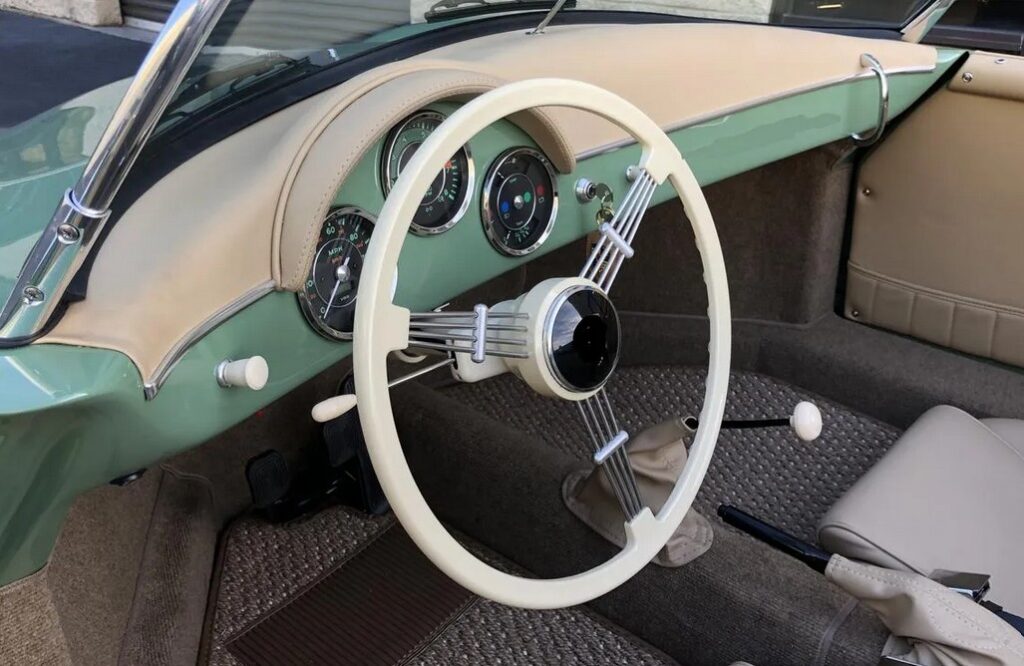
…please note the refreshing absence of all the modern electronic geegaws which bedevil today’s automotive offerings. The only thing missing (which I’d add with alacrity) is air conditioning. (#TexasSummer)
For the faint of heart, let me point out that a new VW Tiguan base model will set you back close to $40,000, and a Jetta (with a stick shift!) only five grand less. And you can bet your ass that both the VWs will come equipped with all the latest in snoop-‘n-control electronics.
Sorry, but no. To hell with all that. I want simple, and I want freedom.
Yeah, Maybe
This also from the American Thinkers:
There were many good reasons for the United States and Israel to finally move against Iran this month, and the need to end the Iranian mullahs’ control of their clients in nearby countries—Lebanon, Gaza, Yemen, etc.—is at the top of that list.
However, if regime change in Iran also enables the Houthis to be defanged and the Suez Canal to be reopened at last—as it must—the billion-dollar-per-day transportation savings to the world economy that result from it will, in itself, have made it all worthwhile.
This isn’t about Israel and the United States alone; it’s about every developed and developing nation on earth. Everyone uses the Suez Canal; everyone needs it.
Errr nazzo fast, Guido. I appreciate that the Suez Canal may be an important sealane, so to speak, and most certainly for Yurp and Britishland. But is it that important to the U.S.? I’m thinking, not. Most of our trade comes from the Far East over the Pacific, and from Yurp over the Atlantic. I’m struggling to think what doesn’t use either of those routes; and if so, why would we care — other than for purely altruistic reasons, i.e. to bail the Euros out of yet another mess — to intervene in the Red Sea?
For that matter, the Straits of Hormuz aren’t that important to Magaland either; as DJT has pointed out, the U.S. gets nary a single barrel of oil out of the Persian Gulf because we roll our own.
Now I can see why Suez might be an important military thoroughfare for our Navy, each time we want to leave the Mediterranean Sea to whack Persian pee-pee, so to speak. But even that is not a priority, really.
Discuss.
Un-Constitutional, Illegal And Nonsensical
…and yet the National Firearms Act (NFA) is still with us, becoming evermore ridiculous, evermore illogical, and always (still) un-Constitutional.
Here’s the best history of the disgusting thing I’ve ever seen which — as with so many of the bullshit laws and bureaucracies that still bedevil us to this very day — stemmed from the diseased liberal New York mind of the sainted Franklin Delano Roosevelt.
And the Act’s very vagueness of terminology makes it almost unique among our forest of laws in its ability to turn any gun owner into an instant felon without him knowing about it until the AT-fucking-F agency thugs drag him away in chains. And said feature alone should make it legal poison, except that the Department of (alleged) Justice is too busy fucking around with irrelevancies like the Epstein files.
Kill the NFA. Kill it stone dead, and then abolish the ATF in toto, because the government has no business in the alcohol, tobacco and (especially) the firearms business. I might make a teeny exception for the oft-elided “E” — explosives — part of the agency’s nomenclature, but those first three initials? X marks the spot in the back of the neck, for each of them.
Otherwise? Line ’em up.
Random Totty
Here’s Katherine Kelly: