Waiting For Special Agent Godot

This post raises some interesting points:

Was the Terrorist Attack in Colleyville a Replay of the Terrorist Attack in Garland in 2015?

This would answer a WHOLE lot of questions posed by my Readers on this very website.  Something stinks about the whole Colleyville thing, and the smell emanates from the FBI, not from the Muslim asshole’s rotting corpse .

I really would love to hear the FBI’s rebuttal of the Colleyville hypothesis above, but as the title suggests, they probably won’t say diddly, because the questions Sundance raises are really pointed:

(1) how did Faisal Akram gain a visa to enter the United States?  (2) Who did he visit?  (3) Who gave him the weapon?  (4) Who facilitated his travel and targeting operations; and lastly,  (5) who financed and assisted him in his attack?

Either the FBI enabled his activities — as Sundance suggests — or they really didn’t know anything about him, which means they’re really fucking incompetent.  I’d prefer the second alternative, actually, but I think the first is more probable because the FBI has a long (and so far unpunished) track record of doing shit like this.

Taking a wider view, Sundance notes:

The FBI is not a law enforcement or investigative division of the U.S. Department of Justice. The FBI is a political weapon of a larger institution that is now focused almost entirely toward supporting a radical communist agenda to destroy civil society in the United States.

Hey, Fibbies:  feel free to supply proof that contradicts all the above.

Motherfuckers.

ZA Factoids

ZA, of course, being the international acronym for South Africa.

Cape Town is one of the world’s most beautiful cities:

The people somewhat less so, but that’s true of just about any city.

Durban looks like Miami Lite:

The Drakensberg range is quite spectacular:


They were named thus by Boer settlers who thought the mountains looked like dragons’ teeth.

The Wonderboom (Wonder Tree), a fig tree that is over a million years old:

…which is why you need to prune your fruit trees.  (It’s that thing in the center that looks like a bush.)

South Africa has its own version of the Grand Canyon, called the Blyde River Canyon:

Not as deep, but then again it’s a couple hundred million years younger.

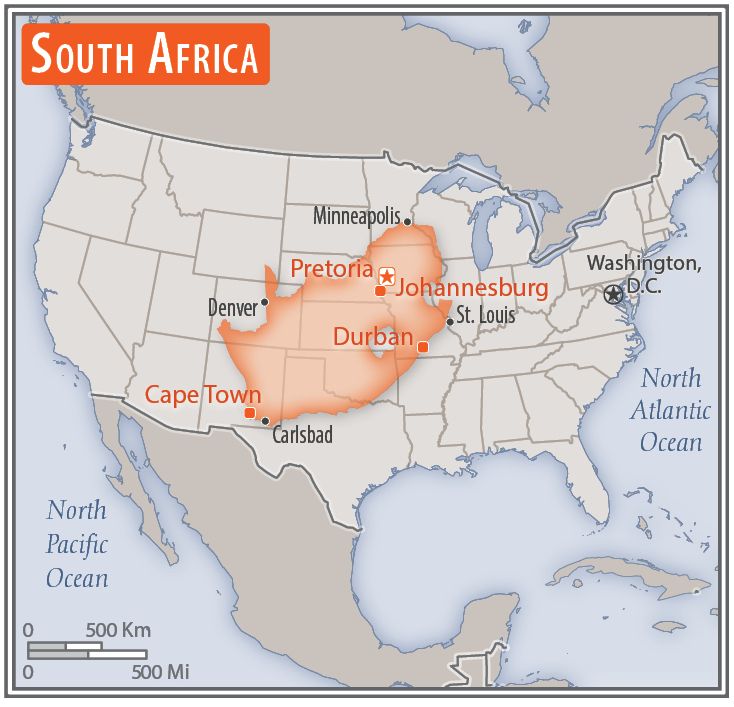
Now for some other size comparisons:

Relative to the U.S. Lower 48:

Relative to Texas:

And here are the Big Five:

Anyway, those were some of the slides I made for New Wife’s “Where I Came From” presentation to the kids at her school.

Toy Cars

I was having a long email exchange with Reader Chaz from Britishland, and we were talking about Ferraris and guns and what have you, and on the subject of cars, I actually surprised myself by saying this:

For a toy car, I would certainly choose a Caterham over any Ferrari made today, and not just because of the price, either.

Here’s the subject car under discussion:


…and I have to confess I was very influenced by this episode of Harry’s Garage, where at about the 13-minute mark Harry Metcalfe talks about how the increasing performance and sophistication of modern cars is making them heavier and less fun to drive — “too much power” (harking back to something I’ve said often with regard to Dodge Whatevers with 500hp engines), complexity following from stupid shit like emission controls and electrification, too many driver options (such as “sport mode”, “memory seats”) and so on.

Increasingly, in my sunset years, I want simplicity in a car:  get in, turn the thing on, and drive off.  (It’s one reason why I love driving New Wife’s Fiat 500 Sputum:  stick shift, nothing to touch in the car — yes, it has a Sport mode button, but on a non-turbo 1400cc engine, it is to laugh and I’ve never used it — and driving it is an absolute pleasure.  Forty-odd miles to the gallon doesn’t hurt, either.)

If I were in the market for a truck, I’d get a base model Toyota Tacoma with a stick shift.  As I’m planning to keep the Tiguan forever, the car issue is moot — but if it was totaled or otherwise became unroadworthy, I’d probably pick a base model VW Jetta with a stick shift.

Or a Caterham with a 2-liter Ford Duratec engine, if the insurance gods were feeling really generous.

No Kidding

One of my favorite movie (and life) lines comes from A League of their Own :  “There’s no crying in baseball!”

Here’s something we all know about.

Facts be damned: Rising use of emotional language like ‘feel’ and ‘believe’ has helped displace rational thought in ‘post-truth era’

A new study suggests we are living in the post-truth era where ‘feelings trump facts,’ as language has become less rational and more emotional over the past 40 years.

A team of scientists found words like ‘determine’ and ‘conclusion’ that were popular from 1850 through 1980 have been since been replaced with human experience such as ‘feel’ and ‘believe.’

The team also identified another major shift around 2007 with the birth of social media, when the use of emotion-laden language surged and fact-related words dropped.

Although the drivers behind the shift cannot be determined, the researchers suggest it could be a rapid development in science and technology or tensions that came about from changes in economic polices in the early 1980s.

Reason #2,465 why I could never work in a modern office.

Coming from a business background where every single proposition or proposal had to be justified with fact, research, real-world experience and (lastly) common sense, the very thought of going through the same process where any suggestion of same might “trigger” some kind of emotional response at best makes me want to reach for the gin bottle. (At worst, it makes my trigger finger itch.)

In fact, an emotional response to criticism would have made my time’s audience suspicious:  Why are they getting upset?  What are they hiding?   Why should we take them seriously when they are such weak people that criticism upsets them?

Nowadays, of course, all the above responses would result in Stern Words from HR (or even, gawd help us, from your own Management, so pussywhipped has the business world become).

No wonder Socialism has become so popular:  because while the eventual goal of Socialism is complete societal control, the way it is introduced is through emotional appeal:  “It’s not fair that…”  or “We need to end [whatever supposed evil]”, without any fact-based foundation but with plenty of anecdotal or emotionally-based evidence.

Small wonder too that the entire Green Movement is based not only on emotion, but a pack of easily-disproved lies (“Climate is cooling I mean warming I mean changing, and we’re all gonna diiiieeeee if we don’t do something!!!”)

Facts don’t need to be propped up by emotion;  they stand proudly on their own.  In fact, it’s probably true to say that the greater the hysteria generated by about some supposed catastrophe, the more likely it is to be complete bullshit.

Dr. Fauci, call your office.