Not Much

I see that all the Press are getting all bent out of shape about the God-Emperor taking hydroxychloroquine as a potential prophylactic (in English, as a preventative) for the Chinkvirus.  I don’t know why they’re getting all excited because if the shit did kill him, we’d be seeing a lockdown-style run on tissues at supermarkets because they’d be wanking themselves to a standstill.

But that’s not what I want to talk about, here.  I used to take hydroxychloroquine or something very much like it against malaria, back when I were a troopie in the Seffrican Army, way back when we’d just made the change from shooting Redcoats to shooting Zulus.   You nah waddeye mean.

Other than some really strange dreams — I mean the kind that you get when you’re sick with a fever, real acid-trip stuff — nothing happened to me, healthwise.  And I never did get malaria, even though there were times when my mosquito bites resembled smallpox sores.

So it’s highly unlikely that POTUS will get sick from the stuff — although if what happened to me happens to him, his tweets are going to be really fun for a while.

Which will piss the establishment media off even more, so it’s a win-win all round.

Viral Load

…or, as I called it a few days back, dosage, gets a more technical examination here (the linked article, by the way, is very dense reading, but I urge everyone to plow through it anyway.  You may learn something that prevents you from getting infected).  A sample:

What evidence do we have that viral load matters?

Three classes of evidence seem strong.

The first is that we have a strong mechanism story we can tell. Viruses take time to multiply. When the immune system detects a virus it responds. If your initial viral load is low your immune system gets a head start, so you do better.

The second category is the terrible outcomes in health care workers on the front lines. Those who are dealing with the crisis first hand are dealing with lots of intense exposures to the virus. When they do catch it, they are experiencing high death rates. High viral load is the only theory I know about so far for why this is the case. Their cases are presumably handled at least as well as others, in terms of detection, testing, treatment and what the infected do themselves. The only other issue I can think of is that they might be reluctant to rest given how urgently their help is needed.

The third category is historical precedents.

Parents infected their children with what they hoped was exactly the minimum dose [of smallpox] required to get them sick enough to develop antibodies and gain immunity. Sometimes this went wrong and the child would get sick. Thus this form of inoculation was dangerous and 1%-2% of patients died. But of those who got smallpox infections in other ways, 20%-30% of patients died. Those rates are well established.

I should point out that Doc Russia, who as an ER doctor has been treating Chinkvirus patients almost daily, fully expected to catch the virus himself, but so far [crossing fingers]  hasn’t.  All I can think of is that because his hospitals (he works in several) don’t have that many infectees compared to those in, say, London or New York, his aggregate exposure is low;  that, his age outside the at-risk group, plus his fanatical adherence to commonsense protective measures, has probably kept him well.  Which leads to the other major point in the above linked article:

The default model is that the longer and more closely you interact with an infected person, especially a symptomatic infected person, the larger your viral load.

In-household infections are presumed to be high viral load, as in the case of measles. So would be catching the infection while treating patients.

Most out-of-household infections that aren’t health care related are presumed to be low viral load. Anything outdoors is probably low viral load. Most methods that involve surfaces are probably low viral load. Infection via the air from someone there half an hour ago, to the extent this is a thing, is low viral load. Quick interactions with asymptomatic individuals are probably low viral load.

I should point out that the above are observations based on admittedly-poor data, but as we know that the level of dosage/viral load is critical in other diseases (measles, smallpox, SARS etc.), it’s not a bad deduction to assume that it’s true also of the Chinkvirus.

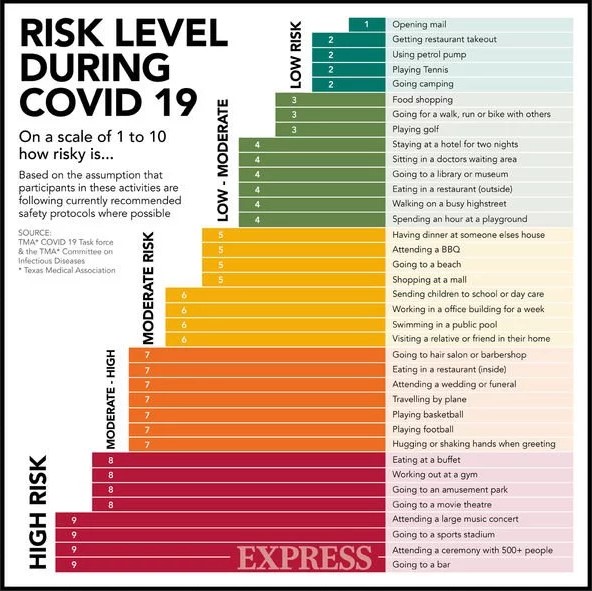
As with all decisions in life, the key to decision-making is risk assessment and odds-calculation.  Use all the above accordingly, as you plan your daily life.

Silver Lining

If anything good has come out of the Chinkvirus pandemic, it’s this:

A comprehensive study of behaviours and attitudes since the outbreak began found that three in five people will stop greeting friends with a hug and a kiss, and will also avoid crowded places in the future.

Include me in that number, although I hardly ever did it anyway.  This modern thing of men hugging other men who are not family has always given me the heebies.  I hug my son — and not even that often — and occasionally my friend Trevor (who insists on doing it because he knows it bugs me, and I don’t kill him because he’s my friend).  Other than that, ugh.

I don’t mind shaking hands, however, because I was brought up to do that with men, further affection being communicated by a punch or slap on the shoulder.

But not with women.  Unless it’s a business thing, I’m always tempted to turn a handshake with a woman into kissing her hand;  mostly, it’s greeted with giggles and sighs.  If I add, “Sorry, but I was brought up to love and respect women,” the response is universally positive.  Hugging is too intimate;  kissing a hand denotes respect.

As for hugging and kissing women I know… well, I’m never going to stop doing that.  (At the doctor’s the other day, I complained to his nurse practitioner — whom I’ve known for over fifteen years — that I wasn’t going to molest her as I usually do when I visit.  She shook her head sadly and said, “And I always look so forward to it, too.”  Aaah, Texas.)

Ultimately, though, I think that for the next few years we as a society are going to be more comfortable about keeping other people — and certainly strangers — at arm’s length, so to speak.  And that’s a Good Thing.  But as time passes, we’ll forget all about pandemic behavior and relapse into over-familiarity, which isn’t.

No News, Good News

Went for my semi-annual checkup this morning, really just for a  blood draw because cholesterol.

Same ol’, same ol’ — heart fine, lungs fine, BP okay, results from earlier colonoscopy excellent… “Now get out and quit wasting my time, see you in six months” from Doctor Sawbones.

Oh, and despite my fears, I haven’t gained any weight.

I was the only patient in his office.   He’s struggling, big time.  Nobody wants to come in to see him — everything is over the phone.

Out of his entire patient list, he’s had ONE (1) positive Coronavirus test — ironically, his nurse’s mother who last February went to Las Vegas  (motto:  we’re #2 behind New Orleans for the Pox Capital of the U.S.A.).  She coughed a bit for about a week, then recovered.  No hospitalization necessary, despite age (72).  East Texas farm gal, what can I say?

It’s time to get back to work, folks.


Update:  forgot to mention that at QuikTrip and Raceway, we’re paying $1.20 for Regular, even less at Kroger with the 3c/gal discount.  Now all I need is someplace to go.

Eternal Life

I have to tell you that if this is true, a lot of men I know are going to live for a VERY long time*.

Masturbation boosts your immune system, helping you fight off infection and illness

So take that, Coronavirus.

“What’s the difference between your girlfriend and a good wank?”
You can’t beat a good wank.

And now, if you’ll excuse me… oh shuddup, it’s for my health.


*This does not apply to actual  wankers, e.g.: