180 Degrees Wrong

I often comment sardonically that if today’s medical warnings make you fearful, all you have to do is wait a little and there’ll be a discovery that OOPS! salt isn’t all that bad for you after all.

That’s all very well.  But what if the previous warning was not only wrong, but massively wrong — i.e. that something that was said to be bad for you (could even kill you) — in that it was not only wrong, but diametrically the opposite.

Say hello to our old friend caffeine:

Although people with heart conditions such as atrial fibrillation* (A-Fib) are often told to avoid caffeine because it might worsen symptoms, new research suggests the opposite may be true. A collaborative study conducted by the University of California, San Francisco, and the University of Adelaide found that drinking one cup of caffeinated coffee per day lowered the risk of A-Fib by 39%.

Let’s just extend that thought.  People were warned off caffeine because it might kill them, but in fact drinking that daily cup of coffee might actually have saved their lives, but didn’t.

WTF?  And people ask me why I’m such a supporter of the spirit of Hammurabic law, where the “experts” who originally proposed the anti-caffeine law could conceivably be executed for spreading dangerous, possibly deadly advice.

While I am grateful for doctors, generally speaking, it’s also true that they’re a bunch of interfering busybodies and utter killjoys, if we listen to them all the time.


*that’s irregular heartbeat, to those of us who prefer simple, comprehensible terminology instead of obscure medical jargon, don’t get me started.

Checkup & Oil Change

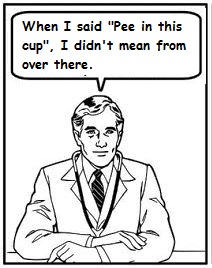
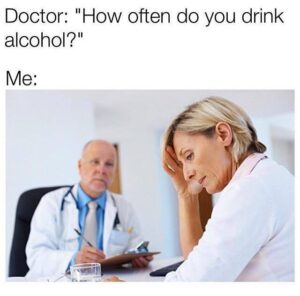
Yup, it’s time for the annual check under the hood, looking at the dipstick and of course all those irritating questions:

Not to mention getting all judgey:

See y’all later, I hope.


Update:  All good, subject to the blood test results.  Alert the media.

Big Fat Hairy Deal

…and I use the word “fat” advisedly.

Eli Lilly and Novo Nordisk officials have agreed to lower the cost of GLP-1 obesity drugs for Medicaid and Medicare recipients and those who pay directly and make treatments more accessible, President Donald Trump announced Thursday.

Medicare will begin to provide coverage for the obesity drugs for some people in mid-2026, which also might cause more private insurers to likewise add coverage for them.

The deal could lower the cost of the drugs to $150 per month for prescriptions that are available in pill form and that contain the lowest doses.

I remain skeptical, and here’s why.

I remember doing the math for Ozempic, and calculated that the cost per month (including the little single-use syringe) was about $5, for the .25ml shot.  What you actually pay is about $150 per month.

As anyone who knows anything about this business knows, the .25ml (the “lowest” as quoted above) barely does anything to you, weight-wise:  that’s the dose which prepares your system to handle the drug’s effects.  The serious weight loss starts with the .5ml double dose — well, it did for me, anyway — and guess what happens to the cost.  It increases exponentially with each increase in dosage.

I’ve had to quit taking Ozempic shots — as of last week, actually, because frankly, for someone trying to live on a fixed income amidst soaring inflation and prices of, well, everything except gasoline (which is still too expensive), I just can’t afford it.  (New Wife, by the way, wants me to continue to take it because she thinks if it keeps me alive, that’s worth it.  I remain unconvinced that it’s a lifesaver.)

My annual physical exam is late next week, and I’ll be discussing the matter with my GP.

Anyway, here’s the thing.  Under Medicare, my BP meds, my gout meds and my statins and others cost me…$11 per month.  Those drugs, I’m pretty sure, are actually saving my life;  the weight-loss stuff?  Who knows.

Maybe I’ll regain all the weight I lost (about 50lbs), or maybe I won’t.  Maybe my diabetes has responded well to the weight loss, or maybe it hasn’t:  the blood tests will tell.  One thing Ozempic did do for me was change the way I thought about food, or at least the quantities I consumed thereof.  I’m not sure that stopping the drug will make that attitude revert to its former self;  I don’t think it will.

We’ll see.  All I know is that as currently priced, the GLP-1 regime of drugs are unaffordable so I’ll just quit taking any of them until the cost comes down to what I can afford.

And if that decision ends my life, I don’t care.  I’m 71 years old, next week, and as anyone who’s reached that Biblical age limit can attest, the prospect of death no longer frightens one as much as it may have done in earlier times — which is what I’m going to tell my doctor next week.

Let’s see what he has to say about it.

In the meantime, though, my reaction to Trump’s much-heralded “price reduction” of this stuff is pretty much encapsulated in the title of this post.

Failed State

Every time I get into any kind of discussion with Brits and Euros (no longer a single entity, of course) about the relative state of our nations, I get hit with the “at least we have free health care”  jibe.

Well, sometimes “free” is better than nothing;  and sometimes, it’s a lot, lot worse:

Our 15 hours of hospital hell after my mother’s stroke. We saw patients urinating in the corridor, nurses being slapped and ambulances queuing for hours… the NHS is truly broken.

I had called my mother for a quick catch-up when it became clear that there was a serious problem.

It was about 10.30am, an average Wednesday two and a bit weeks ago, when my usually sparky, chatty, bright and switched-on mum answered the phone in a way that suggested something was terribly wrong.

With a befuddled voice, she told me she wasn’t feeling well. She was confused and couldn’t work out how to open the back door to let the dog out. ‘I’m supposed to be at work,’ she told me, ‘they keep calling. But I can’t understand how to do anything.’

Because I’m paranoid, and because her mother – my grandmother – had died of one 20 years ago, I immediately suspected she was having a stroke.

I remembered the famous F.A.S.T test to recognise the signs – F for facial drooping, A for arm weakness, S for speech problems, T for time being of the essence if you recognise any of these symptoms.

My mum couldn’t tell me about her face, or her arms, but her speech was confused in a way I hadn’t encountered in all my 45 years on the planet, so I immediately told her to stay where she was while I called 999.

The emergency operator told me the call was marked as high priority and that an ambulance would arrive as a matter of urgency. I would soon discover that my definition of terms such as ‘urgency’ and ‘high priority’ were very different to the definitions used by the NHS in 2025.

Read the whole thing, for the full horror.

So That’s What I’ve Got

This article caught my eye a while back:

Harry Judd’s wife Izzy has claimed that one of their children suffers from what some experts describe as ‘pathological demand avoidance’ – a controversial behaviour pattern said to make even simple requests, such as tidying their room or saying please and thank you, trigger anxiety.

I have no idea who the Judds are — some obscure Brit celebrities, I guess — but reading that sentence would have made my mother go “AHA!”

If “pathological demand avoidance” could also be described as a hostile (and sometimes even violent) attitude towards authority figures, then oh boy:  that would describe me perfectly.  There’s an old English expression that my former housemaster actually used to describe my attitude:  “He’s always kicking against the pricks.”  (Look it up;  it’s quite funny.)

The only thing that sets me aside from the kid above would be the fact that if said authority figure has earned my respect, then the process will sometimes become easier (for them).  The only problem is that my respect is seldom given, to just about anyone and anything.  And by “anything”, I mean conventions, rules, regulations and even — on occasion — laws, if they make no sense.

My attitude is probably the cause of at least a third of the problems I’ve experienced during my lifetime (my love of women is about half, and I couldn’t be bothered trying to think of what constitutes the balance).

Anyway, whenever the occasion presents itself and I stand accused of willful disobedience / outright rebellion,  I can now just trot out the excuse that I’m not a stubborn and disobedient asshole;  I just suffer from this “pathological demand avoidance (PDA)” thing, and claim victim status.

No I won’t.  What a load of old bullshit.

Next thing you’ll be seeing one of those foul Big Pharma TV ads that features — guess what — a pill that promises to alleviate PDA (at $400 per pill, no doubt), as long as you don’t mind the side-effects that include eventual cessation of heart function, a 90% risk of cancer and toenails that grow six inches per hour, in no specific order, and you should talk to your doctor to make sure that Rebyniflorbitylhexacholate (brand name:  Rebate) is right for you.

In case anyone missed it, I am NOT in a good mood today and I’m going to go for my personal cure for the condition:  a couple hours at the range.  Fortunately, the range I call home has few if any range safety nazis, because nothing gets up my nose like some 19-year-old wanker wearing a SIG 320 in a plastic holster telling me about range safety as though my 60-years-plus experience with handling Teh Dangerous Guns doesn’t mean anything.  That doesn’t “trigger” anxiety, but rage.

Bloody hell, I get irritable just thinking about it.

Falling Over

For once, I discovered an interesting article in the ghastly New York Times — motto:  “Other Than That, The Story Was Quite True” — because it has nothing to do with politics, for once:

Public health experts have warned of the perils of falls for older people for decades. In 2023, the most recent year of data from the Centers for Disease Control and Prevention, more than 41,000 Americans over 65 died from falls, an opinion article in JAMA Health Forum pointed out last month.
More startling than that figure, though, was another statistic: Fall-related mortality among older adults has been climbing sharply.

I don’t know quite when I started to lose my balance.  I think it was in my early sixties, when for no reason at all, I would stagger a bit when turning a corner (walking, not driving, of course).  I wouldn’t fall over, but it nevertheless alarmed me.

And when getting dressed, specifically putting on pants or briefs, I suddenly found myself unable to balance on one leg without toppling over;  which means that now I pretty much have to either brace myself against a wall with one hand, or else make sure that if I do fall over, there’s a bed close at hand to catch me.  It’s irritating.

Going down stairs has a similar effect.  Where once I could bound down a staircase with no effort at all, I find myself having to grip the banister like my life depends on it, which it does, now.

Of course, I’m very familiar with the fact that we Olde Pharttes tend to have brittle bones, hence the distressing number of said group suffering things like broken hips, skulls or limbs after toppling over. (see:  novelist Jilly Cooper, dead following fall)

The famous expression “I’ve fallen and I can’t get up!”  is not so funny anymore.

The NYT article suggests this:

The author, Dr. Thomas Farley, an epidemiologist, reported that death rates from fall injuries among Americans over 65 had more than tripled over the past 30 years. Among those over 85, the cohort at highest risk, death rates from falls jumped to 339 per 100,000 in 2023, from 92 per 100,000 in 1990.
The culprit, in his view, is Americans’ reliance on prescription drugs.
“Older adults are heavily medicated, increasingly so, and with drugs that are inappropriate for older people,” Dr. Farley said in an interview. “This didn’t occur in Japan or in Europe.”

Some other guy opines:

The difference, he believes, is Americans’ increasing use of medications — like benzodiazepines, opioids, antidepressants and gabapentin — that act on the central nervous system.
“The drugs that increase falls’ mortality are those that make you drowsy or dizzy,” he said.
Problematic drugs are numerous enough to have acquired an acronym: FRIDs, or “fall risk increasing drugs,” a category that also includes various cardiac medications and early antihistamines like Benadryl.

Which might be plausible, except that in my case it’s not a reason because I don’t take any of the above drugs, or even drugs that are similar.

Of course, we all know that some meds like Benadryl can cause dizziness — FFS, it says so right on the pack — which is why if I do ever take one of those, I take it right before going to bed.

No, I have no idea why I’m suddenly so tottery on my feet, when in the past I always had excellent balance.

It’s also a well-known fact that Olde Pharttes are more likely to experience vertigo when faced with extreme heights or drops.  Just a photo of some idiot hanging from a sheer cliff face by only their fingertips will actually cause my stomach to heave;  I have no idea how I’d feel if facing a sheer drop in person, but I’m perfectly prepared to believe stories about elderly people inexplicably toppling over a cliff as through drawn to it.

I’ve said it before and I repeat it now:  this getting old business is not for the young.