Not Wanting

In a recent poll taken among two thousand Gen Z Brits, the following are ones that these kids refuse to eat, ranking by the negative percentages, so to speak.

Liver (35% refuse to eat)
Blue cheese (32%)
Anchovies (30%)
Black pudding (29%)
Prawns (26%)
Duck (25%)
Tofu (23%)
Mushrooms (23%)
Olives (23%)
Plant-based cheese (21%)

My take, as a Boomer:

Liver — as a rule, I prefer liver in pâté form, but I love me some deep-fried chicken livers, with a passion.
Blue cheese — by itself, a tad strong;  crumbled over a burger:  yummy.
Anchovies — whether on toast or on pizza, I’ll eat them any day of the week
Black pudding — ugh.  The best thing you can say about black (i.e. “blood”) pudding is that it’s tasteless.
Prawns — or as we Murkins call them, shrimp:  love ’em.
Duck — little oily, but tastier than chicken.  (Duck fat, by the way, is the ultimate cooking ingredient.)
Tofu — nope.  Not ever.
Mushrooms — are you kidding me?  I must eat mushrooms of one sort or another at least three times a week.  My favorite:  a substitute for a bun in a hamburger (giant Portobella fried in butter, oh my).
Olives — nope.  Not ever.
Plant-based cheese — LOL, forget that shit.

The Daily Mail  article which fostered this post had the usual scare headline — “These Foods Are Going To Disappear!!!!!”

#

…but I don’t think we need to panic.  If it were only true of olives (never gonna happen), tofu (ugh) and that strange plant cheese (we can but hope, plus all “plant-based” meats), I’m fine with the prognosis.

Lubricant

This is an unusually level-headed look at drinking in moderation, and I for one applaud it.  A sample:

For four years I was teetotal and socializing was always a pain. At parties, small talk was so small, I never felt that anything ever connected, or that there was an actual point to talking. It was so superficial – the weather, my journey, my clothes, the articles I’d just written.

It’s why at a work event not long ago, instead of asking for my usual lemonade, I grabbed a glass of Prosecco from the bar. For a moment I imagined a bolt of lightning would come down from the sky. Was I really going to throw away four years of sobriety? And for what? Because I was… bored?

Well, yes I was. And immediately I felt bonded to this room of relative strangers. Not in a creepy way. Just in a way that made it easier for me to chat to them. It was fun.

And that’s what people miss about the whole booze thing.  Not for nothing is booze called a social lubricant:  it makes people less inhibited, more relaxed, and to be frank, more fun to be with.  But before I go any further, I’m going to make a definitive statement about the above.

The key phrase is:  in moderation.

The problem is that when it comes to booze, most people can’t do moderation — and this is particularly so when it comes to drinking beer in Britishland (an imperial pint is a lot of booze) and drinking short drinks (spirits) in the U.S., where spirits are free-handed out of the bottle by bartenders, making the drinks far too strong.

Unless you’re a fool or addict, the object of drinking booze is not to get pass-out drunk;  it’s to release some of those social inhibitions, to lower the social guards people put up in self defense, and quite frankly, to get a little “buzz” on — because that buzz is really, really pleasurable.

The key, speaking as one who was once a serious boozer and is now a lot less so, is drinking just enough to get that buzz and maintain it.  In my considerable experience, it means that one needs to drink a smaller glass of beer — the much- derided “half-pint” in the U.K. — and to drink it in the same time as one might take to drink a full pint, i.e. more slowly.  For spirits, it means not accepting the overly-generous pour of the bartender, but watering the drink down with a mixer or water.  (If I order a spirit like a G&T at a bar in the U.S., I order the gin straight, and request a three-quarter-filled glass of tonic plus ice on the side — i.e. in a different glass — and pour half the gin into the tonic to treat that as my drink.  Then when that is finished, I order another glass of tonic, and pour the remainder of the gin into that — two drinks for the price of one, and as the evening goes on, I will end up drinking half of what a regular person would.)

And before I hear people saying that the drink tastes “weak” or “watery”, let me say that this is precisely the point.

Let’s be honest, for once.  Most booze tastes like shit.  Remember that time long ago when, after watching your dad or whoever drink beer with all the pleasure in the world, having your first beer and discovering what it actually tasted like?  Horrible, wasn’t it?

Of course, the more you drink, the more the taste of booze is acquired;  and as one gets older, one’s palate becomes more sophisticated, which is why we no longer eat canned Vienna sausages, “blue-box” mac ‘n cheese and drink sugary Kool-Aid.  (And if you still enjoy that stuff, I don’t want to hear about it.)

I love booze.  I love the taste of it, I love the way it makes me feel and I love the way it makes other people feel (if they’re drinking like I’m drinking);  but I’m also extremely wary of the perils of over-indulgence — the consequence of a.) becoming an adult and b.) becoming, like the author of the above piece, less able to deal with the hangovers that follow said over-indulgence.

As I’ve said many times before, I can’t drink by myself and never have been able to.  Booze is a social lubricant, and if you need a social lubricant when you’re on your own, you’re in trouble.  And as Anniki Somerville ends her article:

At one party I sit next to a friend and she whispers to me: ‘You’ve changed. I feel like you’re more on my level again.’ And that is what having a couple of drinks can do. Get everyone on the same level so they can connect.

That’s what my four years of sobriety taught me: so long as you’re keeping to guidelines, a glass of wine can be part of the solution to life’s stresses, not the cause of them.

Precisely.

Nice Try, Nerds

Another breathless warning from some joyless dorks:

Whether it’s a mature cheddar or a crumbly feta, cheese is one of the most beloved foods around the world.  But in news that will concern fans of the moreish treat, scientists have issued an urgent warning about eating cheese. 

For the first time, a groundbreaking study has revealed that these dairy products are ‘ripe in microplastics’.  Scientists believe the tiny plastic particles, measuring 5mm or smaller, could be entering cheese at various stages of production.  Their analysis revealed that the most contaminated products were ripened cheeses – those aged for more than four months – with a staggering 1,857 plastic particles per kilogram.

For comparison, that means a ripened cheese contains around 45 times more microplastics than bottled water.

Yeah, and 45 times “pretty much zip” is still close to nothing.

Since plastics contain chemicals known to be toxic or carcinogenic, scientists are concerned that a buildup of microplastics could damage tissues in our bodies.

“Could”.  Yeah, well at my age I pretty much don’t care, because at some point something’s going to kill me off anyway.  And seeing that these microplastic thingies are pretty much ubiquitous in all food types, I’ll just carry on eating this, my favorite kind of food.

Your opinion may vary, and I don’t care.

An Excellent Idea

A long time ago, I was in Brussels on business.  It was to be my first time there, so as always I did a bunch of research on the place:  things to see, places to visit and (of course) places to dine (yes, that’s a major part of my love of travel).

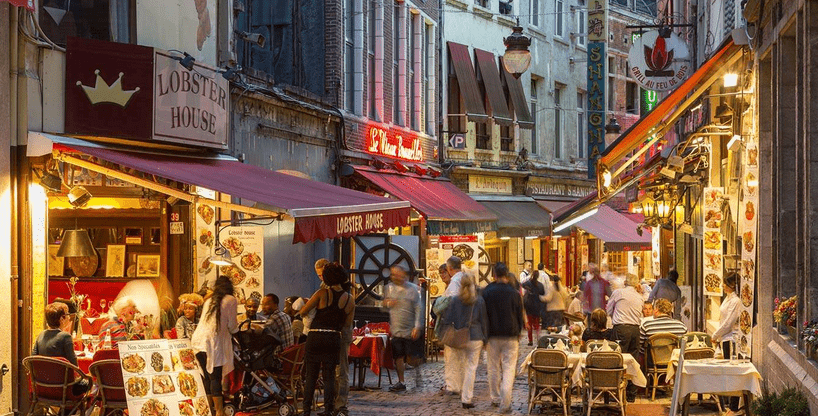
Just off the Grand Place is a street (Rue des Bouchers) lined with restaurants standing cheek-by-jowl together;  so what better way, thought I, to compare the various menus before making a decision to dine?

Bloody hell.

What the oh-so-helpful guide did not tell me was that outside every restaurant stood an extremely aggressive “tout”, who implored, begged and almost kidnapped the unwary diner into the establishment they represented.  Seriously:  one guy actually grabbed my arm and tried to drag me inside, releasing me only when I bunched a fist and threatened to clock him, hard.

The upshot was that none of the restaurants along Restaurant Row got my business that night.  Instead, I found a very nice little pub just off the Grand Place and proceeded to eat (lots) drink (even more) and make merry (to the max), as was my custom in those heady times.

After the experience in that Restaurant Row, therefore, I was overjoyed to read about this action, in Lucca, Italy:

The walled city has experienced a significant increase in visitors this year, particularly after emerging as a ‘timeless gem’ on social media. 

Last year, Lucca reported a record number of one million hotel bookings, and in the first four months of 2024, saw notable rise in visitor numbers.

The city’s leaders have grown increasingly concerned that the influx of tourists and the associated activities are negatively impacting its unique character – now, they’re declaring war on ‘worrying’ restaurant tactics such as touting. 

Touts – known locally as ‘buttadentro’ – are often employed to stand outside restaurants to try to entice passersby to dine there. 

Though they are responsible for attracting customers, some are reported to use persuasive or even aggressive tactics. 

On 10 July, the municipality adopted an ordinance prohibiting the promotion of restaurant businesses in public areas and on public land outside restaurants, bars, pizzerias, and similar establishments.

Mayor Mario Pardini and Councilor for Commerce and Urban Decor, Paola Granucci, said in a joint statement: ‘Lucca is a city with a strong historical, artistic, and touristic identity, and must be experienced with respect and style. Our ordinance does not restrict commercial activity, but protects the urban beauty and safeguards the authentic experience of residents and visitors. We reiterate that promoting one’s services is legitimate, but doing so in an invasive, insistent, or unfair manner is incompatible with the image we wish to preserve for our city.’

Ben fatto, Signori!  Now please get those assholes in Brussels to do the same — you know, in the time-honored EU fashion of sharing laws and regulations across national borders.

And while we’re there:  this?

Rue des Bouchers in Brussels is a lovely narrow street that is lined with restaurants. On display lie mussels, lobsters and oysters, all nicely decorated, awaiting hungry tourists.

It’s a big fat fucking lie.  The only hungry people there are the touts — money-hungry, that is.

Caveat cenator.

Forgetting The Basics

Many years ago, I had subscriptions to the UK’s Country Life and Country Squire  magazines, which, as their names suggest, are dedicated to that country’s rich rural heritage.  Yes, I know the mags’ main emphasis was (and still is) dedicated to the landed gentry, but the mags also contain gems, like this one from Country Squire :

We walk on concrete, but we live on bread. The modern world hums with the illusion of self-sufficiency – our smartphones deliver groceries with a tap, restaurants materialize meals on demand, and supermarkets present endless abundance as if by nature’s own hand. Yet this is a collective delusion.

The truth is simpler, starker: every society rests upon the bowed backs of farmers. They are the uncelebrated linchpin holding civilization together, performing work so fundamental we’ve forgotten to see it.

Their labor defies romanticism. Farming is not some bucolic idyll; it is mathematics written in mud and sweat. A farmer must be gambler and scientist, prophet and laborer – calculating risks against fickle weather, coaxing growth from stubborn soil, fighting entropy itself just to keep the fields productive. One missed frost, one unseen blight, and a year’s work vanishes. Meanwhile, they’re patronized by 5-days-a-week urbanites who’ve never dug a ditch, who speak of ‘sustainability’ between takeaway lattes, who’d starve in a week if the lorries stopped running.

And for what?

To watch agribusiness conglomerates and supermarket oligarchs siphon away the profits? To hear deadbeat politicians lecture them about ‘efficiency’ while folding to trade deals that undercut their livelihoods? To be treated as quaint relics in a world that venerates guff videos on TikTok?

There’s more, much more in the piece, and I urge you all to read it.


There’s unexpected humor, too.  This from Country Life:

And of course, there’s property:

…a snip, at only $120,000 a year rental.

Hot Stuff

No, not some totty flashing her whatsits. Apparently, Dave’s has come to London:

Famously, Dave’s offers a notoriously spicy ‘Reaper’ burger, covered in red-hot batter, said to reduce even the most hardened of chilli lovers to tears.  Although the batter recipe is a closely-guarded secret, the key ingredient is powdered Carolina Reaper, the second-hottest chilli pepper in the world. Carolina Reaper registers a whopping 1.6 million on the Scoville scale, the internationally-accepted system used to measure the heat of chillis. 

So it’s little surprise that customers can only order the Reaper if they are 18 or over and sign a legal waiver. According to the waiver, Reaper can cause ‘sweating, indigestion, shortness of breath, allergic reactions, vomiting and diarrhoea’, but in extreme cases, it can even lead to ‘chest pain, heart palpitations, heart attack and stroke’.

…with dolorous outcomes, because that’s what intrepid reporters do — stupid stuff:

For the first seven seconds after taking a big bite, it feels like the hype around the Reaper has been exaggerated – but the intense burn suddenly takes off like a bullet.  As Johnny Cash’s ‘Ring of Fire’ starts playing on the loudspeakers, the heat-sensitive pain receptors in my mouth are triggered – and I soon turn into a total, sticky mess. Sweat flows from every pore of my face and snot dribbles from my nose, and I can’t wipe the tears from my eyes because I don’t want to touch them with my messy gloved hands.  Struggling somewhat with my coordination, I slosh milkshake over my trousers and the floor. Reaper is ludicrously, idiotically hot.

The only idiot is you, dummy.

Let it be known that I’m not afraid of stuff like Madras curry, for example.  I remember going to a restaurant in Bangalore, and ordering a Madras chicken dish.

The waiter looked at me a little dubiously.  “You know the Madras is very spicy”, he murmured to me.  (“Spicy” being how Indians describe something that’s going to set fire to your mouth.)

“Nah, I’m from South Africa,” I said to him.  “I grew up eating hot curry ” (Which is true.)

And yes it was quite hot, but also very savory.  I could have eaten two dishes of it.  (Madras is actually classed as a “medium” hot curry.)  I have no problem with Vindaloo — the next level up, and you have to hold me back when it comes to Lamb Vindaloo — but I draw the line very firmly at that point, because after Vindaloo, bad things start happening to you.

And for the record:  Vindaloo curry measures about 15,000 to 20,000 Scoville units.

So 1.6 million Scovilles?  You must be kidding.

And I’m calling bullshit on this whole “hot pepper” nonsense.  It’s not manly or macho or any of that crap when it comes to handling peppery heat.  25,000 Scovilles is like rubbing Deep Heating cream on your skin;  1.6 million is pouring gasoline on yourself and setting it on fire.  And I’m not really exaggerating, either.

Guys who brag about how much heat they can handle are vainglorious idiots, and quite frankly, they deserve every perforation they get in their stomachs or intestines.

As our  flipping idiot  brave reporter Jonathan Chadwick describes it:

Reaper is a 24-hour experiment on your body. As it travels, it inflicts different types of pain – burning numbness in the mouth, aching stomach, and, perhaps worst of all, the morning-after sensation of a red hot poker in the worst place imaginable.

A doctor buddy of mine back in Johannesburg told me once of a patient who actually had small lesions and blisters on their anus following a drunken night out feasting on super-hot food.  The patient was female.

But hey:  be my guest, but please don’t come to me for help because I’m just going to laugh at you.