Electric U-Turn

Someone else sees the light:

Audi has become the latest auto manufacturer to perform a dramatic U-turn on its electric vehicle commitments, writing off its promised to stop developing internal combustion engines (ICE) in 2033.

Instead, the Bavarian-based marque will continue to make both ICE cars and plug-in hybrids into the next decade, as part of a ‘completely new’ fuel-powered line-up.

CEO Gernot Döllner confirmed the brand’s revised plans, explaining that ‘flexibility’ is the new direction Audi will take so it can see how ‘markets develop’.

The German car giant had originally planned to build its last ICE-only car next year with the new-generation Q7. However, it suggested earlier this year that petrol and diesel models could run for longer.

Stupid assholes thought they could buy credibility with the wokerati Greens by putting a deadline on the eeeevil fuel-powered engines, despite all the writing on the wall indicating that EVs are not popular in the mass market, that there are serious concerns about the “green-ness” of the EV when the total energy cost of their manufacture is taken into account and not just their eco-friendliness on the road.

And speaking of “on the road”, there’s always this little EV problem:


…and the fact that the EV fires are almost inextinguishable (and can re-ignite even after they are extinguished), and give off toxic smoke.

Yeah… I can’t imagine why a company might want to rethink their position, either.

The fact of the matter is that the auto companies should never have drawn that line in the sand in the first place.

In the meantime, here are a few pics to make us all feel better about this.

There;  I told you it would make you feel better.

Making Life Easier

I really like a couple of the new business-friendly laws signed by TexGov Abbott this week, particularly this one:

Abbott also signed into law HB 2464, which prevents local municipalities from imposing regulations on certain home-based businesses.

I was stung by this one myself several years ago.  Even though Plano is a very business-friendly town (hence all the corporations headquartered there), there were a couple of regs which made it difficult for a home-based business to operate — especially when related to late-night deliveries (“noise abatement”) and so on.  (We frequently used FedEx’s 3am pickup service, for instance, because of deadline issues.)

And frankly, anything which makes it easier and less costly for businesses to open and set up operations is A Good Thing because #Capitalism.

Ignoring Technology

Sometimes I am left astonished at the stupidity of people:

Families are fighting back against a proposed incinerator they fear will harm schoolchildren, vulnerable people and wildlife with chemicals it produces.

Just over a year after a landfill site left Newton Aycliffe, County Durham smelling like rotten eggs, residents say they face another threat to their picturesque village.

Plans submitted by Fornax Environmental Solutions were approved in 2021 but swiftly thrown out by the council which was concerned about the incinerator’s impact on air quality.

There were also fears about burning up to 9,800 tonnes of clinical and hazardous waste a year at a business park long dedicated to attracting companies offering high-paid jobs, including Hitachi and Fujitsu. 

Now, months later, the project is back on track after a planning inspector approved the firm’s appeal.

A 10,000-tonne incinerator, which lies within a mile of a nursery, a primary school and a sixth form college, is being built and will be up and running next year.

But locals are making a last ditch attempt to stop plans, with a social media campaign gathering pace ahead of a consultation with the Environment Agency.

I was going to say “as any fule kno”, but clearly not any fule does:  landfills give off methane (that “rotten egg” smell).  Over Here in Stupid America (as Britishlanders are so fond of calling us), we’ve not only known about this forever but we also harness that effect to good use.

I can’t remember where exactly, but I recall that at one such huge landfill in California, methane emissions are captured and burned, said burning used as fuel to power giant generators which then supply electricity to not one but two fair-sized nearby towns.  I remember seeing a similar operation at a landfill outside Chicago, where a tiny flame burned at a chimney, the sole consequence of generating electricity from that source.  (That landfill, by the way, had been constructed so efficiently that not only were there no seagulls flying around — an infallible sign of a trash dump — but there was a very nice 18-hole golf course situated atop it.)

Had the local government of Newton Ayrcliff just installed a similar operation after opening the old landfill, they could have supplied electricity to the village at a massively-reduced cost to the homeowners — as is the case in California.  Then none of the resultant fuss would have ensued.

I wonder if the village’s new incinerator will incorporate such a feature, but I doubt it.

But that’s not the point of this post.  This is.

In the midst of all the apprehension of the locals about this new incinerator, the attitude of the operators thereof doesn’t seem to inspire much confidence:

‘We do not believe it is appropriate to comment on the environmental permit application at this time other than to say that we have provided all the required documentation to the regulator in advance of their detailed technical review. 

Public and environmental safety is our number one priority and the new facility in Newton Aycliffe has already undergone extensive scrutiny and was approved by the planning Inspector following an enquiry in 2022. 

‘During this process residents concerns were carefully considered and addressed by the governments planning inspector. The facility has been designed and built to meet and indeed exceed all UK and EU strict rules on air emissions, odour control, and habitat protection. 

‘The fears concerning the impact that this facility will have on air quality and future employment uses are unfounded as clearly stated in the planning inspectors report.’

When a statement contains an obvious lie — “Public and environmental safety is our number one priority” my aching ass;  your number one priority is to burn waste material — my nose starts to twitch.

So they’ve provided sufficient “proof” to a bunch of bureaucrats who may or may not be sufficiently qualified to assess risk in matters of this nature — my guess is that they aren’t — and therefore the thing will go ahead as planned.

What strikes me in all of this is that the people complaining about the new incinerator haven’t a clue about the facts of the matter — their opposition is driven by the history of the old dump, so they may be making a fuss about nothing.  The owners of the incinerator have obviously made no attempt to educate them on the facts, hence the public apprehension.

Knowing the nature of companies like this (and forgive me for being cynical), it wouldn’t surprise me at all that Fornax has deliberately worked in secret so that the facts can’t be revealed until the incinerator is up and running and the whole business is a fait accompli.

You see, I don’t know the facts either;  all I have is an abiding suspicion of corporate bastardy, which arises whenever a company operates in secrecy.  Like these guys are doing.

All they had to do, prior to any action, was to blanket the communities with information about their plans so that any reservations could be met with refutation and negotiation.  That they didn’t do this makes my nose twitch even more.

Please forgive my suspicion and cynicism.

Caveat

Here’s a little nugget from the Trump Tariff Front:

General Motors (GM) announced plans to invest $4 billion in three new U.S. assembly plants, including the production lines for the Chevrolet Blazer and Chevrolet Equinox, which the company currently builds in Mexico.

Yay and all that.  Another reaction:

The United Auto Workers (UAW) praised GM’s decision, calling it a validation of the effectiveness of global auto tariffs.

Yeah, fine, whatever.  Let’s just hope that you union assholes don’t jump on this opportunity to make unreasonable wage demands, which is what drove GM to move the plants to Mexico in the first place.

I’m not at all confident that this won’t happen, but as I am not and never will be a target customer of General Motors*, I personally will not be affected, especially as the newly-replanted assembly plants will be building Chevrolet Equinox, Chevrolet Bolt EV, Chevrolet Blazer, Cadillac Lyriq and Vistiq EVs and the Cadillac XT5.  (Lyriq? Vistiq?  WTF kind of names are those?)

I see that GM, with its customary foresight, has slated its EV models for some of the new plants, despite customer demand for said excrescences falling through the floor.

Pathetic.


The only GM car I’d ever consider buying is the Caddy CT4 Blackwing, except that while its engine is admittedly excellent, the CT4 looks like a primitive 1978-era CAD drawing:

In earlier times, we would have described that thing as “uglier than a bucketful of burst assholes”.

As for all GM’s other models:  pass, with extreme prejudice.

Private & Personal

I’ve never been that interested in my origins to have done the 23andMe thing, so I’m personally not affected by this activity.  Nevertheless:

Twenty-seven states and the District of Columbia have sued the genetic-testing company 23andMe to oppose the sale of DNA data from its customers without their direct consent.

The suit, filed on Monday in U.S. Bankruptcy Court in the Eastern District of Missouri, argues that 23andMe needs to have permission from each and every customer before their data is potentially sold. The company had entered an agreement to sell itself and its assets in bankruptcy court.

The information for sale “comprises an unprecedented compilation of highly sensitive and immutable personal data of consumers,” according to the lawsuit.

The genetic data at stake is especially sensitive and should be protected, because if it is stolen or compromised, it cannot be replaced. The data can be used to track not only the individuals who sent the kits, but also people related to customers, including yet unborn generations.

Why, and who is the prospective purchaser of all this “highly sensitive and immutable personal data”, you ask?

[23andMe] is poised to be acquired by Regeneron Pharmaceuticals for $256 million, according to the lawsuit.  Regeneron is a biotechnology company that uses genetic data to develop new drugs.

So there’s no chance that the data will be abused in any way, then. [eyecross]

I think that my position on this kind of thing should be fairly obvious by now.

Your personal data — all of it — belongs to you, and to nobody else.  Only you can authorize its use or dissemination, for whatever reason.

So if some asshole organization — let’s just call them Regeneron, for brevity’s sake — wants to use personal (i.e. unaggregated) data, they should have to ask you personally for your permission, each and every time.  (Once data is aggregated, of course, your anonymity is no longer an issue.)


By the way, the same should apply to US Census data, but that particular bullet has gone through the church countless times already, and it’s a terrible precedent.  (Which is why I always urge people not to fill out the “long form” census questionnaire every time this bit of government snoopery comes around.)

Proper Fake

Last week I slammed the idiots who are seduced by marketing into paying exorbitant sums of money for ordinary products like vodka (Grey Goose) and guns (Heckler Und Koch).

Then yesterday I bitched about modern cars and their electronic gizmos that cost too much (in every sense of the word) and which at some point are going to be taken away from you;  and added that I’d really prefer to drive an older car without all that nonsense.

I thought that it might be kinda fun to combine those two concepts into a single buying experience.  Here’s how I figured it out.

First, we have a car company whose products command premium prices (i.e. you pay through the nose) for their old cars, but whose cars of that era were frankly just not very good, performance-wise.

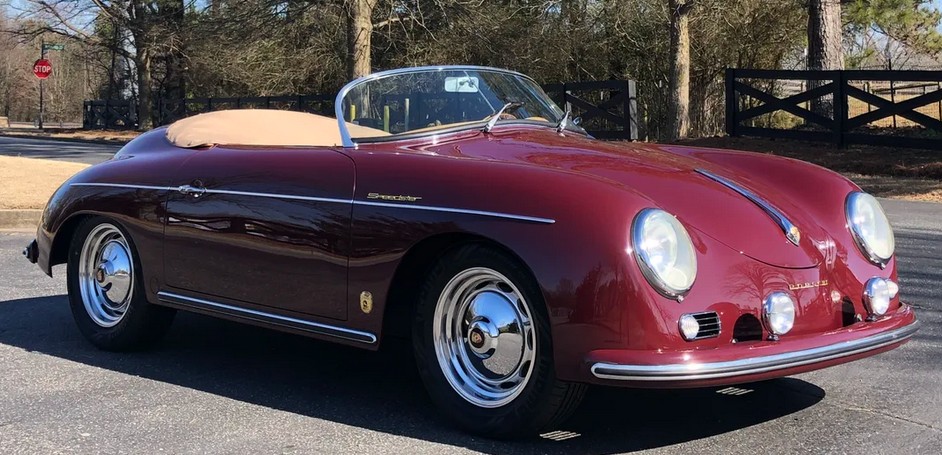
Step forward the 1950s-era Porsche 356, and here’s a good example thereof:

Now let’s be honest, here.  The old 356 may have been very reliable (compared to its competitors) for that time, but if you’ve ever driven an original, you would have been horribly disappointed (as I most certainly was).  The engine is seriously underpowered, it doesn’t handle or brake that well on those skinny tires and drum brakes, although it does give tremendous driving fun because you always feel connected to the road.  But it’s the engine sound which really disappoints.  It sounds pretty much like a VW Beetle engine of the same vintage:  a kind of whiny clatter.  My take:  the original 356 isn’t worth as much as they’re being charged for.  Frankly, the premium prices are a function of restoration “to original” state.  Once you get past the Concours Set, the prices become more “reasonable” because restorers install modern switchgear, better wiring materials and nicer exhaust systems, for instance:

My thing about the 356 is that I just like its looks.  It’s quirky, a little ugly (“a lot ugly” — New Wife) but above all it has character.  Nothing else is quite like it.

But if you strip away all the Porsche stuff and just go with what it looks like, you get one of these:

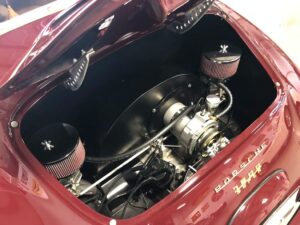
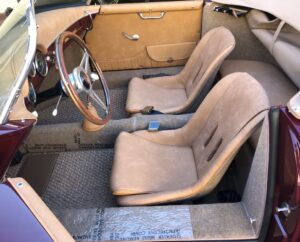
Looks like a 356 museum, dunnit?  But all those 356s are replicas (gasp!):  fiberglass bodies attached to a shortened ’71 VW Beetle chassis, powered by a 2.3-liter VW engine, which pushes out 125 hp (compared to the original 356’s 90-odd hp).  Plenty power for that little body, and they come with a proper exhaust system which makes them sound more modern Porsche than old Beetle.  Modern tires, too.

Price?  Between $60,000 and $72,000.

Still too much?  I don’t think so, because this isn’t one of those DIY garage fiberglass kit cars.  If you order one from this particular manufacturer, you could wait up to two years for your order to get fulfilled.  Me, I’d just get one of the existing stock ones, as in the pic.

But hey, not everyone likes the 356.  However, everybody loves the Ferrari 250 Spyder, right?

Whoa.

Trouble is that these puppies sell for well over a million — or more — and now you’re in a lot more silliness than a $30 bottle of vodka.

Except that the model above sells for $105,000.  How so?  Well, it’s not a “pure Ferrari”.  Like the Vintage Motors replica of the Porsche 356 above, this is a fiberglass bodied Ferrari lookalike with a… 6.9-liter Ford V8 under the hood.  (Take that, Ferrari!)

Okay:  is this going to handle anything like a Ferrari (any Ferrari)?  Most definitely not.  Does it matter?  No.

Because you’re not going to track this car (unless you’re an idiot), you’re going to drive around in a little beauty, at 10% of the cost of the original, with an AC Cobra-like thunder coming out of the exhaust.

It’s all very well being a badge “purist”.  The problem is that the owners of the badges have made their products so expensive that the cars are all being bought by essentially the same 100 people, leaving the rest of us plebs out of the picture.

The thing is that to those 100 guys, the “proper” badges are either purchased for bragging rights (i.e. dick comps) or as investments, no different from a condo in Monaco or a 25-carat diamond (don’t get me started on De Beers or we’ll be here all day).

Just in passing, I wonder how many miles Bill Gates has put on his Porsche 959?  (And if that story doesn’t make you grit your teeth in frustrated fury — for so many reasons — we can’t be friends.)

But there are guys who love the cars not for their “collector value” or any of that bollocks, but for their exquisite beauty and perhaps to a lesser degree, for their performance.  Guys like me.

And I have to tell you that if I won the lottery and some guy had put together a proper fiberglass Dino 246 shell on, say, a Porsche Boxster-type frame and engine…


…hold me back.

So I guess my question for y’all would be:  what quality (but inexpensive) replica would float your boat if you saw one?