Sent to me by former Drummer Knob, from Monaco:

I believe the spaces are in his building… “his” in the sense that he owns the place.

Sent to me by former Drummer Knob, from Monaco:
I believe the spaces are in his building… “his” in the sense that he owns the place.
When I first referred to Jeremy Clarkson as “The Greatest Living Englishman”, it started off as a nod to his unflinching honesty when it came to everything he looked at, such as his (non-)review of some Vauxhall car model back in the 1990s: “If they’re not going to bother to make an interesting car, I’m not going to bother to review it.”
That caused Big Business (in this case, Vauxhall’s then-parent company General Motors) to go apeshit, because that’s not the way car reviewers are supposed to behave.
It’s that same unflinching honesty that he displayed in his first bumbling efforts at farming which turned his Clarkson’s Farm TV show into a runaway smash hit, and along the way almost single-handedly changed the way the British regard both food and the farmers who produce it.
So when he turned that same agricultural ignorance towards brewing beer — simply because he had a barn full of unsold barley which he needed to sell — one might think that it was just another celebrity using their name to sell a product.
In this case, one would be not only wrong, but spectacularly wrong. And if you want to see a case study in marketing that, in hindsight, never had a chance of failing, then I implore you to watch this video.
Time and time again, “the experts” believed that Clarkson was making a mistake, and every single time he proved them not only wrong, but spectacularly wrong.
He turned a few thousand pounds’ worth of unsold barley into a £75 million company, and in the process, changed the way British people think about farming, about beer and about the people who farm and the people who brew beer.
And he did it all with his usual unflinching honesty and openness, which gave the lie to the usual corporate veneer of respectability and care for both their employees and their customers.
Which is why he truly is the Greatest Living Englishman.

I can’t wait to try it the next time I go over to Britishland.
Via Insty (again), I see that Overfinch has crafted a line of bespoke Range Rovers in Holland & Holland livery:
The 2025 Range Rover Holland & Holland Overfinch’s interior is much more overtly extravagant, though Range Rover’s minimalist form language still dominates. Most surfaces are wrapped in Bridge of Weir leather, and those that are not are instead covered with open-pore French walnut veneer or real metal. The stainless-steel inserts in the doors feature the same engraved scroll work as on the “Royal” shotguns, the engraved diamonds embedded in the veneers in the doors echo those on the guns’ stocks, and the Holland & Holland crest is inlaid on the front and rear center consoles, the latter housing a Champagne cooler and a pair of Champagne flutes.
The leather seats feature a unique quilting pattern that also echoes the Holland & Holland diamond motif and features illustrations of game birds stitched into the backrests. In the duo-tone colorway the front seats are trimmed mainly in Harris Green and the rears mainly in London Tan.
Sounds like something an Arab oil sheikh would want to putter around his Scottish estate in, playing a Laird. Still, I like that interior.
Of course, from the outside the thing is 2025 Rolls-Royce-level Fugly:

…but not as ugly as its price of $650,000.
To put it into perspective, that’s just over the price of three new H&H Royal and a couple-three of their secondhand Royal shotguns.
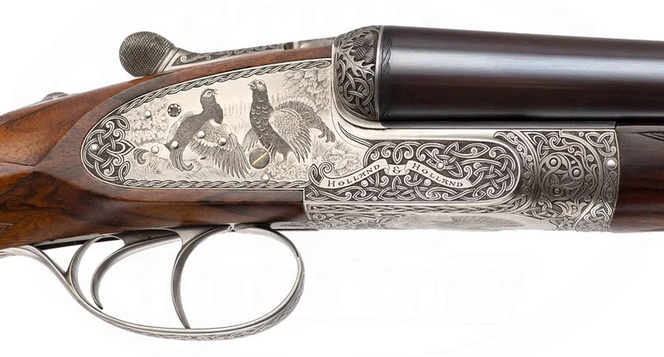

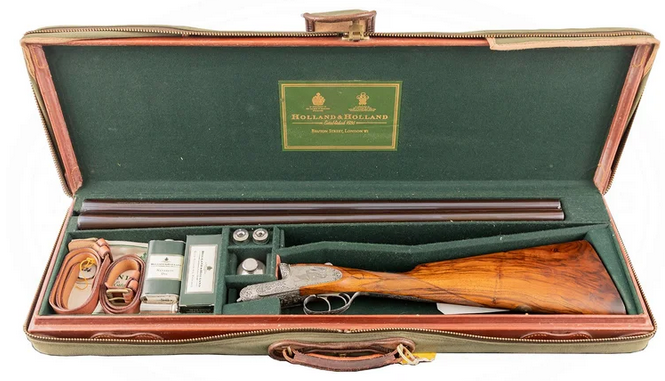
Lovely as all get-out, but not even with a lottery winning would I be tempted. And that’s by any of them: the H&H Range Rover or the H&H shotguns, which taken as the package above would set you back about a million bucks.
Maybe the parvenu status-seekers of today’s ultra-wealthy set would be tempted by such blatant brand-harvesting… hence the title of this post.
As for myself (given a lottery winning as above), my choices are below the fold. Read more
Some Black Friday silliness from PSA:

As I pointed out to Mr. Free Market, that’s $350 for a rifle and cartridge I’d take out into the bush with confidence, any day of the week.
Despite that ugly-ass plastic stock.
This, I think, is Good News:
Long-defunct airline Pan Am is inching towards revival more than three decades after going out of business.
AVi8 Air Capital and Pan American Global Holdings, which owns the intellectual property rights to the Pan Am brand, have begun the certification process with the FAA. AVi8 announced they have completed a business plan for the brand’s revival efforts.
“Avi8 has assembled a world-class team to lead the certification effort and has received strong initial support from aircraft lessors and key vendors,” the company said on Thursday.
If all goes to plan, the company will be based out of Miami with a fleet of Airbus aircrafts*.
Right off the bat, let me say that I loved Pan Am, both the airline and its philosophy — well, before Juan Trippe chased after the lower-income market and cocked up the brand (as documented here).
I just hope that the New Pan Am doesn’t try to be another Spirit or JetBlue (joint motto: We invented cheap ‘n nasty travel, and we never fail to rub your noses in that ), because that way lies utter, abject failure.
As I said earlier, Pan Am’s road to aviation success and profitability is not through the mass market, but by catering to the affluent traveler, with peerless customer service and spotless aircraft. Like they used to.
Despite Pan Am’s earlier demise, their brand might still have some cachet left over, even now. And if they relaunch and re-brand the airline back to its heritage and strengths (including — gasp! comely flight attendants and not grab-a-granny / tattooed slatterns, some overlap), I can almost guarantee they’ll do well.
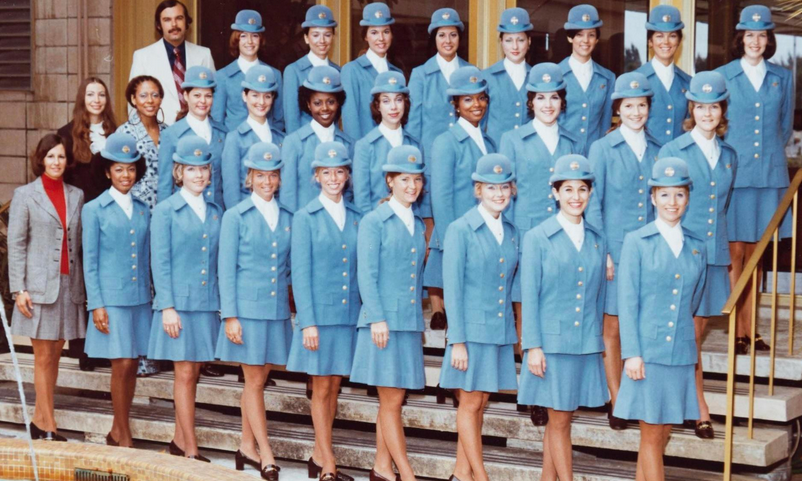
Go for it, guys. I for one look forward to your trip [sic] with great anticipation, and I hope that future passengers won’t be able to beat the experience…
And by the way: resist the impulse to change your old logo. It was wonderful then, and will serve you well now.

*Ummm… it’s aircraft not aircrafts — “aircraft” is both singular and plural, like “sheep” or “deer”, but let’s not have that interfere with the good news.

Well, it finally happened. After just under six decades of faithful service, I finally used the very last one of these:
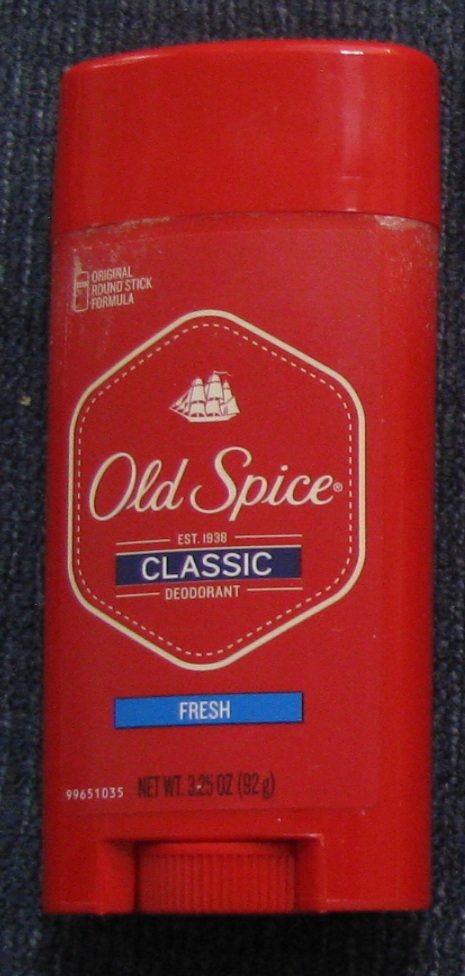
Now, for New or else Forgetful Readers [Alzheimer’s joke deleted], I discussed this problem in some, possibly lamentable detail back here, so I’m not going to rehash the whole sorry tale of Procter & Gamble’s corporate fuckwittery all over again.
Nope. I have swallowed all that rage, and decided to Move On.
So I tried this variant of NEW Old Spice, because at first sniff, it actually wasn’t that bad — almost (but not quite) as good as the original:
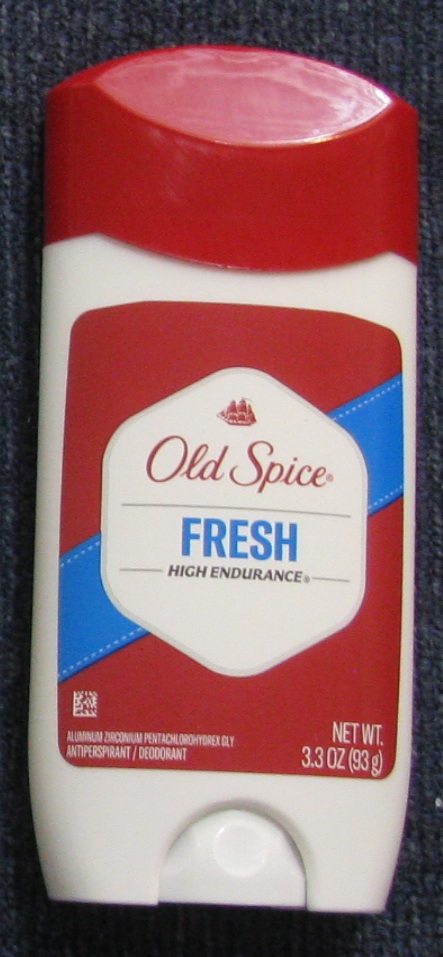
I used it for a few days, but then discovered that while its fragrance isn’t bad, the texture of the deodorant — a sort of stiff paste — is awful. In fact, after a day of wearing the stuff, the next morning’s shower just about requires the use of a Brillo pad to remove the stuff from the old pits, in that it hardens like some kind of ghastly semi-concrete. It’s not a chemical anti-perspirant (which I never use), but I have to feel that the sticky residue performs exactly the same function, simply by clogging up your pores. Sorry, but that just can’t be healthy.
So into the trash it went, leaving me with the same task of finding a decent replacement for my Old Spice Classic Fresh. (Did I mention already how long I’ve been using said deodorant? I did? Yeah, sixty-odd years, without a break, just in case you missed it.)
It seems that most modern deodorants are aimed at girlymen or the LGBTOSTFU Set [some overlap], both in terms of their marketing and their perfume. Needless to say, I am not one of these people.
Thus it was that in my hour of desperation, I happened upon an oldie:

Good grief: do they even still make this stuff? I remember my Dad using the aftershave lotion manifestation, and I was astonished to find the brand was still around. And it doesn’t smell bad, either. When polled, New Wife found it not objectionable, which is factor #2 in its acceptance. Finally, it’s of the same consistency as the traditional roll-on (like Classic Fresh) and doesn’t require a Dremel tool for its removal in the shower.
Clearly, someone at whoever makes English Leather has not made the P&G mistake, and realized that brand loyalty — long-term brand loyalty — should not just be summarily discarded in favor of some New Thing, and kept it going. I hope.
Of course when it comes to business like this, there’s always going to be a fly in the ointment, and therefore it should come as no surprise that the English Leather roll-on deodorant costs nearly three times as much as my Old Faithful. Which I’m just going to have to endure, maybe at the expense of cutting out one range trip a month so as to afford the damn stuff. (I should at this point acknowledge that had the price of Classic Fresh gone up by a similar amount, I would probably have paid the premium — grudgingly, but nevertheless — and continued to use it. So suck on that factoid, you P&G shitforbrains.)
All these ripples came about because some cocksucker [sic] in Marketing / Accounting / Advertising at Procter & Gamble made a decision to end a product that has had a loyal following for many decades, no doubt simply so they can free up the production line for the latest in gayboy scents which will in all likelihood have few long-term customers because that type always goes after the New Thing, and stupid companies like Procter & Fucking Gamble are doomed to follow these tits around in the vain hope that one day these new customers might actually stick with one product variant — kind of like the customers for the Classic Fresh used to do for decades at a time.
I hope that the Old Spice division at P&G goes out of business soon. That, or whoever signed off on the discontinuation of Classic Fresh dies of an unspeakably painful disease, along with his/her entire family.