
I’ve asked this kind of question several times before on this here back porch of mine, but consider the following offers from our good friends at Palmetto State Armory:
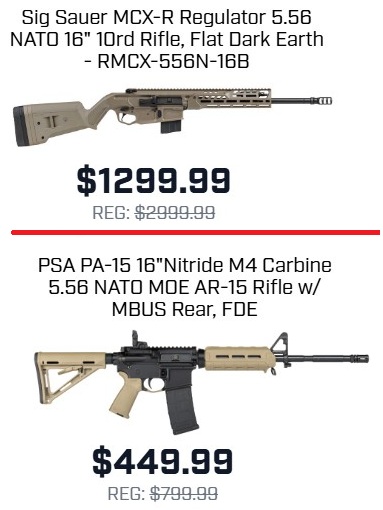
Now I will be the first to admit that I am a woeful ignoramus on the niceties of poodleshooter mechanics, quality of build, materials quality and so on.
But I have to say that I just cannot see that the above-mentioned characteristics are of such moment that the SIG is three times more valuable than the PSA built-from-parts version of what seems essentially the same delivery platform.
Is it all SIG marketing, or am I missing something here?
Informed comparison is required in Comments, in other words, because you won’t get it from me.
There are those who are simply easy marks for the marketing folks, you know that better than anyone here, due to professional experience. The SIG makes cool stuff for the Operators™ and so the Operator Wannabee has to have it. Is it going to go bang any better? Probably not.
For someone like yourself who doesn’t particularly like the weapon in the first place and has it (presumably) on the recommendation from your friends that you have something for civil defense with “standard issue” ammo, meaning that and a 9mm, so you can be supplied or resupply others in an insurrection defense, I’d be fine recommending the PSA. They have a decent reputation from everyone but the Wannabees, who bad mouth it because they have to justify their expensive toys.
Unlike you, I am knowledgeable about these guns, and the ballistics thereof, having built about 8 of them, I would take a middle road, with BCM basics and Mr. Potato Head parts to my liking, but I’m an aficionado. I would have no problem recommending the cheaper gun to someone with similar needs, wants, and preferences as you. It’s likely to serve intended purpose just as well as the other gun.
I can’t speak to the specific choices involved, but as any engineer will tell you, The answer is always “It depends”.
I generally prefer a product engineered and built as a single complete system rather than an assemblage of components from multiple sources. It is highly desirable that all the mission critical parts are built to the same tolerances so the critical pieces all align and work as a single unit. In this case all the parts that assure that a cartridge supplied, loaded and secured in the chamber so the cartridge can be fired and sent down the bore to it’s destination. All the other pieces are secondary.
As Micheal Dell demonstrated, an assembly of components can be a perfectly acceptable solution as long as quality standards are maintained across the system. Such a product is only as good as it’s weakest part. If some of the non-mission critical components are easily replaceable and swapable it can often be a more desirable way to increase customer choices and make options available rather than providing a one size fits all product.
Don’t know if any of that helps — What’s most important to you to complete the Task assigned and the value received?
YMMV
No idea about the Sig, but I bought the most basic S&W M&P series AR at the beginning of the Obama era (damn, 17 fucking years ago). I paid too much thanks to Obama, but I’ve seen them since from below $500 to ~$700 when I checked just now. As for reliability, never had a jam or a misfire. I’ve probably put only maybe a 1000 rounds thru it (not my favorite rifle, but I have shot it some). I’ve used the cheapest surplus ammo and some expensive competition stuff too. With the good stuff and a scope, it’s MOA at 100 yards. With the cheap shit, more like 4 MOA but it’ll do the job. Again, no jams, no failures, no problems. Here’s the kicker. I’ve NEVER cleaned it. Not once. How’s that for reliability.
So yeah, I’d take the PSA any day of the week, twice on Sunday. Take it to the range, run 4 or 5 hundred rounds thru it to see how it handles, and Bob’s your uncle. Fuck the SIG. Over-priced marketing tool for the basement dwellers and Call of Duty video game crowd. I can think of better ways to spend $1300.
Concur. Back in my FFL days, Newbie customers eyes would glaze over at the endless variety of AR configurations (choice is good!). I would suggest that they go for the best bargain basement sale they could find, explaining that there is nothing on an AR that can’t be changed after the fact, and further, some choices you simply can’t make until after you run it.
As for SIG, what JC said. And sorta like HK, “Because you suck, and we hate you”. Yes, I do own one SIG, for a couple of decades now. A 220 factory re-man (red Tupperware) that I bought second hand, so I paid a fair price for it.
When I was a fledgling motorcyclist, I asked my mentor what the difference between an $800 and $150 helmet was, given they were both certified to the same impact standards. His reply I think is appropriate here. “They’ll both do their job just as well, and the $800 helmet is just … nicer. Better build quality overall, better fittings, lighter, more features, more comfortable to wear over long periods” I started with the $150 helmet, which now lives on the shelf as spares for guests, and ended up with the $800 helmets. They’re just … nicer, and for something you use daily, worth the cost. This seems to apply here as well.
Having said that, I think the premiums commanded by the higher end rifles far exceeds what is demanded by the actual improvements in build quality. IMO, there might be a $500 justified premium, the rest is just operator/mall ninja/chump tax.
I don’t have any opinions on these two guns, I just wanted to say to geekWithA.45 that I still miss your blog.
Awww! Shucks.
I don’t write nearly as much as I used to, but you can follow my evil twin on X:
https://x.com/JohnLockeson
Well, it sure is “purty”. Sigs web site says its their version of the “ranch” rifle. Comes in both .556 and 7.62X39. It is a lot more decorative than my old ruger “ranch” mini-14.
Now, about that PSA, I’ve put together a couple of PSA AR’s. Their standard trgger was bad to the point I found a couple of them to be , not just bad but un useable. If it comes with an EPT(enhanced polished trigger) its ok. I put EPT’s on all my AR’s which is good enough for a field gun.
The Sig is a gas piston rifle with no buffer tube vs the direct impingement AR style.
Bingo.
The Sig uses a short stroke gas piston, similar in concept to a SKS or an M1 Carbine. Don’t really know the details of this particular system. That in practice means it can forgo the buffer tube and assembly needed in the AR system. It also lets the gun use a traditional stock, a “ranch rifle,” rather than the straight-line setup in an AR. Both do the job; if you want to spend $800 more for a gun that looks more “traditional,” knock yourself out. I wouldn’t.
The PSA will do anything the MCX will do, and for less, and be much more adaptable and user-serviceable and modifiable in the process.
No experience with the Sig. I do have a Bushmaster that cost me $700 back 15 to 20 years ago. I have built a number of PSA AR’s. I buy PSA blem receivers and I have never been able to find out why there a blem. Operational wise there is no difference in the Bushmaster and PSA. I do believe I could build a Bushmaster clone out of PSA parts and the only difference would be the MOA of the bullet of the ever changing barrel suppliers of PSA.
If I could sell the Bushmaster for close to what I bought if for, I would. If I shoot 5.56 it will be with a Mini-14 Ranch rifle. My preferred AR is a 6.8SPC with a 20″ barrel. Trading rifles is not something I do very often.
That’s what 6 decades of product development gets you – a rifle design that even in it’s cheapest iterations works fine. You can spend just as much (or more) on an AR, but it’s because you want to, not because you need to. The AR also had the distinct advantage of working off a common technical data package that every manufacturer and their brother got access to, an economy of scale that Sig is just nowhere near achieving.
If Sig had those same advantages, it could be in the same ballpark as the ARs. Check back in 60 years. I’m not holding my breath until then, as I don’t expect it to happen.