
Okay, I never expected to see this:
Swarms of pigs have been found with neon blue skin after ingesting life-threatening pesticides.
The electric blue-skinned hogs were first reported in Monterey County, California in March when trapper, Dan Burton, discovered several wild pigs with blue fat and muscle. He told LA Times: “It’s wild. I’m not talking about a little blue. I’m talking about neon blue, blueberry blue.”
The feral swine are thought to have ingested the rat poison from dyed bait or feeding off other infected species.
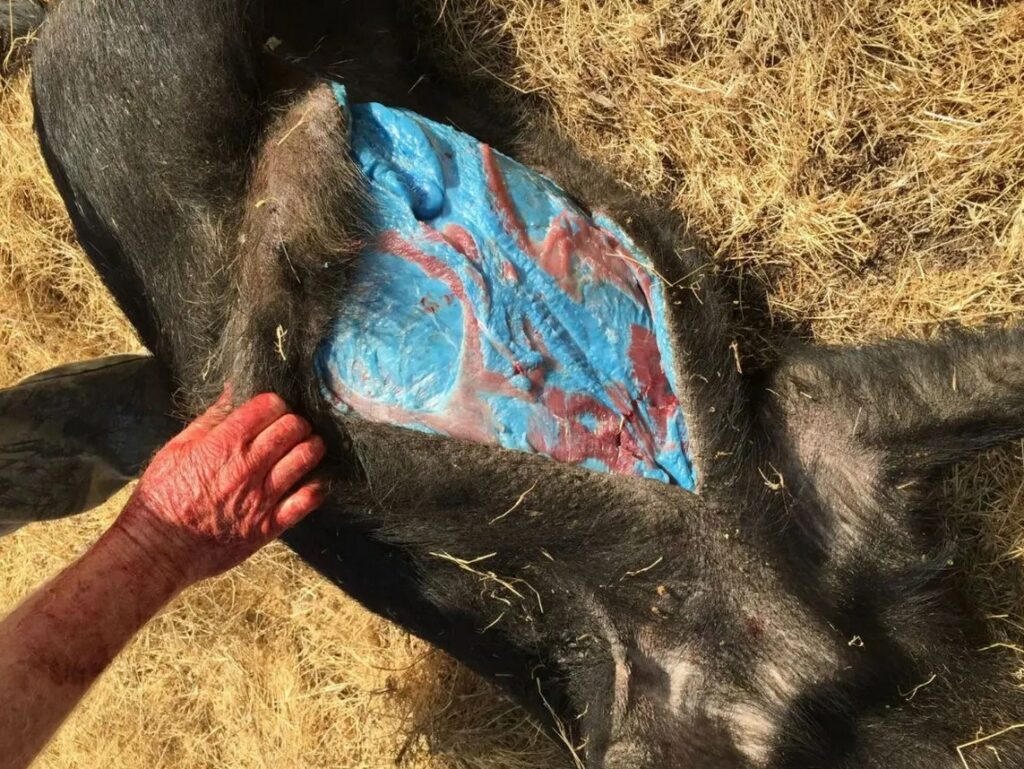
Wow. Assuming that all the above is true and not some cock-and-bull story cooked up by The Usual Suspects, I’m not at all sure how to comment.
I’ve never supported using poisoned bait to keep vermin under control, for the same reason that I don’t support fishing with explosives: a bullet has one intended target, whereas both explosives and poison are simply labeled “To Whom It May Concern” — i.e. it’s indiscriminate targeting.
However: there are two known facts extant. The first is that wild pigs are becoming a pest on a national scale. In Texas, you don’t need a permit to hunt them, and when you do there’s no bag limit, wild pigs being regarded as vermin. Texas farmers not only allow pig-hunters on their property, they welcome them.
The second fact is that the state of California has the same regard for hunters as landowners have for vermin. California, more than almost any other state, hamstrings the practice of hunting with all sorts of nonsensical regulations, even in the remotest parts of the state. So landowners, not wanting to draw attention from the state’s feral bureaucrats and law enforcement, simply use other means to control the population — such as poison.
I’m not saying I agree with the practice, but I sure as hell understand it.
But that pic is still some kind of spooky, innit?
you’re right about poison.
I don’t know what is causing the wild pigs to turn blue. Ask a leftist moonbat. Their hair has been turning blue for years
I’m not a hunter (by choice), so I can only assume that, after hunting your feral pig and getting off a good, clean shot, It would be a pisser of a moment if you start to skin your trophy and you see blue, no matter what shade it is. I think I’ll stick to getting my ham from Smithfield or Hormel.
I tried those mouse poison blocks before, never again. Those little bastards go to die in their hiding spaces behind the walls. Then they start to stink.
This is the second or third entry that concerns these blue dyed pigs. What’s got me most curious is if it’s ‘deadly’ how are they overcoming the poisonous effects? If it was something like warfarin consuming enough to have your internals dyed like the pig in the illustration… should have killed the pig. So, I’m wondering what its LD50 is in pigs and other non-target species. Any information on that score would be appreciated?
Well, at least you know the meat is tainted.
Fun fact: Here in Pennsylvania, feral hogs were not regulated animals, which effectively meant they were open season all year around. It’s been reported that some animal loving group spent $750k getting them regulated, which they thought would save them.
About a day and a half later, the PA Game Commissioner published a finding that feral hogs are regulated as a destructive invasive species, to be killed at will. Followed by about 3 pages of “you can’t hunt for feral pigs during deer season except with an armament that matches the current phase of the deer season”, of which there’s about 30 variants: centerfire, black powder, flintlock, archery, crossbow, etc. Basically, they didn’t want people hunting deer with centerfire out of season using feral piggies as the cover story.
I was thinking the same thing. Hell, now that I know it can happen, my first instinct is that poison should be required to turn the meat blue.
Here’s a good description of the characteristics of the compound written for Extension agents:
https://extoxnet.orst.edu/pips/diphacin.htm
With an LD50 (lethal dose 50%, or the dosage which was lethal to 50% of the test population) of 150 mg/kg…. The LD50 for rats : 3.0 to 7.5 mg/kg … I should think that you don’t have to put out a lot of the treated bait (the one pic I saw was wheat dyed blue. The bait is suppose to only be sold to certified pesticide applicators and they would put it in areas or devices that restricted access specifically to protect non-target species. I need to find the toxicology report on those pigs to compare the concentration of Diphacinone in their tissues with that LD50 value but from how bright blue their tissues were… What if the target species wasn’t rats, but the pigs themselves? Wouldn’t be the first time a toxin was used ‘off label’ to control a pest.
Looks more like someone used a rattlecan of blue paint to create a scene and blame it on “poison”.
not at all uncommon for ecoloonies to do stuff like that for social media attention.
Poison has a place in the fight against pests, but you do have to be careful indeed. Controlled spaces, like bait boxes for rats and mice in or around buildings. Not leaving poisoned food out everywhere where it can be consumed by unintended targets.
We used to use poison against moles in the 1970s and ’80s. Only real way to fight an infestation, traps alone simply weren’t enough for the numbers we were fighting. So cats worms, coat them in nicely blue dyed poison, and stick them in the mole burrows. Worked wonders, usually took only 1 or 2 applications to get rid of the pests, and as the application was reasonably deep down other animals weren’t harmed in the process. Then the government banned the stuff and the mole infestations ran unchecked, no way to fight them and our lawn mower would sink into mole burrows all the time as their runs completely undermined the ground to the point even an adult human walking over it would sink in.