It’s Not Just Humans

Yeah, people in the Western world have been getting taller (and fatter) over the past century or so, mostly as a result of improved diet — or a fuller diet, so to speak — and as a result, the widthwise expansion is seen as A Very Bad Thing by the Perpetual Scolds who bedevil our society.

I don’t know whether this growth is a good thing or a bad thing — I mean, the skeletal look is deemed attractive by the fashion designers and homosexuals [some overlap]  and by the very rich, who despite looking like they’re starving, are of course in no danger thereof.

However, in doing some research for a future post, I came across this pic of Range Rovers, as introduced and what they look like today:

…and it triggered an immediate flashback to my earlier post on bloat, in which I took aim at pretty much everything.

Am I the only one who thinks that the Range Rover on the left is almost dainty — a word which could never be applied to any Range Rover of any generation — and subsequently more attractive?

I know, I know:  the modern Rover is drenched with wondrous technology and (mostly government-mandated) safety devices compared to its predecessor — and I leave it to you to decide how desirable / necessary those additions are — but seriously?

Have we humans — or, to be more specific, the target demographic for Range Rovers — got so much fatter that we now need a double-wide to accommodate our Lizzo-like asses?

Quit Messing With The Formula

And then there’s this development:

The Henry SPD HUSH Series is a bold evolution in lever-action rifle design, purpose-built to be run suppressed. Developed by the Henry Special Products Division—our new R&D initiative focused on forward-thinking innovation—this inaugural release reimagines what a lever gun can be in modern hunting and shooting applications. Offered in five time-tested calibers—.45 Colt, .357 Magnum/.38 Spl, .44 Magnum/.44 Spl, .30-30 Win, and .45-70 Gov’t—the HUSH Series strikes the perfect balance of traditional feel and modern performance.

Lever actions already offer excellent balance and speed, with the added suppressor-friendly benefit of a closed action during firing. Our HUSH Series takes this a step further. Every component forward of the receiver is optimized to minimize weight, keeping the rifle’s natural center of gravity intact—even when a suppressor is mounted. The result is a no-compromise suppressor host that retains the instinctive handling and quick follow-up shot capability that lever guns are known for.

So far, so good.  Then we see what this new paragon of balance and innovation looks like:

As Reader Mike S. (who sent me the link, thankee) says:

Just give me a threaded muzzle and leave the blue steel and walnut alone!

Can’t much argue with that.  But that wouldn’t make the SPD HUSH more popular with the Tacticool Set, would it?  And that means no additional rifle sales.

Still, I can’t fault Henry for doing this kind of thing — from a marketing perspective.  But let me tell you:  if they start discontinuing any of their existing models in favor of this new flavor-of-the-month, they deserve everything they get.

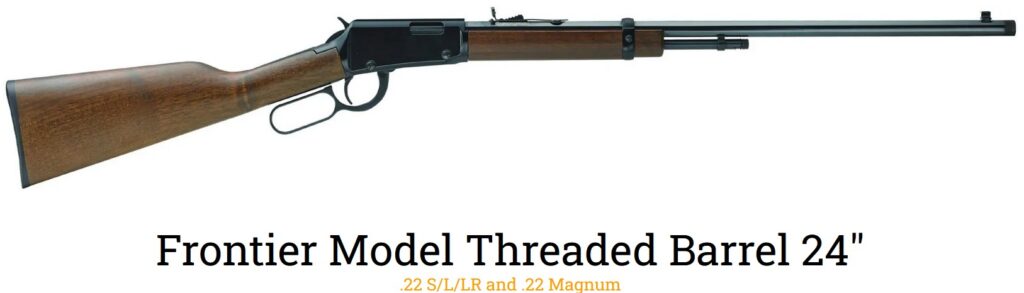
You see Henry already makes a wood ‘n steel that’s ready for a suppressor:

…but Alert Readers will notice that it’s for their rimfire models only.

So why not just extend that concept to the Big Boy and Side Lever models, I ask?

(They don’t have to do that to the Original Henry rifles, of course — I don’t think anyone would support that.)

Some things just shouldn’t be tinkered with.

Stupidity Drift

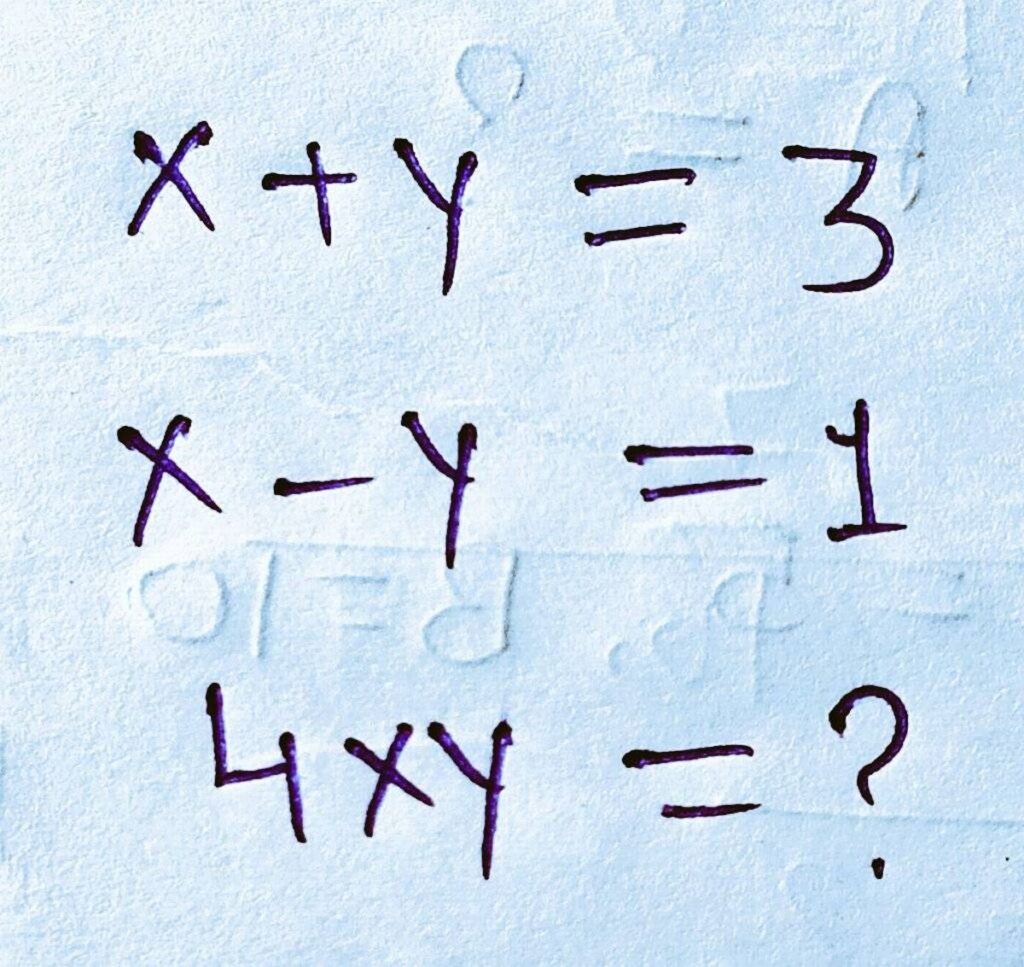
Seen SOTI:


…and according to the headline, only a “maths genius” can solve it in under 30 seconds.

WTF?  I’m no math genius, and it took me about 5 seconds to solve it:

x = 2, y = 1; ergo  4xy = 8

This is not to show off my mathematical prowess, but to decry the fact that so simple an algebraic puzzle apparently requires “genius” to solve it.

Are we truly getting more stupid as a species?

In Defense Of Nudity

I read this article at The Federalist (“The fact that celebrated works from the past contain nudity doesn’t justify us including it in our films, literature, and other mediums”) and much of what Meg Johnson says — and what Tolstoy said — is true.

However, as someone who enjoys nudity in art and pretty much everywhere else, allow me to come to its defense (so to speak).  The problem is that people (like Tolstoy) conflate nudity with its effect on the viewer’s libido, but I’m not sure I agree.

Michelangelo’s Statue of David:  art.
Michelangelo’s Statue of David Sporting A Massive Erection:  not art.

In times when nudity was rare, or frowned upon by the pezzonovanti  in the Church or government [some redundancy], then yes, the sight of a nude buttock or breast might have been titillating or arousing.  And yes, with the relaxation of those rules, simple nudity became much less so.  One has only to compare early Playboy  magazines with modern-day Hustler  to see the truth of that.

People always thought that publishing nudity was the thin end of the wedge, the start of the slippery slope and all the other clichés.  I’m not going to argue with that, because one inescapable fact of nature is that humankind will always push boundaries, whether it’s nudity in art or legal confines.  (Not all that long ago, theft used to be punished by hanging;  now, even murder isn’t always faced with the same consequence.  Speed limits are always tested, to the point where enforcement has had to apply a 10% “grace” allowance so as not to appear too tyrannical.)

Similarly, while “prurient” artistic nudity was banned in the past, “classical” nudity — i.e. nudity drawn to depict a Classical morality tale — was grudgingly accepted, an allowance that almost all classical artists took advantage of.  The example used in Meg Johnson’s article, Bernini’s Rape Of Proserpina in Rome’s Galleria Borghese,  is an excellent example:
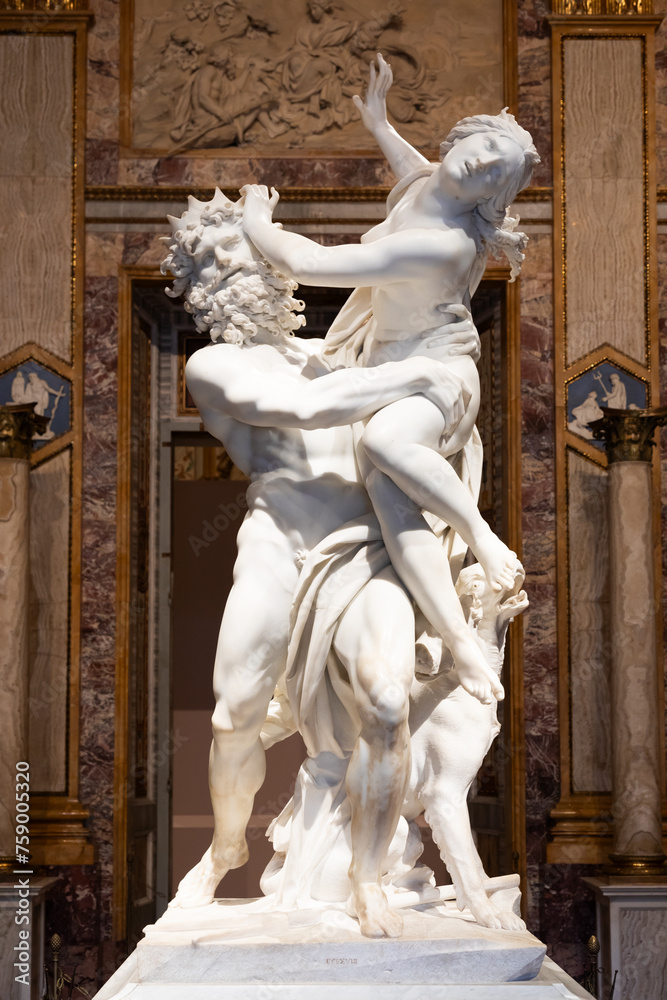
It is, of course, exquisite — as much for Bernini’s skill as a sculptor as its reticence.  Note that Bernini is showing the act of rape by displaying Pluto’s massive muscles compared to Proserpina’s slender feminine ones, the violence of her abduction revealed by her breast, rendered naked by her clothing having been ripped off, and Pluto’s brutally-joyous facial expression contrasting with her fearful one.

Bernini is not depicting the act of rape by showing Plato’s erect phallus plunging into Proserpina’s tender vagina — although he was quite clearly perfectly capable of sculpting it.  But that would have been pornography;  what he did is Fine Art.

I don’t have to show any examples of this comparison, because were I to do so, that would be showing pornography by using artistic criticism as its fig leaf.  (See what I did there?)

But by displaying nudity in art and acknowledging that this could inevitably lead to pornography, does that mean society’s moral ruin is inevitable?

Of course not.  And Johnson’s premise of “The fact that celebrated works from the past contain nudity doesn’t justify us including it in our films, literature, and other mediums” is in fact fatally flawed because it is denying that modern films and literature are themselves forms of artistic expression.

Where a movie director, for example, draws the line is the defining characteristic.  I’ve often deplored the modern movie trend of showing love scenes as sex scenes, instead of simply hinting at it — you know, a close-up of a passionate kiss fading to black and the next scene showing the couple lying together in bed the following morning (or not even that explicit).  To me, showing the sex between a couple denies us, the audience, the opportunity of using our imagination — and that’s a primary artistic flaw if ever there was one.

But simple nudity?  I’m all in favor of it, if for no other reason that it upsets those who insist on their womenfolk wearing maxi-dresses, burkas or niqabs.

The hell with them.