Roasted Taties

I know, I know:  “A recipe?  On this website?  Kim, WTF?”

Bear with me.

As always, this year I’m hosting our family Boxing Day dinner, only this time without New Wife to help with the cooking.

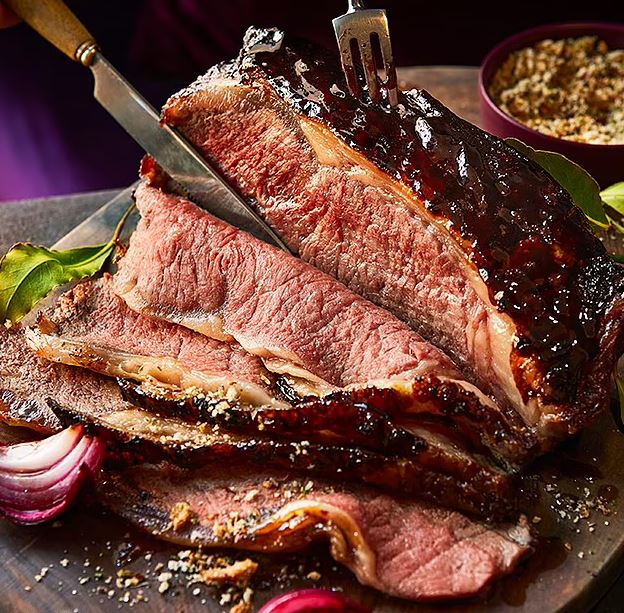
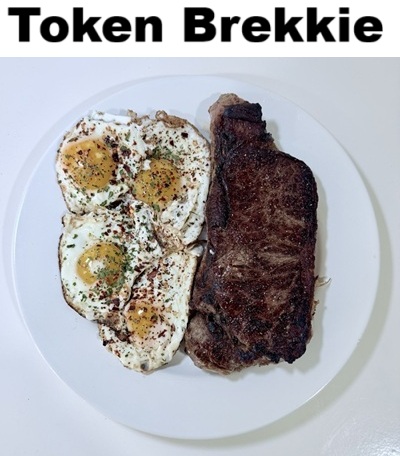
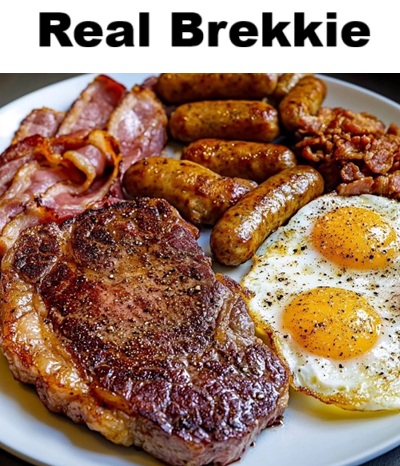
This would not be a problem, because I know how to make the meal of roast beef:

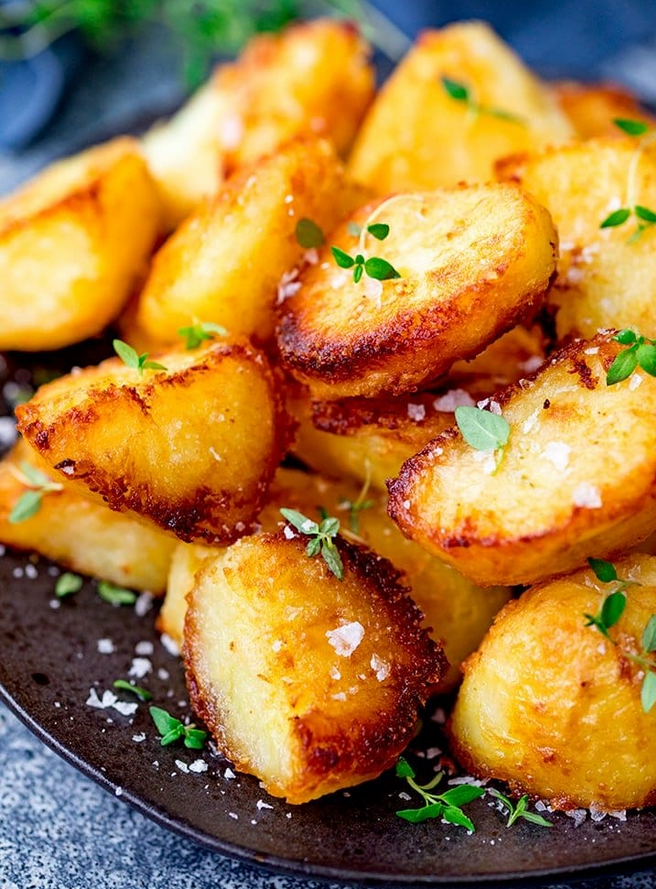
However, the one thing I’ve never been able to master is the quintessential companion to rozzbiff:  roast potatoes.

And without New Wife — did I already mention that she’s gone AWOL to some family reunion thing in Cape Town? — I was going to be in trouble because I won’t say my kids are traditionalists, but any substitution of other potato formats (mash etc.) would likely cause taunting, ugly facial expressions and perhaps even a hanging.

So these past few days I’ve been experimenting, bigly, trying out various suggestions and different methodologies until finally, I figured it out.  Here, then, is Uncle Kim’s Roast Potato Recipe:

Use Yukon Gold potatoes only;  just note that large ones will require longer cooking time — I prefer to use the baby ones, myself.

Skin the things, and parboil them for about 15 minutes.  I’ve found that it works better if you drop them in cold water and bring to boil rather than dropping them into already-boiling water.

Now, about that water:  drop a half- to full teaspoon of baking soda into the water first and stir until the stuff has completely mixed in (beware clumps), and then add a teaspoonful of iodized salt.  (There’s a whole thing about alkali water being better for the potatoes to cook in than acidic water, but I don’t want to bore you to tears with the chemistry explanation.)

Remove the potatoes from the boiling water, and allow to cool for just a bit.  Pat dry with a paper towel — this is important, because they need to be completely dry at this point —  then use a fork to lightly scrape the outsides.

Spray the potatoes with some avocado oil, and sprinkle with just a little coarse kosher salt.  Stick the whole lot in a baggie and shake gently.  The salt “roughs up” the surface of the potatoes, which will make them crispy on the outside when cooked.

To cook:  Set the air fryer to 400, or pre-heat the oven to 450Cook for no less than 15 minutes — longer if you’re using the large potatoes or doing a large batch of the small ones.

Do not let the potatoes touch each other in the oven:  keep them separated.

Take out of the oven, and allow to sit for a just a few minutes.  Cut them lengthways in half — if for any reason they’re still undercooked in the middle, just pop them back in the oven for a few minutes more. Then serve.

Do not be surprised if these roast potatoes take the place of French fries in your future meals.  You have been warned.

It’s Not Hyperbole

When I first referred to Jeremy Clarkson as “The Greatest Living Englishman”, it started off as a nod to his unflinching honesty when it came to everything he looked at, such as his (non-)review of some Vauxhall car model back in the 1990s:  “If they’re not going to bother to make an interesting car, I’m not going to bother to review it.”

That caused Big Business (in this case, Vauxhall’s then-parent company General Motors) to go apeshit, because that’s not the way car reviewers are supposed to behave.

It’s that same unflinching honesty that he displayed in his first bumbling efforts at farming which turned his Clarkson’s Farm TV show into a runaway smash hit, and along the way almost single-handedly changed the way the British regard both food and the farmers who produce it.

So when he turned that same agricultural ignorance towards brewing beer — simply because he had a barn full of unsold barley which he needed to sell — one might think that it was just another celebrity using their name to sell a product.

In this case, one would be not only wrong, but spectacularly wrong.  And if you want to see a case study in marketing that, in hindsight, never had a chance of failing, then I implore you to watch this video.

Time and time again, “the experts” believed that Clarkson was making a mistake, and every single time he proved them not only wrong, but spectacularly wrong.

He turned a few thousand pounds’ worth of unsold barley into a £75 million company, and in the process, changed the way British people think about farming, about beer and about the people who farm and the people who brew beer.

And he did it all with his usual unflinching honesty and openness, which gave the lie to the usual corporate veneer of respectability and care for both their employees and their customers.

Which is why he truly is the Greatest Living Englishman.

I can’t wait to try it the next time I go over to Britishland.

Culinary Discovery

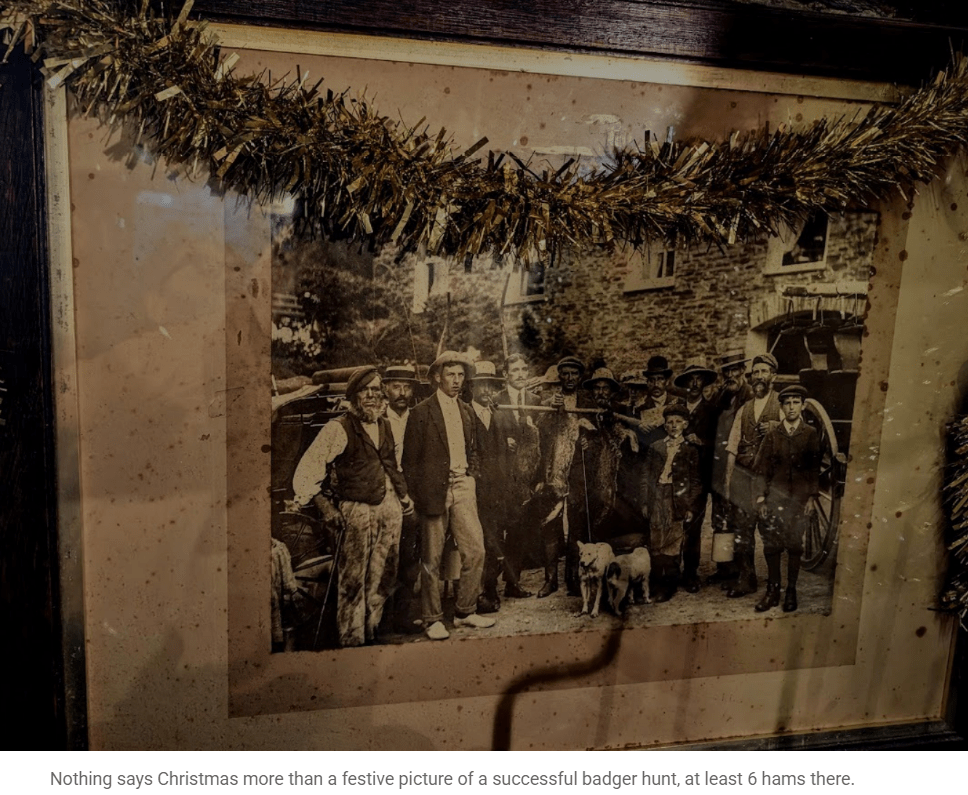
The Englishman sent me this merry little picture:

Of course, I had no idea what he meant (quite a common feature in our conversations, btw), so when I sought clarification (“WTF are you talking about?”), I got this:

Badger hams, I think they were a regular on the sideboard at Tuckers Grave. Badger are at their best from October to November, being fat and succulent by then.

The flesh can be treated as young pig meat in every respect, it being just as rich and having the flavor of a young pig. It can be cured by salting, the hams being exceptionally good fare. Badger pies are even better than pork pies, hot or cold.

Badger Ham, To Bake
A badger ham will weigh 7 to 8 pounds and needs cooking very carefully. Soak the ham for at least 6 hours in cold water. Wash it after soaking in lukewarm water. Cover it with a rough paste made with 3 pounds of flour and 3 pounds of water; make sure to wrap it well. Bake in a moderate oven, pre-heat to 350 F for 2½ to 3 hours.

Remove the paste and cover with bread raspings whilst still hot, if to be served cold. If to be served hot, serve with broad beans and fresh parsley sauce or cider sauce.

I had no idea that badgers were edible.

Also, I have no idea what he means by “Tuckers Grave” or “bread raspings”.

Two nations divided by a common language, we are.


Okay:  Tucker’s Grave Inn is a pub just outside Bath:

Of course, The Englishman assumes that I would be familiar with all the pubs around his farm — admittedly, not an altogether incorrect assumption — but in fact, I take it as a shortcoming of his hospitality that he’s never taken me there. [making note]

Bread raspings are the equivalent of panko crumbs.

Peppery

Via Insty, I found this fascinating article about how America’s food is becoming more spicy:

Consider spicy-hot food — and consider how recent it is as a mainstream phenomenon in the U.S. In 2002 many of us cheerfully chow down on Szechuan and Thai, habaneros and rellenos, nam pla and sambal ulek. Salsa outsells ketchup. But it wasn’t always that way.

When I first came over in 1982, I found American food to be kinda like what I’d left behind in South Africa:  kinda bland, almost-English in fact, and diner food very much so.  Only when I went south to New Orleans and Florida did the food start to spice up a little — in the Big Easy, quite alarmingly so.

Back in Johannesburg, although I’d grown up with at least one curry meal a week, spicy food was definitely not an everyday fare.

Imagine my surprise, then, when I moved Over Here in The Great Wetback Episode of 1986 I found out that over that short period, food in general had spiced up considerably (what the article refers to as “capsaicinization”), and frankly, I wasn’t prepared for it.  It took me a while to get used to it, but I did.

Now?  I eat nachos with one slice of jalapeño pepper per mouthful.  (Without the jalapeño, nachos are pretty awful — close to what Richard Hammond once described as “sick on a plate”.)

What made me realize how my own taste had become so capsaicinized was when New Wife came over from Seffrica to become part of my life Over Here.  Now granted, she’d never been that fond of spicy food — even curry, so much a staple of SA menu, was conspicuous by its absence on her table — and in fact, that was generally true of many Seffricans back in the day, myself included.  So when she came here, her taste buds were set on fire.  And it’s when I prepare meals for her that I realize how much I’ve become used to that increase in spice content;  I have to watch out even when using mild spices like Lawry’s steak salt or paprika.  What seems quite mild for me sets her mouth on fire.  So I make meals accordingly.

Ditto when we visit friends or family:  I have to remind them constantly to be careful of the spice quantity.  (The nice thing about having the kind of friends that I do is that they take such constraints in their stride, albeit with some gentle teasing.  Ditto Daughter and the Son&Heir when we visit them for dinner.)

I’m not going to try and change her tastes, by the way;  had someone tried to do that to me, back in the late 1980s, I’d have kicked back hard.  I may have gradually become accustomed to the modern American cuisine, but it took me well over a decade to do so.

I doubt that New Wife will do it in anything like the same time period, and that’s okay.  At home, we eat more traditional British food, anyway.  Sausage rolls, steak pies and roast beef, for example, were never spicy foods to begin with, and I for one have no problem tucking into the comfort foods of my youth.

I’ll just get the spice when we got out to eat.

Never Mind The Vampires

It all began shortly after I began my career at The Great Big Research Company, when I called on a client for the first time.  Our meeting had been scheduled immediately after lunch, and when I walked into his office and shook hands with him, I was nearly sick.

To say that his breath reeked would be an egregious understatement:  it smelled like he’d just eaten a dozen cloves of garlic.  And it got worse.  As the meeting progressed, he started to perspire (not unusual in midsummer Johannesburg back then, where offices seldom had A/C), and the smell of garlic permeated not only the entire room but even my clothing.

The reason I knew it had stuck to my clothes was when I walked back into the office and my secretary waved her hand in a fanning motion and asked whether I’d had Italian food for lunch.

I’ve hated garlic ever since.

Also, because I saw clients at least once a week, I decided that there was no way I would ever potentially offend them by smelling of garlic;  so I made a conscious effort to avoid garlic-laden foods.  Over time, I actually developed such a strong aversion to the stuff that my long-suffering wives had to take it out of any cooking recipes.

So what had started as a courtesy to clients turned out to be a lifelong aversion.  (I remember watching some cookery show, when the “chef”, in cooking two steaks, crushed five cloves of garlic in their preparation.  I was nearly sick at the very thought of how the meat would taste — and I love steak.)

Feel free to imagine my experiences in Paris and Rome — no doubt a factor in my always choosing to eat outdoors, now that I think of it.

This post was inspired by this article, which extols the virtues of garlic as a cure for just about everything, and by our dinner with the Son&Heir last week, where he and his girlfriend ordered snails as a shared starter.  I could smell the garlic from across the table, but fortunately, it was barely noticeable, even to my garlic-sensitive nostrils.

I know that this little preference (or rather, non-preference) of mine is going to cause outright mirth and shakes of the head, but there it is.  The stuff reeks and I want no part of it, despite all its purported health benefits.