My American Car Experience – Part 1: The K-Car

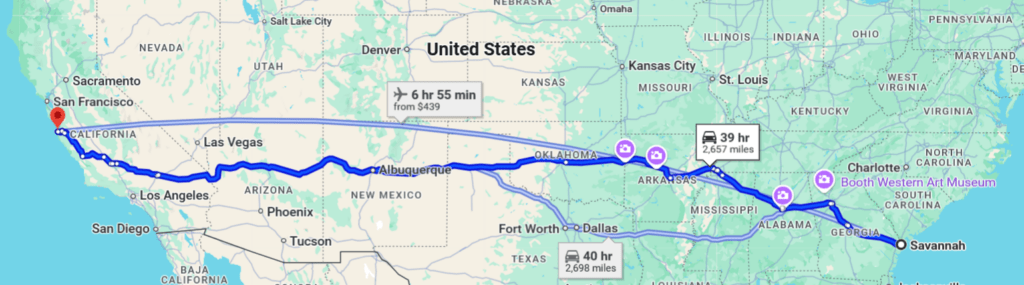
My very first experience driving an American car was in 1982, on my honeymoon with Wife #1.  Our itinerary was first to drive from Manhattan to Boston / New England and back to Manhattan via a different route:

…thence down to New Orleans, over to Disney World, and back up to Manhattan via the East Coast, likewise taking a different path:

This was not a brief visit — we had sufficient vacation time (in Seffrica, as in most places in the world, paid vacation time was three calendar weeks, and we’d both accrued a couple more thereof), so we took five weeks to complete the round-trip.

On arrival at JFK, we spent a few days in Manhattan to get over jet lag and to see the World’s Greatest City.  Unfortunately, we arrived in late September during a) the hottest summer of the decade and b) a NYC garbage workers’ strike, so when it came time to leave, we did so with some relief because when it came to searing heat in city streets and an unbearable smell of rotting garbage, I wasn’t to encounter anything similar until I went to India, many years later.

We’d accumulated considerable coinage during those early days, mainly because I couldn’t count change quickly enough for impatient New Yokkers, so I just threw bank notes around at every purchase.  But when I tried to convert the coins back into dollar bills, the tellers at two banks told us to get stuffed because we weren’t customers.  As we weren’t customers (and unlikely to become such), therefore, I felt no shame in snarling at all of them for their shitty service.

But that was a blessing in disguise, because when we hit our first tollbooth getting out of Manhattan, I ended up in the cash-only lane, and was only able to get us out by flinging handfuls of change into the basket provided until the boom lifted.  (In fairness, it was the first tollbooth I’d ever encountered.)

We’d specified a compact car from Hertz — thinking we’d get the typical small car like a Mazda 323 (First Wife’s car) — but to our amazement, our “compact” car was a six-seater family saloon, a Plymouth Reliant.


(This is the actual color of the car we rented.)

I thought we’d been given a large car by mistake, but was assured not by the rental clerk.  (I’d like to say that this was my first experience with American Portions, but we had been to Katz’s Deli and ordered their pastrami sandwiches.  We ended up eating less than half of one each, and took the remainder and the other one back to the room for road food.)

But on to the trip.

Amazingly, the car drove reasonably well — a little harshly over the concrete slabs on the interstate highways, but the 2.2-liter engine worked fine* and we weren’t in any hurry to get anywhere anyway, so the car was never called on to perform any heroics.  But the handling took a bit of getting used to;  my car back in Johannesburg was an Opel Ascona:


…which was a little bigger than a K-car, but having been built to German-GM standards and not U.S.-GM standards, it handled really well — almost to Mercedes levels.

So the K-car was an interesting drive, to say the least, but as I said, not being in a hurry, it was no problem and there were no mechanical issues.

*I did think that the engine was remarkably lifeless for one of 2.2-liter capacity;  the Opel had a 1.6-liter engine, and it had far more poke than the K-car.  (In retrospect, I think the crappy no-lead U.S. fuel may have been the principal culprit — how I missed, and still miss, the 100-octane no-ethanol rocket fuel of the old days.)

The trip concluded back in Manhattan, where we turned in the Reliant to the astonishment of the rental guy at the mileage we’d covered.  (In those days it cost a little extra to get “unlimited” mileage for a rental, but I paid it gladly, especially when I learned what the per-mile overage charge would have cost.)  I’d also heard horror stories about fill-up charges for gas, so I bought a 5-gallon gas can and filled it back somewhere in (I think) Delaware, and that was sufficient for us to top off and turn in the car with a full tank.  So the gas consumption wasn’t too bad either.

All in all, therefore, my first experience driving an American car wasn’t too bad, car-wise.  (Oh, and the front- and back bench seats were just ideal for honeymooners, if you get my drift.)

That would change in future trips, as you will see.

And So It Begins

Seems as though I’ve opened up a big ol’ can of Murkin worms in posting about the ’66 Mercury Comet last week.

Reader Brad_In_IL wrote:

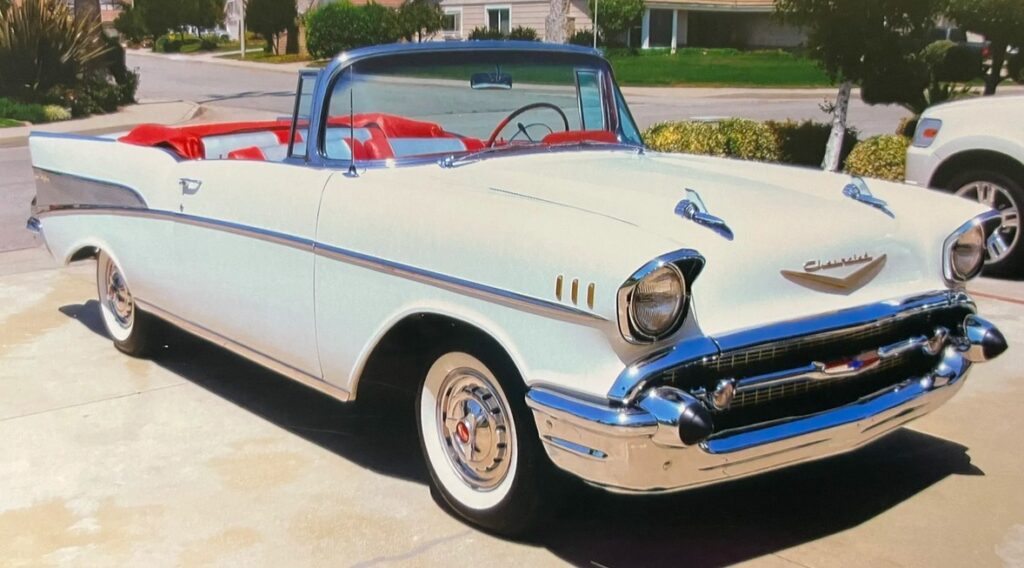
On the way home from work the other day, I was passed by what I’d call “Purty Car”. And what was that fine ride you ask? Something of an American Classic. Twas a 1971 Buick Skylark convertible:

Fucking hell, that’s an ugly barge of a car.  Sorry, Brad — but my taste runs towards this kind of 1971 convertible:

That’s the Fiat Dino, with its Ferrari-inspired 2.46-liter V6 engine.

And Reader Clem C. added his experience:

We owned a ’91 Buick Reatta coupe.  Maybe you’ve heard of it.  I look forward to your take on the car.  We enjoyed it.

Actually, I don’t find that Reatta too appalling.  Although much larger, as is the American way, it compares quite favorably, shape-wise, to the 1990 Toyota MR2:

…although the actual performance of the Buick, when compared to that of the “Mister Two”, makes one understand why Buick only made the Reatta in small numbers for two years while Toyota made a zillion MR2 models over two decades.

(Actually, I prefer the chunkier 80s-style MR2:

…but that’s just me.  I’d drive one today, in original condition.  YMMV.)

In Comments to last week’s post, Reader Don C. spoke of his love for the brawny ’71 PontiaG GTO convertible:

…which would be, I agree, a better choice than that overpriced Mercury Comet, although I still think it’s hideously bloated.  But #MuscleCar, so it can be forgiven.

Reader Topcat loved him his Chevy Nova SS back in the day:

…which I think is easily one of the ugliest cars ever made, but I’ll accept the #MuscleCar excuse here too.

Although I have to say that the more I look at these things, the more I prefer my compact and nimbler Euro cars…

…and I’m not even talking about Ferraris, Lamborghinis or Maseratis.  That’s a 1971 Alfa Romeo Giulia GT 1750cc.

This topic is kinda fun, guys.  Keep them coming.

And tomorrow begins a weekly series of my personal experiences with American cars.

Crappy List Part Tre

Okay, after doing the Limeys and the Krauts, let’s do the Wops.  Here we have a problem because Italy has produced so many amazing cars that it’s difficult, nay almost impossible to keep it to only 25 great ones.  And for the purposes of simplicity, I’ve excluded Italian-styled cars which used off-brand engines, like those from Bizzarini, Intermeccanica, Pagani and De Tomaso.  Anyway, I’ve never been one to back down from a challenge, even if choosing the top 5 greatest Italian cars is really difficult.  Nevertheless, here we go…

1) 1959 Ferrari 250 GT:  Certainly, the ’59 GT set the bar for all other sports cars of the era, and today it’s sought after more for its collector value.  Although as one sees several racing at Goodwood nowadays, the howls of their lively engines are almost drowned out by the collective thudding of the heartbeats of their insurance agents.

2) 1976 Lamborghini Countach LP400:  I don’t know if any other car’s picture has graced more teenage boys’ bedroom walls, and even though the Countach is an absolute pig to drive, to park, in the rain and all that, people love this Lambo with a passion.  Even though some earlier cars can claim to be “supercars”, this one was the first:  impractical, over the top and utterly gorgeous.

3) 1975 Lancia Stratos HF Stradale:  “I know!  we’ll make a car the size of a skateboard and slap a modified Ferrari V6 engine right behind the driver’s head — and then we’ll go and win some World Rally Championships!”  Only Lancia could even have conceived such a concept.

4)  1956 Maserati 450 S:  Take a car that’s won some Formula 1 races, make it street legal and release it to the public almost unchanged.

5) 1969 Dino 246 GT:  One of the top 3 most beautiful sports cars Ferrari ever made, and it’s in almost everyone’s top 5 most beautiful of all cars ever made.

I know, I know… “But Kim, what about…[endless list follows]?”  See if you find yours in the next twenty…

6) 1947 Cisitalia 202:  The very first car made with “single-shell” coachwork, the 202 changed the entire face of the automobile industry.  As each car was handmade, the cost was astronomical and only a couple hundred were ever made.  Still lovely, especially the 1951 Cabriolet…

7) 1946 Maserati A6 1500:  With its post-war Italian design, the A6 set the scene for a huge number of sports cars (especially Aston Martin) to follow in the 1950s.

8) 1957 Fiat Nuovo 500:  The first actual purpose-built “city” car, the 500 went on to sell just under 4 million units over its 18-year lifetime.  Amazingly (by today’s standards), it was first marketed as a “family” car.

9) Lancia Aurelia B24 Spider:   The list of “first to market” features introduced by Lancia is staggering.  The Aurelia B24, for example, was powered by the first production V6 engine and was the first car to use radial tires. And was it beautiful?

10) 1986 Ferrari F110 Testarossa:  The only competitor to the Countach for “posters on the wall”, the Testa is still seriously popular among the Ferrari tifosi.

11) 1938 Alfa Romeo 8C 2900B Spider:  Whether you wanted to race it or just take it for a long road trip through Tuscany, the 8C line could do either with aplomb.  In the late 1930s.

12) 1968 Lamborghini Miura P400:  Some say the Miura is the most beautiful Italian car ever.  I don’t agree, but I can see their point.

13) 2002 Ferrari Enzo:  When you build a car dedicated to the company’s founder, it better be good.  It was, and still is.

14) 1955 Fiat SuperSonica:  Way ahead of its time, the SuperSonica showed that Fiat wasn’t all about the mass market.

15) 1965 Alfa Romeo Spider 1600:  During its eighteen years of production over four distinct styling generations, every single sports car fan, male or female, wanted to own one of these lovely little creatures — hell, it’s probably still true today.  With good reason.

16) 1965 Ferrari 275 GTS:  Pinifarina design, 3.3-liter V12, ’nuff said.

17) 1967 Lamborghini 400GT:  The 350 — Ferruccio’s first car after his argument with Enzo —  was good, the 400 much better.  And much less likely to break down than any Ferrari of the time, too.

18) 1982 Lancia 037 Stradale:  Like the earlier Stratos, this is Lancia’s street version of a monster Group B rally car, and the 037 was the last rear-wheel drive to win the WRC.  And one of the best-looking examples of 1980s automotive styling.

19) 2022 Maserati MC20 Coupé:  When they think that Ferrari has worn the “supercar” mantle for long enough, Maserati steps up with this 3-liter 600hp V6-powered beast, just so that people can remember that they too have a racing heritage.

20) 1973 Alfa Romeo Montreal:  An absolutely stunning sports car, powered by a 2.5-liter V8 (!), it is still the only car I’ve ever driven over 125mph — and I backed off before the engine did.

21) 1984 Ferrari 288 GTO:  While its “parent” 308 GTB was a good sports car, the 288 GTO was a missile.  Its 300+km/hr top speed was the fastest of any non-racing car of the time, much faster than anything made by its competitors and only 3km/hr less than the Enzo.  And it was gorgeous, too.

22) 1964 Lancia Flaminia Sport:  The Flaminia was Lancia’s luxury saloon line, but the Sport model was the more beautiful.

23) 1953 Iso Isetta:  The Fiat 500’s only competition in the “super economy” market, the Isetta’s 236cc (!) motorcycle engine got between 70 and 90 miles per gallon, and actually won the Mille Miglia race twice in the “Economy” class.  Top speed was about 47mph, but it took over half a minute to get there (unless you were on a downhill road with a strong tailwind).  Still, so popular was the Isetta during the mid- to late 1950s that it was made under license in seven other countries.

24) 1985 Alfa Romeo GTV6:  Best of the 1980s Alfas, the GTV6 was powered by the 2.5-liter V6, which is arguably one of the best Alfa engines of all time, giving incredible performance for a non-racing powerplant.  And it looked pretty good too (like the Lancia 037), in an era in which car designs were kinda blah;  and unlike most sporty cars, the GTV6 could carry a massive amount of luggage in its cavernous trunk.

25) 1986 Lamborghini LM002:  “We have to make-a the truck-a for the militaria.  So we make a truck-a, and drop in the 5.3-liter V12 engine from a Countach.  Should-a work-a.”

And that’s my list of 25 great Italian cars.  And incidentally, I’ve actually driven six of them myself.

RFI: Old American Car

Here’s one for you Murkin Car Guys. As any fule kno, I am fairly knowledgeable about Brit and Euro cars, much less so when it comes to Murkin ones because  I’m an iggerant furriner  my heritage, car-wise, is not American.  Sure, I’m reasonably familiar with some brands and types, but those are mostly the “exotic” ones like the AC Cobra and some Corvettes.

But when it comes to “mass market” American cars, I have to plead the Fifth, not for fear of self-incrimination but because I don’t want to show my  ass  ignorance.

Here’s a good example.  I get updates from Hemmings.com each day, and mostly I’m only interested if there’s a “new” Ferrari or similar.  But yesterday’s update featured a car of whose brand I know next to nothing, and hardly anything at all about its place in time.

So, Gentle Readers, talk to me about this convertible:

1966 Mercury Comet Convertible – 1 of 2,158 Ever Made, Numbers Matching and Professionally Restored

From the blurb:  This Mercury muscle car is powered by a numbers-matching 390 S-Code four-barrel engine producing 335 horsepower mated to a Sport shift Merc-O-Matic transmission and a 3.25 locker rear differential upgrade.

All I got from the above is “335 horsepower”.  I don’t know what the relationship between Ford and Mercury was back then — I know that now, Mercury is Ford’s “upscale” sub-brand — or that Mercury even made muscle cars (thinking that was mostly Pontiac or Dodge’s domain).

I have no idea how the “Merc-O-Matic” tranny was regarded back then;  was it a monster, better than others, or just a label slapped on an ordinary tranny?

And don’t even ask me to decipher “390 S-Code four-barrel engine” without resorting to WikiPedia…

Finally:  in its apparently-restored condition, is the asking price of ~$70 grand good, laughable or a bargain?

Of course, I’m not going to try and buy it — hell, I wouldn’t accept the thing as a gift* because it’s hideously ugly to my non-Murkin automotive sensibility, and I have no idea how the thing handles, either.  My experience with 1960s American cars is that they handled like barges and cornered like they were on a skid pan — but was this particular model better than its contemporaries?

My interest is academic only.

All responses gratefully received.


*although had they offered TV spokesmodel Jill Wagner as an optional extra, I might have been sorely tempted, back in the day.


New Mouthpiece

I see that following the resounding flop of the ad campaign for their new line, Jaguar is now looking for a new advertising agency.

It comes after the company announced plans to shift to electric vehicles with a bizarre new advertisement featuring brightly dressed models but no cars.

The group also abandoned its iconic ‘growler’ cat badge, replacing it with a curved geometric J and L symbol.

Defending the campaign late last year, JLR’s Managing Director Rawdon Glover told the Financial Times: ‘If we play in the same way that everybody else does, we’ll just get drowned out.’

Well, maybe so.  But in every good ad campaign — especially so for cars — the product has to come front and center, especially when it comes to their features.

Back to Jaguar:  while everyone’s laughing their asses off about this latest development — me included — allow me to remind you all about the Great Advertising Truism:

“Behind every shitty ad and stupid ad campaign lies a client’s signature.”

Which means that not only the ad agency should be fired, but also the client executive (CEO Rawdon Glover) whose signature okayed the campaign.

My suggestion to the new guys:  ditch the stupid new gay logo and go back to the old snarling jaguar.

And for the clients (headed by a new CEO): go back to making cars that people might actually want to drive — you know, that “heritage” thing.  Hire someone like Gordon Murray or Pininfarina to design it, if you can’t find a decent designer already working at JLR.

I suspect, however, that they’ll be doing neither;  in which case, let’s everyone wave bye-bye to Jaguar.

Crap List Part Zwei

In keeping with last Saturday’s Crap List / Top 25 British cars, here’s my attempt at the top 25 greatest German cars of all time.

1) 1947-1982 VW Beetle:  Yeah, call it “Hitler’s Revenge” or “Porsche’s Abomination” or whatever, the Beetle sold in the jillions in almost every single country in the world — definitely the “People’s Car” in any language — and even today it has the ability to get a smile whenever it’s seen on the road.  Pretty much every model was iconic, from 1947 till the last variant made some sixty-five years later.

2) 1955 Mercedes 300 SL Gullwing:  I’m not sure that anyone can argue with this selection;  easily one of the greatest sports cars of the 1950s (and perhaps of all time), it won the Millie Miglia several times, and still commands top dollar in any sports car collection.

3) 1956 Mercedes W186 300 S Coupé (“SC”):  When the company’s top executive says that the engineers have to build him a car that can run all day on the autobahn at top speed without breaking down, but must still be luxurious… you get the 300 S line, and the two-door coupé was the best-looking.

4) 1966 Porsche 911 S:  Quite possibly the greatest sports car model ever made.  Its shape was (and still is) iconic, and despite the rear-engined layout being a nightmare for handling, it’s a wonderful car.  Alone among “performance” (as opposed to “touring”) sports cars, the average 911 has been driven more miles than any other brand, which says everything about its reliability and fun-to-drive ethos.  Second only to the Beetle in terms of longevity (September of this year will mark its sixtieth consecutive year of production).

5) 1976 VW Golf:  Speaking of Beetles:  you’re tasked with designing the Beetle’s successor and now, some 35 million cars later, it’s still selling like hot cakes.  And speaking of “hot”, its GTI variant set the standard for the “hot hatch” concept across all manufacturers.  Oh, and you can till fit a grand piano in the back. [some hyperbole there]

So that’s my top 5.  Let’s look at the rest.

6) 1958 BMW 507: Definitely one of the best-looking sports cars ever made (and certainly the best-looking BMW sports car ever made), the 507 gained infamy as the car that nearly bankrupted BMW.  In today’s world, the 507 would be a rival to any other sports car;  in the late 1950s, its stratospheric price — higher than any Ferrari — was death to sales.

7) 1979 Audi Quattro:  Took full-time four-wheel drive out of off-road and into passenger cars.  Also killed the rally car scene for other manufacturers until they too went 4WD.

8) 1964 Mercedes 230 SL “Pagoda”:  The shape was different from anything out there, and it lasted through two engine upgrades (250, 280) for the next six years.  Then there’s the fact that the pagoda top was removable — and its removal made the 230 SL a sexy little drop-top instead of just a handsome mini-coupé.

9) 1952 Porsche 356:  Rather underpowered at first, the 356 added “reliability” to the “fun” of the British sports cars of the time and still has a place in the hearts of all Porsche fans.

10) 1969 Mercedes 280 SEL 6.3:  If the base 280 SE was a good car (and it was), the blown-out 6.3-liter-engined W109 SEL monster was the ultimate wolf in sheep’s clothing.  Like its 50s-era 300 S parent, the 6.3 combined blistering speed, handling and luxury in a single model, and was the fastest saloon car in the world for many years.

11) 1938 BMW 328:  Even though the Nazis were forcing BMW to make aircraft engines for the coming little disturbance in 1939, the Bavarians still managed to create a little sportster that was the best of the breed until the late 1950s.

12) 1988 Porsche 959:   The world’s fastest street-legal production car when it was released, the 959 was also the most complex car of its time, the first to use several computers to manage the engine and stop the car from killing the driver (not always successfully).


13) 1976 BMW M3 E30:  Some 50 years since its introduction, the E30 still competes with all the modern cars, and wins.  The entire 3-series has been BMW’s most successful model, but the E30 is the best.

14) 1932 Horch 670 V12:  One of Mercedes’s principal competitors in the interwar years, the Horch set standards for all European luxury tourers.  (Apparently, Audi is planning on using the “Horch” name for its ultra-luxury competitor to the Mercedes Maybach line.)  And speaking of luxury:

15) 1936 Mercedes 540K:   …brought the concept of “much more than 100mph” into everyday car-speak forever.  The supercharged 5-liter engine was, for its time, the equivalent of a Saturn-V rocket.  It was the car that announced that its owner Had Arrived.

16) Audi R8:  With V10 power (or V8 for the wussies / cheapskates), it doesn’t matter that the R8 shares a platform with its cousin, the Lambo.  It means business, and it’s instantly recognizable.

17) 1936 Auto Union Wanderer W25:  Its nearest competitor would have come from England (the MG TA), but the mid-market Wanderer was more powerful, more reliable and cheaper.  And it looked (and still looks) fantastic.

18) 1959 Mercedes 190 SL:  When the 300SL proved to be too expensive and too powerful for the mass market, Mercedes toned everything down a bit, but went a little too far in the power department.  The smaller 190 SL was actually better looking than the Gullwing, but it was hopelessly underpowered by comparison.  So despite the price, the beautiful 190 SL’s sales were underwhelming.

19) 2011 Wiesman GT-3:  The German equivalent to Clarkson’s “a man in a shed called Ken”, and an answer to the question:  “What would a 1935 Bugatti Atlantic look like in the modern era?”

21) 1970 Opel GT:  Proof that even if you’re a division of General Motors (where good car designs go to die), you can still make a small, fun and beautiful sports car.

22) 1972 Mercedes G500:  Yeah, it started off as a .dotmil Bundeswehr  jeep, but its civilian incarnation is sublime.  It makes a statement, that statement being “Yes, I know it costs way too much, gets crap gas mileage, has the style quality (and aerodynamics) of two stacked bricks, and its earlier diesel engine had less power than a Pekinese — but I don’t care.”

23) 2010 Mercedes SLS AMG C197:  Any resemblances between the SLS and the 1950s 300 SL  are completely intentional.  Now add less weight and blistering pace…

24) 1938 Maybach SW 38:  Their engines powered almost all of the WWI German Luftstreitkräfte aircraft and airships, but after that they also made some cars before the little 1939-45 adventure (during which their engines powered almost every Wehrmacht tank).  The SW 38 model made Mercedes sit up and take notice, and MB later bought Maybach in 1960 to turn it into their upscale brand.

25) 1992 Porsche 928 GTS:  Porsche’s first entry into the “luxury family car” market started  in 1978 with a front-mounted (!) 4.7L V8, and ended in 1992 with an absolute rocket, powered by a 5.4L V8.  All the models had room for luggage, unlike any other Porsche before (and arguably since).

There are others, but these 25 are the greatest.