Here We Go Again

In another one of those “Custer Having Difficulties With The Sioux” headlines, we have this nonsense from the Truly Ignorant:

Supermarket bosses are under fire for charging higher prices in shops serving the UK’s poorer communities while customers in leafy suburbs pay less. An investigation by MPs found food can be up to 38% more expensive in smaller “local” or “express” stores, which typically serve lower-income customers, than in full-blown supermarkets owned by the same company, often in wealthier areas or accessible to customers with access to transport.

There’s so much foolishness in this article that I even hesitate to talk about it.  But what the heck, here we are so I might as well.

Actually, as I’ve said before, “zone pricing” is not only common, it’s ubiquitous.  That policy is very much driven by market forces — whether it’s a higher incidence of shoplifting, or the higher cost of doing business (compare the rental cost of a city vs. suburban store, for example) — the simple fact remains that in order to maintain profitability (e.g. sales per square foot at x% gross profit), some stores will have to charge more for the same items than others.

Ignore too the wealth envy in the article — “poor people aren’t as mobile as wealthy people, so they’re trapped into paying higher prices” — because it isn’t relevant:  organizations don’t charge more because of profit opportunity unless they’re a monopoly and can afford to do so.

Of course politicians (and journalists) are going to get involved because it’s an easy way for them to garner both publicity and popularity.  The facts of the issue aren’t important as long as they are Seen To Be Doing Something.

And of course when inner-city stores are forced to close because of government action, the Pore Folx are going to find themselves in a “food desert” that is entirely of their own and their politicians’ making — and I for one will have a simple reaction to this situation:

Stupidity should be punished and not rewarded.

New Ideas

Longtime Friend & Reader Weetabix writes:

Given your history with grocery stores, do you have any thoughts on the Mamdani (Commie, Muslim) plan for government-run grocery stores (“public option”) in NYC?

I foresee:
– low prices because subsidized
– private stores and bodegas priced out of business
– “public option” stores lock everything up because of theft/vandalism
– public outrage at people’s unfair treatment due to what they brought on themselves
– “public option” stores close
– wailing and gnashing of teeth at the new “food desert”

…but, of course, I’m a cynic.

I have no thoughts other than Mr. Bix’s well-reasoned points — in fact, many thanks are due for saving me from having to think about the situation.

Every time Commies try this nonsense they encounter what we call “market experience”, and they call “greedy capitalism”.  There are many such (as outlined above) but allow to address but one, that of prices.

You can’t sell anything at “cost” (i.e. what you paid for the merchandise as it arrives at the store, or F.O.B. — free on board — as usually stated).  What that does is make your retail outlet a losing proposition (what’s nowadays referred to as “unsustainable”).  This remains true even if the operating costs of the establishment (rent, utilities, equipment, salaries etc.) are wholly assumed by city government, as this Marxist asshole proposes.  The drain on tax revenue will be horrendous, even for just the six stores — which by the way will also be denied the benefits of non-issued sales taxes under this loony scheme.  And I haven’t even touched on the city’s subsidization of yet-lower prices, which will not only drain revenues but also increase demand.  And speaking of which:

…ummm only six stores to cover the whole five boroughs of NYfC?  Expect long queues and lengthy waits at the registers as the stores struggle to cope with the (unexpectedly) high demand — and high demand there will be in plenty because if they think that only the Pore&Starvin denizens of NYfC will attempt to avail themselves of these lower prices, they don’t know much about New York.  [200 examples from personal experience omitted for reasons of brevity]

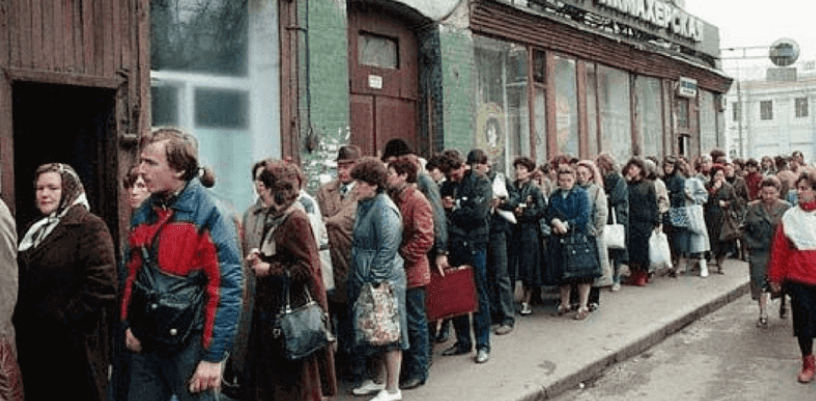
To use a not-so-long-ago example from Marxist establishments of, say, Soviet Russia (Moscow Version):

Whether the famously-impatient Noo Yawkers will stay as docile as their Moscow counterparts will be established on Day One of this Glorious Leap Forward — let me get out ahead of the thing by stating that there’ll be riots and rampant looting, you betcha.

But hey:  never let it be said that I stood in the way of stupid people making stupid decisions and trying stupid experiments, especially when the victims of said stupidity actually voted for all that.

I look forward to Comrade Mamdani’s “new” initiatives (and their unexpected! outcomes) with great anticipation, as will Reader Weetabix and the rest of you.

Let the (Hunger) Games begin.

Don’t Care

Of course we saw this coming:

Walmart is warning it plans to raise prices due to tariffs, despite the fact April’s Consumer Price Index (CPI) showing President Donald Trump’s tariffs did not affect consumer prices.

Walmart CEO Doug McMillon issued the update during an earnings call on Thursday, stating that they will try to keep prices “low as possible,” but the reality is, they are unable to absorb all of the costs due to tariffs.

“But given the magnitude of the tariffs, even at the reduced levels announced this week, we aren’t able to absorb all the pressure given the reality of narrow retail margins,” McMillon stated, adding, “The higher tariffs will result in higher prices.” 

Utter bullshit.  As far as I can see, the tariffs may have affected the price of Chinese goods, but if anything, the goods made in places like Thailand, Taiwan and Pakistan should be reduced with all those other countries getting lower or non-existent tariffs.  So yeah, some of Walmart’s prices on Chinese merchandise should go up, but what they’ll do is raise all their prices to minimize the much-higher Chinese prices.  It’s called “spreading the load” in retail-speak.

Don’t care, because I’ll just stop buying non-foods at Walmart until things quieten down, and buy only the foodstuffs there that I absolutely cannot get anywhere else.  Last time I looked, that’s only one product, and amazingly, it’s made in the U.S.A. anyway.

Besides, if Walmart were truly committed to keeping prices lower, they’d improve their efficiency by ditching their fucking ultra-woke DEI practices — which would never have been instituted in the first place had Sam Walton still been around.  But they’re not going to do that, are they?

Feel free to do what you think is proper in your own circumstances.

But for me?  Toodle-oo, WallyWorld.

BFD

The above title does not stand for “Big Fucking Deal”, although given the average tenor of this website, you may be forgiven for thinking so.

In the grocery retailing business, BFD stands for “Best Food Day”;  that day of the week when grocery stores launch their weekly price discounts on selected items.

The actual day varies from chain to chain, or from one area to another.  Back when I was in the business, one chain’s BFD was on Thursdays, when they dropped their weekly flyer (called a “roto” because of the printing process);  their competitor’s might be on a Friday to capitalize on the weekend’s expected sales uptick, and yet another competitor — whose typical shopper might trend towards an elder demographic — might have their BFD the day after Social Security payments were made… and so on.

Nowadays, I think the BFD concept might have disappeared to a greater or lesser degree because of changes in shopping habits by customers, whether online, delivery, at-store pickup and Internet deals.

I’ve certainly noticed this at Kroger — where I do perhaps 90% of my shopping — because not only have they de-emphasized the roto (the price deals aren’t as aggressive as they once were), there also seems to be a large number of Internet-delivered promotions that you have to visit their website to activate.  And of course, there are the “loyalty card-only” deals which are their way of tracking customer shopping habits (I think;  I haven’t seen much in the way of targeted deals the way I used to deliver them — a topic for another time).

In case anyone’s interested about the other 10% of my grocery shopping, it’s split between Market Street (a Texas chain, owned by Albertson’s) and Wal-Mart, both only for very specific items (e.g. Market Street’s French baguettes and rolls, which are superb and rival the baguettes I tasted in Paris).

Side note:  when I still lived in Plano, I shopped a lot at Central Market (H.E.B.’s upscale outlet), but they saw fit to discontinue several of my favorite products which they carried exclusively — e.g. Old Forest Salami and Jambon de Paris  sliced ham — so there’s no need to go there anymore.  And in any event, their prices were stratospheric before, but since Bidenflation have become frankly unreachable to One Of Fixed Income Like Me.  Also, their South Plano store is now too far from my place to justify the long trip, so there ya go.

By the way, I see that eggs are now selling for $3.99/dozen at Kroger — by “eggs” I mean eggs that we peasants generally eat and not the boutique premium stuff hatched in coops run by virgins and laid by hens sprinkled with holy water.  Limit 2 packs per customer, but not enforced if you buy two packs, take your groceries out to the car and then go back into the store and buy another two, etc.  (Once again, I used to enforce limits by putting a stop on the loyalty card daily quantities.)  Although I cannot see who would need more than two dozen eggs per day unless you have four teenage sons and/or are running a commercial home bakery as a sideline.

I forgot where I was going with this post, but I assure you there was a point to all of it — I just can’t remember what it was.  If I do remember (doubtful), I’ll follow up some other time.

Well… Bye

Reader Mike L sent me this little news snippet:

Macy’s bosses are forging ahead with store closures as they look to reinvent the 166-year-old retailer.  The troubled department store chain announced in February that it would shut 150 over the next three years – including 55 by the end of 2024.   It will be left with just 350 stores – a far cry from the peak of around 1,100 in 2008. Since then it has been in steady decline.  Macy’s has yet to announce exactly which stores will be affected, but employees are speculating whether their location could be on the chopping block.

…and I don’t care.

I’ve hated those New York bastards with a passion ever since they bought the exquisite Marshall Field’s* in Chicago and turned it into… well, Macy’s.

I hope they all perish.


* probably the best department store in the world during the 1980s and -90s.  Their Rare Books Department alone was worth any four departments in Macy’s.  Unsurprisingly, it was the first department that Macy’s eliminated.