
Quality Stuff

I try to be sensible and logical and so on, but I will admit to a weakness for quality (“luxury”) items, across almost all categories of living.  Of course, I don’t have the wallet to afford any of them anymore, but I’d still prefer to drive, say, an Audi instead of a VW.

This philosophy does clash — frequently — with commonsense as I muse on such things, but the lure of quality still gets to me.  And as Longtime Reader Mike Of The Dueling Pistols so eloquently said when talking about watches“You know why I own a Bremont and an IWC? The same reason I own a Hammerli… I like it. My bills are paid, why not buy something I enjoy with the money?”

Amen.  In Daphne du Maurier’s novel The Progress Of Julius, the protagonist is a man who starts off as a street urchin in North Africa and ends up becoming enormously wealthy in Britain.  I don’t remember the exact words, but one night he thinks about the fact that he now wears silk shirts, and wonders if he could ever go back — and realizes that he couldn’t, because luxury is seductive.

And it is.  On the very few occasions when I’ve been able to afford a real quality item, I always felt good about it, and it always repaid my investment in spades.  An example:  back when I was a pro musician, I could have got by with playing a $400 Fender Precision bass guitar, but instead I bought a $1,200 Rickenbacker.

The very first time I played the Rick, I felt a rush of something — enjoyment and satisfaction, I suppose — because I was playing the best bass guitar in the world and good grief… it sounded fantastic.  That’s not a knock on the Fender, by the way:  the old P-bass has been played by bassists far better than I, it’s super-reliable and sounds just fine, and if for any reason the Rick hadn’t been an option, I’d have got the Fender and been quite happy with the thing.  But it wasn’t a Rickenbacker, and it became my (and the band’s) signature sound over the years.

I feel the same about lots of life’s little toys:  cars, watches and guns being the categories where I’m most prone to going for the spendy, so to speak, and which tendency will be well-known to Longtime Readers.

So just as an intellectual exercise, I’m going to do the same for them as I’ve done for bass guitars:  post a perfectly-good choice, against what I’d really like to own.  Note that I’m not going to post a “budget” item — I never even considered a cheap bass guitar like Epiphone or Squier, for example, even though I was quite poor at the time — but only something that’s of (very) acceptable quality.  So here goes:

1911s:  Springfield G.I. and  Ed Brown Kobra

There’s nothing at all wrong with the Springfield — there’s one on my belt as we speak — but the Kobra is exceptional, and I lust after it bigly.


Bolt-action rifles:   Ruger Hawkeye and  Mauser M12

Once again, there’s nothing wrong with the Ruger — I got one for Boomershoot, as you’ll recall — and it’s a perfectly good rifle… until you fire a Mauser M12.  (Both the above, by the way, are chambered in 6.5x55mm Swede.)


Side-by-side shotguns:  AyA No.2 and David McKay Brown Round Action (note:  as we all know, you can go nuts when it comes to fine shotguns — Purdey, Holland etc. — so I gave myself a price ceiling of merely “expensive”, and second-hand to boot)The kicker here is that you can get a new AyA for about $6,000, and a second-hand McKay Brown can run around seven times that, because machine-made vs. handmade.  Indulge me…
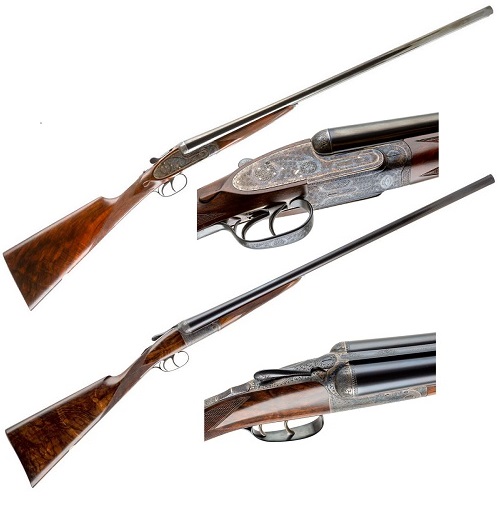

Watches:   Longines Flagship and Jaeger-LeCoultre Master

…and I didn’t even have to go super-pricey on this:  the Longines runs just under a grand, and the Jaeger just under five.  I’ve owned a Longines before, and I still regret getting rid of it (because poverty);  but Jaeger watches are both lovely and super-reliable.

Fountain Pens:  Sailor 1911 and  Pelikan Souveran 800

For when you want to sign that important contract, and the Bic just won’t cut it.  The Pelikan costs nearly three times the Sailor, but Pelikan… I don’t think they make a “regular” pen — all their models are excellent.  If you have big hands and need a thicker barrel, then try the Cross Peerless 125. (And Montblanc Meisterstuck pens are fine — they’re the Rolex of pens — for those who want to be seen using one.  My budget Pelikan writes better, in my hand.)


Classic Sports Cars:   1967 Corvette Stingray and  1957 Mercedes 300 Roadster

This one’s not even close.


Modern Saloon Cars:  Mercedes S560 (4-liter V8) and  Bentley Continental GT Speed (6-liter W12)

Y’all know that I’m holding my nose with this one, because modern cars are almost all fugly.  If I had  to own one, however… but I cheated.  Because while a new S560 costs around $130k at the above dealer, an extra 5 grand gets you a secondhand Bentley, with less than 10,000 miles on the clock.  As with the earlier car choice, this one isn’t close, either.

Feel free to list your “quality” options in Comments — they don’t have to be the most expensive you can buy, just better than the average or typical.  And please:  I’m not interested in hearing from people who are perfectly happy with their 1983 Dodge Whatever, Casio Digital and inherited Winchester 100, and see no reason to upgrade any of them, ever.  Play the game.

Insiders

I see that the Fibbers are investigating a U.S. Senator on suspicion of insider trading:  good.

Burr drew the attention of lawmakers after it was revealed he sold off thousands of dollars worth of stock on February 13—less than a week before the stock market sharply dropped because of the coronavirus pandemic. Most of the shares were in companies like Wyndham Hotels and Resorts and Hilton that took an especially hard hit as coronavirus travel restrictions went into place. Burr’s timely decision to sell netted him between $628,000 and $1.72 million.
More troubling is that Burr’s decision to sell came as his committee was receiving daily briefings on the threat posed by the virus. As such, many speculate the senator may have acted on insider information to protect his assets. If true, Burr could be found in violation of the STOCK Act, which prohibits the use of non-public information for private profit by lawmakers.

For people who can’t understand how politicians can come to Washington as “thousand-aires” and leave as millionaires after getting only a Congressional salary:  this is one of the ways they manage it.

And I don’t care that he’s a Republican, although I wish the Fibbers would go after all these dishonest pricks with the same zeal, regardless of party.

Yeah, I know:  I should be using the word “alleged” and “suspicion of” all over the place.  Let’s just say that I hold elected officials to a higher standard — they should behave circumspectly to avoid even the suspicion of wrongdoing.

What gets me is the stupidity of the action.  Had Burr, or anyone else for that matter, bought the hotel stocks after the price plunged (to be sold later at a profit when the share price rebounded), he’d have made just as much money.  But no:  let’s avoid losses, even paper losses, at all costs.  Greedy fucker.

And if the Fibbers find that Burr’s phone records show that he’d placed the sell orders last year and not right after he had a committee briefing, then I’ll apologize for all the above.  Somehow, though, I don’t think I’ll be apologizing.

The Way Forward

As any fule kno, Insty has put together many excellent posts during his long and storied reign as the King Of The Internet.  This one is not only one of his best, but almost certainly the most timely.

The title is excellent:

FASTER, PLEASE: Unleash the entrepreneurs America needs to build a post-coronavirus economy.

The first link is good, but it’s the second link that sets the post apart from the pack, because it points to history as a way to move forward.  Please read this Reason article (it’s long, but oh-so worth it), and I hope that our various gummint “leaders” read it too.  (I’m not too sanguine about that, though.)

Basically, the “German Non-Miracle” is of particular interest to me because in my major of Modern European History we spent almost an entire semester studying just the period 1945-1990 in West Germany.  What made the course extraordinary was that my lecturer at UNT, the peerless Dr. Alfred Mierzejewski, was not only an economic  historian, but the author of the biography of the man behind West Germany’s recovery, Economics Minister Ludwig Erhard.  (His other two works on the German railway system from 1920 until 1945 are, despite their dry titles, probably the most thought-provoking history books I’ve ever read.  They are to the history of that period as a study of the economic implications of the  Internet would be to our era.)

Needless to say, I devoured the course and read the biography (it wasn’t a set work, although it should have been), and my only wish was that it had been longer.

And for those who are Too Damn Busy to read anything longer than a few lines, here’s the executive summary of the lesson for our modern-day governments as we try to pull ourselves out of the morass of the Chinkvirus-ravaged economy:

Dirty Minds

There’s the old joke of a guy whose wife forces him to go and  see a pyschologist because he’s obsessed with sex.  The psych wants to test him, shows him this pic and asks the man to tell him what he sees:

The man says, “That’s my hard, rampant cock.”  The psych looks puzzled, but shows the man the next pic:

“Oh,” says the man, “That’s my sexy next-door neighbor’s inviting pussy, just waiting for me to stick my big, hard cock into it.”   The last pic is shown:

“Aargh,” the man cries, “That’s my frigid wife, with her legs crossed so I can’t fuck her.”

The psych makes a note and says, “You really are obsessed with sex, aren’t you?”  To which the man replies:

“Well, you’re the one showing me those filthy pornographic pictures!”

In that vein, here are some pictures of similar suggestiveness:

And finally, the importance of not going with first impressions:

The story behind the Swisse Me fruit pics is here.  Watch the video.

Oh, and speaking of fruit, here’s the album cover from 70s band Juicy Lucy:

I miss album covers.

Life, Art, Imitation Thereof

One of my favorite-ever literary passages is in Joseph Heller’s Catch-22, when Yossarian walks into a bedroom to discover that his lunatic navigator Aarfy has just murdered a prostitute by throwing her out the window.  While he’s remonstrating with Aarfy, the military police burst into the room — and arrest Yossarian for being AWOL.

Thus, this:

Teenage girls who were raped while out for a walk during Russia’s lockdown are threatened with FINES for breaking coronavirus restrictions

I know that this was in Russia, where strange shit happens every day;  but I would suggest that the bureaucratic mindset behind this kind of thing is universal.