(Previous: Chapter 1, Chapter 2, Chapter 3, Chapter 4, Chapter 5, Chapter 6)
Chapter 7: Changing Pussyfoot
One of the better things that happened to me that year was that I discovered that Shalima had left their favorite coastal venues and were now playing at the OK Corral, a well-known club just to the east of Pretoria. So I drove up there (about forty miles), met up with the guys, and the result of that reunion was that they came over to my parents’ house on their off night (Monday) for a massive braai (barbecue), during which time vocalist Tommy distinguished himself on two occasions by saying of my mother, “Oh hell, I’d do her,” followed by referring to my father as a “Dutchie” (derogatory term for Afrikaner); one of the other guys bonked a groupie (don’t ask, I don’t know how she got there either) in the downstairs bathroom, and Max had a long and very interesting discussion with my dad. Of course, some of Pussyfoot were also there — Knob, Kevin, Donat, as I recall, although Mike might also have come over. (Clifford hadn’t been invited.) There was much carousing, eating and drunkenness, as any band party worthy of the name would include, and I was really glad to introduce my guys to the band which had so influenced me. Tommy also regaled the guys with the story of how they’d surprised me that night back in the dining room at the Margate Hotel (“I swear, I thought it would just be the usual nightclub shit, but they played some serious jazz, and I’ll never forget trying to put Kim off reading his music, and failing” ). I went back up to “Okies” a couple more times to hang out with Shalima, then their contract ended and they went back off to the Natal South Coast once more, and I got back into getting Pussyfoot “gig-ready”.
As I’ve said before, there wasn’t much “show” in the Pussyfoot Show Band. Knob and Mike were trapped behind the drums and keyboards respectively, and Kevin and Donat were not showmen, being mostly concerned with playing the music perfectly — thank goodness. Which left the whole thing up to the bassist and vocalist. Unfortunately, while the bassist had no problem temperamentally with leaping insanely around on stage, he was often kept in check by a.) having to concentrate on playing his instrument — still very much a problem — and b.) singing harmonies in songs which required them, i.e. most.
Which left the vocalist. Sadly, not only was the vocalist not interested in performing on stage, he was not (to be honest) of the physique and appearance which could enable him to do same without looking like some kind of performing elephant.
Clearly, though, something had to be done about this problem (the “show” part, not the vocalist — yet), and so I set about designing a light system to help things along.
Some words of explanation are necessary at this point. Unlike in the U.S., most South African venues did not have a house P.A. system, and only actual theaters had any form of stage lighting — not that this would have helped, because that would have involved getting stage hands involved and we couldn’t afford to pay them. We’d sort-of addressed the P.A. issue, but there was no question about getting lighting: it was up to us. So I set about building a light system, trying to copy what other bands were doing at their gigs.
It was obvious, though, that whatever system we designed would have to be both portable and easy to set up/break down, by every member of the band. This meant no overhead lights (all those tall stands? not going to happen), and therefore floor mounts were the only solution. So I built wedge-shaped floor stands — one for each of us — with each stand containing two light sockets. For the actual lights, I used 100w Par-38 floods in various colors. (The Par-38s were fantastic: while very expensive, they were long-lasting, very robust and survived being kicked by Clumsy Kevin on more than one occasion.)
The problem was that I wanted to control the power so that I could manipulate which lights were on at any given time: two lights for the lead singer, one each for everyone else, or else two for everyone, or just one for everyone, or just a couple at random (for quieter songs). I’d also found a strobe light, which required all other lights to be off, for maximum effect. And of course, the power had to be controlled by a series of foot switches because I wasn’t going to be able to play bass and manually flip switches on and off — hell, it was hard enough for me just to play the bass semi-competently, let alone do all that other stuff simultaneously.
Where were we going to find a switching board that could do all that? Well, there was no such thing on the market. So I told Donat to build one and wire it together. (You will recall that said rhythm guitarist was studying electrical engineering, so duh.) And he did. I even managed to find foot switches that had a little light to indicate whether it was on or off, although they weren’t very robust.
We were to use this lighting system for the next eight years.
The next thing we had to do was be more showmanlike, which was problematic for the reasons I’ve noted earlier. So I decided to start including more comedic material in our repertoire.
Side note: When I say “I decided”, it was absolutely not a case of me coming up with a decision and the band following it obediently. We were no Shalima, and I was certainly no Max. Every single idea that came up — whether mine or someone else’s — had to be supported by all if not almost all of us before we adopted it. The lighting was an easy one; choice of songs and such: unbelievably difficult. In the end, we didn’t succumb to “minority veto” issues unless one or more of us absolutely hated the song. (We had discovered that if someone felt that strongly about it, the song always sounded like crap.) All our material had to be “blessed by the Pope” in that a.) we had to like it and enjoy playing it or b.) we decided jointly that while we might not especially care for it, if inclusion of that material was important for the performance, we’d go ahead and learn it, and commit to playing it well. Because that was the professional attitude, after all. Which is how we came to play utter crap like the Pina Colada song and anything by Wings. (Okay, I’m being flippant: we actually enjoyed playing Jet.)
We had expanded our repertoire to include many “soft” popular ballads — Engelbert Humperdinck’s Last Waltz, Spanish Eyes, and Tom Jones’s Green Green Grass of Home and Delilah, for example — but the problem was that over time, we got heartily sick of playing them. (It’s the curse of playing in a band: as much as audiences may enjoy hearing a song, they’re probably hearing it only once — as performed by the band — whereas the band may have been playing it for years. And it’s not just the ballads like the above; even popular rockers like Proud Mary can get old over time, and get dropped from the playlist.)
Anyway, we started messing with the lyrics because to be quite honest, most people on the dance floor either don’t know or aren’t listening to the lyrics anyway, and it gave us an inside joke to chortle over. Paul McCartney’s Silly Love Songs, for example, became Sticky Love Songs, and “Sometimes it comes within a minute / Sometimes it doesn’t come at all” was transformed into “Sometimes I come within a minute / Sometimes she doesn’t come at all”, and so on. Occasionally we got carried away, such as when we changed the old rock ‘n roll refrain from “Awop-doowop, awop-pop-doowop” into “cock-sucker / mother-motherfucker” but in all the many times we played that particular little lyrical game over the years, I think we were only ever caught out once, which goes to show).
I’ll give a couple more examples of this as the story unfolds.
As I recall, we did a couple of small gigs — wedding receptions — and then we got our Big Break (or so we thought).
I think it was Knob who learned that a Portuguese dinner/dance club was looking for a band, and arranged an audition. By this time, we’d left my parents’ house — my dad had passed away, and my mom was in the process of selling it — and had rented space in an unoccupied office building in downtown Johannesburg. This was great because while the central business district (CBD) was busy during weekdays, it emptied out at night and was almost deserted over the weekends, so we could practice as loudly as we wanted, unlike back at my parents’ house where we had to be careful of complaining neighbors.
Anyway, came the day of the audition, and we met Silvinho Pereira, the owner of Una Casa Portuguesa. Of course, he preferred that we played Portuguese music, of which we knew not a note, but we somewhat mollified him by playing all sorts of “Latin” stuff (thank you, Carlos Santana!) and of course standards like Girl From Ipanema and Quando Quando Quando. He seemed satisfied, and agreed to sign us to a three-month contract for Fridays and Saturday nights — the proviso for extension being that we learned some Portuguese songs (which we never did). Our only proviso was that we could practice on Monday nights, when the restaurant was closed, which was fine by him. Oh, and he wanted to pay us by having us take the door covers as salary, but Knob nixed that idea (thank gawd) and insisted on us being paid a salary — we agreed to a reduced per-night fee compared to our standard gig charge (about R400), because with all the gear permanently set up in the room, it was a huge relief for us not to have to do the gig thing by packing it into Fred, setting it up at the venue, then taking it all apart, repacking it in Fred and then driving it back to the practice room and setting it up all over again for the next practice. The lack of hassle more than made up for the lowered income.
So after signing the contract, Knob and I went to the club one night to check it out. It was in an upstairs location on the seedier side of Johannesburg’s CBD, but the restaurant itself was small and intimate, and we could see to our dismay that our repertoire was going to have to be nightclub music only. We decided to try the menu out and ordered dinner, and while we were eating the current house band arrived and started to play, and we discovered that they played loud club music almost exclusively. Oh, that looked good for us; and when I chatted to the band’s leader during a break, he told me that the usual format was soft stuff during the first two hours during the dining period, and then the band could cut loose for the remaining two sets. When I asked him why his band was leaving, he just grinned and said, “You’ll find out”, which made both Knob and I very nervous. Still, we’d signed the contract, so that was that. And so began our very first club gig at Vasco Da Gama: Una Casa Portuguesa.
Kevin
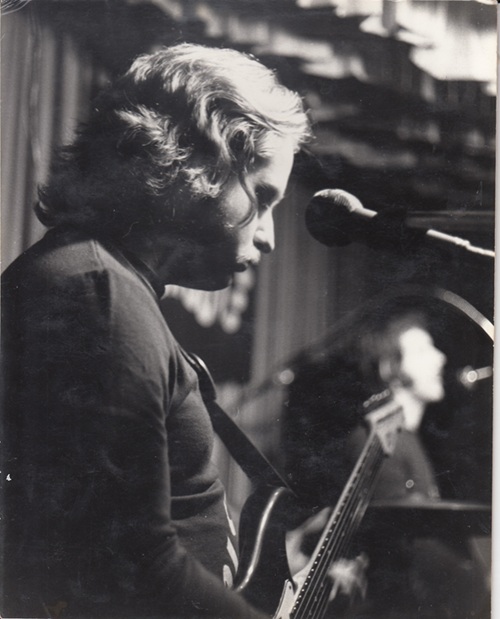
Kim
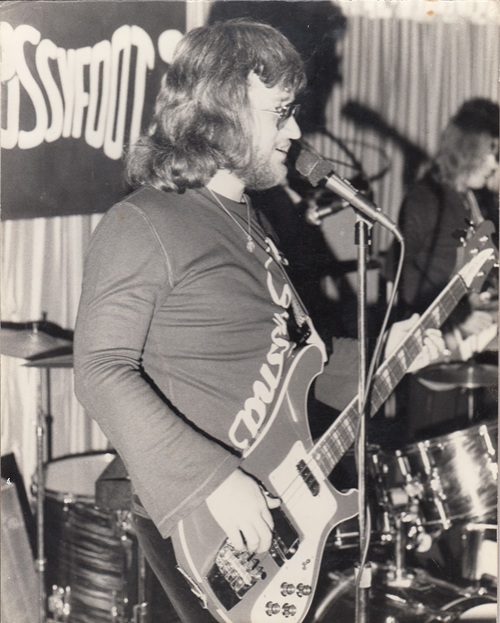
Knob
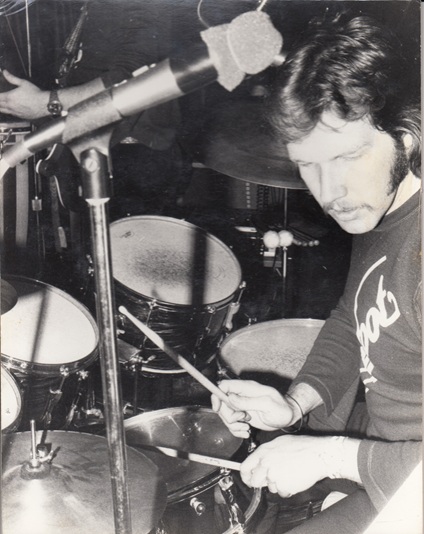
Donat
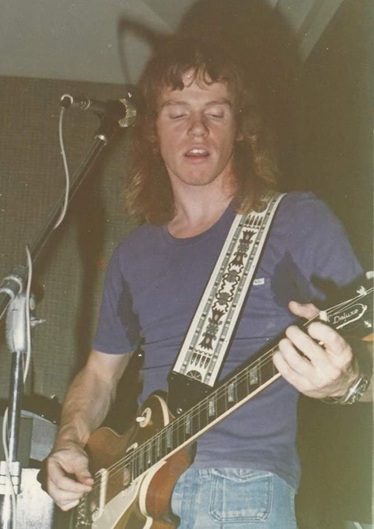
(at practice — his Vasco’s pic has been lost in the mists of time)
Mike
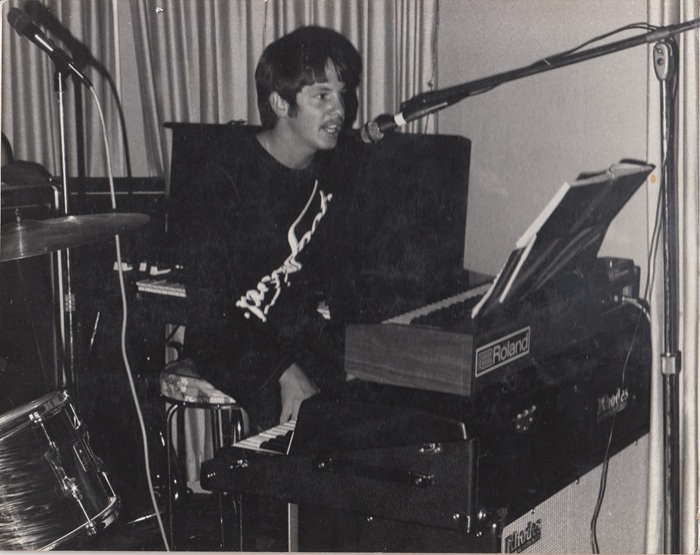
(with his post-Army hairstyle, see below)
There are so many things to be said about Vasco’s. Chief among them was that we could eat anything on the menu, provided that we paid for it — and the food was not cheap. The “staff meal”, though, was a free option. In Silvinho’s words: “It’s a kind of a… a Portuguese casserole, made with pork and a creamy sauce.” (Translated: tripe stew, and pretty much inedible.) We tried it once, and thereafter either ate at home beforehand (which was most of the time), or else the cheapest item on the menu (fish soup and Portuguese bread, which was actually quite delicious, but far from filling).
Another noteworthy thing about Una Casa Portuguesa: no customers. Silvinho seemed to think that a monthly classified ad in the local Porro weekly newspaper (circulation: dozens) sufficed as “advertising”, and when we complained, he upped the ad to a weekly event (what he called, “Going heavy into advertising”). It was a rare night when the customer count ran over two dozen, and most often it was less than that. I have no idea how he stayed in business — probably by laundering cash for the local Portuguese criminal gangs, it wouldn’t surprise me.
At first we didn’t care too much, because we were getting paid regardless. But it was a little soul-destroying to play a new song (that we’d spent three whole practices getting right) to an audience of three couples. Most of the time, though, all the diners left right after dinner, and we were thus free to play the stuff we really wanted to play, which was not Spanish Eyes.
What we did, though, was sharpen up our playing, and our act. I worked out a lighting “set” for every song on the playlist, and it changed the ambience of the stage completely — once I got it to work, it made playing much more pleasurable for everyone. And while it may seem that playing a show only twice a week wouldn’t make the band tighter and more disciplined, it did; that, and the weekly practice (and sometimes two weekly practices) made us better: a lot better.
A fat lot of good that was, however, when we played to an empty room. And the effect of that situation was, as we discovered, getting Silvinho to pay us was like pulling teeth. The terms of the agreement were that we were to be paid weekly, at the end of the Saturday night set; but somehow Silvinho always found some excuse not to do so, with the result that we were getting paid a week and sometimes even two weeks in arrears. (When I bumped into the previous band’s leader one day at Bothner’s and complained, he just laughed and, “Now you know why we quit the gig.”)
But we soldiered on, because that was the professional thing to do and all told, it wasn’t all that bad — as it turned out, we were not offered a single one-night gig during our residency at Vasco’s, so it’s not like we were passing up anything.
Then: calamity. With three weeks to go on the contract, Mike informed us that he’d been called up for an Army Reserve commitment (known colloquially as “camps”). Oh how nice: four nights without a keyboards player. But there was help on the horizon, and it appeared in the form of my old high school buddy, Gibby.
At this point, I need to talk a little bit about Gibby, because he warrants it.
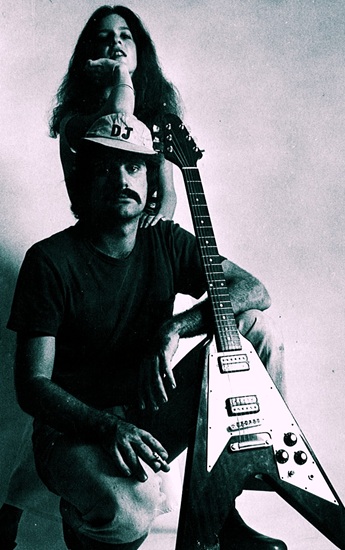
(about the groupie: I have no idea, and nor does his wife)
Gibby came from a very musical family, and could play pretty much any instrument you care to name: piano, organ, guitar, bass guitar, bugle (from the school cadet band days)… put in his hands, and he could play it, often with incredible skill. Of course, having been like me a Leading Chorister in the College choir, he could read music like he was reading the newspaper, and his vocal skills… well, unlike me, he was still singing in the Old Boys’ choir, so no more need be said.
As it happened, he was living just outside Johannesburg at the time, and so I asked him to come and help us out on keyboards. When I broached the substitution to the band, they were of course very apprehensive. Fortunately, Mike hadn’t yet left for his camp so he coached Gibby on our playlist for a couple of practices, which was all the rehearsal my talented friend needed, so we continued to perform without a hiccup and barely any difference in our sound.
The one night we became a true show band. We’d learned the wonderful Sweet Transvestite song from Rocky Horror Picture Show, and it was really popular (to the few Vasco’s patrons who ever heard it, that is). Then we heard that Gibby’s older brother Martin had rounded up six of his buddies and their wives, and was coming for dinner to see what his Kid Brother was doing with his “little band”. Unfortunately, he happened to say the latter in my presence… so we changed it up a little.
Instead of doing the piece just as a straight song, we got Gibby to don a Tim Curry-type outfit and sing the main vocals. Then, as Big Brother was sitting at the stable amidst his group of friends, Gibby strutted across the dance floor, plonked himself in Martin’s lap, and sang the whole song in that position. Of course, the whole restaurant got in on the joke, and I will never forget Martin’s clenched jaw and fixed smile as Gibby draped himself all over him and hammed it up in true Frank-N-Furter style.
And here’s where the whole thing got a little messy.
You see, Gibbyy had essentially played Cliff off the stage with his performance — and most especially his voice. Frankly, he could have taken Cliff’s job right then, and we’d have had not only an excellent singer but another instrumentalist to boot.
So one day when Knob and I were alone together, we got to talking about just that. Unfortunately, Gibby had just been offered a job in Durban — he was an architect — so he wouldn’t be able to take the gig (and playing professional rock music had never been in his plans anyway). But as I said to Knob, it was clear that at this point Cliff was more of a burden on the band than a valuable member. And playing for as little money as we were, the already-paltry weekly salary was being split six ways, which meant that we were in essence playing for almost nothing.
I was really nervous about saying all this, because Cliff was really his good friend. But to my surprise, Knob didn’t argue the point but said simply: “Let’s discuss it with the other guys.”
So a few days later we took a vote, and Cliff lost. We fired him at the next practice. He was not pleased about the firing, and made it a lot more unpleasant than it needed to be — in fact, he and I nearly came to blows, but luckily (for him) he backed off, because I detested him so much I would have killed him.
In the ordinary scheme of things, we’d have been left with a gaping hole in our repertoire; but after Cliff’s departure it was almost as though he’d never been in the band. Between Knob, Kevin and I we picked up the vocals for all but a couple of Cliff’s songs, and in fact a number of songs were actually improved by the substitution. (Here’s one example: Cliff had always hated doing the Spanish Eyes-type songs, and so he had always just gone through the motions in singing them. But when Rob picked up the vocals for Spanish Eyes, the song actually became excellent: his warm tone was far more melodious than Cliff’s tortured tobacco rasp, and the ballad became a permanent early-night fixture on our playlist.)
When the Vasco’s contract came to an end, Silvinho told us he wasn’t going to extend it, and he was actually aghast when I snarled at him that we wouldn’t have accepted the extension because we were sick of begging him to pay our salary all the time, and we were sick of playing to an empty room anyway. We still had one weekend to play, and either Knob or I made it very plain to Silvinho that we expected to get paid the full amount owed immediately after the last set ended on the Saturday night. (I think I said, “And if you don’t pay us, we’re going to fuck your restaurant up.” Sometimes, you just gotta.)
And on that final night at Vasco’s we got a surprise. I’d told Eds Boyle at Bothners about our gig there, and he’d told a few other pro musicians about us: with the result that on that night at about 11, the normally-somnolent Portuguese restaurant was invaded by over a dozen loud and raucous musicians, who proceeded to drink all the beer in the bar as they listened to us play not only our final set but an extra one thereafter — and believe me, we really cut loose.
The other musicians refused to let Silvinho close the place afterwards, so we all sat around and got shitfaced drunk until about 3am (and yes, Silvinho paid us out in full — helped undoubtedly by his enormous bar take for the evening). We then packed up all the gear — “we” being Pussyfoot; no way were the other musicians going to help us, oh no perish the thought — and thus ended our first club gig. It was also our last club gig… as Pussyfoot.
However, one lovely surprise was that playing at Vasco’s gave us a chance to get booked for later gigs.
Because Pussyfoot was an unknown (and salacious) name on the Johannesburg gig circuit, people were usually reluctant to book an unknown quantity for their Big Day (wedding reception, office party and so on), so when we did get an inquiry, it was always coupled with a request for an audition. We had nowhere for people to come and listen to us, so often we’d ask them to come to a gig to hear us, or else to our practice room where we’d play just about anything they asked us to play. But at Vasco’s, there was an excellent venue for prospective customers to come and listen to us, and I don’t remember the exact number of gigs we landed as a result of that, but it was at least a dozen. So we were going to be busy for the foreseeable future — and I’m pretty sure that this was no small factor in our decision to fire Cliff. Money talks, and to an impoverished semi-professional band, it spoke extremely loudly.
The usual scheme of booking a “name” band was as follows: contact said bands, and see who was free, and who was affordable. The number of gig bands was actually quite small: from memory, the main ones were The Rising Sons (Eds Boyle’s band), the Bats, Four Jacks And A Jill, the Staccatos, Black Ice (more on them later), Hudson Show Band, The Bassmen and one or two others whose names escape me. All those bands were unbelievably busy, playing every single weekend night of the year as well as a couple of other days on special occasions. Some (the Sons, Four Jacks, the Bats and the Staccatos especially) had actually had Top Ten hit parade songs, so everyone knew their names. If none of those bands were available, then people would have to cast around and look for someone else — and this was not an easy task.
What started to happen, though, was that as more musicians came to know Pussyfoot and the fact that we were a serious band, we would get referrals from those bigger bands, from Eds and The Rising Sons especially. Why Eds, especially?
My sister’s senior prom night (known back then as the “Matric Dance”) was coming up, and as it happened, Kevin had been invited as my sister’s partner and Donat as her best friend’s. My sister knew a girl in her class who was an “international” student — her parents were living in Italy, as I recall, because her father’s job had taken them there — and of course, being a recent arrival at the school, she had no date. So my sister set the poor girl up with me: and when we arrived at the dance, who was playing the gig but The Rising Sons?
Of course, the three girls got huge boosts to their social standing by their dates knowing the famous Rising Sons, and the boost was raised still higher when the three of us were invited to play a couple of songs with the band’s drummer and keyboards player. By now, we were seasoned veterans at this kind of thing so we blew the doors off the place — Dave Campbell the drummer being the most impressed — and when it came time for the after-dance party (held at our house because it was only about a half-mile from the school), the Sons came along, and a fabulous time was had by all.
Thereafter, whenever the Sons got a request for a gig but were already booked, Eds passed the gig off to us. I lost count of how many there were, but it was a considerable number.
Then one day Eds came to me and offered me a job at the Bothners music shop, where he was the manager of the musical instrument department. The job carried a basic salary plus a commission on sales I’d make. Wait… work with musical instruments and musicians all day and every day, for only a tad less money than I was making as a lousy computer operator at an insurance company? Was there even a question what I’d do?
And it was then that I got to know all the professional musicians in the whole country — the whole country because every pro band ended up playing in Johannesburg at some time or another, they’d come to Bothners for their instrument and accessories — and Eds knew all of them because he’d been part of that scene since the late 1960s.
The job also required going to all the clubs in Johannesburg, Pretoria and the surrounding area known as the Witwatersrand: hanging out with the bands, talking music to them and of course telling them about the cool new gear we had in stock or were about to get from the warehouse (hint, hint). As much fun as that sounded (and it was), there was of course serious business involved — but as Eds advised me: “These guys have pretty much got all the gear they need, so don’t try to sell them anything. That’ll just piss them off. Treat it as a PR thing: keep our name out there, make them your friends, and of course they’ll come to us if they need to.”
On one occasion, Alan Hanekom from Hudson Show Band ran into the shop on a Saturday morning right as we were opening and told us breathlessly that all three of their guitars had been stolen after their gig the previous night, they needed new ones for their gig that same night, and could we help them? Well, of course we could, except that we didn’t have two of the three — a Fender Telecaster and a Gibson Les Paul Custom Deluxe — in stock at that particular moment. But Eds made a quick call to the warehouse, and they did have them on hand. So I jumped in Fred and raced over to pick the things up while Eds took care of the paperwork. Alan was truly astonished that we would help him out so quickly and with such an effort, but Eds just laughed and said, “Both Kims and I play gigs, Al — we know what’s important here.” And another longtime and loyal customer was born.
And so the next six months or so passed pleasantly by, marred only by the fact that Donat announced that he was leaving the band.