My Choice

Met up with Reader Jim and his lovely wife at the range yesterday at the Real New Year’s Day Shoot, and learned something  — or rather, re-discovered something.

You see, Jim’s wife had only recently started shooting, and her handgun was a compact HK 9mm with a green-dot sight.  It was shooting rather low for her, and at first I put it down to her flinch (which was quite severe;  clearly, even the mild recoil of the 9mm out of the diminutive HK was a little much for her).  I should note that she is a petite woman, and thus, I thought, the flinch.

But when I popped a few out of the HK, it still held low;  so I adjusted the sight upwards for her until it fired into the desired area.  That problem was solved, but she was still shooting a little low, and that was definitely the flinch.

So I invited her to shoot a few rounds out of my Buckmark:

…and the results were immediate, and very gratifying:  once she’d got used to the trigger, she was putting all ten rounds into a 3″ group, not once, but several times, with absolutely no flinch.  (Yup, it’s strange how much fun shooting a .22 pistol can be, huh?)

I therefore made a mild suggestion to Reader Jim that he purchase her a Buckmark to play with, and once I let go his arm and he stopped screaming with pain, he agreed that this would be A Good Thing.  (Okay, I’m lying;  he agreed immediately, with absolutely no hesitation, and a big grin on his face.)

Here’s a lesson to everyone:  if you’re going to teach someone to shoot handguns, let their first shots be out of a .22 pistol — Browning Buckmark, Ruger Mk IV, whatever — because shooting should be first and foremost a lot of fun, and you’re not going to pick up bad habits (e.g. a flinch) when shooting the .22 LR cartridge.

“So which one would you recommend, Kim?”

It’s all personal, of course.  But I’d recommend the Browning Buckmark — to be specific, this one, the Standard:


…but if Madame prefers something still lighter, there’s the Camper with its alloy barrel-sleeve:

I would stay away from the Micro, because even though it weighs next to nothing, it’s really difficult to shoot accurately at any distance past 20 feet with that lil’ shorty barrel:

Of course, you can go pretty, like with the Medallion:

…and for those of the red-dot persuasion there are these options (among many):

(For what it’s worth, this last — the Medallion Rosewood — is the one I’m lusting after, but as we speak it runs well over $800 including the scope, so I have to decide which gun I want to sell/trade to get it.  Also, it’s quite heavy — speaking for women in general — but the longer, heavier barrel makes for astounding accuracy.)

“So what about Ruger?”

There’s nothing wrong with the Ruger, specifically the Mark IV.  Here’s the Standard:

…the Target:

…and for those who would prefer less rake on the grip, the 22/45:

…which has an advantage in that it comes in a variety of girly-type colors:


And just so we are all on the same page, so to speak, I prefer the MkIV over all other Ruger .22 pistols because for the first time evvah it’s possible to field-strip and clean a Ruger .22 pistol without needing a third hand.  (In fact, the MkIV is easier to clean than the Buckmark, for that matter.)

And I know, cleaning the guns is typically the job of hubby / boyfriend, so this is not a little thing.  (If the woman in your life insists on cleaning her own gun, by the way, hold onto her with hoops of steel because she’s the rarest of all breeds.)

The only reason I still prefer the Buckmark over the Ruger in general is that the Buckmark’s trigger is miles better than the Ruger’s, in fact it’s better than just about any pistol ever made, including the 1911.

And of course there are jillions of other .22 pistols extant, so be my guest.  But unless Milady wants to go all historical / nostalgic with a Colt Woodsman:


…I’d stick to the above two brands.

Oh, and single-action is better than double, because the squeeze is easier for a first-time shooter.

All comments, of course, are welcome.


One final thought:  I’ve personally owned just about every variant of Buckmark and Ruger before, and fired a huge number of other .22 pistols (Walther, SIG, S&W etc.), and that’s why I pick the above two over all of them.  I will confess, however, to having no experience with the S&W SW22 Victory model, but I will happily hear stories thereof.

A Tale Of “Sixties”

Fiend Reader JC_In_PA sends me this article, which compares two old rimfire warhorses (the Marlin Model 60 and the Ruger 10/22) and then invites me to wade into the argument — which he correctly compares to the various X vs. Y arguments in the gun world (.45 ACP vs. 9mm, etc.).

And I respectfully decline the invitation.

You see, I’ve owned both at various times in my life, fired at least a jillion rounds through each — more than a few times at the same range session together — and for the life of me I can’t / won’t declare a favorite.

I love the heavier barrel of the Mod 60 — I shoot it more accurately than I do the 10/22 — and likewise prefer the reloading ease of the 10/22’s magazine over the Marlin’s tube.

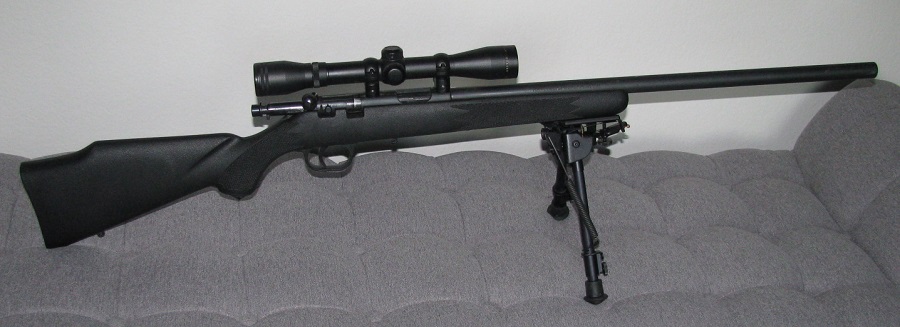
At the moment, I don’t have a 10/22 — if anybody has a spare one that isn’t worn out, I’ll take it under advisement — but I’m not under any pressure to get one because I do have a Mod 60 standing in Ye Olde Gunne Sayfe #2 (alongside its bolt-action brother, the scoped Mod 880 SQ).

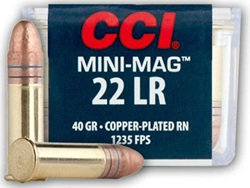
With these two Marlin brothers, therefore, I can indulge my plinking needs, whether in volume at tin cans (60) or when the occasion calls for single-hole accuracy at varmints or swinging plates (880).  I am blissfully happy with either activity.  While both rifles “prefer” CCI Min-Mag ammo, the Mod 60 will shoot just about anything, whereas the 880’s pinhole accuracy tends to drift towards more of a quarter-sized hole.

So yeah, I could do with some kind of 10/22 (because reasons) — such as this one:

…because with my crappy old-fart-eyesight, I need a scope to see the stupid target and one is somewhat limited in scope choice with the Mod 60 because of the scope mount shortcomings;  but I can’t honestly say that the lack thereof is burning a hole in my psyche, either.

What I really want is a Ruger 10/22M (.22 Win Mag) in its “International” full-stock variation:


…but they make hen’s teeth look like a household commodity, and when one does become available, it’s generally at a price which makes my nuts ache and causes my trigger finger to go numb.

Anyway… I seem to have wandered off the reservation here, but there ya go.

Marlin Model 60 or Ruger 10/22?  Take yer pick;  either is a good choice.

By the way:  everyone does own a .22 rifle, right?  Because if not:

It’s un-American.

(Furrin Readers — including those in New Jersey — get a pass on this one, because as we all know, semi-auto .22 rifles are the cause of a million human deaths every second — I read it on Teh Intarwebz, so it must be true  — and that’s why they’re banned in your benighted countries.)

Oh, and the title of this post?

The Marlin was released in 1960, while the Ruger 10/22 was released in 1964, making last year its sixtieth anniversary.

Ummmm

Saith C.W.:

And it is, right up until you pull the trigger.  I’ve had one of these in the past, and let me tell y’all, that teeny barrel doesn’t help with the .357 Mag’s recoil at all.

Carry lots, shoot a great deal less.

New Development

I genuinely do not know what to make of this.

Federal is kicking off 2025 with a bold announcement: it’s “reinventing ammunition.” The company released its new 7mm Backcountry cartridge today, but that’s not even the biggest headline. The Peak Alloy case technology that houses the round is shaking things up even more. 

What wizardry is this?

Engineers were clear that from the beginning, they were working to answer a market call for Magnum velocity out of shorter barrels and tailored to suppressed hunting – all without increasing recoil.

Wait:  building something new in response to actual customer wishes? (Be still, my fainting Marketing heart.)  Are we talking about the gun business?

Anyway, let’s see how they did this:

The physical casing itself is what allowed this round to come to fruition. The case technology, known here as Peak Alloy, is fundamentally different from standard brass casings. According to Federal, the alloy was developed using a proprietary steel alloy that includes other unique elements as a response to United States military solicitations.

The goal is a stronger build that allows Federal to safely increase chamber pressures “far beyond the limits of brass case ammunition, significantly increasing velocity and energy.”

Okay, I get where this is going:  MOAR power and therefore greater velocity coming from the stronger cartridge casing, coupled with lower recoil.  The good news is that they stuck with the tried-and-true 7mm (.284″) boolet instead of reinventing the whole frigging wheel (which would probably have been the case back in the 1990s).

I would love love love to have seen this happen with the 6.5mm boolet — imagine a “new” cartridge casing for my favorite 6.5x55mm Swede — but of course nobody’s going to spend time, money and resources just to please this (my) particular segment of the market.

In any event, these new Wunderkind-Patronen  will of course require a new rifle (as if we couldn’t have predicted that little consequence).

And will these rifles be affordable to our suffering hoi polloi?  Don’t be silly:  just look at the manufacturers who’ve signed on to this little exercise:

…none of whom are renowned for their affordability.  (Although Savage is also slated for an entry, an educated guess will suggest that their guns will likewise be among their existing premium products and not Axios.)

Bah.

Look, I’m sure that this is a great innovation.  But color me skeptical, because at the end of the day, this looks like just another WSSM or Rem Super Magnum product (remember them?  me neither) and yet another attempt to sell more rifles.  There’s nothing wrong with all that — hell, it’s actually a Good Thing, especially in a military context — but it just means that people like myself won’t be participating.

I would be curious, however, to see how this new alloy casing would work in dangerous game calibers such as the 9.3x62mm, .375 H&H or .458 Win Mag, where reduced recoil would be welcomed with open arms.

But that’s never going to happen, is it?

Tried And Tested

And here’s what I was alluding to in the above post.  It’s all very well to go all gooey-eyed over some new whizz-bang cartridge that does x and y better than the older cartridges did x and y.

But I have to ask myself:  how much better, and at what cost?

I have no doubt that the 7mm Backcountry (what will its abbreviation be, I wonder?  7mm BC?  7mm Back?  7mm BCKTRY?) will perform as advertised:  astounding velocity, greater penetration, less recoil, etc. etc.

But if you’re going to drop a premium-priced new product on the market, couldn’t you just get a proven rifle and cartridge to do almost the same thing — bearing in mind that your quarry is highly unlikely to differentiate a boolet arriving at 1,300 foot-pounder from another arriving at 1,100 ft-lbs.

Even better, you could get an old, reliable rifle (such as a pre-’64 Winchester 70) in traditional garb instead of a show-off “operator” rifle of unproven value.  A rifle such as this custom Model 70, in 9.3x62mm:

…or, if we stick to a 7mm bullet, this Wiebe/Kaye Mauser in 7mm Rem Mag:

…and the latter’s barrel, with no iron sights, can easily be shortened, and threaded to take a suppressor.  (I know, they’re as expensive as hell, at well over seven grand each;  but that’s what you get when you start playing with one-of-a-kind custom rifles.)

Let me tell you, I’d take either one of the above out into the field, and not feel hard done by or undergunned.

And still talking about hunting:  I’ve never been that seriously affected by recoil when hunting (except possibly that time with a .458 Win Mag rifle shooting juiced-up handloads — ow, my shoulder just gave me a twinge at the memory);  and in any event, recoil is most keenly felt when firing lots of rounds on the trot, which doesn’t happen when hunting.

It does matter if you’re doing target shooting, of course, where you will be firing lots either in practice or during the event itself.  And this might be where the 7mm Backcountry round will shine — but will it outshine the target-specific cartridges like 7mm BR or .280 Ackley?  I’m not so sure, and nobody will be until we see actual comparisons.

All I can say is that the newbie is going to have to work hard to beat the established players.