Old Eyes, New Optics

As I told y’all last week, I fitted one of these newfangled red-dot thingies to my favorite Browning Buckmark .22 pistol:
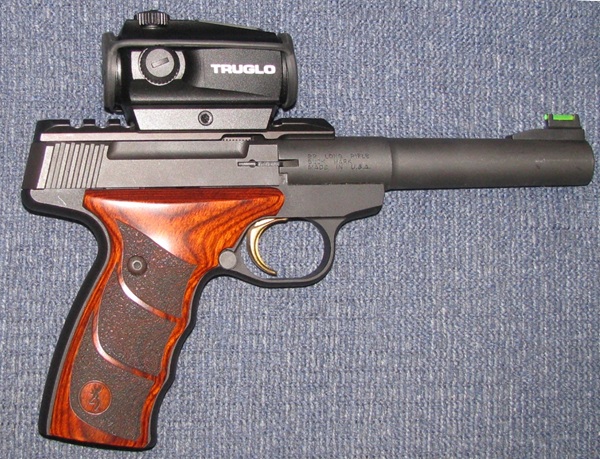
..and off I went to my neighborhood range, bearing a couple of boxes of my trusty go-to .22 test ammo (CCI Min-Mag 40gr solids).  And because this was a sighting-in exercise, I shot off a sandbag rest.
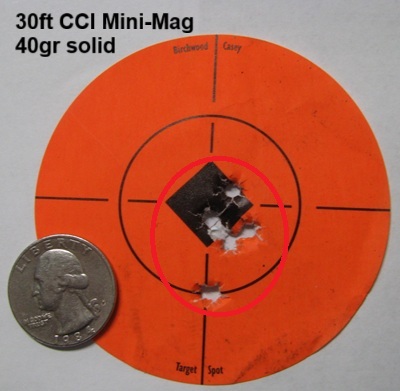
This first target was just to get the sight thingy “on paper” (with a quarter to give some perspective):
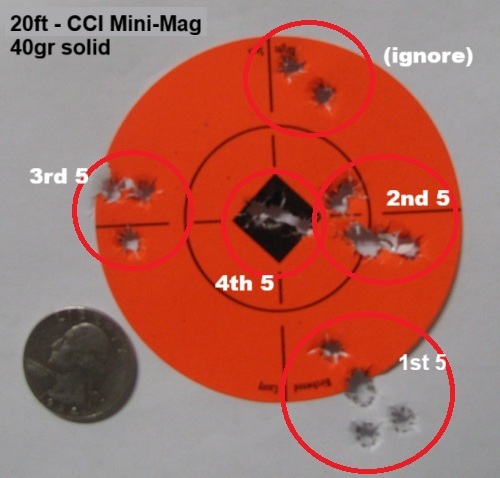
Some words of explanation are necessary.  The Tru-Glo’s adjusting turrets don’t “click” — you need to turn the screw by guesswork — thus, I was going by “feel”, so to speak.  Anyway, the first five-shot string (unadjusted) shot low and a little left.  Up we go, to String #2.  Not bad.
Then the fun began.  Adjusting the left-right screw, I realized mid-adjustment that I was moving the dot  right instead of left — because I’m an idiot — so back left I went, trying to remember how far I’d just turned the thing.
String #3 showed me that I’d cocked the thing up completely and over-compensated (yeah, like none of you have ever done something like that before).  Back I went, guessing again, and mirabile dictu, I got it right first time.  String #4 looked pretty good.

But we all know that sighting accuracy may change at greater ranges, so I sent the target paper back out to 30ft (my normal shooting distance with handguns, whatever I’m shooting).  Would it change?  Indeedy, yes it did:
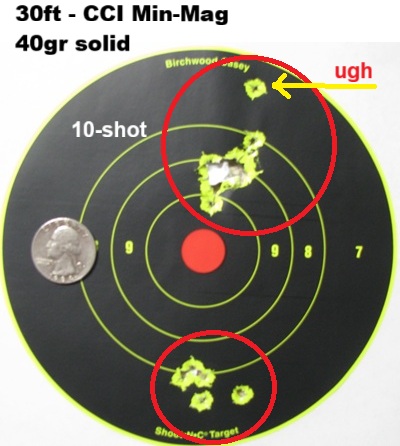
The 10-shot string was done with a center-dot hold, but after I’d adjusted the sight, the 5-shot string was made with a halfway hold (halfway between the bottom of the target and the center dot).
Not bad;  I thought I’d got the thing just right.
So off I went and shot the rest of that box at lots of different targets on the paper, omitted for the sake of brevity — okay, here are a couple, just for the hell of it:
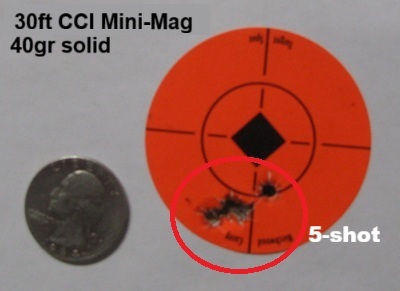

(halfway-down hold)

(center hold)

Finally, I was getting close to the end of my allotted range time, so I packed up the gear to give the barrel a few minutes to cool down a bit, and then got serious, taking lots of time between shots instead of getting all impatient to get done with it (as I usually do):
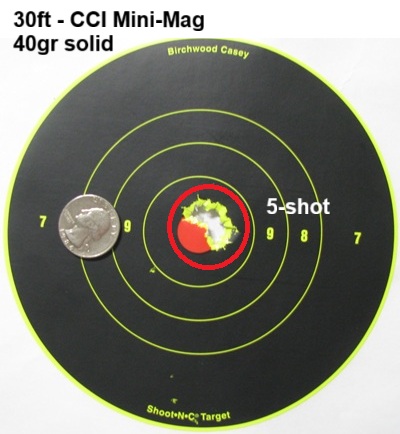
That was fun.  Now to try some different ammo brands and boolet weights to see the differences…

Old Sights, Old Eyes

Longtime Readers will be familiar with my affection for Browning’s Buckmark .22 pistol, she of the wonderful trigger and reliable feeding.  And excellent accuracy… well, except in my hands.

I used to be able to shoot the Buckmark acceptably well, but as old age has buggered my eyes up horribly (stop me if this is familiar to y’all), so has my accuracy suffered.  Of course it’s not the gun:  I’ve owned (counting on fingers) five of the things over the years, and I’ve always been able to make the cans pop and dance, so to speak.

Now?  I’d be lucky to hit the inside of a room.

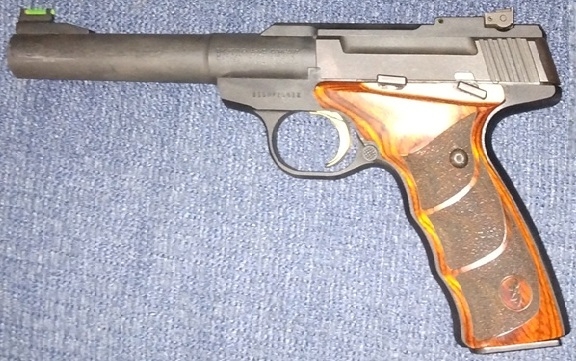
So I’ve had to go from this light, sleek little beauty:

…to this (much) heavier, ungainly-looking thing:

Accuracy?  I’ll let you know next week, after I’ve been to the range and zeroed the dotty thingamajig in.

About That Stuff

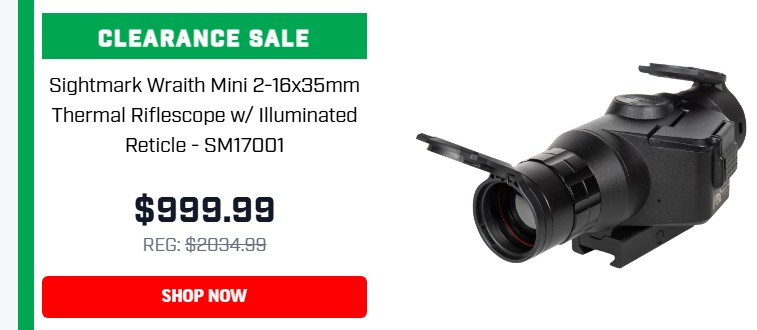
So in PSA’s hourly emailed sales brochure (side note:  seriously?  keep this up and you’re going to end up in the spam folder, guys), I see this:

Now I have no idea whether this is a good buy, or the product quality thereof either, but I have to ask myself:  outside the .dotmil and law enforcement, who the hell would want to buy this kind of thing? 

Don’t get me wrong:  I’m not saying that this shouldn’t be available, and “just because” isn’t sufficient reason to want to own anything gunly.  No no siree, not me never.

But you’re going to drop a grand on something that I can almost guarantee you’re never going to need or use, outside your fevered Red Dawn fanboi fantasies.

Please let me reiterate:  if you’re going to spend a grand on something intrinsically useless, be my guest.

But a thermal optic?

Feel free to correct my thinking, in Comments.


Update:  Clearly, according to my ahem propertied Readers, I’m showing my Suburban Bias.

My apologies to one and all.

Good Choice

Back when I used to hunt, I found that when it came to scope magnification, I very seldom used any power higher than 6x — usually 5x — because the loss of field-of-vision made target acquisition very problematic.  You see, it may be easy to spot your prey with the naked eye, but when you to try to find it again by looking through a scope set to 15x magnification, sometimes all you see is an aperture filled with leaves, grass or still worse, hair.

Also, those big-ass 5-35x56mm scopes are heavy, Bubba, which is fine if you’re benchresting but a lot less desirable when you have to lug the extra weight atop a serious hunting rifle.

Less, in scope terms, is often a lot better than more — whether in terms of weight or magnification.

So I saw this newcomer to the hunting scene with something akin to pleasure:

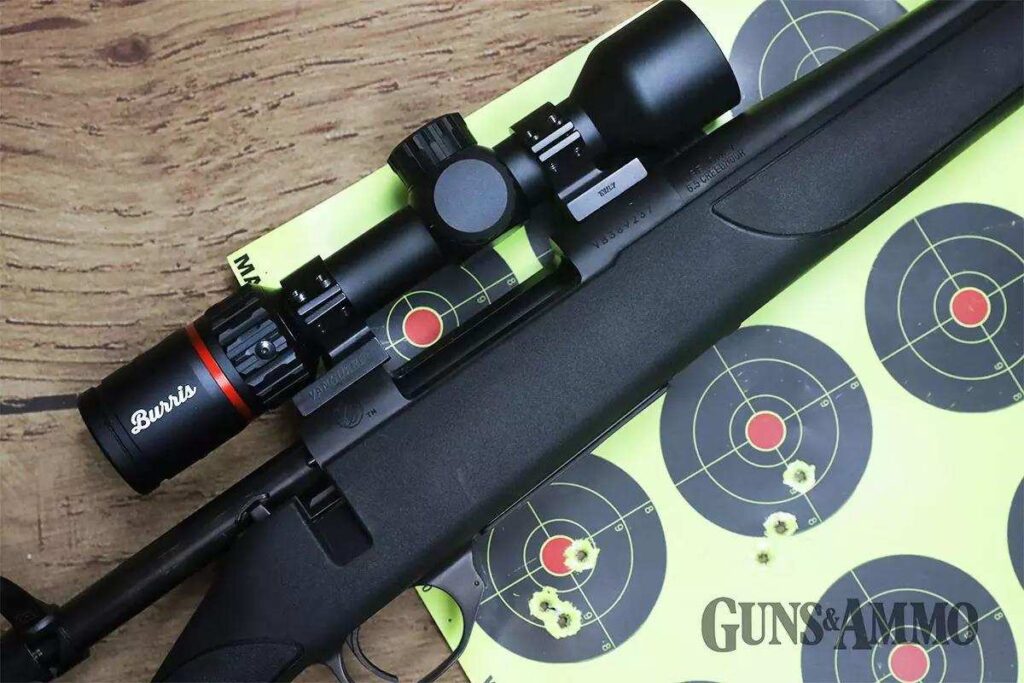
Burris Fullfield 2-8×35: The Do-Anything Hunting Scope

Let me tell you, I really like the look of this one:  small, compact, and it may be the perfect choice for hunters on a budget.

I’m a huge fan of Burris Fullfield scopes — I’ve owned about half a dozen of the things over the years — because I always found them a perfect compromise between quality, performance and reliability.  Sure, there are better scopes, but you’re going to pay a hell of a lot more than $160 or $190 (for the plex and illuminated variants, respectively) to get not much further up the quality curve.

Right now, I don’t have a need for one because my scope needs (for the .22 rifles anyway) are doing just fine.  But if one of them were to break or go sour on me, this new Burris would probably be at the top of the replacement list, you betcha.

(Aiming) Point Of Order

In the Comments on the 2023 Boomershoot gear, Reader Beaner49 says:

“A scope with a BDC is a good choice rather than a simple crosshair.”

I will call mea culpa on myself on this one.

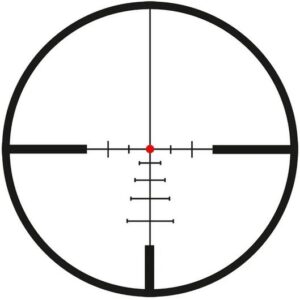
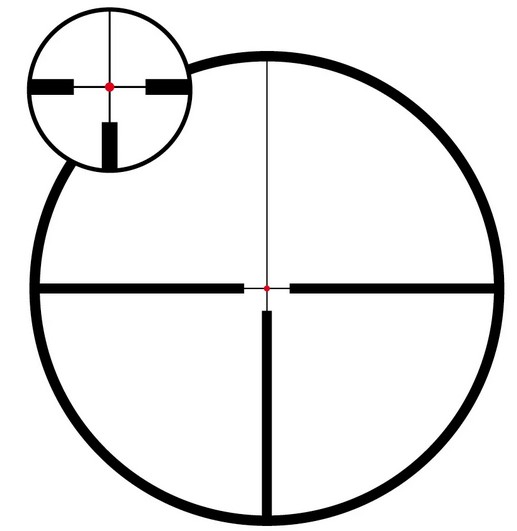
I am so accustomed to using a crosshair sight that I seldom look at any other kind;  but Beaner makes a very good point, and I may be selling the scope part of the ULD rifle short.  We’re talking about this:

  vs. this: 

I have to say that I’m in agreement — never let it be said that I’m so stuck in my ways that I can’t make a change (although by and large, it’s a safe assumption — except when this kind of reasoning comes into play).

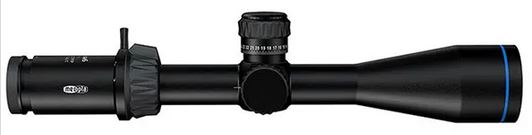
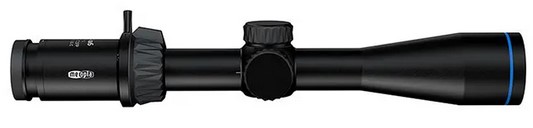
So I think I’ll be going with the Meopta Optika6 3-18×50 Illuminated BDC 30mm FFP (first focal plane).

It costs a couple hundred more than my original choice, but Let’s Go Brandon.  Before anyone asks, the larger and pricier 56mm scope can be a POS to fit onto a rifle for not much more utility — but I’ll be ruled by the consensus of shooters more knowledgeable than I.  (Scary, this new Kim, innit?)

A Tale Of Two Scopes

As many of you know, I’m a big fan of Meopta riflescopes — the guys who make the Zeiss Conquest line — but I recently had a little cognitive dissonance when looking at options.

Typically, I’m looking for long-range “Boomershoot” target scopes, with fairly high magnification (~18x – 25x).  This time, a Reader asked me to look at a different use for him — shorter-range hunting, if you will, where the magnification needs to be more modest (~10x – 15x), with the only specs being variable focus, an illuminated reticle and a 30mm tube.  Small fields, deep woods, you get the idea.

So I got to this model, and it ticked all the boxes:

Meopta Optika6 2.5-15×44 Illuminated SFP 4C$650

Follow the link if you want the detailed specs.

I was just about to save the page for future reference, when I saw this option:

Meopta MeoSport R 3-15x50mm Illuminated SFP 4C – $450

Once again, the details are at the link.

All of which makes me wonder.  Meopta bills its Meosport line as “entry-level”, and the model above compares very well indeed to its more expensive cousin at the top.  In fact, the Sport looks a little better than the Optika:  a 50mm bell vs. 44mm, and so on.

All of which makes me suspicious.  A fifty-dollar difference in price would be one thing, but a $200 spread?  Long experience in marketing and manufacturing taught me that every price reduction for two identical items comes at the cost of quality, in some way, shape or form.  (The Iron Triangle is:  materials / features + quality + price = an equilibrium constant.  Reduce price, and you have to reduce one or both of the other two.)  But as far as I can tell, the features are more or less identical, and Meopta’s quality has been superb.

For the life of me, however, I can’t fathom the difference between the two scopes.  My penny-pinching nature says “Take the MeoSport”, but experience says, “Buy once, cry once”.

Can anyone shed any light on this issue?


Update:  From Reader Will B comes an email:

The price delta is in the glass coatings.  The more expensive scope has more/better coatings.
I also noticed you mentioned a 30mm tube.  You probably think this lets in more light, that is incorrect.
These scopes are made to the European style where they can hunt at night.  Hence the larger objective.  I have not looked through one of these but I would bet that Meopta is using lens coatings that allow the blue light to remain;  this is because in Europe they can hunt at night.  All Austrian/European scopes emphasize blue light waves.  US scopes use yellow light (think Leupold) as it is pretty good at twilight or dusk.
The reason for a 30mm tube is because Europeans do not generally have the kind of flat shooting rifles we generally use in the US.  The European rounds have a greater arc to them.   So the 30 mm tube allows for more mechanical up and down in the elevation adjustment.    That is the sole purpose of a 30mm tube.
You will not likely need that arc accommodation in a shot under 200 yards unless of course you have a slow shooting round, so usually in the US there is no need for a 30mm tube.
I bought a Conquest years ago.  The mechanicals were excellent, the glass was a single coated lens and it sucked.  I gave it away.
I have a Swarovski and a Schmidt & Bender and a few high-end Leupolds.  You can get great glass for under a thousand dollars.  I am not rich, just patient and have saved to get what I use.  Once you use a truly good scope you are ruined forever.
I will say this:  once you have used a scope that preserves blue light you will never want to use anything else.  They are very bright in daylight and are excellent at lower light levels.

I never knew the light-spectrum differences between Euro scopes and Murkin ones, and this is probably why I tend to prefer the Euro glass.  Thankee for the info.