Reader Question

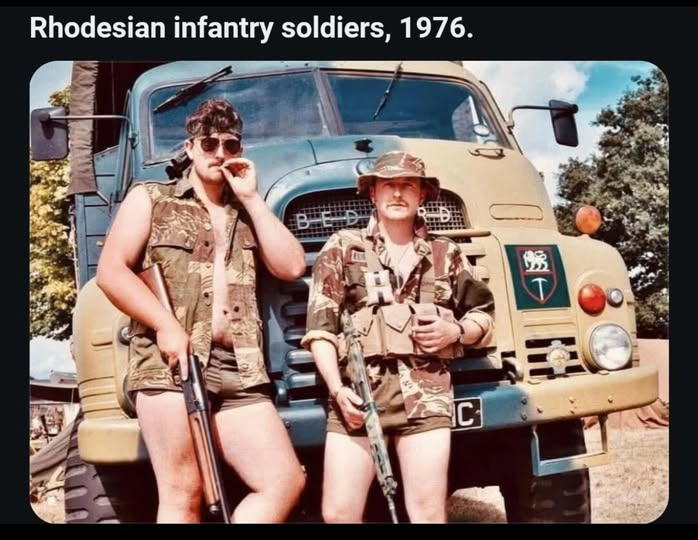
Reader Brian H. sends me this pic and asks:  “Seriously, which one is you?”

Seriously, neither could possibly be me:

  • I don’t smoke
  • I’m not Rhodesian
  • I wasn’t drafted till 1977
  • They’re holding guns, not a guitar, and finally:
  • I’d never wear those little shortie-pants in the African sun;  my lily-white skin would burn to a crisp in about half an hour.

But I’m flattered that you think I would have been in the Rhodesian Light Infantry (RLI).  Those guys were maniacs.

Whatever

This whole Iranian adventure has been framed in terms of its being “regime change” for Iran, and I don’t care.

Frankly, I’m uneasy with the entire concept of “regime change” as a foreign policy goal, because if history has taught us anything — especially in the Middle East — it’s that most of these noble efforts are pretty much doomed to failure, because the entire premise is faulty.  Changing a regime is no guarantee that the next regime will be any better than the previous one.

Here’s the unalterable fact:  democratic capitalism, as a concept and guiding socio-political principle, doesn’t work outside the confines of Western civilization, and by “Western civilization” I mean pretty much the United States.  This is because Western civilization cannot coexist within a nation along with lunatic and highly-flawed political systems like Marxism and/or lunatic medieval social systems like Islam.

One only has to see how the UK, to use but one example, has been undermined by the baleful effects of both the above — Marxism as a home-grown poison (hello, Labour Party) and Islam as an imported poison (hello, untrammeled Muslim immigration).

And that’s within a nation which pretty much gave birth to democratic capitalism.  (They did, too;  we just perfected it.)  Now try to see how well democratic capitalism has worked in other countries which have never had that system as a bedrock principle — Iraq, Syria, Egypt, China, the whole of Africa etc. — and all you’ll find is a constant and comprehensive list of failures.  You can change regimes, by all means:  but the plain fact of the matter is that democratic capitalism is probably going to fail as the “new” regime will pretty much be just a (watered-down at best) copy of earlier regimes, none of which have espoused democratic capitalism.  They’ll be kleptocracies like all the African shitholes, or neo-Communist like Vietnam, or military juntas like [insert South American country of choice here].  (Augusto Pinochet’s Chilean junta, by the way, was very much the exception.)

So I’m simply regarding the destruction of the current Iranian Islamic regime as a side-benefit of the whole exercise.

What we should be stating, in no uncertain terms, is that any regime which exports terrorism or socio-political poisons like Islam or Marxism are on notice that the United States may, at our own discretion, pound these regimes back into rubble rather than allow them to subvert peace and prosperity — the two are very much linked — in the names of their respective ideologies.  “Regime change” is very much a subset of that goal, and not its primary purpose.  (SecWar Pete Hegseth, at least, has the right of it.)

That the United States should be hesitant, indeed resistant to the idea of allowing said poisons into our own country should most definitely be a guiding principle and not government policy.  The noble sentiment on the base of the Statue of Liberty should not only not be taken as government policy, but should also contain the codicil:

“And don’t try to change our country to be more like yours of origin because we’ll toss you out if you do.”

The essence of what I’m saying is that we should not be beguiled into changing our own regime from democratic capitalism into any flavor or subset of the above excrescences.

You may argue with me on any of the above, but you’d be wrong.

Predictable

So you’re part of a group of fishermen, walking off to your favorite fishing spot, when you encounter a herd of elephants.  Most likely there are newborn calves in the herd, which is why the females take offense at a bunch of humans occupying the same zip code.  So you flee the angry herd in panic, and take refuge in a nearby river.  And the predictable occurs.

because Africa.

Of Course They Have

Here’s one that should come as no surprise to anyone:

Afghanistan goes back to the Dark Ages

Just a point of order:  when, precisely, did Afghanistan — or any of the -stans for that matter — ever leave the Dark Ages?  To continue:

The Taliban have ordered dozens of people to be killed by stoning and four convicts to be executed by having walls collapsed onto them, exposing the scale of brutality under the regime.

Figures released by the Taliban’s own Supreme Court show the group also publicly flogged more than 1,000 people across Afghanistan in 2025, including at least 150 women.

The data points to a sharp rise in corporal punishment, with Kabul recording the highest number of cases.

Official Taliban statements reveal that 1,030 people were whipped in public this year for offences including theft, running away from home and acts deemed contrary to Islamic law.

Well, yes:  when you govern according to Islamic law, the Dark Ages is pretty much a given.

Mind you, I’m not altogether opposed to a few public floggings.  I can think of a number of people (like this one or this one) who could only benefit from same, and our society might well be the better for it.

But a flogging for drinking booze and/or wearing a miniskirt?

Forget that crap.

Giving Up

Of course, I read this with great regret and sadness, because it’s my home town being written off:

Johannesburg: The slow death of a city that may have outlived its purpose

Johannesburg is in an advanced state of decay, destruction, ruin, crime, waste, and all of it seems, sometimes, like a mirror image of South African society. We grieve over the once-great city in a veritable cult of grief.

But we are too afraid to look in the mirror because our vanity overwhelms our misery — we are, after all, a great people, and a great people we have to remain…

In and around the city, the families and communities in its suburbs and on the periphery are struggling to live full lives. As days and weeks go by, the denizens are losing reason to value their surroundings. The taps run dry frequently, energy supply is interrupted regularly, flagship institutions, and all those little things like roads, pavements, pedestrian crossings, traffic signs, road signs and robots are bleeding like wounds that will not heal on a body in terminal decline.

The city is depleted, and lacking in the nutrients and the energy necessary to bring it back to full functionality.

We can point, as we may, to mismanagement, maladministration, lack of planning, a lack of foresight and vision. We can, also, consider Johannesburg as a city that has reached the end of its natural life and is approaching the end of its purpose.

Johannesburg, as we came to know it, was established by European settler colonists in about 1886 for the sole purpose of exploiting the gold buried in the rocks below. Those gold deposits are finite. If it’s not entirely finite, mining it is becoming more expensive, while demand may well increase.

Yeah, what the hell.  It’s just a shell of a place, an aggregation of concrete, glass and tarmac:  it’s too difficult to govern or manage, so why bother?

One might also say the same thing about Manhattan or Los Angeles.  In fact, one might say the same thing about all the major cities of the world, where concentration of the population has become too difficult and in most cases, too dangerous.

So let the animals take over and feast on the bones.  And when the bones are gone and the animals need to go further afield to survive… then what?

And now, if you’ll excuse me, I think it’s time to go to the range.