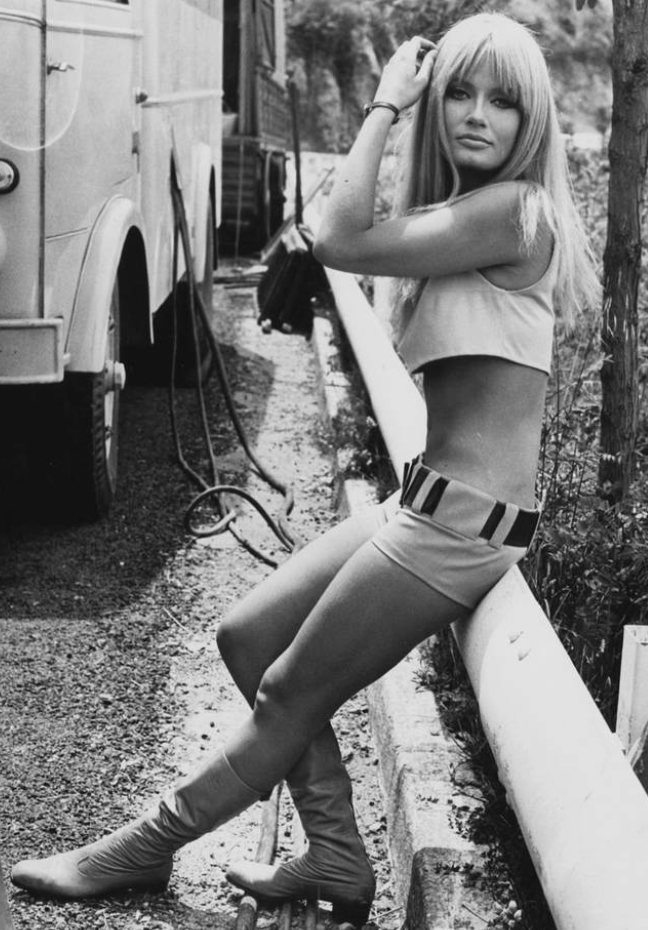
Classic Beauty: Marisa Mell (1)

I found out about Austrian actress Marisa Mell in a roundabout sort of way.  I was watching one of those silly “10 Movies That People Have Foregotten”-kidd of video on EeeewChooob, when suddenly I saw a woman of outstanding beauty appear for a few seconds.  So of course I looked up the cast of said movie, and there she was (and here she is):

…and even as a blonde:

Next week, we’ll look at Marisa in color.  Try to contain yourselves.

Playing Sherlock

Okay, as a longtime data geek and mechanical moron, this video had me enthralled.  What was it all about?  Some guys asking themselves “Why?”

This brand new L87 engine with ZERO miles never even made it into a vehicle before it was condemned by GM. It failed one of their quality control Pico tests and we want to know why. In this video, we tear it down, take some measurements, and run tests to uncover why it was tossed in the trash — and how this single engine design ended up costing GM over a billion dollars in recalls and warranty repairs.

I don’t have the faintest clue what any of the technical pieces or terms are all about, but the search is absolutely thrilling.  It’s when these mechanics start looking at the data gathered from analysis of the different engine components that my inner data geek gets excited,

It’s the kind of stuff I used to do at The Great Big Research Company in my initial job in the Stat department:  picking at the data, looking for stuff which shouldn’t be there and is, and/or stuff which should be there and isn’t.

My favorite quote:  “These are big numbers.  Are they big enough to ruin an engine?” (He’s talking about a hundred thousandths of an inch, which in the real world would scarcely matter except when you’re looking at precision-made machinery.)

I’m not going to post a spoiler, here, but it involves the level of chamfering around some holes.

What I truly love is the level of expertise shown by all the guys in the video — and when they bring in Dave himself, his explanation of the problem is absolutely brilliant.

Go and watch the video.  It’s half an hour out of your day, and I promise you that you won’t be disappointed.  Even if you’re not the slightest bit interested in the minutiae  of engines — which would make you similar to me — the journey is worth the time.

Back Story & The Brand

After I talked about my favorite watch of all time — Tissot Heritage — a couple of people wrote to me to ask about the brand.  (I’m astonished that people had never heard of the amazing company, which sells more watches than any other Swiss brand, period.)

Here’s Teddy Baldassarre’s take on the whole thing, and like his other discourses, it’s excellent.  For those with a limited budget but are interested in a super-accurate chronometer, by the way, it’s worth noting that Tissot makes the cheapest such in the whole market, and its performance equals many of the (very) spendy models like Rolex.


(They typically cost between $800 to $2,000 depending on the model — but the chronometer’s action is automatic, and therefore of no interest to me, a self-winder devotee.)

Yer welcome.

Peppery

Via Insty, I found this fascinating article about how America’s food is becoming more spicy:

Consider spicy-hot food — and consider how recent it is as a mainstream phenomenon in the U.S. In 2002 many of us cheerfully chow down on Szechuan and Thai, habaneros and rellenos, nam pla and sambal ulek. Salsa outsells ketchup. But it wasn’t always that way.

When I first came over in 1982, I found American food to be kinda like what I’d left behind in South Africa:  kinda bland, almost-English in fact, and diner food very much so.  Only when I went south to New Orleans and Florida did the food start to spice up a little — in the Big Easy, quite alarmingly so.

Back in Johannesburg, although I’d grown up with at least one curry meal a week, spicy food was definitely not an everyday fare.

Imagine my surprise, then, when I moved Over Here in The Great Wetback Episode of 1986 I found out that over that short period, food in general had spiced up considerably (what the article refers to as “capsaicinization”), and frankly, I wasn’t prepared for it.  It took me a while to get used to it, but I did.

Now?  I eat nachos with one slice of jalapeño pepper per mouthful.  (Without the jalapeño, nachos are pretty awful — close to what Richard Hammond once described as “sick on a plate”.)

What made me realize how my own taste had become so capsaicinized was when New Wife came over from Seffrica to become part of my life Over Here.  Now granted, she’d never been that fond of spicy food — even curry, so much a staple of SA menu, was conspicuous by its absence on her table — and in fact, that was generally true of many Seffricans back in the day, myself included.  So when she came here, her taste buds were set on fire.  And it’s when I prepare meals for her that I realize how much I’ve become used to that increase in spice content;  I have to watch out even when using mild spices like Lawry’s steak salt or paprika.  What seems quite mild for me sets her mouth on fire.  So I make meals accordingly.

Ditto when we visit friends or family:  I have to remind them constantly to be careful of the spice quantity.  (The nice thing about having the kind of friends that I do is that they take such constraints in their stride, albeit with some gentle teasing.  Ditto Daughter and the Son&Heir when we visit them for dinner.)

I’m not going to try and change her tastes, by the way;  had someone tried to do that to me, back in the late 1980s, I’d have kicked back hard.  I may have gradually become accustomed to the modern American cuisine, but it took me well over a decade to do so.

I doubt that New Wife will do it in anything like the same time period, and that’s okay.  At home, we eat more traditional British food, anyway.  Sausage rolls, steak pies and roast beef, for example, were never spicy foods to begin with, and I for one have no problem tucking into the comfort foods of my youth.

I’ll just get the spice when we got out to eat.

Stupid Money

Via Insty (again), I see that Overfinch has crafted a line of bespoke Range Rovers in Holland & Holland livery:

The 2025 Range Rover Holland & Holland Overfinch’s interior is much more overtly extravagant, though Range Rover’s minimalist form language still dominates. Most surfaces are wrapped in Bridge of Weir leather, and those that are not are instead covered with open-pore French walnut veneer or real metal. The stainless-steel inserts in the doors feature the same engraved scroll work as on the “Royal” shotguns, the engraved diamonds embedded in the veneers in the doors echo those on the guns’ stocks, and the Holland & Holland crest is inlaid on the front and rear center consoles, the latter housing a Champagne cooler and a pair of Champagne flutes.

The leather seats feature a unique quilting pattern that also echoes the Holland & Holland diamond motif and features illustrations of game birds stitched into the backrests. In the duo-tone colorway the front seats are trimmed mainly in Harris Green and the rears mainly in London Tan.

Sounds like something an Arab oil sheikh would want to putter around his Scottish estate in, playing a Laird.  Still, I like that interior.

Of course, from the outside the thing is 2025 Rolls-Royce-level Fugly:

…but not as ugly as its price of $650,000.

To put it into perspective, that’s just over the price of three new H&H Royal and a couple-three of their secondhand Royal shotguns.

Lovely as all get-out, but not even with a lottery winning would I be tempted.  And that’s by any of them:  the H&H Range Rover or the H&H shotguns, which taken as the package above would set you back about a million bucks.

Maybe the parvenu status-seekers of today’s ultra-wealthy set would be tempted by such blatant brand-harvesting… hence the title of this post.

As for myself (given a lottery winning as above), my choices are below the fold. Read more