Checkup & Oil Change

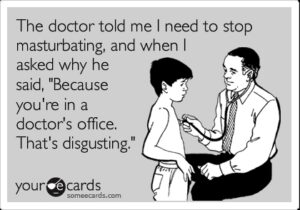
Yup, it’s time for the annual check under the hood, looking at the dipstick and of course all those irritating questions:

Not to mention getting all judgey:

See y’all later, I hope.


Update:  All good, subject to the blood test results.  Alert the media.

Big Fat Hairy Deal

…and I use the word “fat” advisedly.

Eli Lilly and Novo Nordisk officials have agreed to lower the cost of GLP-1 obesity drugs for Medicaid and Medicare recipients and those who pay directly and make treatments more accessible, President Donald Trump announced Thursday.

Medicare will begin to provide coverage for the obesity drugs for some people in mid-2026, which also might cause more private insurers to likewise add coverage for them.

The deal could lower the cost of the drugs to $150 per month for prescriptions that are available in pill form and that contain the lowest doses.

I remain skeptical, and here’s why.

I remember doing the math for Ozempic, and calculated that the cost per month (including the little single-use syringe) was about $5, for the .25ml shot.  What you actually pay is about $150 per month.

As anyone who knows anything about this business knows, the .25ml (the “lowest” as quoted above) barely does anything to you, weight-wise:  that’s the dose which prepares your system to handle the drug’s effects.  The serious weight loss starts with the .5ml double dose — well, it did for me, anyway — and guess what happens to the cost.  It increases exponentially with each increase in dosage.

I’ve had to quit taking Ozempic shots — as of last week, actually, because frankly, for someone trying to live on a fixed income amidst soaring inflation and prices of, well, everything except gasoline (which is still too expensive), I just can’t afford it.  (New Wife, by the way, wants me to continue to take it because she thinks if it keeps me alive, that’s worth it.  I remain unconvinced that it’s a lifesaver.)

My annual physical exam is late next week, and I’ll be discussing the matter with my GP.

Anyway, here’s the thing.  Under Medicare, my BP meds, my gout meds and my statins and others cost me…$11 per month.  Those drugs, I’m pretty sure, are actually saving my life;  the weight-loss stuff?  Who knows.

Maybe I’ll regain all the weight I lost (about 50lbs), or maybe I won’t.  Maybe my diabetes has responded well to the weight loss, or maybe it hasn’t:  the blood tests will tell.  One thing Ozempic did do for me was change the way I thought about food, or at least the quantities I consumed thereof.  I’m not sure that stopping the drug will make that attitude revert to its former self;  I don’t think it will.

We’ll see.  All I know is that as currently priced, the GLP-1 regime of drugs are unaffordable so I’ll just quit taking any of them until the cost comes down to what I can afford.

And if that decision ends my life, I don’t care.  I’m 71 years old, next week, and as anyone who’s reached that Biblical age limit can attest, the prospect of death no longer frightens one as much as it may have done in earlier times — which is what I’m going to tell my doctor next week.

Let’s see what he has to say about it.

In the meantime, though, my reaction to Trump’s much-heralded “price reduction” of this stuff is pretty much encapsulated in the title of this post.

Falling Over

For once, I discovered an interesting article in the ghastly New York Times — motto:  “Other Than That, The Story Was Quite True” — because it has nothing to do with politics, for once:

Public health experts have warned of the perils of falls for older people for decades. In 2023, the most recent year of data from the Centers for Disease Control and Prevention, more than 41,000 Americans over 65 died from falls, an opinion article in JAMA Health Forum pointed out last month.
More startling than that figure, though, was another statistic: Fall-related mortality among older adults has been climbing sharply.

I don’t know quite when I started to lose my balance.  I think it was in my early sixties, when for no reason at all, I would stagger a bit when turning a corner (walking, not driving, of course).  I wouldn’t fall over, but it nevertheless alarmed me.

And when getting dressed, specifically putting on pants or briefs, I suddenly found myself unable to balance on one leg without toppling over;  which means that now I pretty much have to either brace myself against a wall with one hand, or else make sure that if I do fall over, there’s a bed close at hand to catch me.  It’s irritating.

Going down stairs has a similar effect.  Where once I could bound down a staircase with no effort at all, I find myself having to grip the banister like my life depends on it, which it does, now.

Of course, I’m very familiar with the fact that we Olde Pharttes tend to have brittle bones, hence the distressing number of said group suffering things like broken hips, skulls or limbs after toppling over. (see:  novelist Jilly Cooper, dead following fall)

The famous expression “I’ve fallen and I can’t get up!”  is not so funny anymore.

The NYT article suggests this:

The author, Dr. Thomas Farley, an epidemiologist, reported that death rates from fall injuries among Americans over 65 had more than tripled over the past 30 years. Among those over 85, the cohort at highest risk, death rates from falls jumped to 339 per 100,000 in 2023, from 92 per 100,000 in 1990.
The culprit, in his view, is Americans’ reliance on prescription drugs.
“Older adults are heavily medicated, increasingly so, and with drugs that are inappropriate for older people,” Dr. Farley said in an interview. “This didn’t occur in Japan or in Europe.”

Some other guy opines:

The difference, he believes, is Americans’ increasing use of medications — like benzodiazepines, opioids, antidepressants and gabapentin — that act on the central nervous system.
“The drugs that increase falls’ mortality are those that make you drowsy or dizzy,” he said.
Problematic drugs are numerous enough to have acquired an acronym: FRIDs, or “fall risk increasing drugs,” a category that also includes various cardiac medications and early antihistamines like Benadryl.

Which might be plausible, except that in my case it’s not a reason because I don’t take any of the above drugs, or even drugs that are similar.

Of course, we all know that some meds like Benadryl can cause dizziness — FFS, it says so right on the pack — which is why if I do ever take one of those, I take it right before going to bed.

No, I have no idea why I’m suddenly so tottery on my feet, when in the past I always had excellent balance.

It’s also a well-known fact that Olde Pharttes are more likely to experience vertigo when faced with extreme heights or drops.  Just a photo of some idiot hanging from a sheer cliff face by only their fingertips will actually cause my stomach to heave;  I have no idea how I’d feel if facing a sheer drop in person, but I’m perfectly prepared to believe stories about elderly people inexplicably toppling over a cliff as through drawn to it.

I’ve said it before and I repeat it now:  this getting old business is not for the young.

Upright & Locked Position

Via Insty (thankee, Squire), I saw this:

Avoiding couches and chairs might be a good way of keeping your back pain from getting worse, new research suggests.  Finnish researchers found that when people with back pain sat even a little less each day, their pain was less likely to progress over the next six months.

Well, yes, but it depends on your definition of “sitting”, and I’m not being Clintonian, here.

A couple of years before Connie discovered she had cancer, she had back problems — I mean serious back issues, along with crippling sciatica.  Basically, she had three back operations (I forget which, L1S2 or vice-versa), had one of those electrical shock thingies implanted in her butt (electrodes linked to her spinal and sciatic nerves) and of course, serious pain medication.

How had this happened?  Well, basically, as it was explained to us by her back doctor, Richard Guyer of the Texas Back Institute (the man who fixed Tiger Woods’s back), it was because her job was 95% sedentary.  But first, a little history lesson.

According to Guyer, the worst invention ever created by Man was the upright chair.  Basically, the human body was conditioned over millennia of development into two basic positions that could be held for hours on end:  standing erect and lying prone.  The first was for survival purposes (hunting, herding and farming) and rest (sleep).

What the chair did, over a relatively short period of time, was to force the body into a position it wasn’t designed for, which of course placed all sorts of strain onto it, and most especially into the back.  While early chairs (mostly stools and benches) did not encourage lengthy periods of being seated (upright backs and hard seats), the addition of cushions and the creation of non-physically active tasks (e.g. clerical) had the effect of making upright seating a little more comfortable but no less damaging to the spine.  In fact, the added length of time while seated speeded up the damage process.

This is why so many early clerical jobs took place in a standing position, by the way, hunched over tall lecterns instead of being seated at desks — it really helped, and many people in the modern era who have gone back to working in an upright position can testify to the improvement in their physical health thereby.

But what if you can’t stand up for long periods of time?  An aside:

In my case, a youth spent playing competitive sport had messed my knees up — to the point that when I went to an osteopath several years ago, he looked at my X-rays and asked whether I was in the flooring business, because they only time he’d ever seen knees in this condition was from patients who installed carpets for a living.  (I made a joke about it and said that I was on my third marriage, whereupon he laughed and said, “Oh well, that explains it.”)  But my knees were and are no joke — it’s the reason I qualify for “cripple” license plates, by the way, because I can walk a little distance with no rest and without pain, but thereafter I have to start popping pain pills like M&Ms.  My daily pain-free distance at the moment is about 100 yards, cumulatively — about the distance walking to and from the car across a large supermarket parking lot, and a long shopping trip in the supermarket itself.  After that, my knees seize up and I reach for the Tylenol.  But back to the main story…

Anyway, Dr. Guyer’s solution to both my and Connie’s problem was to eschew sitting upright altogether, or at least for any serious length of time.  But for her job (training system design and tech writing) and my writing, that was not possible.

The solution?  Anti-gravity or, as we used to call them, Laz-Y-Boy reclining chairs.

Connie’s back, as it turned out, was too far gone, although her recliner helped some.  In my case, with only a “serious” (as opposed to her “critical”) back issue, the effect was close to miraculous:  my decades-long back pain disappeared within a matter of days, and I could (and still can) remain seated all day without back pain.  (I do have to get up throughout the day for coffee, meals and the related nature calls, relax, so I’m not going to die of deep vein thrombosis.)

So yeah;  as the Finnish boffins claim, sitting down less will help alleviate back pain and -injury.  But if you have to remain seated, do so in a reclining position.  It really works.

Even if the lack of exercise causes you to get other problems, like a fat gut.
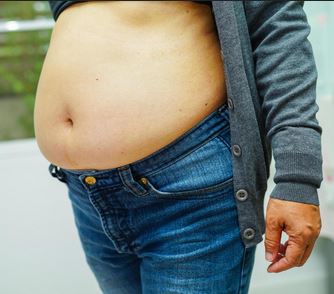
You all know how to fix that problem:  eat less, eat better and exercise.  Or pay through the nose for Ozempic, like I have.

Time For The Old 1498?

Waddya mean, Kim?

Go ahead and watch this video, and wait for this magic line to appear:

…and ask:  why not?

Look, I’m a capitalist, and I believe in the sanctity of patents.  But when the loaded cost of a product is around $5 — hell, call it $10 even — and the retail price ends up being $1,000, even my capitalist free-market mind starts turning towards government intervention.

We Americans are getting screwed, and it’s time Uncle Sam did something useful for its people, for a change.

And after all, the Danes of all people should understand the concept of government intervention in the market.

Read more

Notes From The Doctor’s Visit

I had a chance to chat to my GP yesterday about a couple of matters, and some interesting stuff came out.

First:  I’ve reached my “goal” weight of 220lbs — my weight after boot camp in the army back in 1977 — so I asked the doc whether I should keep doing the weekly Ozempic jab.  His response was that in addition to its weight-loss properties, Ozempic has been shown to lower the risk of heart disease by over 20%.  While I myself have a very healthy heart, my family (especially on my mother’s side) has had a history of heart issues (bypasses, stents etc.), and indeed several have died from heart disease.  So the doc suggested that I keep taking the Ozempic because as I’m almost 70, this would be a prudent prophylactic measure.  (This is also true of my gout medication, which I continue to take — albeit at a half-tab strength — even though I haven’t had a gout flare-up in well over a dozen years.  But as he pointed out, maybe it’s because of the daily half-tab that the flare-ups no longer occur.)

Second:  I had read in the Daily Mail  (can’t find the article, but it’s not important) that one should not take blood pressure meds (e.g. Valsartan) close to when you have your coffee.  The reason given was that caffeine takes away the slow-release coating on the drug, and instead of the magic ingredient trickling into the system over a few hours. it all gets dumped into the body in one shot.  In some people, this can be problematic.  The doc confirmed this, and suggested that I take my BP med (and all my other meds) at bedtime instead, saying that studies have shown that most drugs work better anyway when taken thus.  (The problem is that most people forget to take their drugs at night — but as I already have to take my glaucoma drops every night before bed, I can just add my meds to that routine, no problem.)

Corollary:  One of the reasons I continue to read the awful Daily Mail is because occasionally among the celebrity dreck and panicky headlines can be found articles of real value.  Among American online publications, such articles are seldom published because there’s no blood, there are no politics / celebrities and no scare headlines to be had.  (I have never, for example, got any such articles out of Breitbart or any other of the U.S. news sources I peruse on a daily basis.)  In this particular case, the information was extremely helpful.

So the Daily Mail doesn’t always suck.