More “Legal” Bullshit

Here’s an interesting take:

A University of Miami law professor recently offered reasons why that the public should consider extending copyright law to include “collectively held cultural identities.”

In an excerpt of her paper “Protecting Cultural Personality” in Race, Racism and the Law, J. Janewa Osei-Tutu notes companies such as Timbuk and Louis Vuitton “have designed and marketed clothing based on traditional ethnic clothing styles or symbols” … but without the “knowledge, consent, or involvement of the cultural group” in question.

Osei-Tutu argues intellectual property laws are “underinclusive — at least in relation to valuable intangible cultural heritage from indigenous communities and local communities from the global south [which] allows corporations and those outside the community to capture and monetize this unprotected resource, which means that it is exposed and subject to misappropriation.”

Sounds like bullshit, dunnit?  Gets deeper, though:

In order to protect “cultural personality rights,” Osei-Tutu (pictured) says cultural groups should have “sufficient boundaries and markers, or indicia” by which to identify them.

Groups can be “self-defining,” and it’s “not necessary for the public to have significant knowledge of the group.”

Sure, just make it up as you go along.  Okay, I’ll play.

Supposing I composed and released a blues song in the style of, oh, B.B. King.  (Note:  “in the style of”, not a copy of.)  Am I making an appropriation of the blues culture — defined on the fly as something that is inherently of Southern Black origin?  According to this college harpy professor, probably so.

Fine.  But let’s just examine that “blues culture” thing for a moment.  It was indisputably a lament, born of a race’s suffering, and played on either piano or else guitar by Black musical luminaries such as Otis Spann and Muddy Waters, respectively.

On the piano?  You mean, that keyboard instrument invented and devised in 1700 by Italian Bartolomeo Cristofiori, a White man?  And about the guitar:  the “classical” acoustic version was invented by inter alia  Spaniard Antonio de Torres Jurado, and its electrical counterpart by inter alia  Adolph Rickenbacker and Leo Fender (to name but two).  Regardless, both instruments were invented by White men of European heritage.

If Spann and Waters had had to operate under those pesky “cultural appropriation” restrictions, it’s safe to say that the blues would still be being sung in Black Christian churches and not in concerts all over the world.

Wait:  did I say “churches”?

Doesn’t look too much like something African (or African-American), does it?

Of course, I’m just screwing around here.  But at the heart of this little piece of satire is a very serious message to the racist hustlers like this Osei-Tutu creature:

Stop fucking around and claiming that “cultural appropriation” is somehow an evil thing.  That, or don’t wear jeans (invented by White Jewish guy Levi Strauss) ever again.

And steer clear of fried chicken, while you’re about it, or else the Romans are going to declare a classical fatwa on your ass.

I could go on all day, but I think you get my point.

LOL Poll

Seen at Don Surber’s place, this tongue-in-cheek poll:

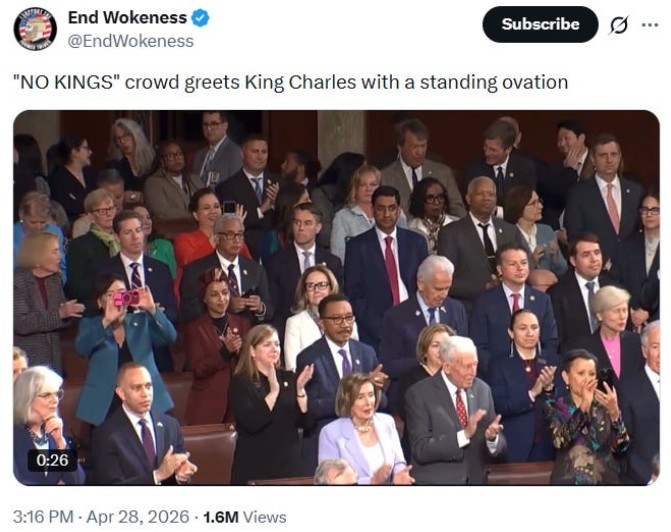
There are two points to be made here.  Surber points out, correctly, that Alberta ain’t Alabama.  Albertans are only conservative compared to, say, their Ontario compatriots.  Adding AB to the U.S. would give the Socialist Party two new U.S. Senators and several U.S. House seats.  This, by the way, is true of all the Canucki fiefdoms (“Fiefdoms, Kim?”  Remember that the actual political leader of Canada — albeit of the rubber-stamp variety — is King Charles III, as Surber also points out).

In the larger sense, this is also true of Cuba, Venezuela and any of our neighboring countries — they’re all frigging Commies, and we sure as hell don’t need more of them in our blessed Republic.  So, as my old friend Patterson would say, fuck that idea for a bowl of cherries.

And as much as the last suggestion (de-stating Minnesota) may seem appealing, that opens Pandora’s Box of Nastiness, because then we’d have to consider the idea of doing the same to (deep breath) California, Massachusetts, Illinois and New York.  (Also, as attractive as it may seem at first, we should forget throwing out New Mexico unless we want an actual Mexican Salient sticking into our underbelly.)

Nah.  Let’s keep all the kiddies in the house, so to speak, and just control their behavior the old-fashioned way:  by whacking their little pee-pees, politically speaking, whenever they get too obstreperous.

Observation, Not Study

I’m often castigated by Friends and Readers (some overlap) for reading the foul Brit Daily Mail rag, and my answer is generally the same:  yes, they’re awful, the articles are often dire, the celebrity-obsession is tiring, and all the rest of it.  I know all that.

What I appreciate is that unlike the other online news outlets I read (Breitbart, American Thinker, NewsMax etc., whose principle editorial slant is politicspoliticspolitics all the time politics), the DM occasionally runs articles that are not about politics, nor about which little-known “celebrity” is bonking another of their own ilk.

Here’s one, written by some doctor bloke:

For years I’ve been taking a daily omega-3 supplement because I don’t eat enough oily fish.

This matters – partly because of the possible heart and anti-inflammatory benefits, but for me, mainly because the disease I fear most is dementia and my hope is that omega 3 will help prevent it.

So when I saw the headline about a new study suggesting omega-3 supplements might not protect against dementia but could actually be linked with faster decline, I panicked – not just worried about myself, but what I advise others, too. The researchers compared 273 people who take omega-3 supplements daily, with 546 similar non-users – and found that those taking fish-oil pills appeared to decline faster on several cognitive scores.

I got worried, too.  I don’t know how long I’ve been popping fish oil tablets (in the absence of actual fish in my diet, don’t ask), but it runs into multiple decades ever since I was first advised to do so by my own doctor.

However, here’s where the article is refreshingly candid:

So am I worried? The study was observational – where researchers look at what people are already doing, and then search for associations; for example, between using omega 3 and cognitive decline.

This sort of study can be useful because it suggests avenues for further research, but – crucially – it cannot easily prove cause and effect.

The curse of observational nutrition research is that it can make almost anything look good or bad depending on how the research is conducted.

Coffee once looked harmful in observational studies, because coffee drinkers were more likely to smoke.

And the good doctor goes on to explain why the original scary headline was a load of old bollocks.

As a one-time statistician myself, I know that this kind of bullshit has been foisted on the public for too long, and it needs to stop.  And it’s not confined to nutritional research, either.

Here’s an old example of where observational research caused actual harm.

Anyone remember the time a government study found a link between elevated cancer risk and a house’s proximity to electrical power-transmission lines?  Yes?  And do you remember that it set off a minor panic in the real estate market, with said properties losing as much as half their market value because who the hell wants to get cancer just by living close to a power line?

Of course, all that turned out to be total nonsense, because the original study had not been designed to measure cancer risk against power line proximity — that “link” was discovered by observation, not by the actual study itself.  In fact, the observation was purely coincidental, caused by sample distortion.  In other words, it just so happened that of the houses in the study, there was indeed a higher-than-average incidence of cancer occurrence.  But when the sample was expanded proportionately to include housing not located near to power lines — a much greater number, of course — it was discovered that the incidence of cancer was not especially higher in one house or another, regardless of any nearby power lines.  Higher incidence of cancer was linked, of course, to cigarette usage and genetics, not to whether your house was next door to a power line.

In the meantime, of course, untold millions of dollars were lost by those unfortunate homeowners whose houses had been branded as “cancer-causing”.

It was irresponsible reportage of the highest order — and by “reportage” I mean the publication of those observations by the so-called scientists who found the alleged linkage, not by the press (who were just reporting what they’d been told by the Gummint).  And yes, I know, the press should have investigated the numbers before making those “Avoid Buying These Houses!!!” headlines;  but journalists as a rule are not renowned for their statistical understanding at the best of times, as any fule kno.

The responsibility for publishing observational data lies completely with whoever compiled the data.  The problem, of course, is that people (scientists and doctors no less than anyone else) are obsessed with prevention of anything that has to do with public health.  That’s not altogether a Bad Thing, of course, but that obsession needs to tempered by reluctance to publish anything that wasn’t part of the original study’s stated goal:  tangential or even parallel conclusions, as we have seen, are at best faulty and at worst harmful.

In the mean time, as Dr. Rob Galloway suggests, you should keep taking those fish oil tablets if you’ve been advised to do so — but what you should really avoid is taking fish oil tablets which are past their expiration date, because those could actually be harmful (for the reason he gives in the article).

So avoid those bargain bins at the supermarket — invariably, they’re filled with old unsold stock, which is why the price has been massively reduced — and take only the stuff still on the shelves.  Saving a buck or two on the cheaper stuff may not be good for your health.

Caveat emptor.

Oh, and go and check your meds and such for any expired products.

Amateur Hour

I suppose that we should be grateful that this latest Leon Czolgosz-wannabe wasn’t as well prepared as he should have been.  Clearly, he went straight to the “Suggested Assassin’s Weapons” tab at Amazon or something — that is to say, he got some things quite right, and a lot of other things very wrong.  Consider this series of pics of his “arsenal” which he hoped to use at the Hilton D.C.:

Okay, let’s look at this “arsenal”.

  • Pump shotgun:  Yes of course.  If you’re going for “maximum damage in a confined area”, there are few better choices.  One might argue that a semi-auto would be a better choice, but potato-potahto.
  • Colt 1911 model:  Also a solid choice for a handgun, although he may have been better off with one of those guns which carry a 500-round magazine, e.g. a Glock.  Still, the chances of him getting to actually use a handgun (any handgun) during a mass shooting are going to be minimal, unless the 1911 is backup for when you run out of 12ga ammo.  But:
  • Knives (4, assassin for the use of):  Four knives?  For a gunfight?  Okay, by all means carry a knife as part of your EDC accoutrements (I do), but let’s be honest about this:  in his proposed scenario, a knife — any knife, let alone four — will be about as useful as a golf club, maybe less so.  And:  two throwing knives?  Useless;  toss them for a couple spare magazines (which you are going to need if shooting a 1911;  ask me how I know this.)  Also, a Ka-Bar is too unwieldy;  that boot knife (which I carry when wearing cowboy boots) would be the only decent option here.

I still think that the Secret Service missed a trick by not shooting the asshole dead on the spot, but that’s just me.  Given how inept the SS have been with their handguns in the past, however, subduing the scrote might have been the better option;  at least there was no collateral damage.

Yeah, I Don’t Buy It

Here’s a piece about former-AG Blondie and the power hierarchy she inherited at the DoJ:

She inherited an agency riddled with holdovers, careerist prosecutors, and institutional muscle memory tuned to the prior regime’s priorities. Her mandate, executed with the cold ferocity of a Florida prosecutor who once stared down the Clintons and lived to tell it, was never to play the long public game of show trials. It was to do the lethal, invisible labor: purge disloyal elements, redirect investigative task forces, shutter the foreign-influence shops that had become political protection rackets, and…most critically…build the factual scaffolding of cases that could survive judicial scrutiny once the political headwinds shifted. That is precisely what she delivered.

And:

First-term chaos taught the lesson: the Senate-confirmed loyalist who survives confirmation must serve as the institutional wrecking ball. The public demands scalps; the law demands airtight cases. Bondi supplied the latter while the former were still being assembled. Those who call her tenure “incompetent” reveal either their ignorance of how the executive branch actually functions or their desire to keep the machine broken so it can never be turned against its former masters. She was never meant to be the permanent face of the Justice Department. She was the architect who laid the rebar and poured the concrete under fire. The structure now stands. The new tenants can furnish it with indictments. That is not failure. That is lethal, disciplined statecraft.

Yeah.  Unfortunately, while I may be ignorant of the big-league governmental powerplays and what have you, I’m not ignorant of the need to look after the interests of ordinary folk, i.e. the voters, who put this lot in power to do all the above, but also to address and right the wrongs perpetrated by the previous bunch of scumbags on ordinary people.

How difficult would it be for the AG to look at, say, the case of Patrick Adamiak — you know, the innocent man railroaded by the ATF (who fall under the DoJ, lest we forget) — and get him out of jail?  Or to withdraw the dozens upon dozens of criminal cases that are still being prosecuted by the DoJ despite the cases being prima facie contrary to both new policy and the law?

Doing both the above may be difficult, but when you are the CEO of an outfit, it’s easy to say to a small task force, “Find all the cases that are being prosecuted but shouldn’t be;  set out a legal (or Constitutional) rationale for nolle prosequi, and I’ll sign the authorizations.”  That’s called “delegation” and it’s what good managers do.

And Pam Bondi didn’t do that.

Let’s just hope that her successor does.