Wrong Way Round

In reading an otherwise-interesting article about the looming collapse in commercial real estate, I hit a speed bump at top speed:
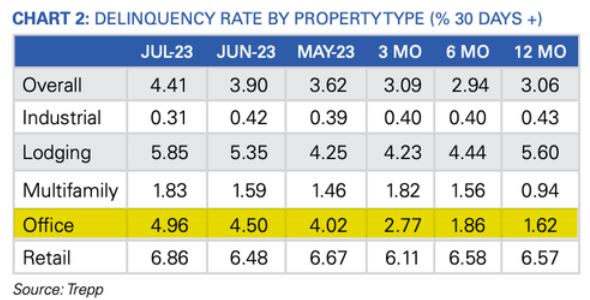
Yes, yes, yes I know that it’s the accepted accountancy practice to put the most recent number at the left of a chart, but it simply supports my thesis that non-grammarians (e.g. cops and accountants) should never be allowed to dictate literacy practices.

To wit:  we go from A to B, from top to bottom, from bad to worse and similar fashion in any number of reading customs and idioms… because in the Western alphabet — in which this article was written — we read from left to right (and not to right from left).  We are not Japanese, or Arabs, or Israelis, who are perfectly free to read diagonally across a page if they so wish, using their chicken-scratch pictograms, hieroglyphs or alphabets, but the language of commerce and industry is English.

Except when it comes to accountants.

So when I read the above chart — and I must remind Readers that reading charts was my métier for well over three decades — I couldn’t see what the fuss was about, until I realized that the fucking thing was written backwards.

I never understood nor cared for this accounting practice, which in non-accounting trend data makes the very next chart in the article perfectly comprehensible:

…simply by virtue of the fact that it follows the accepted timeline format whereby the first data point falls to the left, and the latest data point falls to the right of the trend.

Why accountants have to be different simply beats me.

Once I got past that, the article was extremely interesting:

One major hurdle for CRE (Commercial Real Estate — Kim) space is that “more than 50% of the $2.9 trillion in commercial mortgages will need to be renegotiated in the next 24 months when new lending rates are likely to be up by 350 to 450 basis points,” Lisa Shalett, chief investment officer for Morgan Stanley Wealth Management, wrote in a note to clients.  Shalett expects a “peak-to-trough CRE price decline of as much as 40%, worse than in the Great Financial Crisis.”

But, says BoA, we don’t have to worry:

Bank of America analysts expect challenges in the CRE space but noted, “They are manageable and do not represent a systemic risk to the US economy.”
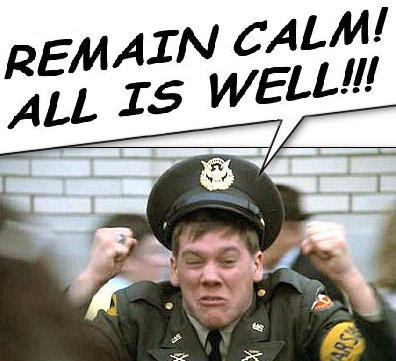
…unless, of course, you’re a small bank, whose CRE investment exposure (from memory, anywhere from 10-15% of total assets) is typically much higher than that of GlobalMegaBankCorp (5% or less).

Fun times we live in, what?  And not helped by stupid grammar.

Euphemistically Speaking

Whenever I see a euphemism, it sets my teeth on edge — probably because as a plain speaker, I try to follow the late Roger Moore’s dictum that the essence of communication is to express your thoughts as clearly and succinctly as possible.

Here’s one that made me chuckle, however:

…you mean “sucked into”, of course.  “Ingested” means taken or introduced into the mouth — one ingests the milk from a glass, or the medicine from a teaspoon, etc.  Also, “ingest” is largely a transitive verb, in that it requires an agent to perform the action — turning it into the passive voice, as here, actually implies no agency — except that as we all know, jet engines “ingest” air in order to propel the aircraft body.

But the writer of the above wanted to try to avoid using the graphic word “suck”, and so resorted to a woolly euphemism.

This is not a hanging offense, of course, but a simple ball-kicking should suffice.

Speed Bump #2,701

I heartily agree with the sentiment, but:

Is it “Males Out Of Female Jails” or “Men Out Of Women’s Jails”?

MAKE UP YOUR FUCKING MINDS

(Given the fact that “male” and “female” are adjectives FFS, the truly correct terminology in the former would be “Male Prisoners Out Of Female Jails” (which scans really nicely) — but that wouldn’t fit on the sign, would it, and by all means let’s not allow linguistic clarity and rhythm to crowd the real estate.)

Another gin, Kim?  Why yes, I think I will.

Speed Bump #8,403

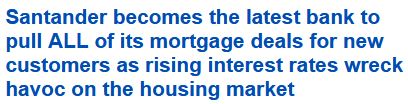
I love headlines that make me want to throw the gin bottle across the room:

…took the “reigns”?  Once again, editing by Spelchek.  Fucking morons.

Still, it could have been worse;  he could have taken the rains, and made the thing even wetter than it turned out to be.

Baby Talk

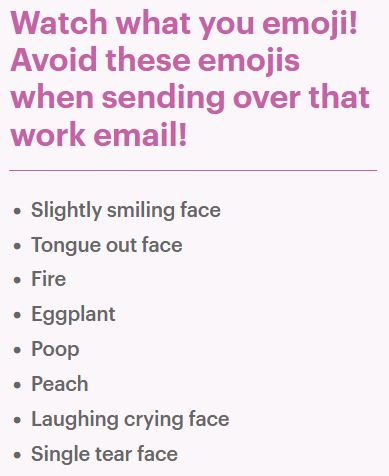
Then we have this silliness:

If I were put in charge of a business today, probably one of the first things I would do is make the use of all “emojis” in corporate communications a cause for immediate termination — whether in internal emails or texts, and certainly in client communication.

Why?  Because a business is a serious thing — there are profits to be made, customer- and client relationships to be forged, and decisions made can have long-term implications and outcomes.

And serious business requires serious communication, not fucking chat-speak shorthand (and by extension, the same goes for acronyms like “AFAIK” and “IMHO”).

There’s no excuse for using any of the above.  “But it expresses what I mean much more quickly and efficiently”  is the common whine in their defense, which tells me that you are a) lazy and b) unable to write / communicate properly.  Neither of those shortcomings is likely to endear you to me, the boss.

I think that this foolishness is in keeping with the modern yoot’s belief that work isn’t serious, that employers have to make employees’ lives easier — safe, yes;  easy, not so much — and it all feeds into the scenario that today’s workers feel that they’re entitled to a job that has few rules, few restrictions on their behavior, and few demands on their intellect (such as it is).

This “work from home” nonsense is another flea on the corporate body.  I once had a job where I worked from home, but only because the (start-up) company was based in Florida and couldn’t afford to relocate me.  Even so, I made a point of spending a full week each month in Florida to meet with other executives and employees, and most especially to justify my continued employment to management.

The way I see it is that if you live closer than twenty miles from the corporate office, you should come in to work every day.

“But I’m just as efficient working from home as from the office!”  (which is a total lie, and everyone knows it) which carries the implication that the employee and not management can set the standard for efficiency.

“But I don’t have to be in the office to work!”  comes the next wail, as though management should have to justify the company’s employment requirements to the employees.  “I decide the working conditions — and if I say you have to work in an office, then you’ll work in an office.  Otherwise, hit the road.”  (or “FIFO” — hah!)

I think it’s the insufferable arrogance that all the above demonstrate that makes me want to walk around with a cane, lightly swatting people who offend me with their attitude and laziness.  (I know, that’s assault — another fucking example of corrective action turned into a criminal misdeed, don’t get me started.)

Long ago, I interviewed a kid for a junior executive position, and was completely floored when he asked me how much access he’d have to senior management, to communicate (as he put it) his “ideas” for improvement.  He was equally taken aback by my response:  “What makes you think that your inexperience qualifies you for such access?”  I then got the “fresh eyes” spiel, whereupon I pointed out that he shouldn’t be so arrogant as to assume that his fresh young eyes were the first such that had ever started work at the company.

Of course, he didn’t get the job — and was somewhat hurt when I told him why I’d made that decision.  (In those days, one actually communicated with applicants when turning them down, instead of ghosting them.  Don’t get me started on this little example of corporate / individual cowardice.)

Elephant herds tend to survive (and thrive) because the older bulls keep the adolescents in line.  In today’s culture, adolescents demand that they should run the show, even though history shows that uninformed opinion and little experience ends up in disaster. One of my favorite movie storylines is that of Big (1988), where Tom Hanks is miraculously transformed into an adult, and whose idea for a toy company makes him a corporate hero.  However, his next idea is terrible, and had he not reverted to childhood, catastrophic failure would have been inevitable.

Never mind history (all that old stuff);  one has only to look at today’s White House and its Cabinet of lightweights like Harris, Buttigieg, Granholm and Raimondo  to see the consequences of such folly.

The business world is no different, by the way, as witnessed by the ineptness and uncaring attitude of adolescent children like Zuckerberg and the twerps at Google, whose “life is just like a game, dude” perspective is equally catastrophic for society.  Great ideas for a start-up, but not so good (okay, terrible) for the long term.

Unfortunately, unlike with Tom Hanks’s Big character, there’s no easy way out for the rest of us who have to live with the Bidenesque- and Metaversal catastrophes.

And while these twerps, insulated from looming catastrophe by age (Biden) and wealth (Zuckerberg), might say “BFD, dude”, the same is not true for the rest of us.

It IS a Big Fucking Deal.