Listening Time

I’m feeling a little under the weather — head cold, nothing to worry about — so please indulge me for a day or two if posting is a little light.

In the meantime, listen to the ever-knowledgeable Victor Davis Hanson talk about the war in Ukraine.  Well worth the time.

Logistics

I was going to talk at some length about the “supply-chain crisis” with respect to the grocery business, but Sundance did it for me.

And for what it’s worth, his diagnosis and analysis are absolutely 100% correct.  As long as there are no hiccups in any aspect of the supply chain, “just-in-time” supply is the Finance Department’s wet dream.  But note the term, “any aspect“.

A driver shortage, a spare parts shortage, a labor shortage, a packaging shortage or a fuel shortage, and the whole Jenga structure falls over.  If all of those happen at about the same time, the Jenga structure disappears completely and would take months if not years to be restored.

As we are going to see very soon.  Stock up now, folks, while you still can.  And for once, I’m not talking about ammo.

First, McVeigh

…and now this asshole:

On Jan. 12, the Del City Police Department received an intelligence bulletin about someone making threats to blow up the Occupational Safety and Health Administration building in Oklahoma City.
Investigators learned that the man said he was going to rent a truck, fill it with gasoline, blow up the building, and then take his own life.

As an impartial observer, I should note that it doesn’t seem like Oklahoma City is the prime location for gummint offices, does it?  (I know, we shouldn’t have so many gummint offices in the first place [/Andrew Jackson].)

Officials say Moore threatened the OSHA because he didn’t agree with the agency’s guidelines regarding COVID vaccinations or face coverings.

Seems a kinda strong response just for “disagreement”, I have to say;  so 10-to-1 says this Covid bullshit was threatening his livelihood.

Or else he’s just a radical libertarian.

Chasing Markets

I’m not going to argue with the genius of Juan Trippe, the late head of Pan Am (as discussed in last night’s homework assignment).  But the problem with genius is that it can overstretch itself, which is what happened to Trippe, and that had dire consequences for Pan Am.

But first, it’s time for yet another one of Kim’s Supermarket Stories (and I promise it has relevance).

I once worked for a chain which prided itself on the quality of its product — not only the merchandise, but the service of its customers.  The Produce Department (Fruit & Veg to non-Murkin Readers) was as good as any “street market” or “farmer’s market”, for the simple reason that the store merchandisers tossed out a tremendous amount of any produce items which they judged sub-standard or even close to going “off” before they ever set it out on the shelves, in the bins, fridges or displays.  The result was that you could pick any item off the display stand, and had no need to check it because you just knew that it had passed a stringent quality test.  And the same was true of every department:  (on-site) bakery, meat department, deli and so on.  As a result, our average basket cost a little more than our competitors’, but then again, our typical shopper belonged to a higher income bracket:  the kind who value quality over price and expect the best.  Our average household, therefore, usually consisted of a high-earning husband/wife with teenage kids, who lived in the upper-middle class suburbs where (surprise surprise) 95% of our stores were located.

I was at the time the senior marketing manager for the chain — ran the loyalty program, worked with the Advertising department, worked with Purchasing on product selection and so on.

Then we had a huge management change:  new CEO, new COO and new CFO.  When I went to the first “welcome” meeting, the new CEO announced, without any fanfare, that our chain would henceforth be aiming for the lower segment of customers:  younger moms with small kids, more “efnic” shoppers, and so on.  After the meeting, I managed to get a one-on-one with the new CEO, and blew up at him.

  • Had he discussed this with Purchasing? (because we’d have to start buying larger pack sizes, cheaper — perhaps lower-quality — products, which meant new shelf set design, and so on)
  • Were all new stores going to be located in more down-market areas? (because our existing stores were not convenient to those areas)
  • How were we going to compete with the multitude of competitive chains who had already staked out the “Every Day Low Price” (EDLP) position in the marketplace? (and we didn’t have the numbers to compete with the large existing chains, anyway)
  • Had anyone looked at how this new strategy was going to affect our gross profits?  (in our end of the market we had hardly any competition, ergo  we could afford our higher prices for the quality)
  • And why the fuck had I not been consulted on any of this? (because I had all the answers to the above questions).

To his credit, the new CEO didn’t fire me on the spot.  But his lofty answer was that the board of directors had decided that we needed to “grow the business”, and as we had the upper end of the market more or less to ourselves, we needed to expand our customer base.

Which brings us back to Juan Trippe and Pan Am.

It’s clear that Pan Am had a quality product, and their clientele were not people who, let’s say, were at the bottom of the market.  Their service was unparalleled, not only in the airline industry but anywhere, and it showed in all aspects of their business:  hiring, training, equipment and cuisine.

Then Juan Trippe decided to “grow the business”, and open Pan Am up to the lower end of the market via mass-market people carriers like the Boeing 747.

I had always wondered why Pan Am ever, or could ever, have gone out of business.  The YouTube video gave me all the answers.  To be blunt, Pan Am went from “You can’t beat the experience… Pan Am!” to “We’re just another airline;  check out our low prices.”

Their demise was as predictable as that of the above supermarket chain:  both went out of business only a few years after making that calamitous decision to chase a new market.

Side note:  I resigned a month after my meeting with the CEO.

Now, had I been Juan Trippe and wanted to “expand the market”, I would have done a couple things differently.

  1. Had the 747 jumbos built, but not flown them under the Pan Am logo, to include ground staff, cabin staff and maybe even pilots.
  2. Named the new budget airline “Dream Trippe” or something similar, and not have the 747s have first- or business class — basically, the economy-class seating (and service) would run from nose to tail.
  3. Kept the 707s going until the new sub-200-seat generation of airliners became available (e.g. the long-haul Airbus 220-300 or the “short” Boeing 757-100).  Then turned them into first-/business class-only aircraft, using the traditional Pan Am staff and pilots, and maintaining the both the higher prices and the clientele who preferred the luxury service levels.
  4. Shared the existing Pan Am slots at airports between the two airlines.

That’s the basic idea of the thing, but you get my drift.  It might not have worked and Pan Am might still not have made it.  But they failed anyway, so how much worse could the outcome have been?

But at least they wouldn’t have screwed up their Pan Am brand, which was priceless.  And the actual blowing up of the Pan Am brand was the entire responsibility of its founder.

Connecting With Voters

I’m not saying I applaud the actions below.  But for some reason my Schadenfreude  button got pushed, twice:

Rep. Mary Gay Scanlon (D-PA) was carjacked at gunpoint in Philadelphia

…and:

Illinois Senate Majority Leader Kimberly Lightford (D) and her husband were victims of a carjacking Tuesday evening

I have no idea whether these two Democrat politicians are of the Leftist persuasion — although suburban Philadelphia and “Illinois Senate Majority Leader” in a liberal, near-Chicago suburban district are pretty good indicators that they are — and if they are supporters of the BLM movement and philosophy, then it’s always good to see the biters bitten, so to speak.

Like I said, I’m glad they weren’t injured;  but to see our politicians the victims of the violent crime they sometimes turn a blind eye towards or even actively support — as long as it happens to others — is not a bad outcome.

Maybe they’ll think twice about their position the next time someone talks about enabling crime.

Good Development

As a retiree, I don’t have a dog in this fight anymore, but back in the day I might have, and my kids certainly do.

Around the world, millions of people are rethinking how they work and live—and how to better balance the two.
The Great Resignation has U.S. workers quitting their jobs in record numbers—more than 24 million did so from April to September this year—and many are staying out of the labor force. Germany, Japan, and other wealthy nations are seeing shades of the same trend.
The pandemic has taken a toll, with surveys showing an increase in feelings of burnout and a deterioration in mental health in many nations.
But the pressure has been building in developed countries for decades. Incomes have stagnated, job security has become precarious, and the costs of housing and education have soared, leaving fewer young people able to build a financially stable life.
Although the Great Resignation is a phenomenon among those who are younger than 40, it’s also reverberating across the economy and forcing a broader conversation about work. Millennials (born between 1980 and the late 1990s) and Generation Z (the demographic cohort after them) tend to marry, buy houses, and have children later than their forebears—if at all.

Let me tell you a story about my Son&Heir.  For the past dozen years he’s been working in the restaurant business, first as a waiter, then as assistant manager, and finally as the Kitchen, Food & Beverage Director at their busiest restaurant.

He was also getting burned out.  One time I met him for lunch, and I was appalled at what I saw:  the normal laid-back, witty kid I once knew was now a nervous wreck:  pale, skinny, with shaking hands and a thousand-yard stare.

I told him to quit and find another job, and he said that he couldn’t:  the company was too dependent on him and his coworkers to keep the place afloat — no bonuses for doing so, of course.  When I told him how bad he looked, and how worried I was about him, he simply said:

“I know.  I’m tempted to quit and go and work as a bartender for a year or so, just to catch my breath and regain a little sanity.”

I nearly fell over.  But as he put it, bartending would mean less money, but shorter hours and no stress.

I didn’t want him to do that, but considering that the Son&Heir looked like he was doing speed (don’t worry, he wasn’t), I agreed, but told him to wait until after Christmas.

I needn’t have worried.  Unbeknown to me, he’d already put out feelers — he just didn’t want to tell anyone until he’d actually got a new job to avoid the stress involved in that — and as it turned out, he ended up getting a really good job with a Great Big Financial Institution thanks to someone who used to shoot with him on the US Olympic development team.

Now he’s a different guy.  The old Son&Heir is back:  relaxed, charming and witty, the excellent company he always was.  Thanksgiving Dinner was great fun, and a solo dinner with just him equally so.  He works regular hours during the week, and never over weekends.  For more money.  And he doesn’t know what to do with all his spare time.  He’s also had to slow down his hell-for-leather approach to work and adjust it to corporate time.

But that’s not my point to the story, good news though it is.

What’s important is that like the people mentioned in the article. he would have been just fine with a lesser-paying job — and if that’s true of the S&H, one of the most dedicated workers a boss could wish to have, then companies are going to have to get their shit together or face serious staff shortages, permanently.

And I don’t care.  Back in the day, a company could work you really hard for decent-but-not-great pay, because the trade-off was job security.  The minute the accountants got involved, and company loyalty became worthless (because long-term employees cost more in benefits to keep, you see), there was no way that companies could keep on overworking staff without it ending in this Great Resignation.  The game, as the saying goes, was no longer worth the candle, especially as the companies were making record profits and the bosses thereof a lot more money than in the past..

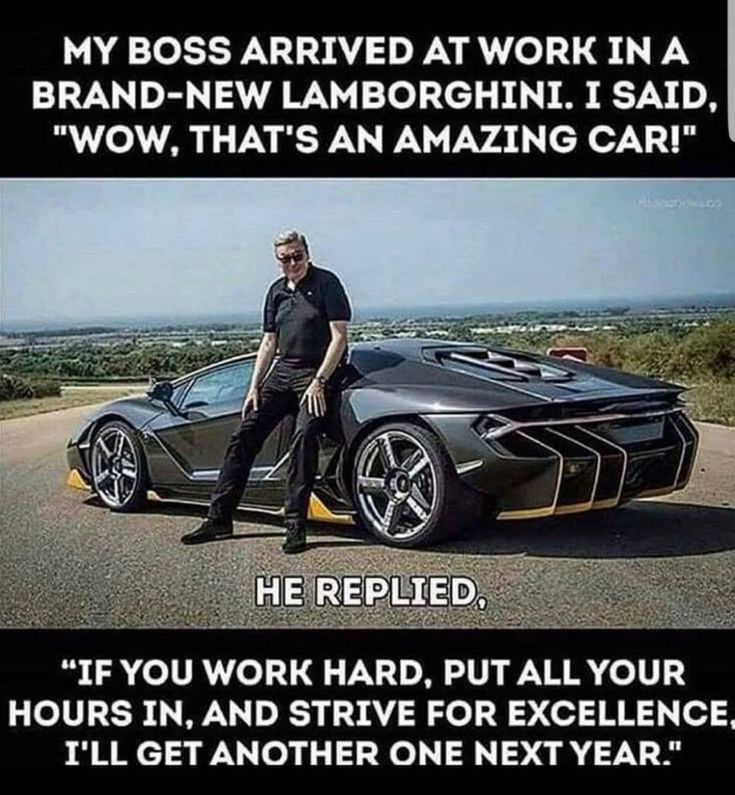
Here’s an example of what I’m talking about:

Guess what, Boss?  Those days might be coming to an end soon.