Upgrades

Via Insty, this little gem:

Owners mourn spoiled food after firmware update
bricks Samsung smart fridges

Affected fridges “suddenly lost power and stopped functioning immediately after” trying to issue a firmware update through SmartThings, Samsung’s smart home platform, per Star News Korea. The SmartThings app then showed the devices as offline. Some users said that their fridge’s internal display was stuck showing the message “Checking SmartThings app during update.”

There are numerous reports on Samsung’s Korean community forum detailing the problem. Some users claim that they have owned their affected fridge for just a year or less.

“[T]he refrigeration and refrigeration functions themselves did not work normally, so all the food in the refrigerator had to be disposed of,” one user wrote.

Of course, Samsung says that this only affected Korea — like it could never happen anywhere else.  Uh huh.

Here’s where all this technology — in appliances, cars, whatever — cocks things up.  What has happened is that “must-have” has been largely replaced by “nice to have”, and in the nature of the human condition, a lot of “nice to have” things have become “must-have”.  Let’s use fridges as an example.

Must have:  maintain a constant temperature that cools or freezes foods.  This is the sine qua non of any refrigerator.

Nice to have:  a means whereby one may control the temperature (initially, by a manual dial inside / outside the refrigerator), and by extension, a means of notifying the customer when the fridge stops working — e.g. the little light inside doesn’t turn on when the door is opened.

So when the above “nice to have” slowly transforms away from the manual / visual of the fridge itself into “you can now check your fridge’s condition on your phone” (to give but one example), all sorts of failure points are introduced into the process.  And that’s the simplest one I can think of;  but of course it doesn’t stop there, does it?

Anyway, I can see that at some point you will no longer be able to get a simple fridge like the one your Mom had in her kitchen.  Oh no:  you’ll only be able to get one that tells you the time, sets variable temperatures inside the fridge by drawer, tells you when the icemaker level drops below a certain point, and so on and so on.  All very nice to know, but nowhere close to being “must-have”.  (It will also cost three times the amount that a basic fridge used to, and will yield five times the profit to the manufacturer, which is your answer right there.)

And when the upgrades come along (why?), and the whole thing falls over, you’ll be left in the same predicament as the hapless Korean restaurateurs.
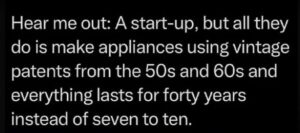
I can dream, can’t I?


Brain Drain

I read SOTI that the number of South African Afrikaans farmers resettled in the U.S. has now exceeded 117,000 — I think that the number is the total (i.e. including family members) and not just the men — but whatever, it’s a lot.

Let’s just remind ourselves that what we’ve gained is a bunch of people who are pretty much experts in their field — dry weather farming — and arrive here not only with that, but with a proven work ethic and most importantly, a profound sense of gratitude that they and their families have left behind a truly sick society which openly calls for their murder just because of their race, and their success.  (It doesn’t matter how these calls are phrased or how the intentions are masked, the net outcome is murder.  It’s still “Kill the Boer!” any way you cut it.)

As to what’s going to happen to the farms they left behind… well, just look a few hundred miles over the Limpopo River into Zimbabwe to see what’s happened there;  and anyone who thinks the outcome will be any different is deluding themselves.

Call it an agricultural brain drain, if you will.

Now let’s look at a brain drain of different dimension:  quantum computing.  Here’s the story:

Caught between climate regulation and catastrophic energy-policy decisions, a growing number of high-tech companies in the EU are packing up and leaving. Through stock-market deals, two top quantum-computing companies, IQM and Pasqal, are gradually moving toward the United States. The bleeding of the European economy is now being accepted with remarkable resignation.

Not a week goes by without another disaster report from the economy. In the first half of the year, the German economy recorded a record number of insolvencies — the highest insolvency figures since 2013. Thousands of industrial jobs are being eliminated as a result, and the economy continues to bleed. A political course correction toward strengthening the economic foundation still appears impossible. And this is only the beginning: the stranglehold of expensive climate policy, the restriction of fossil-fuel energy supplies, and rising regulatory costs are acting like an accelerant on the businesses of the euro economy. Those who can leave, do.

What is happening in Germany is being repeated elsewhere: in Finland, for example, where the company IQM is taking the leap onto the U.S. stock market. IQM specializes in superconducting quantum computers and develops the quantum processors required for them. The systems are being developed for research, high-performance computing, and industrial applications. The company merged with Real Asset Acquisition Corp., a kind of American shell company, and in early July moved to the Nasdaq under the ticker IQMX with a valuation of around $1.8 billion. This is not a classic sale of the company to the Americans — the existing owners received no cash payment but remained invested in the company. However, this changes little about the outcome: capital, market power, and an increasing share of control over the company’s strategy will, in the future, be rooted in the United States — American patents, American knowledge of future technologies, made in Europe.

A look at France shows a similar development. This is where Pasqal is based, a spin-off of the Institut d’Optique, founded in 2019. While global players such as IBM and Google rely on superconducting circuits, Pasqal found a different approach: the highly specialized team traps individual rubidium atoms with focused laser beams — so-called optical tweezers — inside vacuum chambers and arranges them in precise 2D and 3D lattices. With this principle, the company’s researchers appear to have succeeded in avoiding the production errors that have plagued other qubit technologies so far. The discovered method makes it considerably easier to scale the technology to ever larger numbers of qubits. Knowledge is power, especially in high technology. Given its complexity, the company’s innovation is probably only fully understandable to a few specialists.

In the case of Pasqal, the acquisition of the company by the shell company Bleichroeder Acquisition Corp. II on August 28 paved the way for its know-how to cross the Atlantic. The company is currently valued at around $2 billion — but this is likely to be only a snapshot; its potential is enormous. With its patents, research results, and academic substance, Europe is losing its intellectual foundation — all the more serious because the continent is energy-poor, politically cornered, and steering aimlessly through uncertain waters. Europe is simply no longer attractive enough for cutting-edge research, top-tier capital, and top talent.

Now as to why quantum computing is such a critical industry, read the rest of the article.

But while the quantum computing companies’ managers and owners are not personally being threatened with death, the threat to their companies themselves by the European mindset, laws and regulations is no less dire.

Of course they’ll move to where it’s safer and technology is not treated as a dirty word — and that place is not Switzerland, Germany, Cuba, Russia, Singapore or China (to name but some).

So bienvenue (and however you say that in Finnish), folks.  Europe’s loss is our gain, and they have nobody to blame except themselves.  Ditto for those racist assholes in South Africa.

Same Family, Different Purpose

Here’s a little mind game.

Say you were offered two cars to own and keep.  These would be to take care of you and your family (ad arguendo, you were of that age, say mid-forties, with a wife and two preteen kids).

The only catch is that the cars must come from the same brand:  Chevy, BMW, VW and so on.  In other words, the badge on the hood or grille must be identical to the other one.

The cars can be older, or modern, and they’re in excellent running condition — showroom condition, so to speak.

Which would you pick?

And just so it’s a little more clear, here are a couple of pairings:

BMW M3 / BMW X3

(Yeah, I mixed up the model years so you can get an idea of the scope.)  Another:

Chevy Camaro and Suburban

Feel free to specify the model years and the reasons for your picks.

Here are mine:

Read more

RFI: Wetherspoons

This one is especially for my Brit Readers, and it was sparked by this article.

Since visiting her first Wetherspoons with her now husband Andrew in 2024 — it was The Moon Under Water in Watford, in case you’re wondering — Stacey Gitten has now visited 71 Wetherspoons up and down the country. It’s a mission that has seen her travel as far as Edinburgh from their home in Southampton, and she ‘even went to Wales just to go to a Wetherspoons’, she tells me. 

But despite having visited 71 of the chain’s carpeted pubs — a mission that she has documented on TikTok under the handle @staceyintheUK (she moved from Chicago to be with her husband) — Stacey has tried surprisingly little of the menu. In fact, she has a go-to order; her control she uses to compare across the ‘Spoons outlets.

(It’s Eggs Benedict, by the way.)

For my Murkin Readers, Wetherspoons (or “Spoons”) is a budget-friendly alternative to the typical pubs and restaurants Over There, with a common menu across almost all establishments, with some local variations.

Okay, I have an admission to make:  I’ve never been to a Wetherspoons pub.  There’s no reason for this, unless it’s a subconscious desire not to go to any chain restaurants when I’m Over There.  I remember being tempted by The Bear in Melksham (I went to that town often because it’s just down the road from Free Market Towers), but never went inside.

Perhaps I should have.  (Unless it was because they didn’t serve Wadworth 6X?  I dunno.)

Anyway, is our Murkin transplant in the article an idiot?

All input will be gratefully received.

News Summary


...make it a long prison term, y’all.


...ditto.  Also:


...pictures show the “protesters” waving Mexican flags, when the bullets’ recipient was actually Venezuelan (I told you they all look alike).  I guess ActBlue didn’t have any Venezuelan flags in stock.


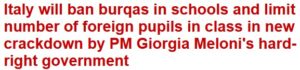
...”hard-right” being the equivalent of “centrist Democrat”, in U.S. terms.


...oh look:  Asshole Muslim Nation #1 is bombing Asshole Muslim Nation #2.  Any more of that popcorn around?


...fraud in Minnesoduh?  Well I never.


…in which we play our popular game of “Guess The Race”.  (Hint:  Louisiana)


...once our problem, now Canuckistan’s.  Whatever.


...that’s not news.  “Penelope stuns in black garbage bag”… oh wait, that wouldn’t be news either.


...oh, how these poor people suffer for their art.  Although it must be said, the Mara sisters would not be my first choice for a cinematic threesome.
#Penelope&MonicaCruz