That Gun Registration Thing

Reader Clarence R. offers a mild correction to my earlier rant about gun confiscation in Canuckistan:

Kim:
In Canada not all guns are registered, only (legally owned) restricted and prohibited firearms are in the RCMP database and cannot be sold without notifying the RCMP. Hunting rifles and shotguns are non-restricted and therefore not registered to the owner and can be sold to other PAL holders without notifying the RCMP.
In 2022 the govt created a list of 2,500 rifle models that were previously unrestricted, declared them prohibited and now wants owners to self report that they possess them so they can be confiscated. Those who report first may receive financial compensation if the money doesn’t run out first.
I have an M1 Carbine which was restricted when I purchased it because one bank robber in Montreal in the ’60s had the habit of concealing a paratrooper M1 under his parka. As of 2022 it is a prohibited weapon, I can’t sell it or take it to a gun range.
I chose to self report because I knew that the RCMP database listed my M1. If the Liberals were to win the next provincial election and wanted to “take guns off the streets” it would be a simple matter of comparing two datasets, the restricted firearm database and the list of self reported firearms. My name would pop up and I would be guilty of a firearms-related crime. At this point the police would have cause to arrest me and confiscate all my guns after which the govt would show all my rifles and pistols (I think I have [lots more]) spread out on some tables and falsely claim the streets were safer. So I made the decision to give up one low powered gun in order to not risk losing all my guns.
When I went to the govt website and punched in my RPAL (Restricted Possession and Acquisition Licence) it immediately brought up my M1 complete with serial number and a buy-back value of $650Cdn.

Needless to say I didn’t volunteer any information about any other guns in my possession that may or may not be on the list of “assault style rifles”. The general consensus at the local gun shop counter is that no one is reporting “assault style rifles” that the RCMP doesn’t know about.

Thankee for the clarification [sic].  (Yeah, I took out the actual number of guns he owns because Good Reasons, given the Canucki gummint’s penchant for spying on their  citizens  subjects.

Just the very fact of the RPAL’s existence sets my teeth on edge.

As for my U.S. Readers:  never forget that the above rigmarole is precisely what our local Socialists want to do to us… or worse.

How Steep The Slope?

I think it was Adam Smith who said:  “There is much ruin in a nation.”  What he meant was that a nation’s downward decline from prosperity to ruin can take some considerable time — nearly five hundred years, in the case of ancient Rome — because all the foundations of that prosperity and the institutions which maintained it may have inherent strength;  and decay, while apparently certain, can still be resisted or even held back and improved by the efforts of the nation’s people.

None of which applies, of course, when the nation’s institutions are actively destroyed or its policies undermine its very foundations.

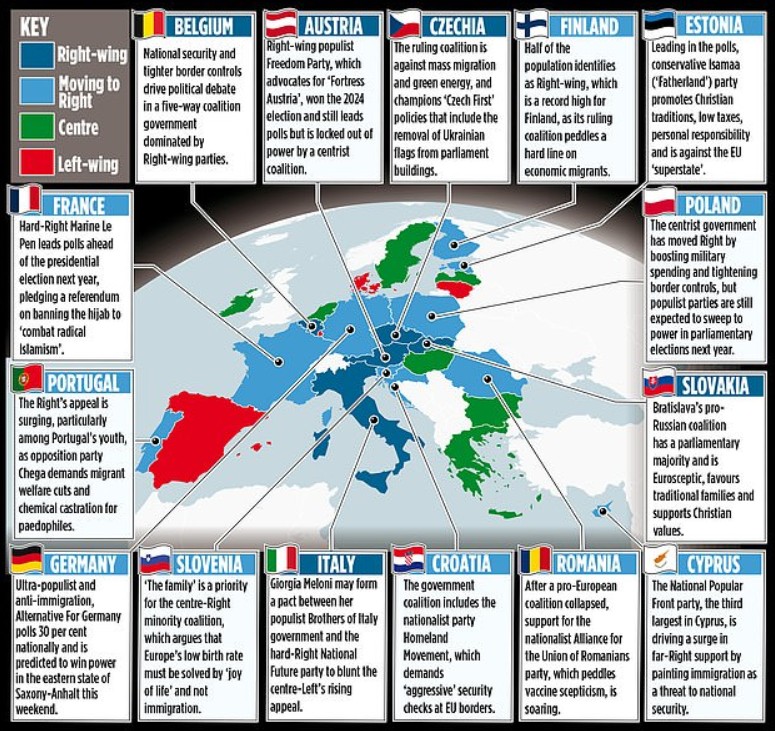
Which leads me to Germany, which is doing both by not taking the Greens out and standing them in front of the machine-gun pits.  (Okay, maybe that metaphor could be interpreted as a little too strong, given Germany’s not-so-distant use of said pits, but you know what I mean.)

I suspect that you’ll change your opinion on that metaphor when you read this article:

In response to the intensifying European energy crisis, the green lobby in Brussels and Berlin is accelerating the pace of transformation. Politics lacks the imagination for a real energy crisis scenario. Civil society submits, nearly paralyzed, to its fate.

Anyone who expected that empty gas storage in Germany and the escalating energy crisis in Iran would silence the green lobby in the country must think again. The political representation and its media apparatus — the extended arm of the green crony system — fight with all means to preserve the green transformation complex, regardless of the force with which the waves of reality now crash against the thin green dam.

While economists and business associations worldwide foresee a new energy price shock — with the potential to derail the global economy — solutions to the mercantile bottleneck at Hormuz barely emerge from Berlin’s intellectual narrowness.

On the contrary: On this side of ideologically dismantled infantilism, political elites focus primarily on the survival of their power construct — the Green Deal.

As the saying goes: even civilized societies are always only two missed meals away from chaos. And energy — a steady, secure, and affordable stream of this life force — is the very foundation of what we call civilization.

Stepping back to illustrate the societal phenomenon: under the Green Deal, a highly complex web of politically proliferating environmentalism has emerged — a highly opaque yet extremely effective redistribution machine. Supported by decades of cultivated green moralism, widely accepted in the population — or at least hardly questioned until now.

In this way, an extraction mechanism has emerged that systematically siphons wealth from the productive machinery of society. This wealth is channeled precisely into the green parasitic system, which can proliferate in the shadow of political programs and moral justification without facing significant resistance.

Over time, a state within the state has emerged, its structures deeply grown into economic and institutional fabrics. This entity now seems to be entering a new phase — one of exponential weakening of its host body. Rising energy prices, which over the long term translate into higher inflation rates, are a symptom of the host’s weakening.

I apologize for the lengthy excerpts, but as I read the article, I couldn’t help thinking, “There but for the grace of Donald Trump goes America.”

But more to the point:  if we fail to see that the Green Catastrophe will, if we allow it to, become as much a part of our polity as it is in Europe.  Hell, thanks to the Obama Dozen Years it nearly did, and it’s taking a Herculean effort by the Trump Administration to undo and untangle us from that strangling creeper.

Suicide may be woven into the Western European polity;  but I’m sure as hell hoping that it’s not in ours.
New Name For An Old Thing

Sent to me by Combat Controller, this description of a Diversity Bollard:

A recent innovation of installing bollards outside festivals, events, concerts etc. with a high volume of foot traffic to protect the common citizen from diversity-driven cars, vans and trucks.

Of course, nowadays one has to be extremely careful when leaving a house because of the above phenomenon.

I really like the term “diversities” because it’s an all-encompassing term for all sorts of dangerous scrotes like ghetto dwellers, muezzin groupies, mescal swillers and so on.

Consider it part of my lexicon from now on.

Right Idea

I see that the famously-tolerant Swedes are coming to their senses about this immigration business:

Sweden’s government on Tuesday said it would put forward a bill introducing a requirement for migrants to adhere to an ‘honest living’ or face deportation.

The country’s centre-right government, supported by the anti-immigration Sweden Democrats, came into power in 2022 and vowed to get tough on immigration.  They are now trying to rapidly push through a slew of reforms in various areas ahead of legislative elections in September.

The new requirement would make it easier to withdraw residence permits for migrants.

Speaking at a press conference, Migration Minister Johan Forssell told reporters: ‘Following laws and rules is a given, but it must also be a given that we do our best to live responsibly and not harm our country.  If, for example, you ignore paying your debts, if you don’t comply with decisions from Swedish authorities, if you cheat the benefits system, if you cheat your way to a Swedish residence permit… then you do not have the right to be here,’ Forssell said.

Other examples the government cited as examples included working without paying taxes or not paying fines.

That all sounds perfectly reasonable to me.  Immigrate (lawfully) by all means, but once you’re here, act like an actual citizen and not like some criminal scrote, or face getting tossed out.

Loath as I may be to suggest that we learn any policy from the Scandis, this would be an exemplary one for us to implement as well.  I don’t know the specifics of their policy, but it should be made that said repatriation and loss of residence status would include the entire family of the deportee, including any children born Over Here.

Shutdown

As Longtime Readers know, I’m not shy to take the occasional swipe at Oz and the Strylians.  This, however, is not good:

We are fifteen days into the Iran–US war. The Strait of Hormuz, the narrow stretch of water through which 20% of the world’s oil and gas normally flows, is effectively closed. Tankers have been hit. Insurers have pulled coverage. Commercial shipping has ground to a standstill for over a week. Brent crude closed Friday at US$103 per barrel, up from $70 before the war, having already spiked to $119.50 during the week. Iran’s military spokesperson has warned oil could reach $200.

Australia imports over 90% of its refined petrol, diesel and jet fuel, almost all of it processed in Asian refineries that are now hoarding output for their own populations. China has banned refined fuel exports. Thailand has suspended petroleum exports. Singapore and South Korean refineries are operating under force majeure. The International Energy Agency has just announced the largest emergency stockpile release in its 50-year history — 400 million barrels across 32 nations.

When the world’s energy watchdog fires its biggest gun, you don’t need a PhD to know the situation is serious.

I hope my Oz Readers (both of them) will take this warning to heart, if they haven’t already.

It’s no longer a joke.

Welcome Change

As anyone who’s read this website for any length of time should know, I love the country of Chile.  In fact, of all the Third World countries I’ve ever been to or even lived in, Chile ranks #1, by miles.  I love its people, its scenery, its way of life, the women are among the sexiest I’ve ever seen and the climate is wonderful;  so despite the language difficulty, if someone were to say:  “You have to go and live in Chile”, my response would be:  “Gimme the ticket.”  I’d learn Spanish just to go and live there.

I can’t remember if I’ve told this story here before, but in case I haven’t, here goes.

You will recall that at one point, our family traveled extensively around the world (either on vacation or on business), and over three years we visited nearly two dozen countries, several repeatedly.  We knew that the travels were going to end at some point (for all sorts of reasons) so at the end of what turned out to be our final trip, we polled our three kids with the following question:

“Assuming that you could afford to live there (had a job, etc.), which are the top three countries you’d choose to live in?”

The answers were as follows:

Daughter:  1. Tokyo, 2. Paris
Son&Heir:  1. London 2. Heidelberg (Germany)
#2 Son:  1. Tokyo 2. London

All three picked Chile — specifically, Viña Del Maras their third choice.

My only reservation about Chile — it was one of my top choices, too — was that I got the feeling that it was just one revolution from becoming Communist.  And incidentally, that fear was also prevalent among many of the native Chileans I met on our trip there.

Which makes the most recent political news from Chile all the more exciting:

In December, former congressman José Antonio Kast found himself in a runoff against the Communist Party’s Jeannette Jara. Thankfully, Kast won in a decisive victory with nearly 60% of the vote.

But the people of Chile are ecstatic. The country has more or less been taken over by socialists and leftists for decades, and its most recent president, 40-year-old Gabriel Boric, may have been the most hardcore — and least popular — of all.

So, let me warn you that as you peruse the fake news media today that you’ll probably see a lot of headlines about how Kast is “far-right” or “ultra-conservative” or a big fan of the country’s former dictator, Augusto Pinochet. First of all, Kast has praised Pinochet’s economic reforms — he was a big capitalist, free market kind of guy who saved the country from full-on Communism — but Kast has also condemned him for his human rights abuses and all the bad stuff he did. It’s not like he has posters of him hanging on his office walls. Sheesh.

Second, Kast has been called “Chile’s Trump,” and that right there is enough to make the MSM lose its collective mind.

Kast campaigned on being tough on crime and restoring law and order to the South American nation. That includes deploying the military to cities with high crimes, strengthening the country’s borders, mass deportations of hundreds of thousands of illegal immigrants, putting the interests of native Chileans first, and getting tough with cartels and terrorist organizations like Tren de Aragua.

Sounds like Chile, at last, is in the right [sic] hands, even though it seems unlikely that ChilePres Kast is going to revive Air Pinochet, which is rather sad.

Now if you’ll excuse me, I’m going to see what it costs to fly to Chile… wait, less than $900 return?  Whoa.

Oh, and one last story.

When we arrived in Santiago and checked into our hotel (Four Points Sheraton), we got a call from the kids’ room:  “We’re hungry;  can we get room service?”

Well, a week prior to that we’d been in Zurich, where room service required a credit check.  So with great trepidation I scanned the Four Points’ room service menu, converted the CLP$ (peso) into USD$, and said:

“You can order everything off the menu.”
“You mean anything?”
“No, I mean everything.”

I don’t remember what anything cost, but it was about 20% of what the same thing would have cost in a U.S. hotel, and about 1% of what it cost us in Zurich.  (I’m not exaggerating.)

So yeah;  add “affordable” to your travel plans.

I am seriously considering this idea, funds permitting.


Note:  It appears that Chile no longer charges U.S. citizens an entry fee of $160 per person, nor does the U.S. do likewise for Chileans entering the U.S.  This was the only fly in the ointment on our trip there, and thankfully it is no more.