Owning, Or Being Owned?

Several Readers (thankee) have pointed me to this article at American Thinker:

There was a time — not very long ago — when the automobile represented one of the clearest expressions of individual choice in a free society. Limited only by fuel, roads, and imagination, a person could choose where to go, when to go, and how to get there. The car was not merely a machine. It was mobility made personal — an extension of autonomy and freedom.

Sadly, that is no longer the case. Increasingly, this same instrument, once a tool to facilitate individual independence, has been repurposed into a system of monitoring and control. Though advertised as safety measures for the consumer, these measures were clearly designed to empower the state.

Modern vehicles are no longer just mechanical devices; they are computers on wheels. Embedded sensors track speed, braking patterns, seatbelt usage, location, and even driver attention. Event Data Recorders — commonly referred to as “black boxes” — have been standard in most new vehicles for years. Originally justified as instruments to reconstruct accidents, these devices record data in the moments before a crash. Few object to understanding the causes of collisions. But it is worth noting that once data exists, its use rarely remains confined to its original purpose.

Insurance companies now seek access to driving data to adjust premiums. Law enforcement agencies have used vehicle data in criminal investigations. Courts have admitted such data as evidence. Each of these developments can be justified in isolation. Together, they represent a quiet but unmistakable shift: the automobile is no longer simply your property — it is a source of information about you.

More recently, legislative developments have accelerated this trend. The federal infrastructure legislation passed in 2021 includes a mandate for advanced impaired driving prevention technology to be installed in all new vehicles within the coming years. While often described in benign terms — systems that passively detect intoxication or driver impairment — the practical reality is that these systems must continuously monitor driver behavior in order to function. Monitoring creates data. And data, once created, rarely remains unused. It takes on a life of its own.

Proposals and discussions around remote vehicle disablement — popularly referred to as “kill switches” — have raised further concerns. While proponents argue that such features could prevent high-speed chases or stop stolen vehicles, the existence of remote-control capabilities introduces a fundamentally different relationship between the individual and the machine. A car that can be disabled remotely is clearly not under the control of its owner.

I’ve ranted about this little bit of rampant evil on many occasion, and the gist of all my screeds has been all around this concept:  giving up control — to anyone, for even the most laudable purposes — will, inevitably, end your freedom.

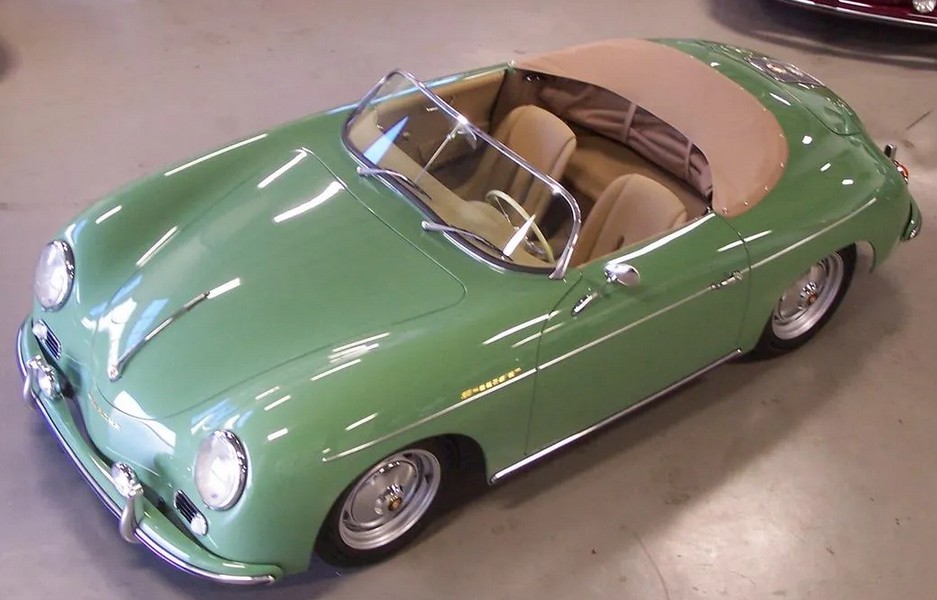
I’m unlikely ever to buy a new car, and certainly not a “modern” car which would contain all the electronic snoopery and filth as discussed above, and most especially at today’s bloated and excessive prices.  But if I were ever to be forced into buying a replacement for the Tiguan or the Fiat, and given that no matter what I buy, it would carry a horrible price tag withal, then why would I just not get a much older car that while expensive, at least allows me the freedom that cars of yore gave me?  Something like this one, for instance:

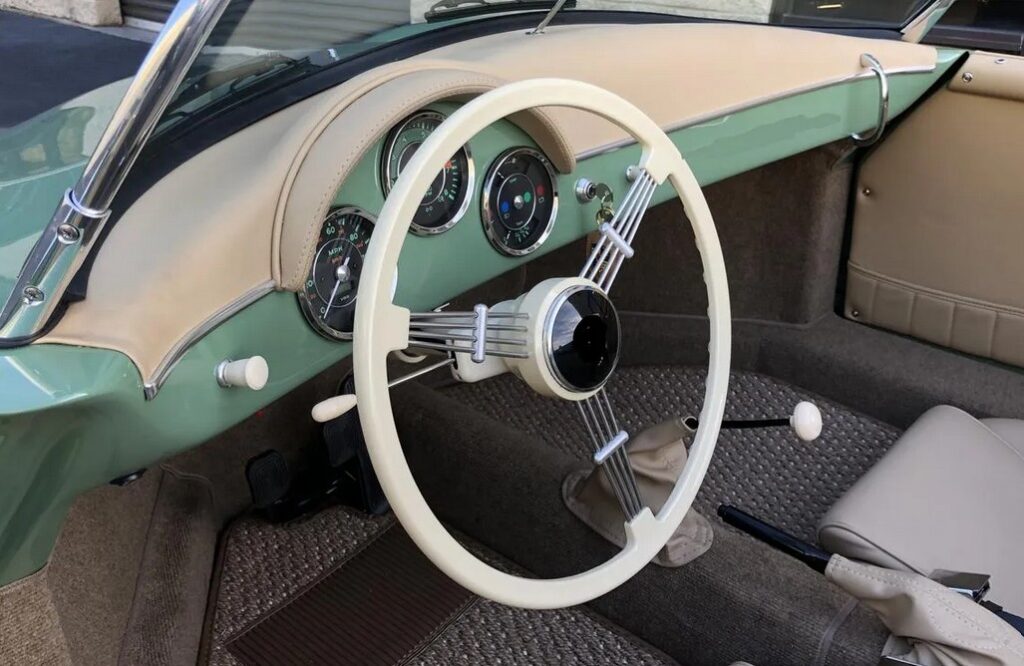
I know, fifty-odd grand for what is in essence a gift-wrapped VW 2300cc engine may seem excessive to some;  but I don’t need much more than 145hp (especially on that featherweight chassis), and it least it doesn’t look like every other car on the road (#WindTunnel).  But most of all:

…please note the refreshing absence of all the modern electronic geegaws which bedevil today’s automotive offerings.  The only thing missing (which I’d add with alacrity) is air conditioning. (#TexasSummer)

For the faint of heart, let me point out that a new VW Tiguan base model will set you back close to $40,000, and a Jetta (with a stick shift!) only five grand less.  And you can bet your ass that both the VWs will come equipped with all the latest in snoop-‘n-control electronics.

Sorry, but no.  To hell with all that.  I want simple, and I want freedom.

Why Only Now?

The headline refers to this action by DJT:

President Donald Trump will launch a strategic critical minerals stockpile with $12 billion in funding as part of an effort to protect American manufacturers from supply shocks as the Trump administration seeks to cut reliance on Chinese rare earths.

Formally known as Project Vault, the project would take $1.67 billion in private capital and $10 billion as part of a loan from the Export-Import Bank to obtain and store minerals for automakers, tech firms, and other companies that need access to rare earths.

Reports have compared the idea to the country’s emergency oil stockpile. Project Vault would obtain rare earth elements such as gallium and cobalt, which is used in iPhones, batteries, and jet engines.

So… anyone have any ideas why this hasn’t existed since, say, the appearance of the PC and digital phones in the market?

Given that our defense systems — aircraft to tanks to ships — have relied on computer chips since, oh, the 1980s, it astonishes me that no Administration since the 1980s had established this already.  Then again:  Clinton, Obama, Biden — that’s  seventeen  twenty years of Presidency that essentially hated the whole concept of a Defense Department because they’re all either overt or quasi-Marxists.

Explicable, but still inexcusable.

RFI: OS

As someone who is actively looking to do this, can someone please explain the last panel to me?

…because I don’t understand the iconography.  What are the products?

#StupidOldFart #OutOfTouch

Sand In The Shoe

Over here, a couple of guys gripe about ten most irritating things about modern cars.  To save you time, I’ve listed them here, with my thoughts:

  • Beeping — It’s like being locked in your car with a nagging Catholic/Jewish mother:  do this, don’t do that, why haven’t you etc. etc.  Whether it’s seatbelts, lane changing (more of that later) or any one of the many things that someone else thinks that you should/shouldn’t do, I am often tempted just to cut the fucking wires to the speaker.
  • Wireless phone chargers — I haven’t come across this nonsense myself because I last bought a car in 2015, but the guys in the video sum it up perfectly:  it makes your phone hot, and doesn’t perform as advertised unless your phone is perfectly positioned.  It’s all part of making everything bluetoothed instead of cabled.
  • Artificial engine noise — First they soundproof the car, and then because some drivers would actually like to hear the sound the car makes, or want their car to sound all shouty without the necessary engine to make it so, the car pipes in fake engine noise.  If that’s not a good analogy for the A.I./fake/digital/artificial times we live in, I can’t think of a better one.
  • Voice-activated assist — I call this “creeping Alexa”, where one has to rely on some fucking software to recognize your voice (which it often can’t, with comical / disastrous consequences), all instead of you just turning a switch or pushing a button.  And speaking of which:
  • Screen buttons instead of actual switches — There’s no excuse for this, and this has nothing to do with “safety” (the usual excuse) because the plain fact of the matter is that screen switches are cheaper than mechanical switches, and that saves the manufacturer money (which savings are never passed on to the customer, needless to say).  And speaking of safety:  the screen buttons require that one be at the correct screen to enable the things to work;  if not, one has to scroll backwards or forwards until the correct screen puts in an appearance — and all this requires taking one hand off the steering wheel for an extended period, and taking one’s eyes off the road.  Anyone else see a potential problem here?
  • Modern headlights are too bright — I’ve noticed this trend, and it’s fucking dangerous to other drivers, especially in rainy and/or night-time conditions.  You’re not having to land an airliner on a narrow runway;  you’re driving down a street, FFS, with oncoming traffic.  (And if you’re out in the boonies and need brighter lights, add a spotlight bar.)
  • High-gloss finishes (e.g. piano black) — I don’t even like shiny finishes on gun stocks (hello, Browning!), and I see no need for something similar in a car that is basically a dust/fingerprint collector.
  • Subscription services / features — Once again, just another way for auto manufacturers to bleed money out of the customer once the car has been sold.  The nice part of this is that not having some of these features (seat warmers, etc.) has the effect of taking us back to earlier times when we managed perfectly well without all these luxury geegaws.  But I await with bated breath the time when things like windshield wipers, turn signals and high beams all become something you have to pay monthly fees for, instead of them just being part of the (horribly-inflated) sticker price of the car.  And when I say “bated breath”, I mean when the breath becomes “unbated”, that will be a signal to load up the AK.
  • Start/stop buttons — I have ranted about this piece of automotive excrescence more times than I can count.  Yes, I know that you can disable the thing;  but the latest wheeze from these godless fucks is to make it reset every time you switch off the car, which means you have to disable the function as part of the starting procedure every time you want to drive somewhere.   The days of getting in, turning a key and moving on are so far in the distant past that one wonders how the Three Wise Men made it to Bethlehem without satnav — which, by the way, is fast becoming yet another subscription service.
  • Lane assist / traffic distancing — It’s one thing when these functions beep at you as a warning;  it’s another thing altogether when the functions takes over the driving for you.  Apart from the foul nanny philosophy behind the thing, it can also be life-threatening.

Now go and watch the video — especially the last couple of minutes — because those guys are funny where I’m just fucking enraged.

No More

Being a history buff, I’m always attracted to those Eeewww Choob videos that talk about the events that shaped our world.  But now I look askance at these videos, and in most cases I turn them off after only a few minutes.

The reason?  A.I. narration.

WTF is going on?  How difficult can it be to hire a speaker — an actual human — to read a frigging script, instead of turning the script over to some machine to create a sorta-human voice?

I am, as my Readers will know, something of a stickler for correct speech, be it grammar or spelling (in print, of course), and that sticklishness extends very much, oh very much indeed to the spoken word as well.

When I hear mispronounced words — sometimes with several different pronounciations of the same word during the course of the narration — it irks me as much as would a series of different misspellings of the same word in print in the course of a single article or essay.

So no, I’ve made a decision to ignore any video, no matter how interesting the topic, if it uses that stupid, wooden A.I. nonsense.

I’m irritated almost as much, by the way, by A.I.-generated “photos” or pictures, but when it comes to history, of course, there’s not always a photographic record of the event or of the people involved, so I can sort of deal with it.  Historical re-enaction using actual human beings can be horribly expensive, for not much benefit, so I can get along with phony actors and scenery.

But when it comes to speech?  Ugh, no.  There’s just too much dissonance — I mean, my own dissonance — for me to have any respect for the material, no matter the initial interest.

There it is:  no more A.I. narration for me.  I’d rather just buy a book on the topic.

The Comrades Lose Control

I’ve been ranting about this issue for about as long as the nonsense first appeared with software-dependent cars.  Now it seems as though it’s for real:

Hundreds of Russian Porsche owners have found their cars immobilized across the country, amid fears of deliberate satellite interference. 

Drivers have complained that their vehicles have suddenly locked up, lost power and refused to start, as owners and dealerships warn of a growing wave of failures that has left hundreds of vehicles stuck in place.

The nationwide meltdown hit Porsche models built since 2013, which are all fitted with the brand’s factory vehicle tracking system (VTS) satellite-security unit. 

The vehicles have been ‘bricked’ with their engines immobilized, due to connections with the satellite system being lost. 

Okay:  leaving aside the paranoia concerns — it’s the Daily Mail, of course there was going to be some panic warning — let’s just go with the system failure (regardless of cause) that causes one’s normally-reliable car to quit working.

I know I’m not the only person in the world who regards this “development” as creepy and worrisome.  The fact that some situation could occur that renders one’s possession useless makes me deeply apprehensive.

As I said earlier, whether the immobilization was a factor of technology fail or else of some malignant third party is unimportant.

Note that this VTS thing is touted as a “security” feature — i.e. one that lessens the effect of the car being tampered with or stolen, a dubious benefit at best — and this supposed security guards against another feature (keyless or remote start) that seems to be all the rage among today’s cars, for no real reason that I can ascertain.  In other words, car manufacturers have made it easier to steal their cars, and then have to come up with yet another feature that can negate that situation.

While some drivers were told to try a simple workaround by disconnecting their car batteries for at least 10 hours, others were advised to disable or reboot the Vehicle Tracking System, known as the VTS, which is linked to the alarm module.

Some owners have been stranded for days waiting for on-site diagnostics, tow trucks or emergency technicians.

There are reports of Russians resorting to ‘home-brew’ fixes – ripping out connectors, disconnecting batteries overnight, even dismantling the alarm module. 

A few cars were revived after 10 hours without power, but others remained immobilized.

And they call this “improvement”?

By the way, it’s not just Porsche, of course.

Last year, MPs in the United Kingdom were warned that Beijing could remotely stop electric cars manufactured in China, as relations between the two nations deteriorated. 

The previous year, lawmakers cautioned that tracking devices from China had been found in UK government vehicles. 

Yeah duh, because China is asshoe.

As for Porsche, this makes me realize why their older, non-VTS-equipped models are fetching premium prices in the second-hand market.  I mean:

300 grand for an ’87 911?  Are you kidding me?  (Yeah, I know it’s been fully restored at a cost of about $50 grand — but even taking twice that amount off the asking price would still leave you with a $200 grand ask, which is ridiculous.  No wonder the vintage sports car market is starting to tank.)

But at least this 911 isn’t going to stop working every time there’s a meteor shower, or whenever some controlling remote entity decides that you’ve been driving it too fast or too much.

It’s a fucking nightmare.  And we’ve allowed it to happen.