Another Unexpected Find

Over time, we’ve come to realize that A Pathway In Monet’s Garden  is too big for the dining room.  (It was originally intended for the living room, but plans changed and a better thing was found.)

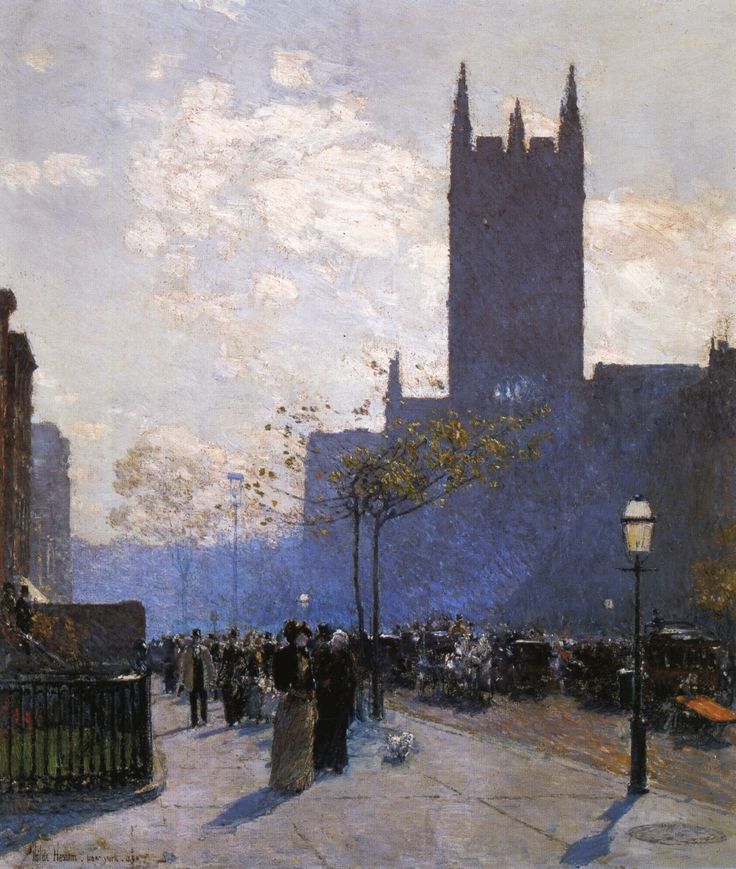
So yesterday morning we decided to mothball the Monet, and put something else up in its place.  So off we went to iCanvas, my favorite place to buy art online.  Rather than getting just another Monet (there are four in the house currently), we decided to look instead at Impressionist paintings set in portrait format rather than landscape, with no regard to the artist.  Hours passed by, paintings considered and then discarded (wrong color, wrong mood, wrong style, etc.) until we stumbled onto this:

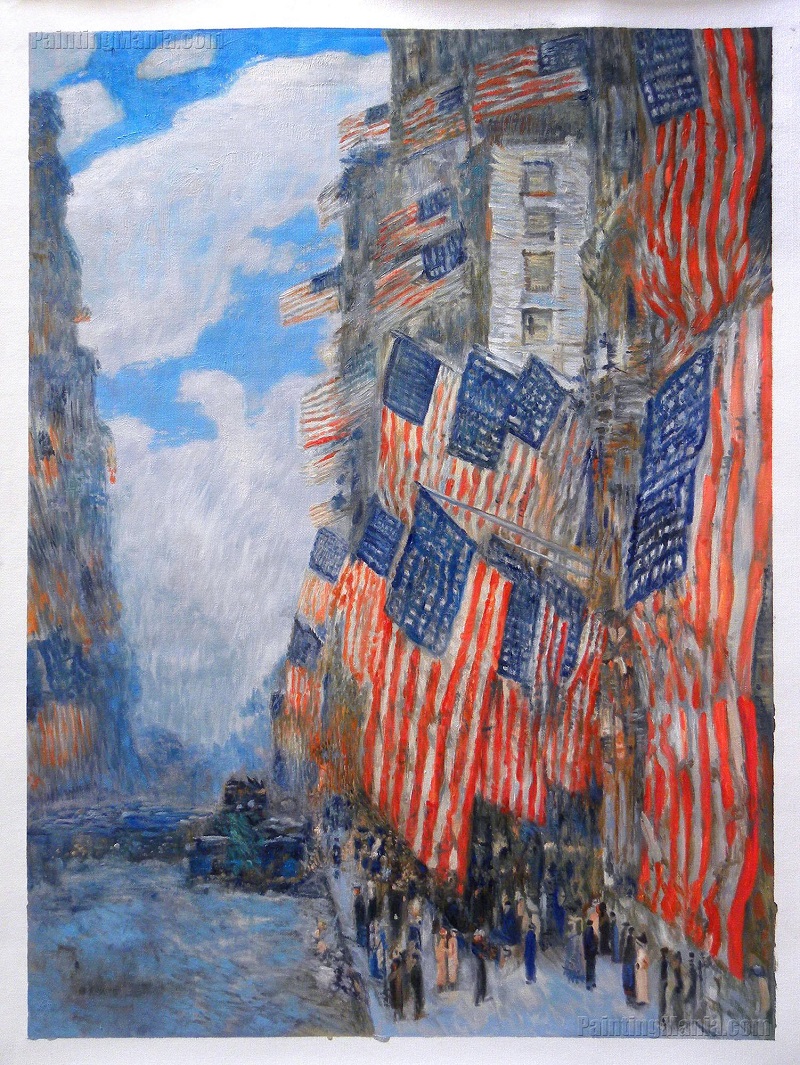
5th Avenue New York, 1891, by Childe Hassam

Wait a moment.  Who is this “Childe Hassam?”  I’d never heard of him/her (him, actually), so I went to his page at iCanvas and looked at his works, which numbered over a hundred.  I like almost all of them — which meant I had to look to see whose work I was enjoying so much… hello, Wikipedia.

Wait… an American Impressionist?  And I had never heard of him before?  And (wait for it) his paintings were all done during the late 19th- and early 20th century, which as any fule kno is my favorite period of history;  and in all, he produced over three thousand  works… BINGO!

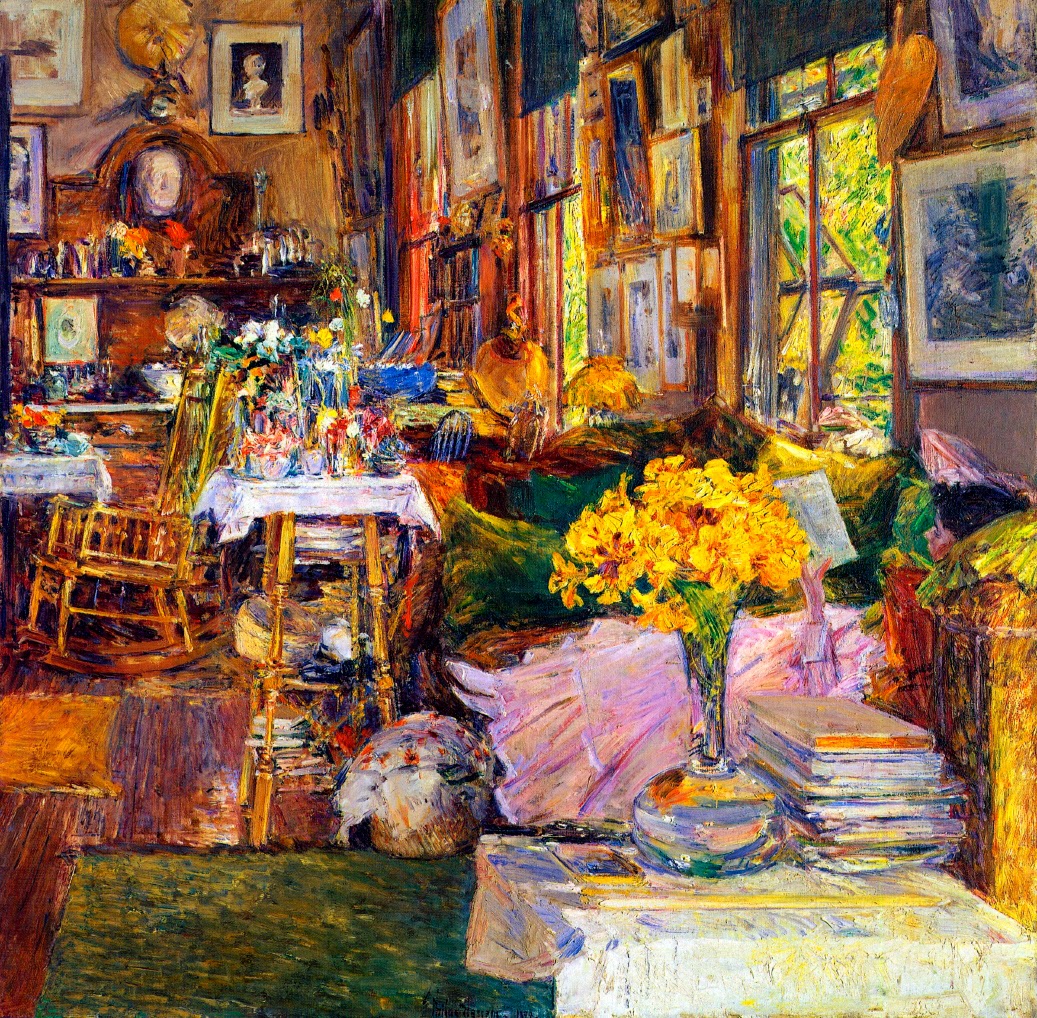
What I like about Hassam is not just his technique, which is excellent, but also his choices of subject matter.  Unlike many Impressionist painters (hello Monet and Cezanne), Hassam painted a dizzying variety of subjects:  landscapes, cityscapes, models, you name it;  he used both watercolors and oils (!) and over all that, he also covered a multitude of colors and moods.  Here’s A Room Of Flowers :

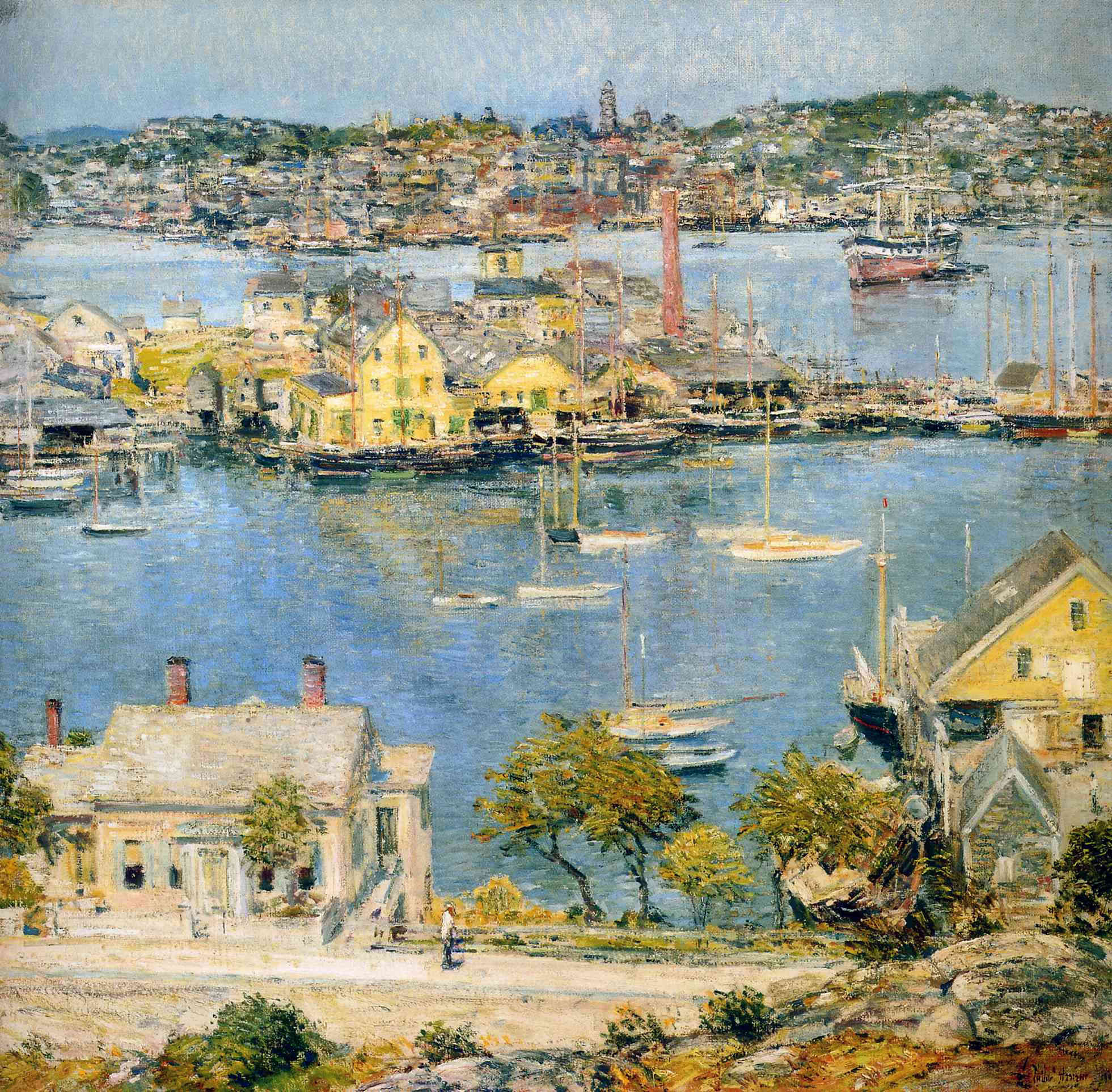
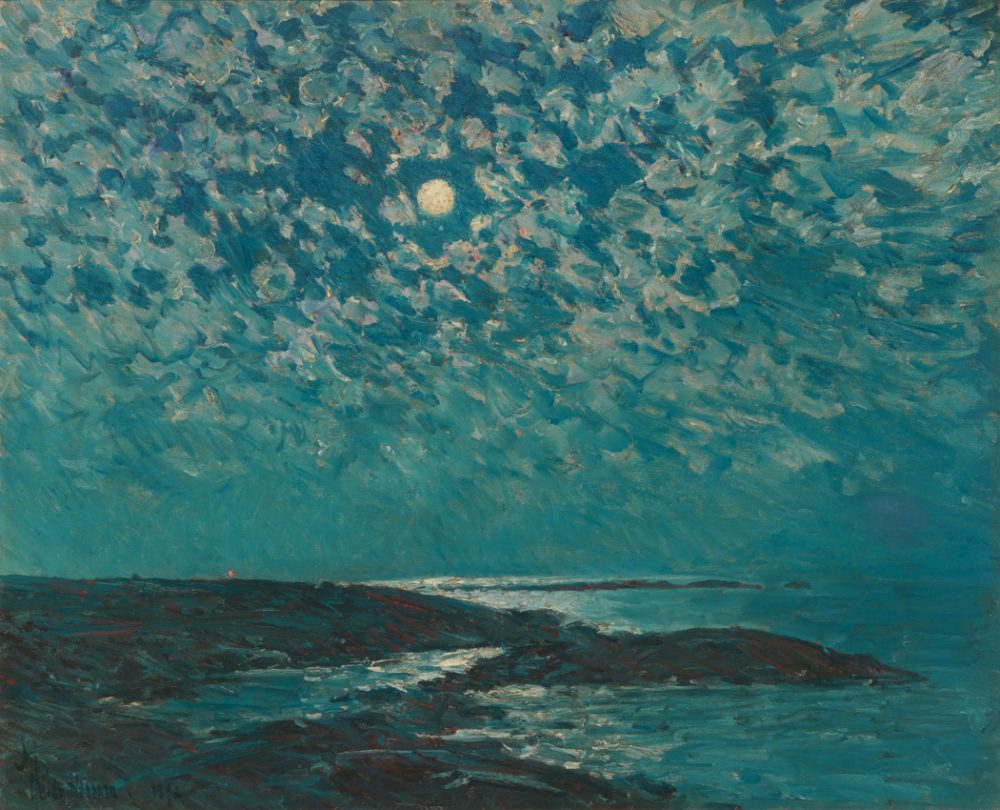
Gloucester Harbor :

Cloud Front, Maine :

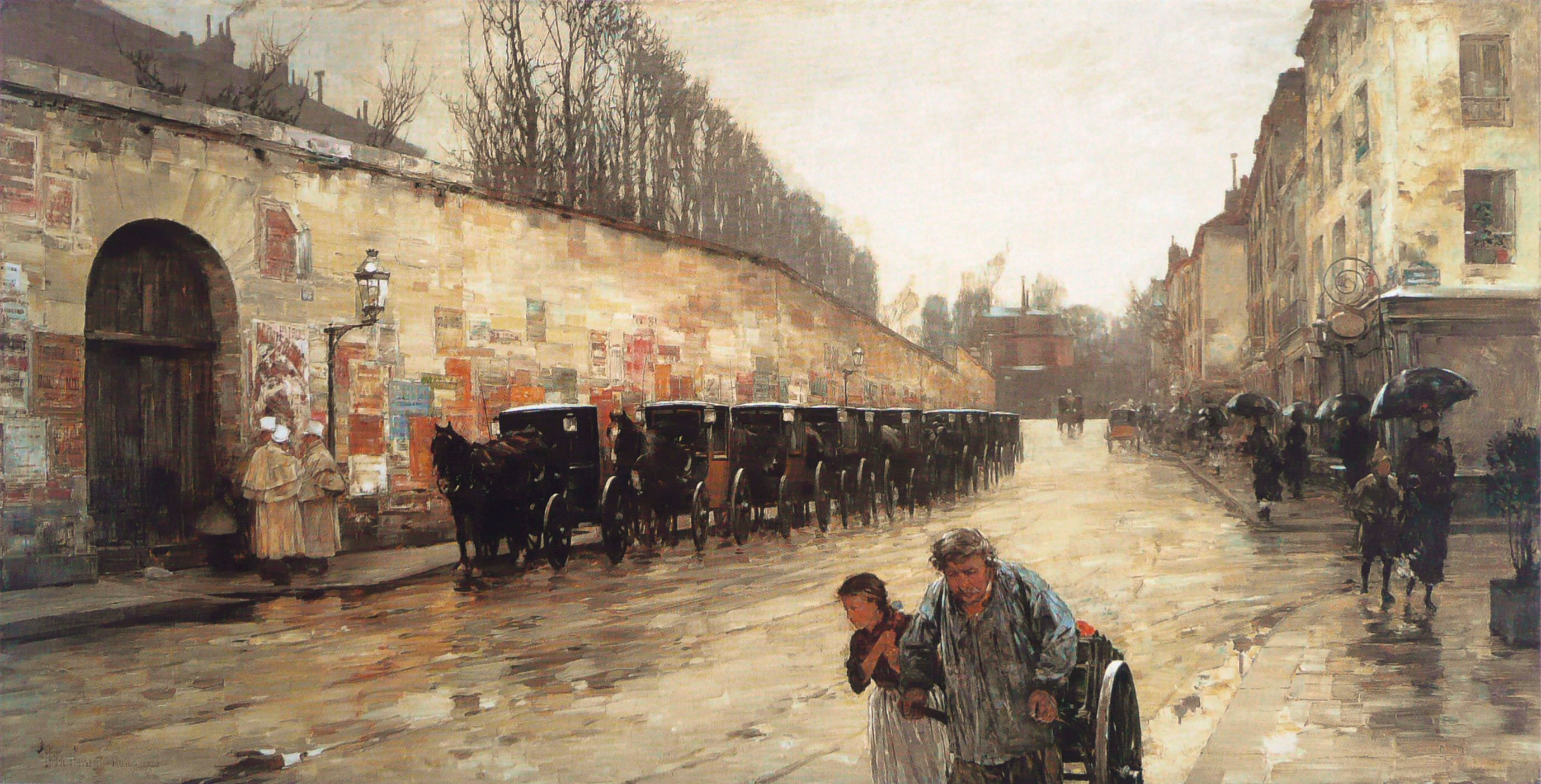
…and in one of many abrupt changes of both topic, color and mood, Taxi Rank on Rue Bonaparte  (which I love but The New Wife doesn’t, alas):  

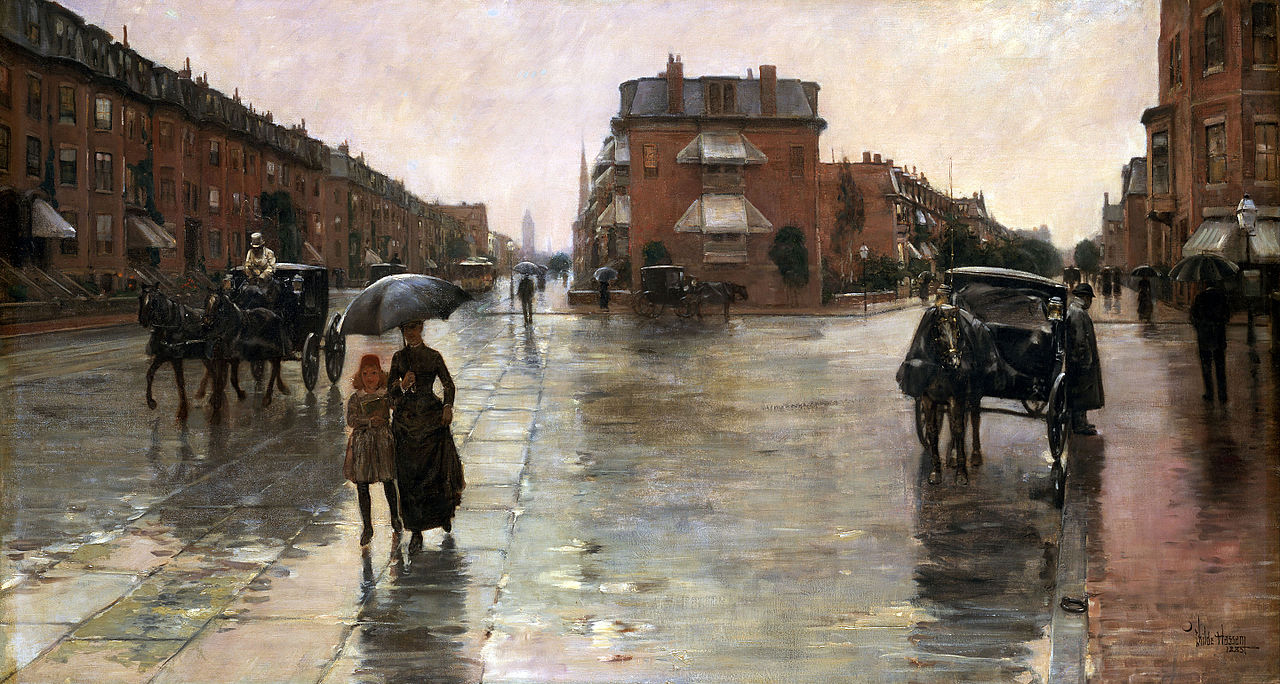
…and continues the theme with Rainy Day, Boston :

Yes indeed:  our American painter didn’t restrict himself to the U.S.A. at all (although he painted the New England and Pacific Northwest seascapes, to name but two).  Rather, his work also covers France, Italy, and all points in between.  Wherever he found himself, he painted it.  To our great advantage.

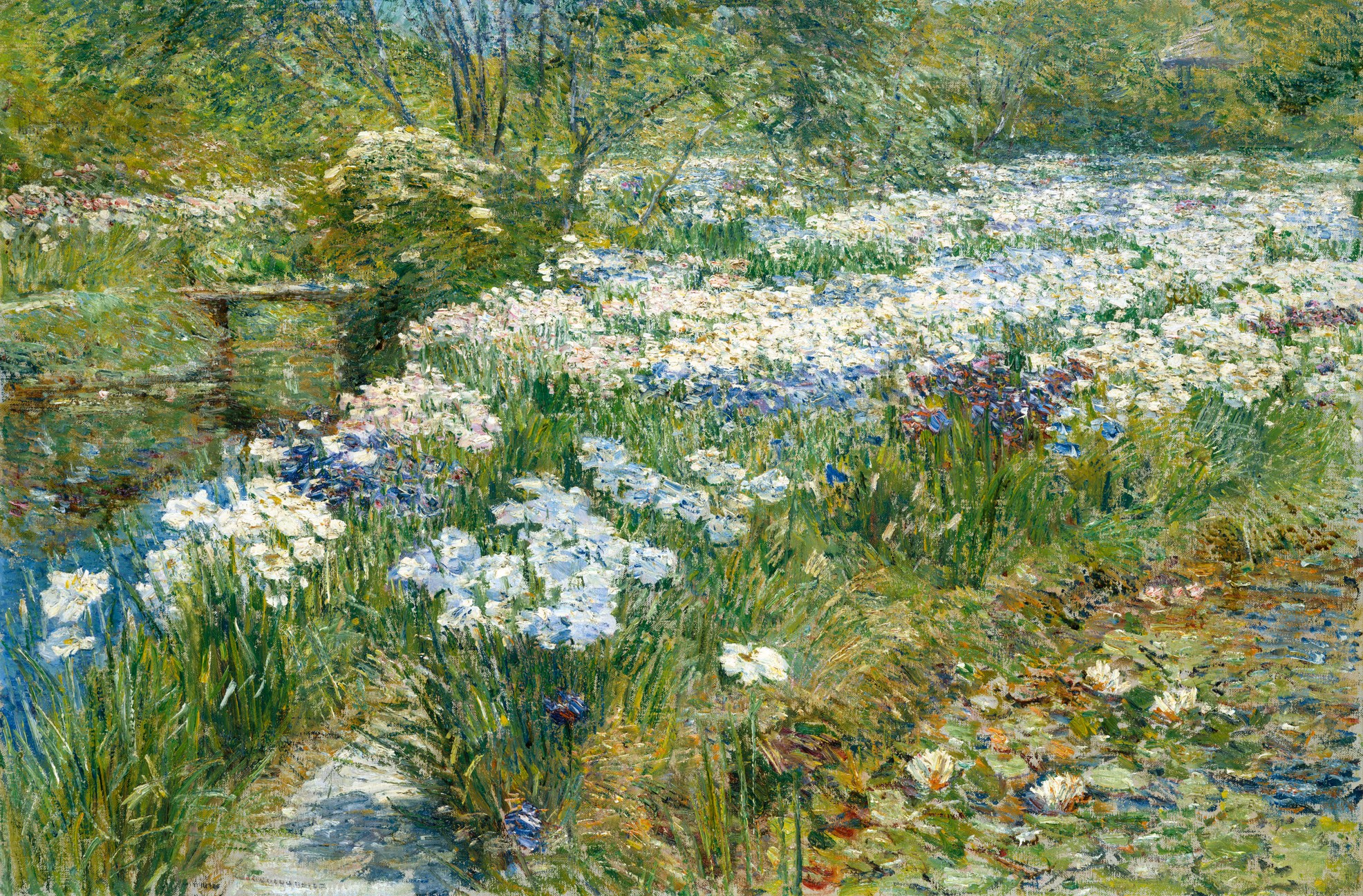
Because if you like Impressionism but can only see so many paintings of haystacks (ahem), I bet you’ll find a Hassam painting that will be right up your street.  Maybe like this one, The Water Garden

…or even Church At Old Lyme, Massachusetts (of which, unusually, he painted several seasonal variations): 

…never mind his patriotic “Flag” series, like for example Fourth of July, 1916

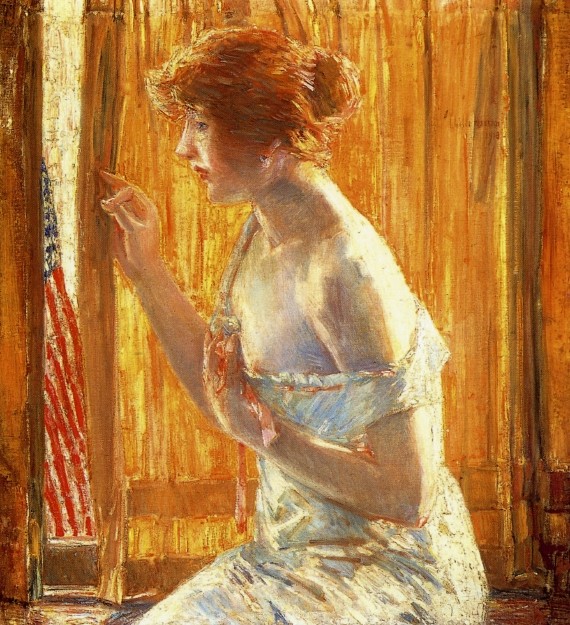
…or the sublime Watching The Boys March By, 1918 :
…which is also sometimes called The Flag Outside Her Window.

I like this artist.  I like him a lot.

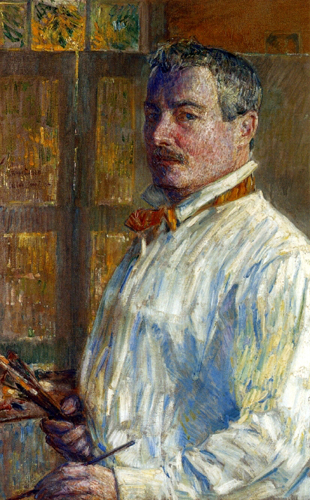
Self Portrait, 1914

Oh, and for people (like me) who loathe Modernism, allow me to quote his attitude thereon:

He denounced modern trends in art to the end of his life, and he termed “art boobys” all the painters, critics, collectors, and dealers who got on the bandwagon and promoted Cubism, Surrealism and other avant-garde movements.

“Art Booby”… I am so  going to steal that for myself.

Whitey Not Wanted Here Either

Only in the Diversity Hell that is modern academia can such a thing occur:

“Refusing Institutional Whiteness: Possibilities, Alternatives, and Beyond”

…with the kicker:

“Whiteness continues to be a crucial problem in our English department.”

Also English, but that’s no doubt the topic of next  month’s seminar.

To put this into perspective, let’s just imagine a statement: “Blackness continues to be a crucial problem in our Blues Studies department.”

Or we don’t imagine anything, but instead just make the necessary preparations.

Working Towards A Conservative Democracy

We are constantly being reminded that the United States is a representative republic (which it is) as well as being a liberal democracy (which is also true).  For the longest time, I’ve had the gnawing suspicion that the two concepts may be antithetical, nay even contradictory, and recent events have proven me correct.

The standard-bearers of the modern liberal democracy have tended towards the “liberal” part of the description, and their modernism has turned liberalism away from its classical roots (the Enlightenment) towards a more baleful and statist, ergo illiberal  ethos.  It is small wonder, therefore, that this modern liberalism is attacking both the “representative” and even “republic” towards a full democracy, into a government created by a national popular vote instead of a democracy limited by proportional representation.  (The sudden popularity of socialism — one of the more repressive governmental systems, is simply indicative of this intent, and the “democratic” prefix attached thereto is, like most of socialism, a figleaf to mask its true purpose.)

It seems clear that if we are to reverse this trend, we need to try to implement an antithetical alternative to the liberal democracy — that antithesis being a conservative democracy, as explained here by Yoram Hazony. I’m pretty sure that few if any conservative small-r republicans will take issue with this principle, for example:

Liberals regard the laws of a nation as emerging from the tension between positive law and the pronouncements of universal reason, as expressed by the courts. Conservatives reject the supposed universal reason of judges, which often amounts to little more than acceding to passing fashion. But conservatives also oppose an excessive regard for isolated written documents, which leads, for example, to the liberal mythology of America as a “creedal nation” (or a “propositional nation”), defined solely by certain abstractions found in the American Declaration of Independence or the Gettysburg Address. Important though these documents are, they cannot substitute for the Anglo-American political tradition as a whole—with its roots in Scripture and the English common law—which alone offers a complete picture of the English and American legal inheritance.

Yes.  The famous expression on the Statue of Liberty “Give me your tired, your huddled masses…” etc. is a lovely sentiment, but it is not policy  which allows untrammeled immigration, nor does it confer a “right to immigrate to the United States” upon the rest of the world’s populace.

Read the whole thing.  It’s really long, but it has to be — overturning a liberal democracy and reverting to a conservative one does not lend itself to bumper-sticker aphorisms so beloved by the Left.

And overturn it we must, in order to return to the proud Anglo-Saxon heritage that is the foundation of our Western civilization.


Afterthought:  note the emphasis placed on religion — most specifically, Christian religion — by Hazony.  I should point out that I, an atheist, have absolutely no issue with it.  I am a conservative first, an atheist second, and I treasure the Christian values of our heritage and their foundation of our culture.  That said, the values I treasure are also the traditional  aspects of Christianity and not the modern-day travesty they have become.  My conservatism is all-embracing.

Blast From The Past: Right And Wrong

Right And Wrong

January 8, 2006

I watched the movie of Scott Turow’s Presumed Innocent this morning, and through all the legal twists and turns, I found the most egregious twist to be that innocence is relative, guilt is sometimes not guilt, and perverting the law is okay if it helps someone else.

Of course, Scott Turow is a lawyer, so all these things are to be expected.

Plot summary: A DA has a fling with some female lawyer, she’s found dead, and he’s accused of the murder even though we know he didn’t do it. The evidence against him is substantial, but he’s eventually found not guilty. Then [plot twist warning], he discovers that his own wife actually killed the woman, and planted all the evidence, thinking that it’s so thin that he’ll never be accused of it—but of course, he is, and it’s only through some skullduggery that the evidence against him disappears, during which time we discover that the dead tramp was a Truly Evil & Corrupt Person (which, clearly, makes her murder sorta-okay), and the prosecution aren’t angels either, being pretty corrupt themselves (which also exonerates the defense’s wrongdoings).  (There’s a huge gaping hole in the plot, by the way, but that’s not relevant to the point of all this.)

The end of the movie has wifey confessing the crime to him. He doesn’t turn her in, of course, and the voice-over (his) which closes the movie says that he’s not going to deprive his son of his mother, and he’ll have to suffer the torment of knowing that he’s living with a murderer.

Am I the only one who thinks that this is relativist nonsense?

I am reminded of the real-life FBI agent in (I think) North Carolina who discovered that his own son had killed someone. Rather than protecting his son, which he could have done simply by keeping his silence, the FBI agent turned him in, even knowing that his own son might fry in the chair or go to jail forever. Now thatwould have made a good morality play, and a fine movie, because every single parent could say to themselves, “I hope I’m never faced with that decision, and if I am, I hope I have the moral strength to do what that man did”—because few would. I don’t know if I would.

But that movie will never be made.

When I compare real life to Hollywood, I find that in Presumed Innocent, Hollywood has made an open-and-shut case of morality into something a little more cloudy (surprise, surprise), where “the slut deserved to die because [blah blah blah]”. And the torment of the hero knowing his wife’s guilt, and of his own complicity in not revealing this, somehow makes up for the fact that a woman was killed just because she screwed another woman’s husband. And it’s okay to hide evidence because the prosecution is also doing the same kind of thing. And, and, and… the list of moral excuses runs on and on.

After watching the movie, I cannot tell you how dirty I felt. Because I’d followed the story avidly, seeing morality being bent and twisted this way and that, and all I could think at the end was: No wonder that murderer O.J. Simpson was acquitted.

That’s the pernicious effect of Hollywood, and its insidious effect on our modern culture cannot be underestimated. Wrong is right, provided there are extenuating circumstances, right can be wrong if the other side isn’t being honest on their part, and so on.

At the end of all this, there is no moral compass left on which one can make the proper judgment. The only important thing is winning in the short term, regardless of what harm comes from so doing.

It’s not just in the movies.

I watch people playing sport, and bending the rules to their utmost extent to try to gain a little advantage. I see little honor in sport nowadays: if I were playing Wimbledon, and the linesman made a call against my opponent which was clearly wrong, I would either tank the next point in protest, or I would complain to the umpire and insist on the call being reversed—warning that if not, I would tank the next point in protest.

But that never happens, and these so-called “sportsmen” go on and win huge sums of money, sometimes based on the certain knowledge that they won because of a wrong decision. How do they sleep? I’m not interested in saying that “it happened to him today, it could happen to me tomorrow” and using the law of averages to excuse a wrongful action. I’m not interested in excusing such behavior because great sums of money are involved, either. That’s like excusing a shoplifter because he only stole “a little” money.

Because not correcting an obvious mistake, and profiting thereby, is as wrong as committing an unnoticed foul and going on to win in consequence.

People ask me why I watch golf. You know why? Because golfers call fouls on themselves, even if they may be disqualified from the competition thereby. Golf may be the last true sport left in the world, because people still play the game with scrupulous honesty.

I’m not setting myself up as some paragon of virtue, and that’s not the point of all this.

But in the so-called “bad old days”, Hollywood movies were supposed to show that crime doesn’t pay—even if there are extenuating circumstances. In High Sierra, Humphrey Bogart dies for his crimes, even though his downfall was caused by his feelings for a crippled girl. In modern-day Hollywood, that would be sufficient to secure his escape, and with all the money he’d robbed from a bank into the bargain.

We all chuckle at those old-fashioned rules, where wrongdoing had to show its consequences, and sneer about “censorship” and censors inflicting their “morality” on others.

Let me tell you something.

When the history of this era comes to be written, and people wonder how a society which had become so prosperous, so healthy and so settled, could have sunk into such depths of depravity that the Menendez brothers weren’t executed for cold-bloodedly shotgunning their own parents to death, all the evidence will be found in novels and movies like Presumed Innocent.



Western Civilization

Here’s a map which ranks the various countries of the world from light to dark, from least corrupt to, well, Somalia.

Pop quiz:   Of the lighter-colored (i.e. least corrupt) countries, find the common thread.  (Hint:  it’s in the title of this post.)

For those who are surprised at the relatively-low ranking of the United States among the civilized nations, I would suggest that we would rocket upwards with the conviction of Bill and Hillary Clinton, the dissolution of the Clinton Foundation and the imprisonment of all its officers.  To reach the top of the charts, we’d have to convict all members of Congress (active and/or retired) who became millionaires whilst earning only a Congressional salary.

And by “conviction”, of course, I mean this:

Snowflake Warnings

One of my most treasured memories is watching the late Frank Zappa tearing into that foul scold Tipper Gore during Congressional hearings.  Gore, you may remember, thought that rock music lyrics were eeeevil and caused kids to become mass murderers or Satanists or something, and Zappa just took her precious little thesis and trashed it with a wonderful mixture of scorn, opprobrium and educated analysis of her silly, nonsensical fears and creeping Puritanism.

I was taken back to those good times when reading this piece of utter bullshit:

Old favorites, outdated attitudes: Can entertainment expire?

They exist throughout society’s pop-culture canon, from movies to TV to music and beyond:  pieces of work that have withstood time’s passage but that contain actions, words and depictions about race, gender and sexual orientation that we now find questionable at best.
Whether it’s blackface minstrel routines from Bing Crosby’s “Holiday Inn,” Apu’s accent in “The Simpsons,” bullying scenes in “Rudolph, the Red-Nosed Reindeer,” the arguably rapey coercion of “Baby, It’s Cold Outside” and “Sixteen Candles” or the simplistically clunky gender interactions of “Mr. Mom,” Americans have amassed a catalog of entertainment across the decades that now raises a series of contentious but never-more-relevant questions:
What, exactly, do we do with this stuff today? Do we simply discard it? Give it a free pass as the product of a less-enlightened age? Or is there some way to both acknowledge its value yet still view it with a more critical eye?

I have a better idea.  Treat it all as entertainment.  And in the manner of Tipper Gore and her ilk, feel free to pepper the covers with all sorts of “parental advisories” or better still, my favorite all-purpose warning that one’s childish sensibilities may be offended by the contents thereof (number to increase with the frightfulness of the content):


At least a “10-” warning will announce that I’m about to really enjoy myself.

But for the love of Jupiter’s throbbing headache, leave the classics alone for us grownups to enjoy for the fabulous bits of entertainment they are.   Frankly, there’s absolutely fuck-all about the classics which should frighten anyone, whether it’s Mark Twain using the word “nigger” so freely in Huckleberry Finn  (which novel, lest we forget, did more to change attitudes about race than a dozen Jesse Jacksons) or Gary Cooper taking Claudette Colbert in hand in Bluebeard’s Eighth Wife (1938):

At the end of the brilliant movie Thank You For Smoking (2006), there’s a scene where the foul Senator protagonist talks about going back into all the classic movies and digitally removing all traces of smoking, thereby “improving” them.  The man’s unctuous smugness coupled with his utter conviction is so creepy it makes your skin crawl.

And that’s what these pricks are talking about now.  And make no mistake, there’s absolutely no end to it.  If a treasured classic like Baby, It’s Cold Outside can be interpreted to containing “rapey coercion”, then let me assure you all of one thing: nothing is safe.

I have a simple solution to this nonsense:  every time some asshole indulges in some censorship dream like the above, the nearest person should horsewhip them.  Literally.  They get “triggered” by the suggestion of stalking in The Police’s Every Breath You Take ?  Well, I get triggered by their wanting to change the whole fucking world to accommodate their tender sensibilities.

Just remember:  this wonderful, sexy scene in Tom Jones is one day going to disappear forever because some fucking vegan got triggered.

I am getting so sick of people trying to tell me what I should or should not do, or what I may or may not eat, or what entertainment I may or may not enjoy, that there may well come a time when you’ll read about some snowflake getting flogged for trying to bowdlerize the lyrics of Run For Your Life.

And the flogger’s name will be mine.  Which reminds me:  I need to oil the old sjambok, just in case.