So… you want to go hunting in southern Africa, do you? Well, see if you can spot the lion:

If it took you longer than five seconds, too bad, you lose.

So… you want to go hunting in southern Africa, do you? Well, see if you can spot the lion:
If it took you longer than five seconds, too bad, you lose.
I know I said I wasn’t going to do the Speedbump thing anymore, but that’s only because I was sick of correcting stupid spelling- and grammar mistakes.
But this is different. (My game, my rules.)
Specifically, I want to address an editorial quirk that has me reaching for the 1911: this nonsense of using the plural “they/their” instead of “he/his” or “she/her”.
Now there are times when this device is appropriate, e.g. when using generalities such as “Anyone should be able to call their congressman an asshole”, where usage of “his” instead of “their” might be taken to mean that only men may call their congressman an asshole, which is clearly not the case. (We used to be able to use “his” in these cases, where the word was understood to mean either sex, but it seems that in our ultra-sensitive times, even innocent words like “mankind” can be adjudged as sexisss by the Ultra-Sensitive Set.)
Anyway, here’s a perfect example where this androgynous practice becomes ridiculous and in fact can cause confusion:

(I’m not at all interested in the content of the article, of course.)
Note that the use of “they” and “their” could easily be interpreted that both Ore and his sister committed suicide, which isn’t the case — unless they dressed him in tiny Pride pants and read out a statement of his sexuality after he popped the magic pills, that is.
But that didn’t happen. Only the sister whacked herself, so the headline should have been written as follows:
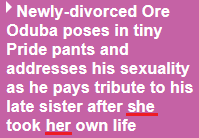
Simple, with perfect clarity. But this woke nonsense of using the impersonal plural terms has the effect of confusing the issue — not that the cloth-eared editors and writers could care, because who needs clarity when feeeeelings are at stake?
Tossers. And a pox on them for making me irritated enough to have to write about this bullshit.

In a promo piece from Kohl’s (normally the squarest of Midwest retailers):

JHC.
Well, I won’t be buying any of those.
From The Divine Sarah:
“I want a government small enough to fit in the Constitution.”
No comment necessary.
This is BritTV soap actress Nikki Sanderson:








And now you know.
This is an unusually level-headed look at drinking in moderation, and I for one applaud it. A sample:
For four years I was teetotal and socializing was always a pain. At parties, small talk was so small, I never felt that anything ever connected, or that there was an actual point to talking. It was so superficial – the weather, my journey, my clothes, the articles I’d just written.
It’s why at a work event not long ago, instead of asking for my usual lemonade, I grabbed a glass of Prosecco from the bar. For a moment I imagined a bolt of lightning would come down from the sky. Was I really going to throw away four years of sobriety? And for what? Because I was… bored?
Well, yes I was. And immediately I felt bonded to this room of relative strangers. Not in a creepy way. Just in a way that made it easier for me to chat to them. It was fun.
And that’s what people miss about the whole booze thing. Not for nothing is booze called a social lubricant: it makes people less inhibited, more relaxed, and to be frank, more fun to be with. But before I go any further, I’m going to make a definitive statement about the above.
The key phrase is: in moderation.
The problem is that when it comes to booze, most people can’t do moderation — and this is particularly so when it comes to drinking beer in Britishland (an imperial pint is a lot of booze) and drinking short drinks (spirits) in the U.S., where spirits are free-handed out of the bottle by bartenders, making the drinks far too strong.
Unless you’re a fool or addict, the object of drinking booze is not to get pass-out drunk; it’s to release some of those social inhibitions, to lower the social guards people put up in self defense, and quite frankly, to get a little “buzz” on — because that buzz is really, really pleasurable.
The key, speaking as one who was once a serious boozer and is now a lot less so, is drinking just enough to get that buzz and maintain it. In my considerable experience, it means that one needs to drink a smaller glass of beer — the much- derided “half-pint” in the U.K. — and to drink it in the same time as one might take to drink a full pint, i.e. more slowly. For spirits, it means not accepting the overly-generous pour of the bartender, but watering the drink down with a mixer or water. (If I order a spirit like a G&T at a bar in the U.S., I order the gin straight, and request a three-quarter-filled glass of tonic plus ice on the side — i.e. in a different glass — and pour half the gin into the tonic to treat that as my drink. Then when that is finished, I order another glass of tonic, and pour the remainder of the gin into that — two drinks for the price of one, and as the evening goes on, I will end up drinking half of what a regular person would.)
And before I hear people saying that the drink tastes “weak” or “watery”, let me say that this is precisely the point.
Let’s be honest, for once. Most booze tastes like shit. Remember that time long ago when, after watching your dad or whoever drink beer with all the pleasure in the world, having your first beer and discovering what it actually tasted like? Horrible, wasn’t it?
Of course, the more you drink, the more the taste of booze is acquired; and as one gets older, one’s palate becomes more sophisticated, which is why we no longer eat canned Vienna sausages, “blue-box” mac ‘n cheese and drink sugary Kool-Aid. (And if you still enjoy that stuff, I don’t want to hear about it.)
I love booze. I love the taste of it, I love the way it makes me feel and I love the way it makes other people feel (if they’re drinking like I’m drinking); but I’m also extremely wary of the perils of over-indulgence — the consequence of a.) becoming an adult and b.) becoming, like the author of the above piece, less able to deal with the hangovers that follow said over-indulgence.
As I’ve said many times before, I can’t drink by myself and never have been able to. Booze is a social lubricant, and if you need a social lubricant when you’re on your own, you’re in trouble. And as Anniki Somerville ends her article:
At one party I sit next to a friend and she whispers to me: ‘You’ve changed. I feel like you’re more on my level again.’ And that is what having a couple of drinks can do. Get everyone on the same level so they can connect.
That’s what my four years of sobriety taught me: so long as you’re keeping to guidelines, a glass of wine can be part of the solution to life’s stresses, not the cause of them.
Precisely.